Sunday, January 15, 2012

Bill Hester: Five Risks to the Global Economy in 2012

As we're all a bit forecast weary by this point in the year, here's a list - not of prognostications - but rather of potential risks that may come into even greater focus this year. These risks – whether they intensify or pass – will likely play an important role in driving the performance of global stock markets in 2012.

1) The Persistence of Wide Spreads Among European Debt – Even if Bond Holders are ‘Rescued'
There are two components of the European credit crisis - debt levels and economic growth prospects. While the conversations to this point have leaned mostly toward reducing debt levels, economic growth prospects and the overall viability of a common currency will likely get a closer look this year, especially as Europe heads for recession.
During this two-year crisis investors have continually called on the ECB and euro area leaders to ‘fix' the debt issue: by wiping out half of Greece's debt, by protecting Italy's access to debt markets through bond purchases, or by suggesting a levered EFSF, the euro area's rescue vehicle.
But even if the ECB does bend to the will of the bond markets this year, and begins to buy sovereign debt directly, the single currency is left with all of the same weaknesses that existed prior to the crisis: the inability to tailor interest rate policy for each individual economy, the lack of foreign currency adjustment needed to offset differences in competitiveness, and growth-limiting trade dynamics throughout the area.
Martin Feldstein, a long-time euro skeptic, in this month's Foreign Affairs magazine made the point this way: “During the past year, Germany had a trade surplus of nearly $200 billion, whereas the other members of the eurozone had trade deficits totaling $200 billion. A more comprehensive measure that factors in net investment income reveals that Germany has a current account surplus of nearly five percent of GDP, whereas Greece has a current account deficit of nearly ten percent of GDP. Put another way, Germany can invest in the rest of the world an amount equal to five percent of its GDP, whereas Greece must borrow an amount equal to nearly ten percent of its GDP to pay for its current level of imports”.
One of the strongest benefits at the introduction of the common currency was that investors priced government debt similarly across the euro area. During this period investors thought of the euro area as a group of countries that would not only share a currency, but also share economic performance and long-term outcomes. Smaller countries and those of southern Europe experienced the greatest amount of benefit from converging yields. Yield on Greek debt fell by more than half in less than 10 years. Even stock market valuation ratios converged. The spread between the countries with the highest and lowest PE ratios dropped by more than half during the period.
While this period could have been used to improve some of the issues surrounding productivity, competitiveness, and trade dynamics among countries, what occurred instead was that governments took on larger amounts of liabilities, and as interest rates fell, housing bubbles formed. With that period passed, it's difficult to imagine that investors will soon return to the mindset that Portugal, Ireland, or even Italy, will soon again converge materially – in either economic performance or level of credit risk - with Germany.
I highlighted this risk and the graph below early in the European credit crisis ( The Great Divergence ). At that point the sovereign debt of Portugal was priced at 200 basis points above German bunds, compared with 1100 basis points today. Here is an updated graph.
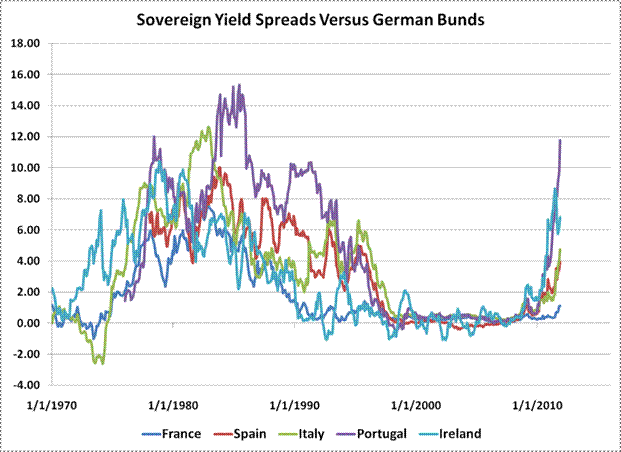
There is a long history prior to the period of the shared currency where spreads among countries and with Germany were dramatically and persistently wider than even today. This was because expected economic growth rates, inflation expectations, and the real rates required by investors differed. Now that investors have been reminded of the structural weaknesses of a common currency – even outside of the discussion of high debt loads - persistently high spreads may be here to stay. Those spreads will surely play a role in the potential long-term growth rates of economies and euro area stock market valuations.
2) Sovereign Debt Rollover Risks
When the history of the European Credit Crisis is written, it'll likely be in two parts. The first part will cover the debt crisis of the smaller European countries – mainly the woes of Greece, Portugal, and Ireland. It will cover Greece's admission that its accounting didn't add up. And how Ireland's bad bank debt was turned into sovereign debt – which tripled its debt to GDP ratio in just three years. It will also cover the trajectory of peripheral sovereign bond yields in the face of investor uncertainty, where yields were first pushed above seven percent, and then eventually to much higher levels, forcing a rescue program.
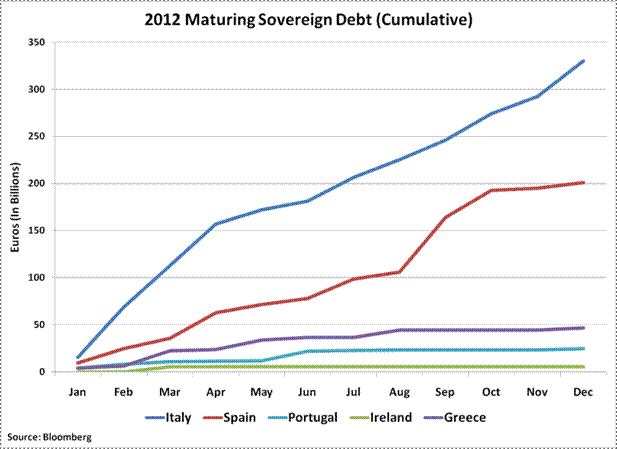
The second part of the story will be about Italy and Spain, and potentially France, and how they were either pulled into the fiscal debt maelstrom or whether the ECB and euro area leaders were able to ring-fence them from the more troubled smaller euro countries. It will cover whether investors pushed these core countries from liquidity concerns to solvency concerns. While these chapters are still being written, the outcome may very well be available to historians (and investors) much sooner than many are expecting. One reason is because of the vast amount of sovereign and bank debt that is due to mature this year, all of which will needed to be rolled over because of existing budget deficits. The two countries that pose the greatest risks for rolling over this debt are Italy and Spain.
The chart below gives some sense of the relative importance of Italy – and to a slightly lesser degree Spain – in meeting its rollover demands this year versus the smaller euro area countries. The graph shows the cumulative amount of debt that will mature this year in the countries listed. (These totals count all government debt coming due – including shorter term notes – and are therefore larger than estimates of only long-term debt.) The graph shows the limited bond market needs (and therefore rescue funds needed) of Greece, Portugal, and Ireland, relative to those of Italy. Also, notice how steep the line is for Italy's maturing debt during the first four months of the year – when almost half of this year's total debt will mature.
It will be important to watch bond auction demand in Italy and Spain in the beginning of the year. The recent bid to cover ratio – a measure of the eagerness of bond investor to participate in an auction – for Italy's 10-year notes has mostly been in line with results from early last year. Of course, the level of yield will also matter. The chart below shows the weighted coupon of the existing debt outstanding for each country (in blue) versus the current yield (using the weighted maturity of existing debt) of its bonds (in red). For many years during the Euro's first decade, borrowing costs continued to fall versus the average cost of the existing debt of these countries. This trend has now changed for most of Europe, except Germany and France. This will likely continue to further widen economic divergences among countries.
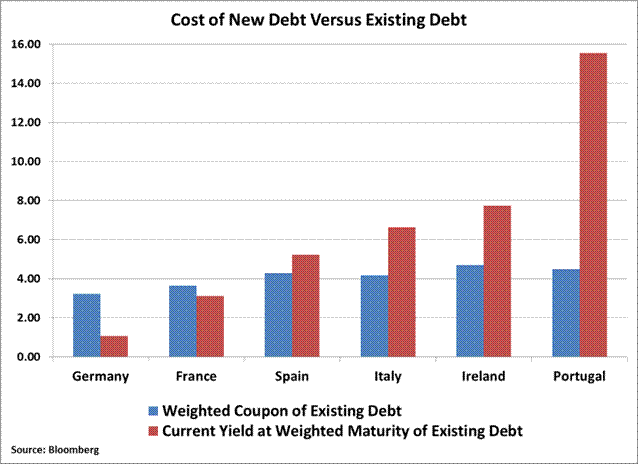
This is one more benefit Germany is deriving from the crisis. In addition to a weaker euro, which helps fuel its export-oriented economy, the cost of financing its sovereign debt relative to its existing debt continues to fall while the smaller countries struggle with rising financing costs.
3) The Depth of Italy's Recession
It would be difficult to overemphasize the importance of Italy retaining access to the bond markets, and mitigating further losses in its sovereign bonds. According to the Bank for International Settlements, foreign claims on Italian debt total $936 Billion – that's larger than the combined foreign claims on the debt of Portugal, Ireland, and Greece. And core Europe is long a mountain of Italian debt. French banks, for example, hold 45 percent of Italy's liabilities. Much more is at stake than France losing its Triple-A rating if Italy moves from a liquidity concern to a solvency concern.
What eventually would force that shift is if investors come to believe that the country's ability to handle its debt load over the long term is compromised. Those concerns can be partly alleviated if Italian Prime Minister Mario Monti delivers a balanced budget by 2013, which he promised this week. Unfortunately, near-term economic risks could make these goals difficult to meet in practice.
This year economists expect the Italian economy to contract only slightly – by 0.3%. The graph below shows the year-over-year change in the OECD composite leading indicator for Italy (lagged by six months) versus the year-over-year change in Italian GDP. The change in the leading indicator is currently -9.8 percent. That's suggesting a much deeper contraction in the Italian economy than current forecasts. Following any decline of greater than 5 percent in the year-over-year change of the leading indicator has led to an average contraction in the Italian economy of about 3 percent six months later.
Even assuming austerity measures might ease some of the country's debt load, it would be difficult to offset this steep of a decline in output. Hold debt levels static, and that rate of economic decline would force Italy's debt to GDP ratio to rise to 122% from 118% – clearly the wrong direction if the hope is to ease long-term solvency concerns.
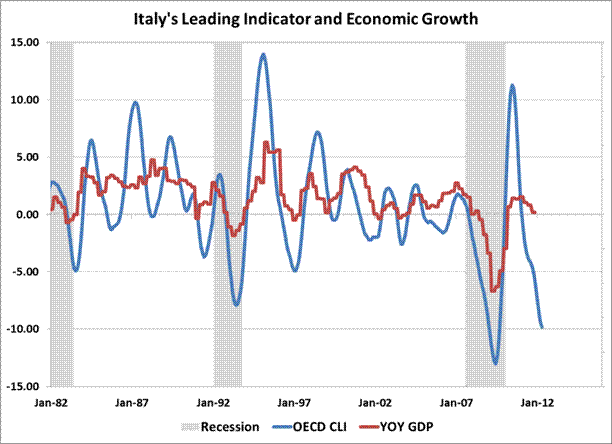
Investors in Italian stocks may have moved some distance toward pricing in a deeper recession than what is currently expected by economists. The FTSE MIB Index declined 40 percent peak to trough last year (the index fell 25 percent on a calendar basis). But a deeper decline in Italy's economy this year that pushed debt to GDP ratios materially higher would likely catch bond investors' attention, and then ultimately the attention of global stock investors.
4) The ECB, LTROs and European Bank Funding
Will the ECB's three-year long-term refinancing operations (LTRO) work as a stealth quantitative easing program? Will banks borrow long-term funds from the ECB and turn around and buy sovereign debt? That's the hope. But there are strong tides of data pushing back against this idea.
While there was much fanfare last month after the ECB loaned 523 banks 489 billion euros, the actual amount of new funds was a more modest number. This is because two earlier loan programs expired on the same day as the three-year LTRO was held, and banks probably rolled these funds into the three-year operation. The earlier operations included a 3-month loan of 141 billion euros offered in September, and a net 112 billion euros of overnight loans. The ECB also allowed banks to shift 45 billion euros from an October operation into the 3-year LTRO. Of the 489 billion Euros operation, that left about 191 billion euros of fresh loans. (See this link for ECB euro operation results.)
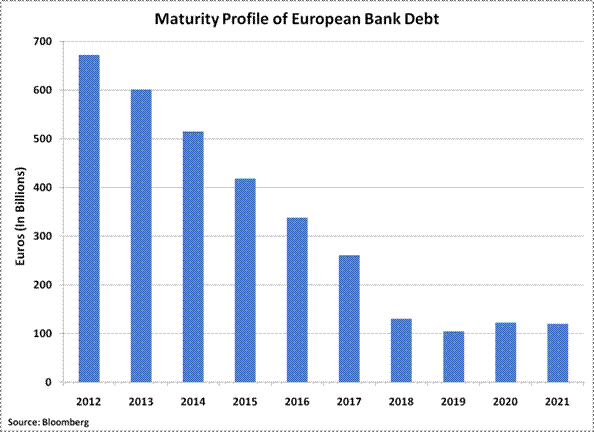
Will this smaller figure be used by banks to buy sovereign debt? Any purchases will probably not in be in large amounts. That's because, as Bloomberg Economist David Powell recently pointed out, the 191 billion euros of new loans are less than the value of bank debt scheduled to come due this quarter alone. And with the unsecured debt markets essentially closed to many of these banks, the ECB loans will be needed to fund existing assets.
Up to 700 billion euros of European bank debt comes due this year, with about 200 billion euros coming due the first quarter, according to Bloomberg data. The financing needs coming due in the first quarter “imply that euro area banks will not have extra money as a result of the three-year auction to purchase European sovereign bonds, using a carry-trade strategy, because the amount of fresh cash is less than the amount of bank debt that will mature during the quarter”, Powell wrote recently.
Meanwhile, the ECB's balance sheet continues to grow. At 2.7 trillion euros, it's now levered 33 times to its own capital, versus a leverage ratio of 25 back in September. For investors holding out hope that the ECB becomes more involved in the debt crisis, it's clear that the central bank is already deeply involved.
As the size of the ECB's balance sheet grows, the quality of its collateral is declining. Open Europe, a Brussels-based think tank, estimates that through government bond purchases and liquidity provisions to banks, the ECB's exposure to Greece, Portugal, Ireland, Italy, and Spain has reached 705 billion euros, up from 444 billion euros in early summer - a 50 percent increase in six months (their note was published prior to the December 21 three-year LTRO, which likely further boosted lower quality collateral). They also remarked, “the number of banks which are becoming reliant on the ECB is alarming and hopes that the functioning of the European financial markets will ever return to normal are diminishing – creating a long-term threat to Europe's economy.”
5) Widespread Global Slowdown
Risks exist outside of Europe, too. Leading indicators suggest that the risks of a synchronized global downturn are building. (See John Hussman's recent discussion on this topic: When "Positive Surprises" Are Surprisingly Meaningless . ) The year-over-year changes in the OECD's Composite Leading Indexes for the United States, the United Kingdom, Japan, and Europe have all turned negative to varying degrees. Of these, the OECD's index that tracks Europe's major economies is declining at the fastest pace (-6.5), with the 12-month change in the US index falling just below zero in the latest release of the data.
Now that negative leading indicator readings for these four major regions of the world are in place, stock market risks have climbed considerably. The graph below is one way to show the typical outcome when all of these leading indicators are negative. The red bars (right scale) represent drawdown – or the decline from each prior peak - in the MSCI World Index. The blue bars (left scale) are just a sum total of the number of regions where the year-over-year change in the OECD leading indicator is positive. The large blocks of blue areas reaching the top of the graph represent periods of widespread economic growth, such as the late-1980's and -1990's, when the leading indicators for all four regions were positive. The large blocks of white space represent those periods where economic contraction was widespread – such as in 1974, the early 1980's, in 2000, and in 2008. Importantly, the sum of positive leading indexes has dropped to zero once again.
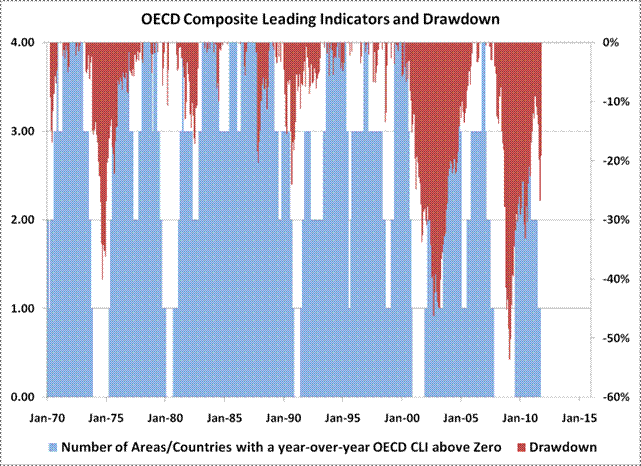
Probably the best way to summarize this chart is that when the majority of developed economies have negative leading indicators on a year-over-year basis, investors should at least allow for large stock market declines. The declines beginning in 1974, 1990, 2000, and 2007 all began from periods when the leading indicators of all four regions had – or were about to - turn negative. The worst of those - 1974, 2000, and 2007 also began from very rich market valuations. The stock market collapse in 1987 is the only example of a large decline without at least some notification from the OECD's leading indicators of oncoming weakness. The 1980-1982 period, where global stocks fell more modestly, can be explained by the extremely low levels of valuation during that period, unlike today's higher levels.
The above global composite of OECD leading indicators also does a surprisingly good job of providing a coincident signal of US recession. Here are the dates where all four indicators first turned negative along with the actual month a US recession began in parenthesis: December 1973 (November 1973), February 1980 (January 1980), December 1990 (July 1990), December 2000 (March 2001), and November 2007 (December 2007). The indicator warned 5 months into the 1990 recession, and 3 months early in 2001, but within a month of each other recession (missing only the 1981 recession). This composite indicator turned negative with the October data.
Debt loads and economic growth vulnerability probably sum up this list of risks best. While these were topics investors focused on in 2011, this year will raise the stakes. Large quantities of debt will need to be rolled over and coincident indicators are likely to follow the currently downbeat leading ones. Both will need to be watched closely.

Mauldin: Europe and Sovereign Debt Economics; the Endgame Approaches -- Soon!

One of the interesting things about being in Hong Kong is that I get to see the weekend edition of the Financial Times 12 hours early. And the headlines were not all that pleasant. As I promised last week, we will cast our eyes to Europe and ponder what is in store for Europe for the year and the next five years. And what do we read on page 2? The "ECB raps revisions to draft a fiscal pact." Seems they feel there are too many loopholes, which will make the document meaningless … somewhat like the treaty they have now. And we further learn that "Greek default threat grows as talks falter." Seems there is a lack of agreement on how much of a haircut the investors ought to take, and the Greeks don't want to guarantee any future debt, just in case they need to default some more in the future. But they do want the €15 billion they need to keep the debt machine running for a few more months.
And on page 1, in big type, we are surprised (but not very) by the headline, "France and Austria face debt blow." Seems those sharp-eyed accountants over at S&P have decided to downgrade French debt from AAA. Which of course leads to another headline on page 2, suggesting "Firepower of bail-out fund cast into doubt." The currency markets were shocked – shocked I tell you – that S&P would do such a thing and promptly took back the euro rally and cast the euro down to recent cycle lows. Who knew, other than the entire free world not watching reality TV, that S&P was planning to do such a thing? And we read elsewhere that the European Commission is dismayed that S&P would do something so clearly not right, at least according to the way they keep their own books.
Even here in amazing Hong Kong, with the growth of China driving a wave of prosperity, eyes are fixed on Europe. How will they deal with the crisis? We read that US exports to Europe were down 7% last quarter, and Europe has not yet really entered into recession, which is almost guaranteed this year. And if US exports are down, then so are Asian and Latin American exports. Global growth appears to be threatened.

Solving the Mayan Code

There are so many pieces of data to go through in order to augur Europe's future – I want readers to know I have left no stone unturned! In fact, I went to some very old stones to get help with this week's letter. I began to scrutinize the Mayan Code from ancient Central America, which so many feel predicts the end of the world on December 21 of this year, bringing my fresh eyes to an old mystery.
After much deliberation, I have come to this astounding insight: The Mayan academics who created the code were not in fact astronomers or even astrologers. No, it is clear they were another breed of even more dubious forecasters, called economists. Once you approach the glyphs with that understanding, it becomes clear they are not predicting the end of the world, merely the end of Europe. One symbol clearly shows the Greek flag dipping to the ground. Another depicts the Italian flag with its wheels coming off. Oh, and you don't even want to know what they have prognosticated for the French. This is a family e-letter and I can't squeeze such language past the censors. But now that I have provided the basic insight, I leave it to you, fellow scholars, to decipher the rest of code.
And we will spend our time together here this week trying to discern what it means, in fact, for Europe to come to the place in its journey where it must make extremely difficult and often painful choices. As I wrote last week, as I started this voyage of discovery with you, the choices the various countries in the developed world are now making will put us on a path that does not allow us to turn back without severe consequences. (If you missed last week's letter, here it is.) We are left with debt that must be dealt with, with imbalances that must be balanced, and with deficits that must be brought under control. No matter what we choose, there will be pain for all of us. You cannot make debt go away without paying it back or defaulting, one way or the other, which means someone loses. And as we will see, paying it back can be very difficult, indeed, once it has grown this large.

To Solve the Crisis You Must Solve Three Problems

There are three main problems in Europe. The first is that most of the banks are massively insolvent, because they have 30 times their capital invested in the second problem, which is the sovereign debt of countries that are going to have trouble paying that debt. If the banks have to mark down the debt to what its real value is – or to what it will soon be – they will be bankrupt on a scale that makes 2008 look like a waltz in the park.
Countries simply cannot function in a manner that can be called normal without viable banking systems, which is why the authorities spend so much time worrying about them. If banks can't make loans, then businesses must cut back, which means fewer jobs, products, and services, which quickly becomes an ugly spiral. Losses in the private sector mount up. This obliges the treasury secretary to get on one knee and beg some elected official who has no understanding of how business and economics work to save the world as he knows it.
But if countries must step in and save their banks, then they have to assume some of the losses. (I am assuming that this time shareholders get completely wiped out, as do most bondholders. Taxpayers – read voters –are actually paying attention this time. They are in no mood to bail out bankers.) But most of the countries in Europe with the worst banks simply do not have the money to invest. They already have too much debt. Where do they get the capital? (More on that later.)
For most of the past two years, European leaders have tried to deal with the problems as though they were short-term liquidity problems: "If we just find the money to buy some more Greek bonds, then Greece can figure out how to solve its problems and then pay us back. Given enough time, the problem can get solved."
They have now arrived at the understanding that it this not a short-term problem. Rather, it's a solvency problem of the various governments, which of course creates a solvency problem for their banks. They are now addressing the problem of solvency and providing capital until such time as certain countries can get their budgets under control and the bond market sees fit to provide the capital they need.
But they are completely ignoring the third and largest problem, and that is massive trade imbalances. Germany exports products to the peripheral European countries, which run trade deficits. As I have shown in several letters, a country cannot reduce private-sector leverage, reduce public-sector leverage and deficits (balance its budget), and run a trade deficit all at the same time. That is simple, unavoidable math, based on 400 years of accounting understanding. Ultimately, there must be a trade surplus if leverage and debt are to be reduced.
Greece runs a trade deficit of about 10% of GDP. Until they can stop that bleeding, they cannot get their government and private budgets under control. It is not simply a matter of cutting budgets or raising taxes. Indeed, their economy will continue to shrink, making it more difficult buy foreign goods without increasing their own production of goods and services. It is a vicious spiral. And that same spiral will spin up to take in all of Europe. Again, more on that later, as we consider what their choices are.
But for now, let's start with my contention that if you do not solve all three problems you do not solve the real problem. Greece cannot "stand on its own" without a change in its cost of production relative to Northern Europe. Neither can Portugal, et al., unless Germany either changes how it exports and consumes more, or Germany is willing to fund Greek (and Portuguese and Italian and…) debt, so those countries can continue to run large deficits.
Let's resort to something I have done in the past, and that is to create a simple model to help us understand the issues involved. As always, when we make simple assumptions we are ignoring the real complexities. I know things are vastly more complicated than the following simple analogies, but the underlying truths are basically the same.

Getting Simple About Europe

Let's assume a country that has a gross domestic product (GDP) of $1,000. In the beginning it taxes its citizens about 25% of GDP and spends the money for the public's benefit. But alas, it spends about 30% of GDP, so it must borrow the overage (about $50) from its citizens or from the citizens of other countries. Because the country starts out with relatively little debt, interest rates on this loan are low, because those who buy the debt can easily see that the the country can pay them back. If the debt of the country is only 5% of GDP ($50) and the interest rate is 4%, then the amount that must be paid as interest is only about $2 per year. Not a whole lot, about 0.2% of GDP.
But this goes on year after year. Sometimes the deficits get smaller and sometimes they get larger, depending on the economy; but government expenditures grow at the same rate as the country grows, and the debt keeps growing at an average of 5% of GDP per year. Now, if the country is growing at 3% a year, after 24 years the economy will have doubled to $2,000 GDP. That means the debt has grown (roughly) to a total of $1,800, which is now a debt-to-GDP ratio of 90%. Debt has grown faster than the country's economy. Note that if the country had held its budget down to where it grew slower than GDP, thus reducing its need for debt, that ratio would be lower, even if the debt had grown. You can indeed grow your way out of a debt problem if the growth of government spending is less than the growth of the economy.
But what if the size of government grows to about 50% of GDP, rather than 25% or 30%, over the 24 years, as politicians decide to spend more money and voters decide they want more benefits? (Think France.) Then the private sector must pay about 50% of its production to the state – plus, the debt is now growing unwieldly. The private sector has less to invest in new businesses and tools, and the growth of the economy slows.
And then along comes a very nasty recession. The revenues of the government fall as the economy shrinks. If the economy shrinks by 3% and total taxes are 50%, then tax revenue falls to $970. But the government does not cut back; and indeed, because it must pay unemployment benefits and welfare (because unemployment rises in a recession), its expenses actually rise by 5%! So it now needs $1,050 to pay all its budgeted expenses. And it must now borrow $80 to pay everyone it has promised to pay, in addition to the $100 it was already borrowing every year to cover its deficit, or a total of $180 a year, which is 9% of GDP.
(Yes, I know that debt must change as a percentage over time and nothing is stagnant, but work with me here.)
Now debt-to-GDP is rising by about 5% a year. Not a large number in the grand scheme of things, and everyone knows that the recession will soon be over and the deficits will come down. Sovereign governments never default on their debts – our government leaders assure us of that. They can always raise taxes or cut spending, can't they?
And things rock along just fine, and the bond market continues to buy the debt, until one day you look up and the debt is 120% of GDP. Then the bond market gets nervous and says that instead of 4% it wants 7%. Now the interest payments are over 8% of GDP and 16% of government spending, which means the government must either cut back on services or salaries or benefits, or raise taxes, or borrow more money. But cutting spending and raising taxes have consequences. They reduce GDP growth over the following 4-5 quarters as the economy adjusts.
What if that interest rate cost rose to 10%? Then the interest cost to the government would become 20% of its expenses and be rising faster than the country could grow, even in the best of times. And if they continued to borrow at 7% and the country did not grow, those interest expenses would rise at least 7% a year – as long as interest rates didn't go up.
And what if the other countries who had been buying the government's debt looked at the basic math and realized that, another step or two down the current path of government spending, there was no way they would be able to get their money back?

How Much Risk Do You Want in a Government Bond?

Now, government bond investors are a curious breed. They invest in government bonds because they actually think there is not supposed to be any risk. They want their money to be safe. If they wanted risk, there are lots of opportunities to invest with the potential for more reward.
The moment that government bond investors begin to think they might be at risk, they leave. And history suggests they tend to leave seemingly all at once. It is the Bang! moment. Someone fires the starting gun, and they all head for the exits. They start selling their bonds to speculators at discounts, which makes the effective interest rates in the market rise, sometimes by a lot. That means that if a country wants to borrow more money, it will have to pay the effective price in the market, or maybe as much as 15-20% IF – a big IF – it can even get someone to buy the bonds, which of course makes it even more difficult to pay their debt as interest costs rise.
Now, let's add a twist. The other countries that have bought those bonds are not actually countries, but banks in other countries. And because the regulators of those banks knew it was impossible – inconceivable – that a sovereign country might default, they allowed their banks to buy 30 times as much sovereign debt as they had capital in their banks. They did not have to reserve against any losses, so these were "free" profits for the banks. You pay 2% on deposits or short term commercial paper and buy bonds paying at 4%. You make a 2% spread, which you then do 30 times. Now you are making 60% profits on your capital and deposits. It is a very nice business – as long as everyone pays the interest. And because it is such a good business, you just roll over the debt every time the bond comes due, because you want more easy profits.
Let's say that banks bought up to 10% of their total government sovereign-debt holdings in our problem country. If the country gets into trouble and says, we will only pay 50% of our debt (we will discuss why below), then that means the banks lose 5% of their total assets. But they only have about 3% capital, because they were allowed to leverage. That means they are functionally bankrupt.
Without a functioning banking system, other countries now have to step in and take the losses (and perhaps wipe out the shareholders and owners of their banks). That would be bad for the other countries, as that much spare cash is not just lying around in government coffers. They are ALL borrowing money already and have their own deficits to worry about.
So everyone gets together and they tell the bankrupt country (because that is what it really is), we will lend you more money to keep you alive, but you must agree to balance your budget. And since that is the only way the problem country can get more money, they initially say, "Sure. We can do that. Just give us some money now so we can get it figured out and get everything under control."
In the world of government, living within your means is called austerity. And it's an uphill slog. Let's say your deficit started out at 15% of GDP (somewhat like Greece's). If you agree to cut that deficit by 4% a year for four years running, if everything stays the same, you could be back in balance. But the other counties would have to agree to lend you the difference between what you budgeted to spend and what you took in as tax revenues. Just to keep things going. Otherwise you'd have to default on your debt. If the countries simply have to guarantee the loans and not actually spend the money, it is a lot easier than having to find real money to save their banks, so they agree.
But the cuts you have to make are not as easy as everyone hoped. It seems that employees don't like having their pay cut, and unions don't want pensions cut, and retirees certainly expect the government to fulfill its promises; and don't even get started on cutting healthcare, which is a God-given right.
So you raise taxes and cut spending by about 4% the first year. But a funny thing happens. That reduces the private economy by about 4%, so the base on which taxes are collected is reduced, which means less revenue is raised, which means that the deficit is much worse than projected. And then the following year you have to make another 4% in cuts, plus the last shortfall, just to make your plan and get to the agreed-upon deficit, in order to get more loan money. It becomes a very vicious circle.
And let's look at the endgame. That debt-to-GDP ratio will rise to at least 150%, while the economy is actually shrinking. If interest rates settle to a mere 7% (hardly likely), it means the people of the country are going to have to pay over 10% of their total production to foreign banks each and every year for decades, never mind paying down the principle.
Let's throw in one more twist. The country has been buying about 10% of GDP more from other countries than it sells to them. That is because the relative wages in the problem country are about 30% higher than in the "good" countries. The good countries get the money from what they sell and have a nice surplus. The problem country soon runs through its savings, trying to buy the goods and service it wants; and the private sector, as well as the government, must cut back.
What happens is that you are locking in what feels like a depression initially, and then you have a slow- or no-growth economy for many years, as so much of your work goes just to pay back that debt to the banks of other countries.
Understand, your government has freely obligated itself to pay that debt. But it means that its citizens in effect become debt slaves for a generation or two to foreign banks. Not a very popular platform for a politician to run on for re-election.
Long-time readers know I think the neo-Keynesians do not have a proper view of the world. They live in a theoretical world divorced from what really happens. But in this respect they are deadly right. Austerity on the scale needed by many countries will only reduce potential GDP. The Keynesian prescription is to therefore run deficits and borrow money until you get growth again; but when you have already exhausted your ability to borrow money, it just doesn't work.
More debt makes if far more difficult to grow your way out of the problem. If you are already drunk, you can't get sober by drinking more whiskey. If Greece cuts its deficit by 15% of GDP, the reality is that GDP over time will be reduced by about 20%, and the debt will grow, both in real terms and as a percentage of GDP. A 20% decline in GDP is by any standard a depression and makes it even harder to grow, as so much of what you do make has to go to basic expenses and not productive capital. And if you have the burden of massive debt it becomes damn near impossible.
That is why individuals can file for personal bankruptcy. We no longer force people into slavery or debtor's prison to pay their debts, at least in most places.
So our problem country goes to its lenders and says, "We think you should share our pain. We are only going to pay you back 50% of what we owe you, and you must let us pay a 4% interest rate and pay you over a longer period. We think we can do that. Oh, and give us some more money in the meantime. And if you refuse, we won't pay you anything and you will all have a banking crisis. Thanks for everything."
The difficult is that if our problem country A gets to cut its debt by 50%, what about problem countries B, C, and D? Do they get the same deal? Why would voters in one country expect any less, if you agree to such terms for the first country?
So now let's return to the real world of Europe. Greece cannot pay its debt without a major depression. So its wants to pay only 50%, but it doesn't even want to guarantee that in any meaningful way; so bondholders scream, "We get nothing in return for agreeing to take a 50% haircut?!" Which is today's headline.
Greece cannot print its own money, so unless it leaves the Eurozone, it's stuck. They can default on their debt, but that means they are shut out of the bond market for some period of time. That would force them to make the spending cuts they are now resisting, as they would simply not have enough money to pay their bills. Even with a 100% haircut they're looking at a shorter but very real depression. And because no one will sell them products they need, like energy and food and medicine, unless they can sell or trade something in return (that trade-deficit problem), they will be forced to change their lifestyles. Wages must drop or productivity rise to be competitive with northern Europe. And that differential is about 30%. I am not certain, as I have not been to Greece in a long time, but my bet is, you won't find many Greeks who think they are overpaid by 30%.
But that is what the market is going to say. And that is the third problem, which Europe is not addressing. Germany and the northern tier are simply more productive than the Southern periphery. (With the possible exception of Northern Italy, but Italy all gets lumped together, which is why many Northern Italians want to be their own country and not have to pay taxes that go to Southern Italy. I am not taking sides, just observing what we read in the papers.) Until Germany consumes more from the peripheral countries or the peripheral countries become more productive, the imbalance will not allow a positive solution.
Prior to the euro, the imbalances would be handled by currency exchange rates. The value of the drachma would go down relative to the value of the deutschmark. Things would balance over time. Now, all of the eurozone countries are effectively on a gold standard, with the euro standing in for gold this time. Britain, the US, and Japan print their own currencies. Their currencies can rise or fall over long periods of time, based on national accounts and the desires of foreigners to buy goods or invest in their countries.
Greece and the other peripheral countries face a difficult choice. Do we stay in the euro and pay as much as we can, and watch our economy drop; pay nothing and watch our economy drop (as we get shut out of the bond market); or leave the euro and go back to our own currency and watch our economy drop?
They have no choices that allow them to grow and prosper without first suffering (for perhaps a long time) some very real economic pain. As I have written in previous letters, leaving the eurozone has severe consequences; but the economic pain of leaving would go away sooner and allow for quicker adjustments, than if they stayed. However, the initial pain would be worse than the slow pain they'd suffer by staying in the euro. Their choice is, simply, which pain do they want – or maybe, which pain do they think they want? Because whatever they choose, they are not going to like it.
And just as I was finishing this section, this note came from Naked Capitalism:
"The three Troika inspectors—Poul Thomsen from the IMF, Mathias Morse from the EU, and Klaus Mazouch from the ECB—are supposed to head to Greece next week to inspect its books; the budget deficit is once again higher than the revised limit that Greece had vowed to abide by. And they're supposed to negotiate additional 'structural reforms.' But there probably won't be three inspectors, according to senior IMF sources. Missing: Poul Thomsen. The IMF has had enough.
"Already, according to more leaks, IMF Managing Director Christine Lagarde had warned German Chancellor Angela Merkel and French President Nicolas Sarkozy that the fiscal and economic situation in Greece had deteriorated. Hence, the 'voluntary' haircut on Greek bonds held by private sector investors should be increased to more than 50% to maintain the goal of bringing Greece's debt load down to 120% of GDP. And the second €130 billion bailout package, agreed upon on October 26, should be enlarged by 'tens of billions of euros.'
"The German reaction was immediate. 'There has to be a line somewhere,' said Michael Fuchs, deputy leader of Merkel's party, the CDU. 'This cannot be a bottomless barrel.' Even if Merkel were amenable to committing more taxpayer money to bail out Greece, she'd face a wall of opposition in her own party. And he wasn't brimming with optimism: 'I don't think that Greece, in its current condition, can be saved,' he said."
The article goes on with a description of the chaos in Greece. It is worse than I have described. Really. And so terribly sad.

Do You Have a Spare €1.5 Trillion?

Before I hit the send button this week, let's look at a few charts that can help us judge the current scope of the problem. These are from the very astute Bill Hester of the Hussman Funds. He wrote a very solid piece entitled "Five Global Risks to Monitor," at http://hussmanfunds.com/rsi/fiveglobalrisks2012.htm. It is very good, if sobering, reading.
This first chart shows how much bank debt is maturing in Europe over time. You have to add in how much new debt must be sold, as they will need to raise capital to balance the sovereign debt losses. Do you have a spare €1.5 trillion? Yes, some of that is rollover debt, but banks are trying to reduce their exposure to each other and may not want to roll over that debt, unless they can turn around and get capital from the European Central Bank to buy it, which is a back door to debt monetization.

The next chart shows how much debt must be rolled over by governments in the coming year. Notice how much Italy must raise in the first three months!

And one last chart from Hester. This is the rise in the cost of new debt as older, cheaper debt comes due. My simple example is not at all extreme.

Next week we will look further into Europe. As a preview, I do think this is the year they will be forced to the very hard decisions. We will examine what a fiscal union would look like and how likely it is to happen, and what the prospects are for a break-up of the eurozone, and compare several scenarios for what Europe may look like in five years.

Saturday, January 14, 2012

But Stocks Nearly Back to Flat

It's a Downgrade Parade

But Wall St is still in denial. Downgrade disaster, but Wall St ignores it and buys the market right back up in anticipation of more Fed money-printing.

Friday, January 13, 2012

Forbes: Worst Recovery Since Great Depression

Thanks, Obama!

The recession started in December, 2007.  Go to the website of the National Bureau of Economic Research (www.nber.org) to see the complete history of America’s recessions.  What that history reveals is that before this last recession, since the Great Depression recessions in America have lasted an average of 10 months, with the longest previously lasting 16 months.
When President Obama entered office in January, 2009, the recession was already in its 13th month.  His responsibility was to manage a timely, robust recovery to get America back on track again.  Based on the historical record, that recovery was imminent, within a couple of months or so.  Despite widespread fear, nothing fundamental had changed to deprive America of the long term, world-leading prosperity it had enjoyed going back 300 years.
Supposedly a forward looking progressive, Obama proved to be America’s first backward looking regressive.  His first act was to increase federal borrowing, the national debt and the deficit by nearly a trillion dollars to finance a supposed “stimulus” package, based on the discredited Keynesian theory left for dead 30 years ago holding that increased government spending, deficits and debt are what promote economic growth and recovery. That theory arose in the 1930s as the answer to the Great Depression, which, of course, never worked.

That was the beginning of President Obama’s Rip Van Winkle act, pretending not to know anything that happened over the previous 30 years proving the dramatic, historic success of the new, more modern, supply side economics, which holds that incentives for increased production are what promote economic growth and recovery.  Indeed, that Rip Van Winklism pretended not to remember the 1970s either, when double digit inflation and double digit unemployment proved Keynesian economics grievously wrong.
As should have been long expected, Obama’s trillion dollar Keynesian stimulus did nothing to promote recovery and growth, and almost surely delayed it.  That is because borrowing a trillion dollars out of the economy to spend a trillion back into it does nothing to promote the economy on net. Indeed, it is probably a net drag on the economy, because the private sector spends the money more productively and efficiently than the public sector.
The National Bureau of Economic Research scored the recession as ending in June, 2009.  Yet, today, in the 49th month since the recession started, there has still been no real recovery, like recoveries from previous recessions in America.
Unemployment actually rose after June, 2009, and did not fall back down below that level until 18 months later in December, 2010.  Instead of a recovery, America has suffered the longest period of unemployment near 9% or above since the Great Depression, under President Obama’s public policy malpractice.  Even today, 49 months after the recession started, the U6 unemployment rate counting the unemployed, underemployed and discouraged workers is still 15.2%.  And that doesn’t include all the workers who have fled the workforce under Obama’s economic oppression.  The unemployment rate with the full measure of discouraged workers is reported at www.shadowstats.com as about 23%, which is depression level unemployment.
Today, over 4 years since the recession started, there are still almost 25 million Americans unemployed or underemployed.  That includes 5.6 million who are long-term unemployed for 27 weeks, or more than 6 months.  Under President Obama, America has suffered the longest period with so many in such long-term unemployment since the Great Depression.

Notably, blacks have been suffering another depression under Obama, with unemployment today, 49 months after the recession started, still at 15.8%. Black unemployment has been over 15% for 2 ½ years under Obama.  Black teenage unemployment today is over 40%, where it has persisted for over 2 years as well.
Hispanics have also been suffering a depression under Obama, with unemployment today still in double digits at 11%.  Hispanic unemployment has been in double digits for three years under President Obama.  Over one fourth of Hispanic youths remain unemployed today, which also has persisted for years.
The Census Bureau reported in September that more Americans are in poverty today than at any time in the entire history of Census tracking poverty. Americans dependent on food stamps are at an all time high as well.
Real wages and incomes have been falling so steadily under Obama and his confused, throwback, Keynesian/neo-Marxist Obamanomics, that the Census Bureau also reported that real median family income in America has fallen all the way back to 1996 levels.
Obama apologists cannot argue that this is because the recession was so bad, because the historical record in America is the worse the recession the stronger the recovery.  Based on historical precedent, we should at worst be finishing the second year of a booming recovery by now.
Compare Obama’s lack of a recovery 2 ½ years after the recession ended with the first 2 ½ years of the Reagan recovery.  In those years under Reagan, the American economy created 8 million new jobs, the unemployment rate fell by 3.6 percentage points, real wages and incomes were jumping, and poverty had reversed an upsurge started under Carter, beginning a long term decline.
While Obama crows about 200,000 jobs created last month, the most for a month during his entire Administration, in September, 1983 the Reagan recovery less than a year after it began created 1.1 million jobs in that one month alone.  Under Obama, we are still almost 6 million jobs below the peak before the recession started over 4 years ago! In the second year of the Reagan recovery, real economic growth boomed by 6.8%, the highest in 50 years.
The chief excuse of the Obama apologists is that what we have suffered was not just a recession, but a financial crisis, and, they argue, recovery from a financial crisis takes a lot longer than recovery from a recession.  But that is not the experience of the American, free market, capitalist economy.
The experience of the American economy is reported in full at the National Bureau of Economic Research, as cited above – recessions since the Great Depression previously have lasted an average of 10 months, with the longest previously 16 months, and the deeper the recession the stronger the recovery.  That is the standard by which the performance of Obamanomics is to be judged.  Which of those American recessions was a “financial crisis” that breaks the pattern?
The apologists cite in their support the book, This Time Is Different: Eight Centuries of Financial Folly, by Carmen Reinhart and Kenneth S. Rogoff. That book “covers sixty-six countries over nearly eight centuries.”  It “goes back as far as twelfth century China and medieval Europe.”  The data “come from Africa, Asia, Europe, Latin America, North America, and Oceania.”  The experience from 12th century China, medieval Europe, spendthrift demagogues and socialist economies from Latin America, Europe, Africa and Asia, do not set the standard of expectations for post depression, free market, capitalist America over the last 70 years, the most powerful economic engine in the history of the world.
The data in the book is marshaled to explain why, in fact, “this time is different” is actually always wrong.  Seizing upon the data in the book to try to give some sort of pass to Obamanomics for failing the economic performance standards of American history is just political propaganda.
Indeed, exactly none of President Obama’s policies have been well designed to restore economic recovery and traditional American prosperity.  They have consistently been the opposite of everything that Reagan did to end the American decline of the 1970s, and restore booming growth for 25 years. That is why Rush Limbaugh is saying Obama deliberately wants to trash the economy, thinking the resulting dependency will lead a majority to continue to vote for the liberal political machine.  President Obama certainly thinks that traditional American, world leading prosperity is morally embarrassing because of the global inequality it represents.

The American economy will likely show continued, long overdue, signs of life in 2012, which will amount to way too little, way too late, based on historical standards.  But even worse than his first term is what Obama is brewing up for 2013 on his current course.
Most people do not know that already enacted in current law for 2013 are increases in the top tax rates of virtually every major federal tax.  That is because the tax increases of Obamacare become effective that year, and the Bush tax cuts expire, which Obama has refused to renew for singles reporting income over $200,000 per year, or couples reporting over $250,000 per year (in other words, the nation’s small businesses, job creators and investors, in plain English).
As a result, if the Bush tax cuts just expire for these upper income taxpayers, along with the Obamacare taxes, in 2013 the top two income tax rates will jump nearly 20%, the capital gains tax rate will soar by nearly 60%, the tax on corporate dividends will nearly triple, and the Medicare payroll tax will leap by 62% for those disfavored taxpayers.
This is on top of the U.S. corporate income tax rate, which is virtually the highest in the industrialized world.  The federal rate is 35%, with state corporate rates taking it close to 40% on average.  But even Communist China has a 25% rate.  The average rate in the social welfare states of the European Union is less than that.  Formerly socialist Canada has a 16.5% rate going down to 15% next year.
These U.S. corporate tax rates leave American companies uncompetitive in the global economy.  Yet under President Obama there is no relief in sight.  Instead, he has spent the past year barnstorming the country calling for still further tax increases on American business, large and small, investors, and job creators.
Higher tax rates mean producers can only keep a smaller percentage of what they produce.  So tax rate increases reduce the incentive for productive activities, such as saving, investment, starting businesses, expanding businesses, job creation, entrepreneurship and work, resulting in less of each. And that is what the tax tsunami of 2013 would do, which would once again swamp the weak economy.
Most small business profits are reported from households earning more than $200,000/$250,000 per year, and those small businesses produce more than half the new jobs.  So the 2013 tax tsunami effectively targets small business, and the nation’s job creators.  That will hurt working people the most, because they will lose the jobs and the wage income they need to maintain their basic standard of living.
In addition, the Obama administration is in the process of imposing a blizzard of new regulatory costs and barriers that will be building to a crescendo by 2013 as well. Academic studies estimate the total costs of regulation in the economy to be rapidly rising towards $2 trillion per year, or $8,000 per employee.  That is close to 10 times the corporate income tax burden, and double the individual income tax.  When the resulting effects on the economy are considered, the total losses due to regulatory burdens may total $3 trillion, or one fifth of our entire economy.
But by 2013 these regulatory costs will have exploded in unprecedented fashion.  That reflects the Obama Administration’s global warming crusade, assault on private energy production, the still oncoming Dodd-Frank regulatory burdens on the financial community, Obamacare regulations, particularly the job killing employer mandate, and many others.
By 2013, the Fed may be in contractionary mode as well.  If history is any guide, the Fed might decide that right after the election would be the perfect time to cut back on its historically loose monetary policy with record low interest rates that have persisted for years.  Adding rising interest rates to the above brew of soaring marginal tax rates across the board and exploding regulatory costs would accumulate to a powerful contractionary force.
Art Laffer predicted the Coming Crash of 2011 on the basis of the expiration of the Bush tax cuts on the upper income earners alone.  Those tax rate increases were extended to 2013 in December, 2010 out of fear that prediction was right.  But now in 2013 in addition to those tax rate increases we have all of the tax increases of Obamacare, the further exploding costs of Obama’s building regulatory blizzard, and the possible contractionary effect of the Fed’s monetary policies, all at the same time.  Unless we reverse course, the result may well be one big, bad crash in 2013.
Adding that on top of Obama’s first term, the entire period will look like an historical reenactment of the 1930s.  Unless the American people choose to change leadership this year, we will have achieved that result the old fashioned way – we will have earned it.

Stocks Down on Bad News

There is a plethora of bad news this morning. S&P is imminently planning to downgrade the debt of various European countries. Novartis is laying off nearly 2000 employees (and we all thought the pharmaceutical industry was impervious to recessions), JP Morgan announced that earnings were down 23%, etc. Stocks down about 140, but it looks like Wall St has already put in a bottom at around -150 for the day.

Thursday, January 12, 2012

Corn Limit Down

Chicago Board of Trade March corn futures plunged 40 cents Thursday morning to a little over $6.11/bushel as traders reacted to an earlier crops report forecasting a smaller-than-expected drop in inventories.

US corn stocks are to fall 2 million bushels in January as increased export demand is expected to offset a rise in production, according to the World Agricultural Supply and Demand Estimate report released by the US Department of Agriculture.

"Basically, the report did not live up to expectations," said a market source, adding that the "market had already priced in the expectation, so now it's reacting."

As a jump in demand slightly outpaces a rise in supply, the projected total ending stocks for US corn in January edged down 2 million bushels from the December projection to 846 million bushels, according to USDA.

Back to Flat

As I expected, Wall St has ignored today's bad economic news. They will continue to do so until it can no longer be ignored. Stocks are now higher for the day! Imagine that! Stocks move higher on bad economic news. Bad is good on Wall St!

Sharp Reversal As News Doesn't Match Narrative

Jobless claims shocked the market this morning, and so did retail sales, with both disappointing the market. I rode the market higher on the uptrend (top left), and got out profitably. I'm glad I did! I lost about 1/3 of my gains. Now, following these two data disappointments, the market has shown a sharp reversal and is still trending lower. This may be the beginning of a much-needed wake-up call for Wall St.
Over the past few months, it has been reading lagging and coincident indicators as signs that a second recession is not going to happen, while shrugging off the leading indicators that are flashing red flags world-wide. John Hussman eloquently covered this in his weekly market commentary last Monday.
Somehow, I suspect that today's disappointing data will be shrugged off as well. It will take several shocks to the market for the world's most entitled group of people to awaken to the awful reality that recession is soon coming, and the Pollyanna Party, no matter how elated the euphoria, is not going to stop it.

Tuesday, January 10, 2012

Orange Juice Limit Up

Stunning chart!

But Stocks Move Higher

Mauldin: "No Good Choices"

"Happy New Year. We enter 2012 with a great deal of hope, but our hopes are not for more bailouts, or money printing, or any of the myriad policies that investors seem to hope will save bad investments and sustain elevated valuations. Instead, our hope is that in 2012, the market will finally "clear," in the sense that bad debt around the world will be recognized as bad and restructured; that overleveraged financials will be taken into receivership instead of forcing austerity on every corner of the global economy in order to make them flush again; that rates of return will rise enough to compensate and encourage saving – and high enough to encourage borrowers and other users of capital to allocate the funds productively. Of course, in order to restructure bad debt, someone has to accept a loss. In order for rates of return to rise, valuations must decline. In short, our hope is for events that will unchain the global economy from an irresponsible past and open the gates toward a prosperous future. Maybe that is too hopeful, but we are not entirely convinced that bailouts and 'big bazooka' will be as easily procured in the year ahead as a confused public has allowed in recent years."

– John P. Hussman, Ph.D. ( hussmanfunds.com
 
) 2012 will the year that the consequences of the choices made by nations of the so-called developed world will begin to truly manifest themselves in the economic realm. We are in the closing chapters of the current Debt Supercycle, with different countries strewn out along the path, some at more advanced stages than others but all headed for a destination that will force major decisions if politically painful actions are not taken. The longer that process takes, the fewer options that are available and the more painful the outcomes. Some countries (think Greece, et al.) have a choice between dire economic circumstances and disastrous. The option for merely difficult choices was passed long ago, and the rules are such that there is no going back to where you started without a different but equally painful outcome.
This is the time of year I think about the future, and foolishly opt to make predictions. This year I have decided to be especially foolish and to think about the next five years, especially for the US. Why five? Because I think by then the consequences of our past and immediate future choices will have been realized, the "reset button" as it were will have been pushed, and the economies of the developed world will be ready to move on to a brighter future. The question is, from what level will that new upward journey begin? It will be very different for different countries, depending on the paths they choose.
Let me presage my thoughts. Most countries are being faced with dual choices, which differ according to their own particulars, but all deal with what to do about the need to deleverage, both in the public and private sectors. The end of the Debt Supercycle is a tectonic plate shift of massive global economic proportions, unlike anything the world has seen for 70-80 years. It will cause all sorts of economic earthquakes, tsunamis, and volcanoes. While the choices each country makes are their own, the consequences of their choices will have a much larger effect upon the world, as global interconnectedness has landed us in a world where isolating the impact of a problematic country is no longer possible. The need for global cooperation is most paramount at a time when politicians will be more and more restrained by the exigencies of their local problems and voter angst.
Jumping ahead and, by way of example, taking a peek at the Greek newspapers, one would not think that the current Greek crisis is at root a problem of their own making. The culprits are those nasty Germans. Political cartoons depict Germans as saying they have finally won WW2. Not exactly the climate in which Greek politicians are able to make calm decisions or explain the need to accept a great deal of pain. And the German editorials and columns are awash with the question of why Germans should work longer and harder to pay for Greek retirements and "lavish" benefits while Greeks don't pay their own taxes.
But choices must be made to proactively deal with the problems, or have the market force a severe solution. It is not a choice between pain or no pain, but exactly which pain do we prefer and how much? And anesthetics are not available on the pain menu. This is pain that will be felt from head to toe of the various national economic bodies, worldwide.
The US, Europe (including most of Eastern Europe), Japan (a bug which will soon find that windshield!), and even (especially) China must all deal with the problems that come with deleveraging. To fully understand the nature of the choices and their consequences, we are going to start somewhat far afield with some thoughts about choices and path dependence, then look back at history to see if we can get some clues about what deleveraging looks like (warning: it is not pretty), then examine the choices faced by specific countries and make some guesses as to outcomes, where possible.
I should note that in spite of the rather dark tone of this introduction, I remain an unabashed long-term optimist. History shows that these periods end and new periods of growth and prosperity emerge. While for the moment the situation is stressful, the trick for individuals is to make the best possible choices, given the circumstances, with a view to that moment in the future when risk will once again be something to be wooed and willingly accepted, rather than avoided as much as possible. For nations, it is preferable to make the choices that will bring about a new equilibrium, even if doing so requires some pain. The longer that difficult choices are avoided, the greater the pain will be when the choices are either taken or forced upon us.
That being said, so many choices are made by people and nations who happily blunder forward into what proves to be a disaster, swept along by the tides of emotion and rationalization, thinking that by avoiding the consequences of the real problems, things will somehow turn out OK. I am reminded of the times when I told my children to clean their rooms before they went out to play, and was cheerfully told, "I did," as they poured out the door, only to have Dad find that they'd stuffed all the detritus that was on their floors into the closets, drawers, and under the bed. The appearance is that there is order and calm, while in the shadows and cubbyholes lurks the sad reality.
To be able to make wise choices means understanding and dealing with the real problems and not just the symptoms. In the US, the old joke was that doctors routinely told their patients to "Take two aspirin and see me in the morning" (which simply shows that I am old enough to remember an era when everyone had their doctor's home phone). And that was often the best advice, as most things do eventually take care of themselves, one way or another.
But if you are lying in a ditch bleeding on the side of the road, you need more than aspirin. The European interbank credit markets are screaming that the system is at risk of a cataclysmic failure. Think Bear Stearns and Lehman. On steroids. We are rapidly coming to the point where we can no longer stuff the dirty clothes and toys under the bed. There is no more room. We are going to be forced to actually deal with the mess. That means that we will have to put "playtime" off for a little bit, but Mr. Market is going to stand over us and force us to clean the room. Better to get on with it.

The Consequences of Path Dependency

Breathes there a parent who has not lectured his teenage children on the consequences of making good and bad choices? Who has not tried to help them learn to figure out their own path in life?
We make choices every day. What do we eat? What color shirt today? Do we take a new job, or ask for a raise? Almost everything is a choice or the result of a previous choice. There are whole genres of academic literature on choices and what drives us human beings to choose and do the things we do. Behavioral psychology and in particular behavioral economics is a topic oft discussed in this letter. But today I want to briefly focus on what might be thought of as the opposite of behavioral studies, and that is path dependency. These are not the choices that we think we make or that we would like to make, but the limited choices we have because of past choices and circumstances.
The classic studies of path dependence try to explain how the set of decisions one faces for any given circumstance is limited by the decisions one has made in the past, even though past circumstances may no longer be relevant. (I would encourage those interested to Google "path dependence" and spend an afternoon [or night] reading some of the research.) But now, let me dismay the academics among my readers and resort to anecdotes and analogies to set the stage for our analysis of the end of the Debt Supercycle and to open a view on what awaits us as we journey down that path.
There are several different types of path dependency. The simplest analogy is that we go down a path, come to a fork in the road, choose one direction, and go down that path until we are presented with another fork. If we decide we don't like that path we can always go back to some previous fork and take another path. Our only loss is the time we took and the energy (or money) we spent on that path, while we did gain some knowledge of the path we left, even if we ultimately decided not to go on.
How many of us went to school to study one topic and perhaps even got a degree that we now don't use? Or started all over again in a different course of study? How often do voters elect a different group of politicians, hoping for change or a new direction, only for a majority to become disenchanted with the changes and opt for yet another change, or go back to the old political party? We fall in love with a stock or investment and then lose that love over time, and either stick it out or find a newer, more interesting investment.
We can't change the past, but we often tell ourselves that we can change things back if we want to – we can always turn around and try again, we assure ourselves.
Often there are things that are somewhat in our control. We can change. We can decide to eat healthy and exercise, or to change careers if we are unhappy. Sometimes those changes are positive and sometimes we act, even though the new path is not an easy one or one that makes everyone else happy.

There's No Going Back

The problem is that there is another type of path, one that we cannot retrace. After we choose that sort of path, the way back is blocked, and we must go on dealing with the consequences of our chosen path. We may come to forks in the road and vary our directions on the path, but we can't turn back, no matter how much we would like to. We can choose other paths into the future, but the past will always be there.
If we make a bad investment, we will lose money. I can't ask the market to give me back my money if the stock I picked goes down. If I own a business that is dependent on one customer and I lose that customer, I am out of business. If a bank lends money to someone who can't pay the money back, it is going to take a loss (unless it is a subprime mortgage and they can find some pension fund in Europe to buy it because Moody's say a whole bunch of bad loans are now suddenly AAA).
If you are eight months pregnant, you can't go back to being just four months pregnant. It is better to make the wise, if harder, choice as soon as you can.
And then there is yet another category of paths, the ones that are chosen for us, whether by family, circumstances, or fate; and once on them we don't know what we may have missed on alternative ones. Parents move to a different town and take the kids with them. A "chance" meeting becomes a new business endeavor. A torn muscle forces a promising athlete into another career. War erupts and changes the plans of young men. Accidents happen.
Let's look at an example of a seemingly small choice that had large consequences much later. In 1953 some CIA types, with the blessing of senior US and British administrators, decided it would be a good idea to replace the elected prime minister of Iran with the Shah, who would more or less do what we asked and keep Iran from turning communist, which was a big deal in Western government circles at the time. And who really cared? We were focused on the Korean War and Russia and China, nuclear threats, and all sorts of other "distractions." It was a different time and culture. We trusted our government to do what was right to keep us safe. There was barely a mention of Iran in the papers.
And eventually (1979) we got the Iranian revolution and the rise of the Islamist parties, with Iranian support, throughout the Mideast. Fearing that an Islamist revolution might develop in some of its republics, Russia panicked and invaded Afghanistan. An otherwise low-profile Democratic Congressman from Texas named Charlie "Good Time" Wilson (he did like to party) decided to make the Afghanistan rebels his personal cause, and "traded" all sorts of favors to get what became massive secret funding for the Afghanis, who not only succeeded but turned into the Taliban and helped train and arm a young Saudi named Osama bin Laden. And then along came 9/11 and the wars in Afghanistan and Iraq. Could any of that have been foreseen in 1953? Is there a path-dependent link? You be the judge. What would have happened if we had not meddled? Perhaps things would have been better, or they might have been worse. We will never know. All we know is what did happen (or at least what we have been told).
We all have a lot of stories about the paths that we chose or the limits of our choices. The good choices we take credit for and the bad choices we blame on circumstances or find some way to rationalize them.
The "invisible hand" of the market is millions of people making their own individual choices. Do we choose to rent or buy a house because one choice is better for the national economy? Why do some companies or unions support trade barriers and tariffs? Because they know that given a free choice individuals will buy the products of companies from "foreign" sources, and they persuade politicians to limit the choices of consumers to protect their own incomes, either by forcing them to pay more for foreign products or to buy inferior, locally made products. "We need to protect our jobs, don't we?" Even if it means we all pay more for products.
And our choices add up. They become cumulative and create an economic tide. Policies and practices that initially seem small in the grand scheme of things can become much more significant when taken together and given a little time.

The End of the Debt Supercycle

And that brings us to the Debt Supercycle. Let me quote a few paragraphs from my book Endgame:
"When we mention The Endgame, you'll immediately want to know what is ending. What we think is ending for a significant number of countries in the "developed" world is the Debt Supercycle. The concept of the Debt Supercycle was originally developed by the Bank Credit Analyst. It was Hamilton Bolton, the BCA founder, who used the word Supercycle, and he was referring generally to a lot of things, including money velocity, bank liquidity, and interest rates. Tony Boeckh changed the concept to the simpler "Debt Supercycle" back in the early 1970s, as he believed the problem was spiraling private-sector debt. The current editor of the BCA, Martin Barnes, has greatly expanded on the concept. (And of course Irving Fisher talked about the long debt cycle in his famous 1933 article.)
"Essentially, the Debt Supercycle is the decades-long growth of debt from small and manageable levels, to a point where bond markets rebel and the debt has to be restructured or reduced. A program of austerity must be undertaken in order to bring the debt back to acceptable levels. While the focus of BCA has primarily been on the Debt Supercycle in the US, many of the countries in the developed world are at various stages in their own Debt Supercycle."
A Debt Supercycle is not some new thing. Rogoff and Reinhart write about 266 such events in the past few centuries in their epic work This Time Is Different. It seems to be part of the human condition. We increase the amount of debt in a system until there is too much debt. Each and every time, the people and leaders in a country convince themselves that "this time is different" and the debt is not a problem to worry about. And that is true until some moment in time when the markets lose confidence in the ability of governments or businesses to service the debt.
Professor John Cochrane of the University of Chicago has written a series of brilliant papers and articles on this problem, forcefully demonstrating the math that interest rates are partially a reflection of the risk that investors perceive concerning the potential for returns on their money. When they begin to lose confidence that a government (or business) will be able to raise enough revenue to pay off the debt at some point in the future, interest rates begin to rise. At first, there are all sorts of reasons given. Then there is a moment when the bond market simply walks away. Rogoff and Reinhart call it the "Bang Moment."
Once that confidence has been lost, it is not easily regained. "A program of austerity must be undertaken in order to bring the debt back to acceptable levels." Governments or businesses have to demonstrate that they can get their budgets under control in order to get renewed access to the bond market. And make no mistake, austerity is a path for slow growth and/or recessions.
We are used to countries like Argentina having their problems. But in the 1990s we saw what happened to both Canada and Sweden as they had to deal with that lack of confidence. While they had different answers, they came through their respective crises, although there were clearly economic costs, higher unemployment, losses, and very difficult decisions made. It is not just "banana republics" that have debt problems.
Only a few years ago, European regulators were allowing European banks to leverage as much as 40 to 1, gorging themselves on sovereign debt, because everyone "knew" that sovereign nations in a modern world would not – indeed could not! – default; so why worry about leverage on government debt? Until Greece and then Ireland and then Portugal and now Italy, etc. I was writing early last year that Greek bonds would lose 90% of their value. This week we read that Greece indeed wants private investors to agree to a 90% write-off. Soon it will be public bond holders like the ECB that will take haircuts.
No country starts borrowing money with the thought that they will keep on borrowing until there is an economic collapse. It all starts with good intentions. No bank lends money not expecting to have it returned. Then things change over time. Since there seemed to be no problem with the current level of debt (and spending), why can't we increase it a little more?
There are countries that can keep their budgets and debt under control (like Switzerland and others). But politicians like to promise benefits today and pay for them with debt that future generations must incur (like the US and countries all over Europe). Or they try to spend their way to prosperity and growth (like Japan).
And of course they promise that "in the very near future" they will get the deficits under control. "We will grow our way out of the problem. We will limit the growth of spending next year, when the economy is better. We can always raise taxes on the rich. Or increase consumption taxes. Or create some taxes somewhere." Whatever it takes to convince the bond market to keep on funding their spending.
And so the choices to provide this benefit and that program, each justified by some reason and desired by some group of voters, add up over time. Everything goes well until there is a recession. Then revenues go down and costs go up, because unemployment benefits rise. But because the natural business cycle leads to recovery and growth, things soon get better and the game continues.
But then the accumulated debt becomes too much to handle when the next recession comes along. And bond investors lose confidence and the Bang Moment has arrived. Cochrane shows that there is no magic number or formula, no way to know in advance when that moment will be. Unless a country chooses to deal with the pain of cutting spending and raising revenues, eventually there is a true crisis, resulting in massive dislocations and losses. Bond holders lose a large percentage (if not all) of their investments. That moment is often precipitated by a credit or banking crisis. And when the banking system freezes up, businesses lose access to capital, and the recession can turn into a depression if not dealt with aggressively. But that means pain.
Let's jump ahead to an illustration we will refer to again later. In the late '70s, inflation in the US rose to over 14%. I remember borrowing money at 18%. The stock market lost about 40% in just 18 months. Unemployment was high and rising.

It was the single largest failure of US monetary policy since 1950. While some blamed it on high oil prices, or speculators, or greedy businesses or unions, the fact was that the Fed printed money to allow the government to run large deficits. And US politicians supported the policy because it allowed them to spend money.
And then came Paul Volcker. He is now credited with almost singlehandedly forcing the inflation genie back in the bottle. He is everyone's hero. But back then there were plenty of people who did not like what he was doing, because he precipitated two major, back-to-back recessions, in 1980 and 1982 (as bad or worse than what we just went through). Unemployment climbed above 10%. The stock market got hammered even further. We look back now and say "It had to be done." That is great with hindsight, when we are long past the recessions. But it was tough in the middle of the recessions to explain just why we needed a tighter monetary policy in the face of 10% unemployment.
What if there had been no Volcker? No one to stand at the door of the Fed and say "No more!" What if the Fed had continued to print? Then inflation would have risen even more. 25%? Bank loans of 35%? Higher? Who knows?
At some point, the math, even for the US, does not work. There is a limit to what a government can borrow and a central bank can print without a total collapse of the economy. There would have been another depression at some point. There would have been no Reagan Revolution, because to cut taxes when inflation was 25% and deficits were higher would have been unthinkable. We would have stumbled from crisis to crisis, cutting spending and programs only to have revenues fall and costs rise. It becomes a debt spiral that always ends badly. Would Reagan have tried, anyway? I think so, as that was part and parcel of his philosophy. But he would have been blamed for the recessions, and not Volcker. And in the midst of a crisis, how do you get Congress (or any politician) to make the right decisions?
Volcker chose a hard path. But it was a better path than the one we'd been going down. He hit the reset button. But did it seem like a better path at the time to anyone who could not find a job? To those on a fixed income? To the business owners who lost everything? To investors who gave up faith in the stock market?

The Time for Hard Choices

Most nations in the "developed world" are coming to, or are already at, the end of their Debt Supercycle. They will soon lose their ability to borrow money at low rates, absent a demonstrated ability to control their budgets. An abilitythat almost none has shown. And when you look at the cost of the promises made to an aging population for healthcare and retirement benefits, the future costs are staggering. There is no way such promises can be kept. And one by one, with increasing frequency, countries will find their interest rates, the cost of servicing their debt, of getting people to buy their bonds, will rise to the point where, absent a central bank willing to print money in massive quantities, their budget and economy will collapse. Banks that have "invested" in huge amounts of sovereign debt will see their capital wiped out, seemingly overnight.
In Europe in the past few weeks, almost €500 billion has been deposited at the ECB for a return of 0.25%. The interbank market, when it functions, will pay 0.40%. Why would a bank take less money from the ECB? Because they can't get other banks to lend them the money. Banks no longer trust the ability of other banks to pay them back. UniCredit in Italy is raising money at a 40% discount to their already depressed stock price. They will not be the last to be forced into such choices. The credit markets are telling us there is a crisis in the making, on the scale of Bear Stearns or Lehman in 2008, except that now governments have less ability to step in and salvage the banks. Now, government debt is the problem.
Just as you can't solve the problem of being drunk with more whiskey, you can't solve a debt problem with more debt.
But that means hard choices. And the choice right now, is how long should this letter be? I think we are at a good breaking point, so next week we will look at why the choice in Europe is between recession now or depression later. We will take a look at periods of deleveraging in the US in the 19th century, and see what happened. While there were indeed massive dislocations of the economy and huge investor losses, a few good lessons were learned and applied, until recently. We will look at what choices countries can make. Some, like the US, still have a viable path to control their bond markets and avoid a depression or major recession; but there will be pain. Think Volcker. Others simply will get to choose between what type of depression they want: short and deep or long and exhausting.
Will the Greeks become debt slaves, working for an entire generation at reduced wages to pay their debt and remain in the eurozone, or will they leave and suffer very large currency losses and the loss of access to the credit markets? Not a very good set of choices, but that's all they have, unless they can convince German taxpayers to fund their deficits and rising costs ad infinitum. Good luck on that one.
We will find that the European crisis will create serious problems for the rest of the world. Global growth is set to slow rapidly. By the end of this year, we may be happy that there was any growth.
And next week we must address Japan, China, and the US. So much for the quick, easy forecast. But those you can get anywhere. Google "economic forecast 2012." There are 2.8 million hits. I'm sure you can find several that fit whatever mood you're in.
We will take the longer path, but when we finish we will have some idea of where we're going. Stay with me.

Tuesday, January 3, 2012

Crude Up Nearly $4

Stocks Leap Into 2012

And so do commodities! Grains, energies all leaping higher. Crude is up nearly $4 today!

Crude Hits $101, Up $2

Eurozone Economy Contracts Five Straight Months

...but stocks are higher in the new year. Yup! Makes perfect sense... to the delusional! 

from Marketwatch:

The final December reading of the Markit purchasing-managers index for the manufacturing sector rose to 46.9 from a 28-month low of 46.4 in November, matching an earlier estimate.

“Euro-zone manufacturing is clearly undergoing another recession,” said Chris Williamson, chief economist at Markit. “Despite the rate of decline easing slightly in December, production appears to have been collapsing across the single-currency area at a quarterly rate of approximately 1.5% in the final quarter of 2011.”

For the second month in a row, all nations covered by the survey reported a decline in output.

Williamson said it was particularly worrying to see new orders falling at a far faster rate than output. That indicates firms have relied on orders placed earlier in the year to sustain current production levels, he said.