U.S. stocks opened sharply lower after disappointing U.S. economic news compounded the market's worries about trade in China, European sovereign debt and continued unrest in the Middle East and North Africa.
The Dow Jones Industrial Average sank 182 points, or 1.5%, to 12030, led lower by Chevron, off 3%, and Exxon Mobil, down 2.6%, which sank in response to a drop in the price of oil. The Standard & Poor's 500-stock index shed 19 points, or 1.4%, to 1301 as its energy, industrial and materials components slumped. The Nasdaq Composite fell 47 points, or 1.7%, to 2706.
Initial claims for U.S. unemployment benefits rose by 26,000 to 397,000 in the week ended March 5, the Labor Department said in a weekly report. The prior week's figures, showing claims fell to the lowest level in almost three years, were revised up slightly, to 371,000 from an original estimate of 368,000.
Economists surveyed by Dow Jones Newswires had forecast claims would rise by only 7,000 in the week ending March 5. The results pressured investor sentiment.
Investors spent much of the morning eyeing overseas developments. Besides continued unrest in Libya and the Middle East, a downgrade of Spain's credit rating and a slowdown in Chinese exports sent global markets lower.
"The market is in a tug of war right now between the recovery and evidence that the economy is slowing, and frankly, [is] dependent on quantitative easing," said Terry L. Morris, senior vice president at National Penn Investors Trust Company.
In separate U.S. data, the U.S. deficit in international trade of goods and services jumped 15.1% to $46.34 billion from a downwardly revised $40.26 billion the month before, the Commerce Department said. The December trade gap was originally reported as $40.58 billion.
The January deficit was the largest in seven months and much bigger than expected, with oil prices playing a key role. Economists surveyed by Dow Jones Newswires had estimated a $41.5 billion shortfall.
European stocks and the euro were each lower after Moody's Investor Services Inc. downgraded its rating on Spanish government debt, a move that throws the euro zone's debt issues back into the limelight. The downgrade comes on the eve of a European Union summit in Brussels scheduled for Friday.
Also helping set the bearish tone, China said that its monthly exports in February grew only 2.4% from the year-earlier period, while imports rose 19.4%. The growth represented a sharp slowdown from January, pushing China's trade balance to a deficit of $7.3 billion in February. Asian stocks finished sharply lower following the Chinese data; the Shanghai Composite index closed down 1.5%.
Thursday, March 10, 2011
U.S. Data Disappoints Too

Monday, December 20, 2010
Employment, Economic Indicators Show Decline
from the Chicago Fed website:
Led by declines in employment-related indicators, the Chicago Fed National Activity Index decreased to –0.46 in November from –0.25 in October. Three of the four broad categories of indicators that make up the index deteriorated from October to November, with only the production and income category improving.
Friday, September 3, 2010
David Rosenberg Points Out Something Fishy With Latest Economic Data
The latest batch of data has been highly confusing, to say the least. The chain store sales data were skewed by one-offs, such as retroactive jobless benefit checks that were mailed out in early August and the growing number (17 this year) of States offering sales tax holidays. We estimate that absent these influences, year-on-year sales growth would have been closer to 1% than 3%.
The spending data also belied the information contained in the Conference Board’s consumer confidence survey, as the facts-on-the ground ‘present situation’ index sagged to 24.9 in August from 26.4 in July — only 5% of the time in the past has it been so low. The ISM manufacturing index, which really got the ball rolling on this ‘take out the double-dip’ trade, managed to spike even though the three leading sub-indices — new orders, backlogs and vendor performance — all declined in what was a 1-in-100 event.
Not only that, but the employment component of the ISM surged to its highest level since December 1983, and yet the manufacturing employment segment of the payroll survey fell 27,000 — the first decline this year and the sharpest falloff since last October. Furthermore, the manufacturing diffusion index slumped to a seven-month low of 47 from 53 — in other words, fewer than half of the industrial sector was adding to staff requirements last month. It begs the question as to what exactly the ISM is measuring.
The list of inconsistencies in the data didn’t stop there. The entire increase in private sector employment in August was in the service sector — mostly health and education, which says little about the cyclical state of the economy. Yet 90 minutes after the jobs number was released, we got the ISM non-manufacturing survey and it flashed a contraction in services employment to a seven-month low of 48.2 from 50.9 in July.
Just a tad confusing, but the newly found bullish view of the economy is sort of corroborating evidence.
The employment report did not detract from the view that the economy is losing steam. The fourth quarter of a recovery typically sees real GDP growth of over 6% at an annual rate, but in this post-bubble credit collapse, what we got this time was 1.6% at an annual rate in Q2.
Moreover, there is nothing in the data to suggest anything but a further slowing in Q3, and the only reason why there is no contraction this quarter is because it looks as though we are getting another lift from inventories — though now the buildup looks involuntary, which will cast a cloud on fourth-quarter GDP barring a sudden reversal in the declining trend in real final sales.
Private payrolls were +247,000 when the equity market peaked in April, it slowed to +107,000 by July and was +67,000 last month. What does that suggest about the trend? Ditto for goods-producing employment, which was +67,000 in April, subsequently softened to +37,000 by July, and in August was the grand total of zero.
One can easily draw the conclusion from the data that we have dodged a bullet. But that does not mean we are out of the woods. Employment is a coincident indicator. Leading indicators, such as the ECRI, continue to deteriorate and to levels still consistent with nontrivial double-dip risks. Keep this in mind — private payrolls came in at +97,000 in November 2007 and the “Great Recession” began the next month. In other words, the +67,000 tally we saw today basically tells you nothing about how the pace of economic activity is going to unfold as we move into the fall.
Monday, January 4, 2010
Contrarian Indicators Show All Bulls -- An Ominous Sign!


The NASDAQ appears to be nearing completion of an Elliott Wave b wave of a C wave within a larger corrective descending horizontal triangle:


Monday, April 20, 2009
The Rising Tide of Fresh Bearish Economic Data -- Swept Under the Rug!
from VIX and more's Bill Luby:
I have been bullish since March 5th (SPX at 687; Intermediate Bottom Potential Is High), but a number of factors have turned my bias back to the bearish side in the course of the past few days.
Apart from some technical indicators which suggest equities are overbought at present, there has been a recent wave of economic data, much of it swept under the rug, which suggests that bullish headlines may soon be on the wane. The news spans housing starts to foreclosures to credit card charge-offs to retail sales and industrial production. Frankly, none of it looks promising.
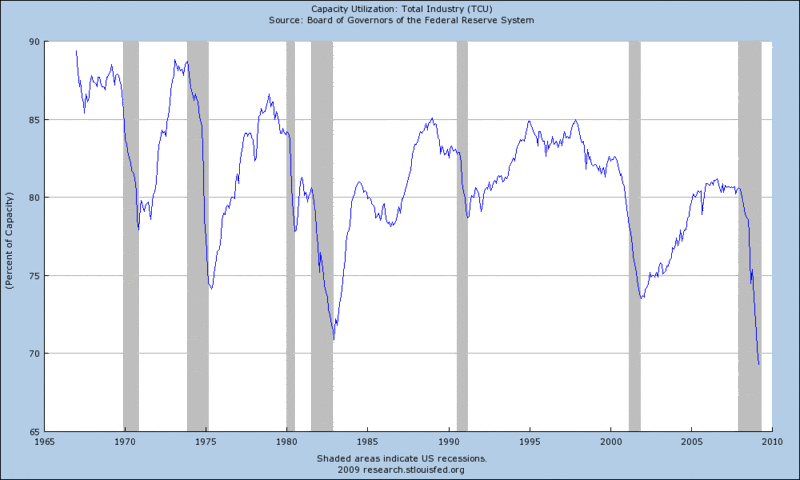
Joined at the hip to the industrial production report is capacity utilization data. Essentially, this statistic measures how much of the national production capacity is being used and how much is sitting idle.
This week’s chart of the week looks at the full history of total capacity utilization in the United States, based on data available from the Federal Reserve. Total capacity utilization for March was just 69.3%. This is the lowest number in the history of this statistical series, which dates back to 1967. While not shown in the graph below, manufacturing capacity utilization fell to 65.8%, which is the lowest number since records were first gathered in 1948.
In terms of interpreting the capacity utilization data, it is probably best to think of the number as a broad measure of demand relative to existing infrastructure. Of course the current record low numbers reflect a historic weakness in demand. Capacity utilization is also a strong predictor of inflationary and deflationary pressures. With so much slack in the system, deflationary pressures are sure to increase as prices get slashed in order to offset the high fixed costs of so much idle productive capacity.
In addition to the current bad news, there are some complicating factors which may make it difficult to reverse the recent trend. Looking ahead, a stronger dollar and weaker consumer does not bode well for future production data – and should raise new concerns about the possibility of deflation.
Industrial production may steal most of the headlines, but capacity utilization is an often overlooked important piece of the economic puzzle.
Thursday, February 21, 2008
Soybeans: Trades 5-11

Trade #8 was too tiny for the arc to be seen, and was a small loss of 4 ticks. Trade 11 is still active at this posting, but the Klinger indicator has turned down, so I have tightened my stop in anticipation of this trade being closed out. Trade 10 started off very shaky, but has become one of the most profitable of the day.
Trading Win/Loss Ratio
Thus far, 9 of my 11 trades have been profitable, and the ones that lost money cost me only 5 ticks and 4 ticks. Good day! Working these up and down movements in the markets is what swing traders are most effective at doing.
If the trade looks questionable, I consider other factors:
- What do other indicators tell me (for example, the Bollinger Squeeze, Moving Averages, and MACD)?
- What do the indicators in the higher time frames suggest?
- Is there important support or resistance at this point? In this case, prices had already found support at the same price point three times today, so I considered it to be a good risk to remain in the trade.
- How much profit have I made so far today? Am I willing to take a little more risk, or are my profits too sparse to risk losing them today?
- How good is volatility right now? If the past few trades have shown sufficient volatility to take reasonable profits from the market, then I consider volatility to be good.
Wheat trading over the past few days has been supported by poor volume, and liquidity has suffered somewhat. I will wait until volume and volatility improve again.
Monday, December 3, 2007
Indicator settings
 Another post from Tradestation forums dated Nov 19th, 2007
Here are the indicators I use in my trading. I also use a 3 minute and 15 minute chart. On the 3 minute chart, I have also added the 15 minute EMA, and on the 15 minute, I have also added the 60 minute EMA. I added them so I can see the potential support and resistance that they provide.
One of the nice features I've noticed about soybeans is how smoothly the market moves, with relatively little market noise compared with some other instruments. I also like that there is often a very active trading market during the evening hours in my time zone. This chart, for example, is for TONIGHT. Note how active the market is this evening. This is NOT atypical.
Indicators usage explanation

This was a post I placed in the Tradestation forums on Nov 19th. It explains how I use some of my indicators.
Here is the 15 minute chart for soybeans today, beginning at the dotted line from 7:30 pm EST last night. Soybean futures are my favorite instrument to trade because it has more volatility than wheat or corn, but moves slowly enough for me to be able to get in an out with good executions, combined with strong liquidity (soybeans are the USA's second largest grain crop - corn is #1). I include this chart to show how nicely the 8 period EMA works as dynamic support and resistance. Don't ask me why, but it does. (In his Encyclopedia of indicators, Rober Colby says that EMAs tested better than any other indicator he has tested; he also mentions an interesting phenomenon of EMAs is that they change direction ONLY on the candle in which prices close on the opposite side of the EMA. Note this phenomemon occurs in the price graph of my chart, changing between red and blue in the 30 tick chart of my prior post. It makes it easy to see.)
Note also that the Klinger + ATR indicator tonight is suggesting a bullish reversal is very likely, especially since soybeans are in a long-term bullish trend since Oct 9. There appears to be strong buying activity, and I will wait until at least one of my MA's (Hull, Guassian, or EMA) before I buy. This leading signal is what makes Klinger so useful, I believe.
The pale yellow horizontal dashed line is the settlement price from the prior days' trading. With grains, there are daily lock limits, and I mark those with solid yellow lines. (Soybeans rarely reaches the lock limit price of 50 cents, but wheat and corn quite frequently hit their lock limits of 30 cents and 20 cents respectivly.) I mark them every day, however, so I don't take a trade right before lock limit is reached. I also change the color daily, so I don't mistake a prior days' line that was above or below my visible range on the chart for today's lock limits.
I also use MA's to help me gauge when the reversal of trend is occuring, and the MACD to confirm that one is under way (bottom subgraph). Klinger is a wonderful leading indicator of a change in accumulation/distribution, but I use the MA's to help me time when this is happening. The Hull MA is located in the 2nd subgraph (blue for UP, magenta for DOWN), and the Gaussian is located in the 3rd subgraph (green for UP, red for DOWN).
I also use the Bollinger Squeeze indicator to help me know when a loss of momentum is under way and continued add-ons or new trades would be inadvisable.
I have tried my hand at trying to program a strategy, but after spending months at it, I finally realized my programming skills were simply not up to the task. Still, this method is working well for me. Just don't ask if I have automated it; the answer is "no".
Anyway, this is my contribution thus far, in the spirit of sharing. Any suggestions or additional ideas (or questions) are welcome. However, since I am trading every day, I don't spend much time in these forums. Regards to all my fellow traders.
One last observation - quite important and interesting, too:
Note in the second and third subgraphs that when the MAs cross below the other indicators, this moment quite consistently represents the nadir/apex of the trade. It is usually the best point to exit. I like BOTH the Hull MA and Guassian to cross over the other indicators (Klinger in the 2nd subgraph, and slow stochastic in the 3rd subgraph) at nearly the same time, which they do almost perfectly in this example. They often cross on precisely the same candle. If they don't cross nearly simultaneously, I question the signal. You can see this phenomenon in both of the charts I've posted tonight (the 30 tick chart, and the 15 min. chart). I believe this occurs with such consistency, at least partly because stochastic and Klinger (with my settings) are very sensitive and leading in nature, while MAs are lagging by nature.