This is the price of corn futures today. The price of corn and other food futures continue to rise sharply. Expect food inflation soon!


This is the price of corn futures today. The price of corn and other food futures continue to rise sharply. Expect food inflation soon!


Quiet Commodities! There are few movers today! Only cocoa and soybeans are showing good volatility!


Even the Euro was down nearly 1%, a very large move for currencies!

Pension funds and other institutions are retreating from popular
investments linked to commodities after finding they did little to
protect their portfolios against inflation risk and the unpredictable
returns of stocks.
Investors have yanked nearly $10 billion from
tradable indexes tied to energy, food, metals and other commodities
after two years of record outflows. That leaves about $133 billion, said
Kevin Norrish, a managing director at Barclays PLC.
The trend
is accelerating this year, analysts and investors said, driven by
lackluster returns and looming U.S. regulations that could make these
investments more complicated and costly.
Commodities closed today:     LAST      NET    PCT     YTD
                                        CHG    CHG     CHG
 US crude                   106.27    -1.13  -1.1%    7.5%
 Brent crude                124.93    -1.05  -0.8%   16.3%
 Natural gas                 2.246   -0.078  -3.4%  -24.9%

 US gold                   1701.10   -10.30  -0.6%    8.6%
 Gold                      1700.46    -7.57  -0.4%    8.7%
 US Copper                  384.60    -1.25  -0.3%   11.9%
 LME Copper                8466.50   -33.50  -0.4%   11.4%
 Dollar                     79.885   -0.156  -0.2%   -0.4%
 CRB                       315.480   -2.130  -0.7%    3.3%

 US corn                    667.75    13.75   2.1%    3.3%
 US soybeans               1334.00     2.25   0.2%   11.3%
 US wheat                   652.00    13.25   2.1%   -0.1%

 US Coffee                  182.35    -3.85  -2.1%  -20.1%
 US Cocoa                  2382.00   -28.00  -1.2%   12.9%
 US Sugar                    23.52    -0.14  -0.6%    1.2%

 US silver                  33.740   -0.472  -1.4%   20.8%
 US platinum               1699.40    14.50   0.9%   21.0%
 US palladium               706.85    -3.10  -0.4%    7.7%
Chinese corn imports may be at a "tipping point" ahead of higher purchases, Standard Chartered cautioned, as ideas of higher purchases sent corn futures higher again, with the near-term lot hitting a four-month high.
And so do commodities! Grains, energies all leaping higher. Crude is up nearly $4 today!

Grains are at similar levels to the commodity bubble of 2009, but there is no media coverage any more. These charts are today's chart for soybeans. Other food commodity prices are similarly leaping higher.
Intraday (today)


Great analysis from Zero Hedge by Richard Koo at Nomura:
Over the past several days, quite a few readers have been asking us why we are so confident that QE3 (in some format: it does not and likely will not be in the form of the Large Scale Asset Purchases that defined QE1 and 2 - the Fed could easily disclose that it will henceforth sell Treasury puts, a topic discussed previously, or engage any of the other proposals from Vince Reinhart disclosed in June of 2003, or worse yet, do what the BOJ does and buy ETFs, REITs and other outright equities) will eventually be implemented by the Fed. Luckily, instead of engaging in a lengthy explanation of the logical, Nomura's Richard Koo comes to our rescue with his latest research piece. While we disagree with Koo on various interpretations of his about monetary theory (namely that the Fed is not in effect "printing" money and thus creating inflation - this is semantics and leads to a paradoxical binary outcome, whereby if there Fed was successful in boosting the economy, the economy would indeed be flooded with the nearly $2 trillion in excess reserves held with reserve banks. And good luck trying to contain this surge by changing the IOER - if the Fed indeed pushed the IOER to the required 5%+ level it would immediately destroy money markets, leading to the same liquidity freeze that marked the post-Lehman days, confirming the "Catch 22" nature of Quantitative Easing that we have observed since its beginning) we do agree with his analysis of what would happen to the economy if either stocks or commodities are in a bubble (and judging by the violent opinions out there, most investors believe that either one or the other has indeed reached bubble territory), should QE2 end cold turkey: "Viewed objectively, the central banks are trying to push up asset prices using quantitative easing and the portfolio rebalancing effect. The resultant rise in asset prices based on this effect represented a potential bubble—or at least a liquidity-driven event—from the start. The question is whether the real economy can keep pace with asset prices formed in those liquidity-driven markets. If it cannot, higher asset prices will be considered a bubble and will collapse at some point. The resulting situation could be much more severe than if quantitative easing had never been implemented to begin with." Bingo. "In other words, if stock and commodity prices are in fact in a bubble and if those bubbles were to collapse, the balance sheets of the financial institutions and hedge funds making investments with the expectation of higher asset prices could suffer heavy damage, exacerbating the balance sheet recession in the broader economy. an increase in DCF values, either." And there you have it: Bernanke's all in gamble that QE2 would have been sufficient to restore the virtuous circle of the economy has failed with less than 2 months to go under the QE2 regime. As such, and with fiscal stimulus a dead end, the Fed has two choices: watch as the economy collapses in flames to a state far worse than its pre-QE1 outset, or do more of the same. That's all there is. The rest is irrelevant. And since the Fed will choose the latter option, the market would be wise to start pricing in precisely the same reaction as what happened following the Jackson Hole speech...although to the nth degree.
And some other key observations from Koo:
Government borrowing has supported money supply growthAnd the conclusion:
The question, then, is how to explain the modest growth in the money supply at a time when private-sector credit has steadily contracted. A look at Japan’s experience shows that the answer lies in increased bank lending to the government. As long as the government continues to borrow, banks can continue lending (by buying government bonds) even if the private sector is deleveraging in an attempt to clean up its balance sheet.
If the government spends the proceeds of those debt issues, the people on the receiving end of that spending will deposit money with a bank somewhere, leading to an increase in the money supply.
In effect, the money supplies of both the US and the UK are being supported by government borrowing. If the two governments chose to embark on fiscal consolidation, their money supplies would contract.
Portfolio rebalancing effect was primary objective of QE2
So what are the actual problems inherent in QE2? Mr. Bernanke has stated from the beginning that QE2 would not lead to an increase in the US money supply.
If so, why did the Fed carry out QE2? The simple answer is that it believed QE2 would result in a portfolio rebalancing effect. The portfolio rebalancing effect can be described as follows. When the Fed buys a specific asset (in this case, longer-term Treasury securities), the price of that asset rises. That prompts private investors to re-direct their funds to other assets, which leads to a corresponding increase in the price of those assets.
Private-sector sentiment may improve as asset prices rise, and if that prompts businesses and households to spend more money, the economy may improve. In effect, the Fed hopes that quantitative easing will lift the economy via the wealth effect. Inasmuch as the balance sheet recession was triggered by a drop in asset prices, monetary policy that serves to support asset prices may also help pull the economy out of the balance sheet recession.
Reasons for divergence of liquidity supply and money supply
The decline in private-sector credit in the US and the UK is attributable to both the unwillingness of banks to lend and the unwillingness of the private sector to borrow. The two factors are rooted in balance sheet problems and are indications that both countries remain in balance sheet recessions.
When a bubble collapses, the value of assets drops, leaving only the corresponding liabilities on the balance sheets of businesses and households. To fix their “underwater” balance sheets, companies and individuals do whatever they can to pay down debt and avoid borrowing new money even though interest rates have fallen to zero. Banks, for their part, are not interested in lending to overly indebted companies or individuals, and often have their own balance sheet problems. With no borrowers or lenders, the deposit-growth process described above stops functioning altogether.
US banks now appear slightly more willing to lend money, although that is not the case in the UK. In neither country, however, are there any signs of greater willingness to borrow among businesses and households.
Unable to buy more government bonds or private-sector debt, investors have few places to turn
In the hope of producing a portfolio rebalancing effect, Chairman Bernanke declared that the Fed would purchase $600bn in longer-term Treasury securities between November 2010 and June 2011. This was roughly equivalent to all expected Treasury debt issuance during this period.
From a macroeconomic standpoint, these purchases of government debt meant that—in aggregate—private-sector financial institutions would be unable to increase their purchases of US Treasury securities, because all of the growth in Treasury issuance would be absorbed by the Fed.
The fact that US businesses and households were rushing to repair balance sheets by deleveraging meant that—again, viewed in aggregate—private investors would be unable to increase their purchases of private-sector debt.
With the private sector no longer borrowing and all new issues of government debt being absorbed by the Fed, US institutions found themselves with few investment options.
So funds found their way to equities and commodities
The only remaining destinations for these funds were equities, commodities, and real estate. Real estate had just been through a bubble and remained characterized by heavy uncertainty. In commercial real estate, for example, banks—at the request of US authorities—are engaging in a policy of “pretend and extend” and offering loans to borrowers whose debt they would never roll over under ordinary circumstances. That means that current prices do not accurately reflect true market prices. Housing prices, meanwhile, resumed falling late in 2010.
UK house prices have been falling since mid-2010, and the Halifax House Price Index dropped 1.4% in April 2011 alone (the decline was 3.7% on a y-y basis).
The only remaining options for private-sector investors have been stocks and commodities. That, in my opinion, is why both markets have surged since the announcement of QE2.
QE2 was Bernanke’s big gamble
When the situation is viewed in this light, we come to the realization that Mr. Bernanke’s QE2 was in fact a major gamble. It was a gamble in the sense that the Fed tried to raise share prices with QE2. If the wealth effect resulting from those higher prices led to improvements in the economy, the higher asset prices would ultimately be supported by higher real demand, thereby demonstrating that prices were not in a bubble.
However, I cannot help but feel that the portfolio rebalancing argument was putting the cart before the horse, in the sense that it is ordinarily a stronger real economy that leads to higher asset prices, and not the other way around.
It might be possible to sustain the portfolio rebalancing effect for some time if conditions were such that investors were totally oblivious to DCF values. But with market participants paying close attention to DCF values, any delay in the economic recovery will naturally bring about a correction in market prices, thereby causing the portfolio rebalancing effect to disappear.
by Chris Powell at Journal Inquirer:
As gasoline prices passed $4 per gallon in Connecticut, Sen. Richard Blumenthal and Rep. Joseph D. Courtney joined President Obama in denouncing "speculators" and urging investigation of manipulation in the oil market. There are a few problems with this.
First is that such investigations have been undertaken before, including investigations by Blumenthal himself during his 20 years as Connecticut's attorney general, and they never found anything more than the OPEC oil producer cartel's public but uneven efforts to support the oil price. Anti-competitive as its activity is, OPEC's formation a half century ago was only a defensive response to the rigging of the currency markets by Western central banks and particularly by the U.S. Treasury Department and Federal Reserve, which were manipulating the value of the world reserve currency, the dollar, the international means of payment for oil, long before OPEC began to try to manipulate the oil price.
The second problem is that there are always speculators in all major markets. There were speculators in the oil market when gasoline last went to $4, in the summer of 2008, again when it crashed to $1.65 at the end of that year, and ever since then as it has risen back to $4. Big players in commodity markets can get away with a lot of manipulation because regulation by the U.S. Commodity Futures Trading Commission is so weak, but as the biggest players are investment banks allied with the government, which wants lower commodity prices, much of that manipulation is actually downward.
Third, and most important, the value of the U.S. dollar as measured in other currencies has fallen about 13 percent over the last year, hitting its lowest point since the dollar's last link to gold was broken in 1971. The dollar's fall reflects the U.S. government's long mismanagement of its finances and the nation's economy.
Any review of market manipulation should start with the biggest manipulator -- the U.S. government itself. With nearly complete secrecy, the Federal Reserve lately has been funneling hundreds of billions of dollars to private financial institutions, purportedly to stabilize markets. Congress and the public have little idea of what actually has been done with this money, nor any idea at all of the private understandings the Fed and Treasury Department have with investment houses like J.P. Morgan Chase that often act as government agents in the markets.
Further, federal law long has established an office in the Treasury Department whose very purpose is market manipulation: the Exchange Stabilization Fund. While it originally was intended to stabilize the dollar against foreign currencies, the fund is authorized to intervene in any market at the discretion of the treasury secretary and president. The law says the fund's decisions "are final and may not be reviewed by another officer or employee of the government."
The Fed and the Treasury Department routinely refuse to answer questions about their secret market interventions. Now that the government bond market is admittedly and almost entirely a Fed operation, even reputable market observers suspect that the government's market intervention has become comprehensive as the government's financial mismanagement has worsened -- that not just the bond market but the dollar and equity markets as well are being held up only because of secret government intervention.
So congressional investigation of market manipulation should start with the government itself -- if members of Congress aren't too scared of what they might find.
My thoughts exactly:
“I also suspect that this selloff was not an accident, that it was possibly orchestrated by the Fed acting behind the scenes. The surge in commodities was becoming an enormous problem for them. Bernanke said at his press conference that there was nothing the Fed could do about it. That was a preposterous statement and it should have rung bells. While the Fed did not overtly ‘do anything about it,’ there’s no way that this is just the invisible hand of the market at work, in my view.
“The question now is whether the Fed will be able to control or mitigate the process on the downside. I have my doubts. Markets can be manipulated up to a point. When they become unstable, the reactions can become self-feeding and uncontrollable. The powers that be may find that there are unintended consequences. This is where I would hope that technical analysis will come in handy." Lee Adler, Wall Street Examiner
We are seeing a full-scale commodities rout over the past few days, that is accelerating today.


Another brilliant piece by John Hussman Phd.:
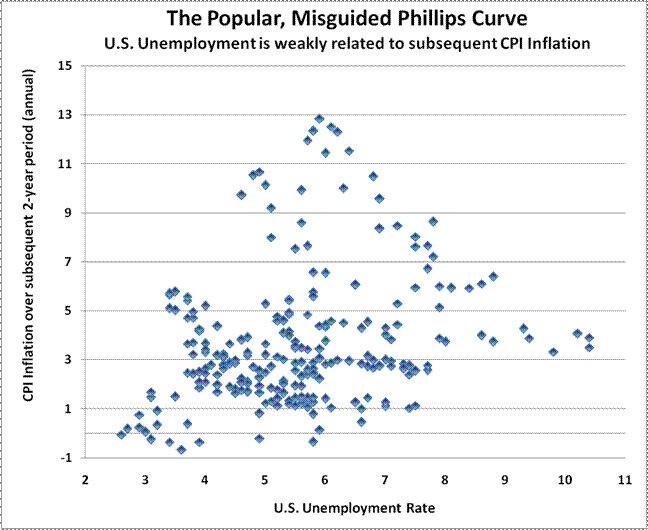
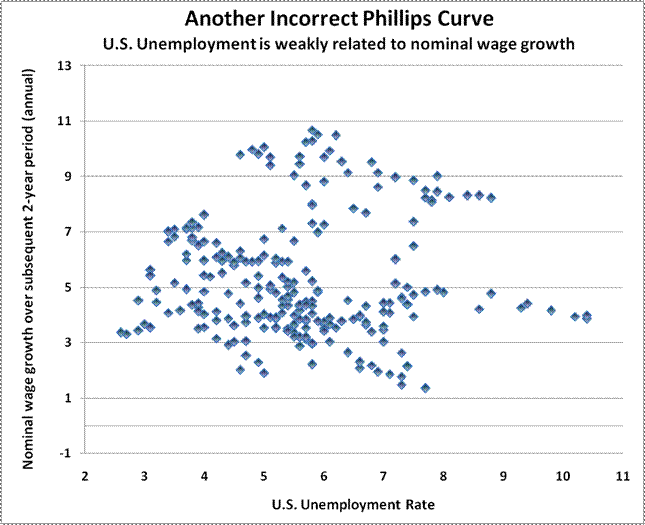
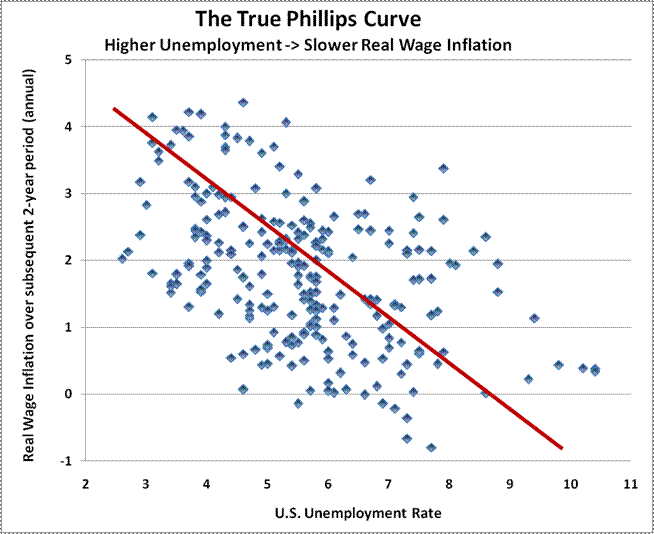
Much of the intellectual basis for the Federal Reserve's dual mandate - "to promote effectively the goals of maximum employment, stable prices, and moderate long-term interest rates" - is based on the belief in what economists call the Phillips Curve. The Phillips curve, named after economist A.W. Phillips, is widely understood as a "tradeoff" between inflation and unemployment. The idea is so engrained in the minds of economists and financial analysts that it is taken as obvious, incontrovertible fact. High unemployment, the argument goes, is associated with low inflation risk, and in that environment, policy makers can safely pursue measures targeted at increasing employment, without undesirable consequences for inflation.