

Saturday, October 20, 2012
Friday, October 19, 2012


Thursday, October 18, 2012
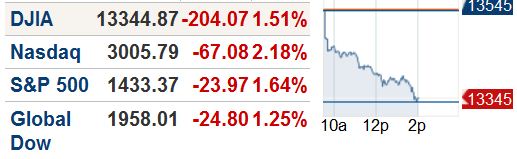
Figures That As Headlines Worsen, Stocks Rise!


The Fed's Unintended (As In "Self-Defeating") Consequences
Interesting quote from Goldman Sachs today:
"Once the price of Brent
crude /oil/ reaches $125 /per barrel/, global economic growth becomes
challenged and ultimately makes QE self-defeating. "
(Today, Brent crude is trading at $113.)
And from Zero Hedge regarding oil:
"The
unending efforts of our glorious central-banking planners to raise
asset prices and encourage 'animal spirits' through the trickle-down of
unicorn-tears via the wealth effect have side-effects. Unintended
consequences of 'leaking liquidity' finding its way into hard assets and
'things that have relatively limited supply' have stalled hopes of a
stimulus in China (/due to high/ food inflation) and caused refis to
mysteriously lag on misplaced future rate expectations in the US (ZIRP
/the Fed's Zero Interest Rate Policy/). The biggest 'problem' the
central-bankers face, however, is energy prices. The liquidity surges
directly impact the price of oil (which is already under pressure from
the ever-igniting fears of Middle-East flare-ups)."
Philly Fed Surpasses Explanation

ANOTHER EXAMPLE OF DATA MANIPULATION?
The Philly Fed manufacturing index was just released for September. It was surprisingly BETTER than expected.
But as they say, the devil is in the details! ALL of the internal data worsened from the previous month. It seems very strange that the headline figure can improve, while all the internal supporting data that created that headline WORSENED at the same time!
Here's one explanation of the bizarre data:
"And yet anyone who takes the 2 minutes to look at the internals, such as the collapse in the Number of Employees Sub-Index, which tumbled from -7.3 to -10.7 (the lowest since September 2009), the decline in the Average Employee Workweek, or the surge in Prices Paid from 8 to 19, double the change in Prices Received which means plunging corporate profits, or the ever critical New Orders which declined from 1.0 to -0.6, and one can see why this is a report only an Econ Ph.D-cum-Central Planner can love. Finally adding insult to injury, is the 6 month forecast, which unlike all other regional Fed diffusion indices, collapsed by half, from 41.2 to 21.6, as the Hopium at least in the city of brotherly mugging appears to be running out. Stocks kneejerk in every possible direction hoping the Fed will provide a direction."
Last Week's Halcyon Unemployment Claims Turn Sour Again
As of this morning, we now know that last week's huge drop in
unemployment claims to the lowest levels in 4 years was very clearly an
aberration, not a new trend. We know this because this week's
unemployment claims leaped back to the trend. And not just to trend, but
to the upper end of the trend! Of course, Wall St. is ignoring this
news. They are having another Pollyanna Party.
Today's
unemployment claims, which this week includes California (last week, the
BLS said California didn't report), showed 388,000 new claims. That is
closer to the 369,000 from two weeks ago and near the upper trend line
that we have been accustomed to over the past several months. Last
week's, just for the record, was just 339,000, the lowest level in four
years. Of course, it didn't include more than 10% of the population of
the U.S.
But as expected, the propaganda media is ignoring this
news today. It's just soooo mundane to report the real trend, instead of
the dreamily overoptimistic outlier from last week that was no doubt
intended to prop up Obama's re-election prospects.
The BLS' explanation THIS week of LAST week's aberration?
"it appeared that state-level administrative issues were distorting the data"
Well duh!
Tuesday, October 16, 2012
Euphoria! The Pollyanna Party Continues
Modestly mixed economic news yesterday has sparked a sharp stock market rally yesterday and today, bouncing off the lower Bollinger Band. Yesterday's modestly better-than-expected retail sales figures, while ignoring the Empire State manufacturing index that showed continued contraction, ignited the rally, which is picking up steam today. The Pollyanna Party is renewed!

Current Economic Perspective With a Chess Twist
I just love this guy. May I nominate Hussman for Fed Chair?
John P. Hussman, Ph.D.
“Patience is the most valuable trait of the
endgame player. In the endgame, the most common errors, besides those
resulting from ignorance of theory, are caused by either impatience,
complacency, exhaustion, or all of the above.”
– Pal Benko
– Pal Benko
I’ve long been fascinated by the parallels between
Chess and finance. Years ago, I asked Tsagaan Battsetseg, a highly
ranked world chess champion, what runs through her mind most frequently
during matches. She answered with two questions – “What is the
opportunity?” and “What is threatened?” At present, I remain convinced
that the key opportunity lies in closing down exposure to risk, because
prices in both bonds and stocks have been driven to the point where
the prospective additional compensation for risk is extraordinarily
thin on a historical basis, and much of these gains are the result of
monetary interventions in perpetual search of a greater fool.
The final minutes of a Chess game often go
something like this – each side has exhausted most of its pieces, and
many pieces that have great latitude for movement have been captured,
leaving grand moves off the table. At that point, the game is often
decided as a result of some seemingly small threat that was overlooked.
Maybe a pawn, incorrectly dismissed as insignificant, has passed to
the other side of the board, where it stands to become a Queen. Maybe
one player has brought the King forward a bit earlier than seemed
necessary, chipping away at the opponent’s strength and quietly shifting
the balance of power. Within a few moves, one of the players discovers
that one of those overlooked, easily dismissed threats creates a
situation from which it is impossible to escape or recover.
My impression is that investors have been so
entranced by the moves of their two Knights – Ben Bernanke and Mario
Draghi – that they have allowed an entire army of pawns to pass across
the board without opposition. In Chess, those overlooked, seemingly
insignificant passed pawns can draw away the opponent's resources, or
even be poetically transformed into the most powerful pieces in the
game.
What are those passed pawns? On the basis of
normalized earnings (which correct for the cyclicality of profit
margins over the business cycle, as stocks are very, very long-lived
assets) our projection for 10-year S&P 500 total returns is lower
than it has been at any point prior to the late-1990’s bubble, with the
exception of 1929. While it is very true that valuations have been
even richer at various points in recent years, it should also
be noted the S&P 500 (including dividends) has now underperformed
Treasury bills for well over 13 years as a direct result. Similarly,
the Shiller P/E remains higher than about 95% of instances prior to the
late-1990’s bubble. Numerous recent weekly comments have detailed the
variety of hostile indicator syndromes we presently observe,
particularly the variants of “overvalued, overbought, overbullish”
conditions that have regularly been followed by profound market losses
over the intermediate-term (though not necessarily the short-term).
Meanwhile, my view continues to be that a
recession in the U.S. is already an overlooked passed-pawn, as is the
sharper-than-expected economic weakness in China, as is the
overleveraged, undercapitalized state of the European banking system –
particularly in Spain – where policy makers are misguided enough to
believe that Draghi’s words alone are sufficient to substitute for bank
capital and fiscal stability. The growing U.S. debt/GDP ratio is
another passed-pawn, because while I expect the “fiscal cliff” will be
resolved by a half-hearted combination of tax cuts and modest spending
reductions, the final result is likely to leave a large structural
deficit which we are only capable of financing due to the good fortune
of unrealistically depressed interest costs and a combination of
monetization and Chinese capital inflows (all which make endless
deficits seem misleadingly sustainable).
Hugh Hendry of Eclectica recently got the tone right in his concerns about the endgame we are facing:
"Today, the world is grotesquely distorted by the
presence of fixed exchange rate regimes. There are two. There is the
Euro, and there is the dollar-remnimbi. All of Europe has defaulted.
There are many stakeholders in the European project. There are
financial creditors and then there are the citizens of Europe.
Remarkably, the political economy of Europe is that the politicians
chose to default on their spending obligations to their citizens in
order to honor the pact with their financial creditors. And so of course
what we're seeing is that as time moves on, the politicians are being
rejected. So when I look at Europe, the greatest source of inspiration I
have is fiction... We have the longest-serving Prime Minister, the
Prime Minister of Luxembourg Mr. Juncker, who is on record as having
said that 'when times get tough, you have to lie.' … the truth is
unpalatable to the political class, and that truth is that the scale
and the magnitude of the problem is larger than their ability to
respond, and it terrifies them. The reality is that you just can't make
up how bad it is. But it has precedent, and precedent perhaps offers us
some navigation tools.
"The number one rule in terms of looking after
wealth is preserving that wealth... I think we are single digit years
away from the most profound market clearing moment - a 1932 or a 1982,
where you don't need smart guys or girls, you just need to be bold. The
crisis started here, it went to Europe… we could see a hard landing in
Asia, coinciding and indeed being encouraged by the problems in
Europe, and if you get those two events colliding, and given the lack
of protection on such a scenario in Asia, then you would have another
profound dislocation. And that's the point where you reach the bottom,
and you don't need wise guys, you just need courage."
As an economist, I think it is important to
recognize the underlying factors that support the present situation, as
well as those that threaten it. The U.S. has benefited from low
monetary velocity - the willingness of U.S. savers, financial
institutions, China’s central bank, and others, to hold idle currency
balances without meaningful compensation. Indeed, the reason that
tripling the monetary base has not resulted in inflation is that
monetary velocity has declined in direct proportion to that increase. In
effect, people have passively held zero-interest money in whatever
amount it is created. Contrast this with the German hyperinflation,
when velocity rose as money became a “hot potato” – causing prices to
rise even faster than the rate at which money was printed. Contrast the
present situation also with the period from 1973 to 1982, when
monetary velocity was rising, which also resulted in prices rising
faster than the money supply. What creates inflation is the
unwillingness of people to passively hold money balances, which then
turns money into a hot potato. Higher interest rates on safe assets
would have this effect, as that would create an alternative to
zero-interest currency (which is why continued low inflation now relies
on either holding interest rates at zero indefinitely, or massively
contracting the Fed’s balance sheet should non-zero interest rates ever
be contemplated).
Somehow, I suspect that all of us recognize that
the present state of the world economy is being held up by
extraordinary distortions both in the monetary realm and in fiscal
policy, but for whatever reason, it is more pleasant to simply assume
that everything is just fine, instead of thinking about the adjustments
that would be required in order to move back to a sustainable global
economic and financial situation. To some extent, we’ve become
desensitized to extraordinarily large numbers – if hundreds of billions
don’t solve the problem, then a few trillion will – ignoring the
magnitude of those figures relative to our actual capacity to produce
economic output.
Our problems are not insurmountable, but they are
very difficult problems that do not have an easy solution or quick fix
in some bold policy action (even in unrestrained ECB monetization).
Deleveraging is hard. You simply cannot bring down the
debt/GDP ratio unless a) economic growth exceeds interest rates by
enough to offset the primary deficit*, or b) the government chooses to
default on and restructure its debt obligations.
[*Geek's note : technically, the requirement is
that (g - i) * Debt/GDP + PD/GDP > 0, where g and i are GDP growth
and the interest rate on the debt, respectively (either both real or
both nominal), and PD is the primary non-interest deficit (or surplus if
positive)].
Importantly, printing money can bring down debt/GDP only if the government first locks in a low interest rate on its publicly-held debt by issuing very long term bonds, and then pursues enough inflation to raise nominal
economic growth above that interest rate. Inflation will not devalue
debt if the interest rate on the debt can be continuously reset in
response. Presently, nearly all of the publicly-held U.S. debt is of
short maturity. At an overall deficit of nearly 10% of GDP and a
primary deficit of about 6%, there is very little chance that the ratio
of publicly-held debt/GDP, which has nearly doubled since 2008, will
easily stabilize in the coming years – particularly if we experience
another recession. Moreover, we are unlikely to get consumer demand
sustainably growing without dealing head-on with the problem of
mortgage restructuring and underwater home equity – something that has
been utterly ignored by policymakers. Done correctly, all of that is
uncomfortable enough. Done poorly, it is profoundly destructive. Europe
has already done it poorly, and it is not finished.
That said, I should emphasize that our present
defensiveness does not rely on the assumption that we’ll see some
profound economic dislocation. Rather, our defensiveness is driven by
syndromes of evidence that have repeatedly been associated
with negative return/risk outcomes in dozens of subsets of historical
data. I’ll say this again: we are not defensive because of recession
concerns or views about global financial strains. We are defensive
because the market conditions that most closely resemble those at
present have regularly, and throughout history, been associated with
negative return/risk outcomes, on average.
The endgame of the market cycle
Just as the endgame is the part of the Chess match
that counts the most, the final part of a market cycle is often where
the most critical choices are made. The fact is that a bear market
wipes out more than half of the gains achieved during the average bull
market. For cyclical bear markets that occur during extended “secular”
bear periods as we’ve observed since 2000 (featuring multiple bull-bear
cycles, each which achieves successively lower valuations at the bear
troughs), the bear markets typically wipe out closer to 80% of the
gains achieved during the preceding bull period.
“Once you are in the endgame, the moment of truth
has arrived... The amount of points that can be gained (and saved) by
correct endgame play is enormous, yet often underestimated.”
– Edmar Mednis
In early March, our estimates of prospective stock
market return/risk dropped into the most negative 2.5% of historical
data (see Warning, A New Who’s Who of Awful Times to Invest),
yet the S&P 500 is presently about 4% higher than it was then, and
our estimates have dropped further, to the most negative 0.5% of
historical observations. As I observed at the time, “While a few of the
highlighted instances were followed by immediate weakness, it is more
typical for these conditions to persist for several weeks and even
longer in some cases ... When we look at longer-term charts like the
one above, it's easy to see how fleeting the intervening gains turned
out to be in hindsight. However, it's easy to underestimate how utterly
excruciating it is to remain hedged during these periods when you
actually have to live through day-after-day of advances and
small incremental new highs that are repeatedly greeted with
enthusiastic headlines and arguments that ‘this time it's different.’”
And so, we find ourselves facing the likelihood of
another cyclical endgame, where in Benko’s words “impatience,
complacency, exhaustion, or all of the above” can encourage investors
to ignore rich valuations, weak economic fundamentals, heavy insider
selling, overbullish sentiment, overbought market action, increasingly
negative earnings preannouncements, and other syndromes that have
historically been hostile for stocks.
These risks are easy to dismiss. Yields and
prospective returns have been driven lower as investors seek an
alternative to an ocean of zero-interest money, and prices have been
driven higher – a fact that makes rising prices seem somehow automatic.
The question is this - what else is left for investors to anticipate,
with prices not depressed at all (as they were at the start of prior
rounds of QE), and with QEternity now having removed any further
“announcement effects.” Though market risk has been advantageous, it is
doubtful that the market returns we’ve observed are durable.
“It often happens that a player is so fond of his
advantageous position that he is reluctant to transpose to a winning
endgame.”
– Samuel Reshevsky
So while it is true that stocks have advanced a
few percent since March, my strong view is that this is good fortune
born entirely of investor anticipation of ECB and Fed announcements
that are now behind us. Indeed, the S&P 500 is lower now than when
QEternity was announced, and on a volume-weighted basis, is also lower
than when Draghi threw his hail-Mary pass over the Bundesbank. By our
estimate, the present ensemble of market conditions is associated with a
historical rate of loss in the S&P 500 approaching -50%
annualized. Now, I don’t expect conditions to be similarly negative for
a full year - the typical course is for the market to transition to
less negative conditions after an initial hard decline. But I continue
to believe that the gain in the S&P 500 since March, when our
return/risk estimates became overwhelmingly negative, should not be the
basis for complacency here.
“In the endgame, an error can be decisive, and we are rarely presented with a second chance.”
– Paul Keres
From a strategic standpoint, I believe that the
best approach to the complete market cycle is to accept risk roughly in
proportion to the return that can be expected as compensation. Indeed,
this is one of the key results of finance theory. Our estimates of
return/risk vary over the market cycle based on prevailing market
conditions – being very hostile in periods when the market is in a
mature, overvalued, overbought, overbullish market environment, and
generally being aggressive when the market is in an undervalued,
oversold, overbearish environment. To believe that we simply will never
see the latter environment again, or that the next point we observe it
will be at even higher prices than today, is an assumption that strains
credibility from a historical standpoint. In any event, my perspective
is that investment positions should not be based on a one-off forecast
of what will occur in this specific instance, but on the average return/risk profile that has historically accompanied each prevailing set of market conditions.
“It is not a move, even the best move, that you seek, but a realizable plan.”
– Eugene Znosko-Borovsky
As Tsagaan suggested, the two ways to progress,
and the two ways to err, are embodied in the questions “What is the
opportunity?” and “What is threatened?” For our part, this particular
cycle – this particular chess game – has been unusual in that we were
forced to ask in 2009 whether far more was threatened than what had
typically been at risk during other post-war market cycles. The
“two-data sets problem” to address that question took enough time to
solve that we missed an opportunity that we could have taken if our
methods were already robust to out-of-sample Depression-era data at the
time. That said, I believe that investors are committing a mistake in
casually dismissing the question of “What is threatened?” in a mature,
overvalued, overbought, overbullish market here. From my perspective,
it appears to be the same error they made in 2000 and 2007.
“The winner of the game is the player who makes the next-to-last mistake”
– Savielly Tartakover
From an investment perspective, the menu of
opportunities appears very limited in an elevated stock market, with
10-year Treasury yields now down to 1.6%, and even corporate bond
yields down to 2.7%. The opportunity here seems much more likely to be
in limiting risk and taking gains than in extending risk and seeking
further advances. Meanwhile, the historical chronicle of bull market
gains that have been lost during the endgame, and the extent to which
bear markets cause the surrender of those gains, should be a compelling
answer to the question of what is threatened.
... and a final quote with absolutely no context
“A computer once beat me at chess. But it was no match for me at kick-boxing.”
- Emo Philips
The foregoing comments represent the
general investment analysis and economic views of the Advisor, and are
provided solely for the purpose of information, instruction and
discourse. Only comments in the Fund Notes section relate specifically
to the Hussman Funds and the investment positions of the Funds.
Monday, October 15, 2012

Friday, October 12, 2012
Volume Reverses, Shows Strong Selling

Tuesday, October 9, 2012
EZ Slides Toward the Abyss

NEW YORK—Stocks opened lower as investors digested a bleak assessment for global growth and waited to see whether the start to earnings season would underscore economic worries.
The Dow Jones Industrial Average ticked down 22 points, or 0.2%, to 13563 in the minutes after Tuesday's opening bell. The Dow fell 26.50 points, or 0.2%, on Monday, snapping a three-session win streak.
Monday, October 8, 2012

OECD Tells U.S. To Put It's Fiscal House In Order
And just when the slowing economy was reaching stall speed, economists at the OECD give us this:

The world's finance ministers gathering in Tokyo this week will ramp up pressure on U.S. and European officials to resolve two mounting threats to the global economy: a standoff over budget policy in Washington and another dangerous turn in the euro-zone debt crisis.
At the annual meetings of the International Monetary Fund and World Bank, officials from the 188 nations that own the two institutions will plead for action as the world economy decelerates to its slowest growth since the global recession that started four years ago.
Friday, October 5, 2012
Today's Unemployment Farce
It wouldn't be election season, would it?
Today's unemployment report is so clearly a farce that it doesn't deserve any mention, but it is still today's market mover. So far, as the news and data is sliced and diced, stocks have given back about 75% of the initial gains.

from Zero Hedge
We already noted the absolutely stunning surge in reported Household Survey jobs which "added" 873,000 jobs, or the most since 2003 and the second most in the past decade, which was just a little bit off the Household Survey used in the monthly NFP jobs changes, which came at 114,000, or about 8 times less. But what was the reason for this epic jump in Household survey jobs? Simple, and those who have read our series on America's transition to a part-time worker society know the answer. The reason is that the number of part-time people employed for economic reasons soared by 582,000 to 8,613,000, the most since October 2011, and the largest one month jump since February 2009, when "restoring" confidence in the economy was all the rage... and just before the Fed announced the full blown QE1 in March of 2009. Odd symmetry.
more:
Here's a peculiar statistical aberration:
- Household Survey people employed: +873,000 (source)
- Part-time jobs for economic reasons: +582,000 (source)
Aka: precisely two thirds. Whatever are the odds...
Thursday, October 4, 2012
Stock Market Volume Explodes
The Klinger Volume indicator is exploding the last couple of days. See the circled are in the lower panel of this chart. If the Fed is funneling money to the big banks, who are funneling those funds into their own stocks (financials) and commodities, then this is highly inflationary!

Is the Fed trying to manipulate stocks higher to get Obama reelected, or are private investors feeling more confident after Romney's performance in the debates last night. The fact that they are buying "materials, energies, and financials" is evidence of the first scenario!
Of course, with the jobs report tomorrow, anything could happen, but clearly, Wall St is anticipating good news tomorrow morning.
Commodity Prices Push Stocks Higher


Did Stock Futures Rise Because Romney Won the Debate?
I couldn't help noting that stock futures rose suddenly and sharply last
night immediately during and following the Presidential debate between Mitt Romney
and Barack Obama. What struck me was the odd hour -- between 8 and 10
pm Mountain Time -- that it occurred.
Why is this such an odd
hour? Because at 10 here in Utah, the East coast of the US is already
asleep (midnight), and it is still just 5 am in London, when most
Europeans are still in bed. Both of North America and Europe are still
asleep. Asia is awake, but the market movers in Asia usually occur
earlier in the evening, around 6 pm here.
Thus, market movers at
10 pm are very rare. Perhaps the market was reacting to the perception
that Romney handily won the debate, even in the eyes of left-wing
pundits! Perhaps the market is reacting to the shift in momentum that
this is likely to create in the presidential race, and a likely surge
for Romney in polls!
Subscribe to:
Posts (Atom)



Now, reality returns to Wall St! Today, we learn that existing home SALES have declined. There is NO housing recovery!