Thursday, May 13, 2010

Description of Swing Trading

from MB Wealth blog:

Definition/theory:
Swing trading is typically defined as a trading practice whereby the underlying instrument is bought or sold at or near the end of an up or down price swing caused by daily or weekly price volatility. A swing trade position is typically open longer than a day, but shorter than trend-following trades or buy-and-hold investment strategies. Although a number of commodity trades that I’ve been involved in have been quick, others have lasted several months. The average duration of our commodity swing trades in 2009 has been 3-6 weeks.
Explanation/how to (stochastics, channels):
Swing traders attempt to forecast changes in an instrument’s price caused by oscillations as it “swings” around the dominant trend line. The price is alternately bid up by optimism and then bid down by pessimism over a period of a few days, weeks, or months. Profits can be sought by engaging in either long or short trading at each reversal. 
  Identifying whether a market is currently trending higher or lower, trading sideways and when this will change is a challenge for many swing trading and long term trend following trading strategies. A common misconception is that swing traders need perfect timing, to buy at the bottom and sell at the top of markets is impractical. Small consistent earnings that involve strict money management rules can potentially compound returns appreciably. It is crucial to understand that there are no fail-safe mathematical models that will always work so only use such parameters as research tools, also including both fundamental and technical analyses not as definitive decision engines but rather guidelines.
Risk of loss in swing trading typically increases in a trading range or sideways market as opposed to in a bull market or bear market. A market that is clearly moving in a specific direction, albeit up or down is more appropriate for swing trades. A sideways or non trending market increases the potential for whipsaws or false breakouts. In trending markets (either a bear market or a bull market), momentum may carry the traded instrument’s price for a much longer time in one direction only, making swing trading strategies that do not incorporate this trending less profitable than trend following strategies.
 
Handy tips (do/don’t and why):
Some general rules that I try to abide by while swing trading are as follows:
1.)    Go with the trend.
2.)    When getting long buy when a market is oversold & when getting short sell when a market is overbought.
3.)    A trade may have more validity if the daily, weekly and monthly charts are all saying the same thing.
4.)    Have a target if the trade moves as you presume and also an exit strategy if the trade goes awry.
5.)    Try to ignore the noise.
6.)    Don’t forget to manage the trade
In addition to the general guidelines above, I believe implementing a specific set of trading guidelines is required to be successful. For instance, we are more likely to take a trade if both the fundamentals and technicals indicate that prices are too low or too high. However, if the fundamentals do not justify a move higher yet the prices are making fresh highs day after day and the technicals indicate there may be more upside, we would still consider taking the trade.  We may simply suggest a smaller position or perhaps an option as opposed to a futures trade. There are numerous technical indicators used by traders and everyone has their favorites. The main indicators that I use for my analyses include open interest, volume, moving averages, stochastic and Fibonacci retracement levels. That is not to say we never inspect more exotic indicators such as Ichimoku clouds or the McClellan oscillators, but overanalyzing markets is often ineffective. 
The goal of adhering to strict trading rules is to remove the subjective decision-making from swing trading. We suggest exercising caution when trading correlated asset classes or even when trading correlated commodities. In addition to an awareness of correlations and prudent money management, also be cognizant about the “risk to reward” dynamic when putting on your trades. A trade that requires risking $5,000 and offers a profit potential of $2,500 should not be entered.
As with all financial instruments, risk of loss trading commodity futures and options can be considerable. This risk can best be mitigated by using a trading strategy that is back tested on the particular equity, index, or commodity and continues to prove its worth with successful trades.
Swing trading should not be the only form of trading incorporated into managing one’s investment portfolio but it could serve as a valuable tool within their investment toolbox. We are convinced that in the current environment buy and hold is dead and regardless if swing trading is for you, investors will be forced to be more nimble and to be more active managing their portfolios.

To illustrate two commodities that MB Wealth has and will continue to swing trade you will see charts on corn and silver.
 Corn: 
click on the chart to view
 Since corn has bottomed out in early September with prices reaching a 3 ½ year low, MB Wealth has had a bullish bias and wants clients to be long via futures or options. After bottoming out, the price has resumed its uptrend and on a closing basis we’ve climbed higher without violating the support line over the last 3 months for any extended period. For further affirmation, once prices bounced off support, one could wait for movement above the 20 day moving average. The stochastic indicates whether the market is overbought or oversold and should be watched closely. This helps to time entry and exit and to place stops. Not only did the technicals suggest long exposure, but with wet weather, cooler temperatures and the slowest harvest in over 2 decades, the fundamentals also suggest higher prices are achievable.  

click on the chart to view
Longer term charts sometimes help to confirm that it makes sense to go long or short a certain commodity. They can also help to give a trader more conviction and guide the sizing of the trade. As one can see, the $3.25 level has served as solid support for the last 3 years.
Silver: 

click on chart to view it
On a longer term chart, we experienced over a 61.8% Fibonacci retracement at the end of 2008.  This move lowered the price of silver to roughly to $10/ounce. For chartists, this would indicate an entry for those looking to get long.
click on chart to view
For the last 6 months the price of silver has been largely contained in a $2.00 – $3.00 trading range with a rising slope. This suggests that those with a bullish bias, including MB Wealth and their clients, should look to buy near the lower line and take profits near the upper line. Traders who do not believe that silver prices are moving higher or who want to do a counter trend trade would sell near the upper line and look to cover near the lower line. The stochastic shown at the bottom of the chart could help with entry, exit and stop placement. Finally, fundamental analysis of the historical relationship between gold and silver is also bullish for silver not to mention continued US dollar weakness and the inverse correlation.

Tuesday, May 11, 2010

Euro Closes Lower Two Consecutive Days Following Verbal Intervention

And the Dollar is higher, seen here.

China On the Brink

HONG KONG (MarketWatch) -- China's economy is teetering on the edge of a major slowdown, though it's not a shakeout in the property market that's about to spark the distress, according to a noted China strategist.
David Roche, an economic and political analyst who manages the Hong Kong-based hedge fund Independent Strategy, says the world's third-largest economy is now on the brink, faced with the inevitable reckoning that follows an extended bank-lending binge.
"We've got the beginnings of a credit-bubble collapse in China," said Roche, predicting the economy will likely cool from its stellar double-digit growth rate to a 6% annual expansion as a result.
While that may not sound bad, Roche believes the collateral damage from the cooling will be anything but mild, as the banking sector comes under pressure from cumulative years of bad investment and mispriced capital.
"The economy in China has peaked, unless the economy in the U.S. really gets going and drives exports," Roche said.
The emerging picture is one of a substantial contraction in credit growth and infrastructure expenditure, he says.
The shrinkage is grim news for an economy heavily dependent on such outlays. China managed to escape recession during the global crisis mainly because of bridges, railways and other infrastructure-project spending, estimated to have accounted for about 90% of economic growth last year, according to Roche.
About 85% of the funding for these projects was arranged by local government financing vehicles "borrowing money they can never repay" from state-owned banks, says Roche. Nearly 3 trillion yuan ($440 billion) of the 11 trillion yuan extended to these entities has been wasted or stolen, he estimated.
Economic data for April released Tuesday showed China's inflation accelerated from March, beating expectations, while bank lending also surged ahead at a surprising fast rate. See full story on April inflation and other data.
Roche said he's betting against China's banking sector in the expectation their share prices will get hammered as problem loans begin to mount, exposing such institutions' thin capital buffers.
"What do you think a bunch of ex-Communist Party officials in Chinese banks ... know about growing credit at 30% a year?" he said.
More worryingly, as bank lending dries up, there won't be the firepower to sustain new investments in infrastructure, eroding a core pillar of China's growth model, he said.
Much of the focus on potential asset bubbles in China has been on the property sector, but Roche suggested that housing-price inflation is intertwined with unsustainable gains in other areas.

Contagion Is a Myth; Only Weak Countries Catch It

May 10 (Bloomberg) -- Greece sneezes and Portugal catches a cold. Portugal coughs and Spain falls ill. Spain runs a fever and Italy comes down with the flu.
Contagion, or contagion theory, is sweeping the euro zone, where Greece’s debt crisis is infecting neighboring countries and threatening to make its way across the Atlantic to U.S. shores.
At least that’s what we’re told on a daily basis. European Central Bank council member Axel Weber warned last week of “grave contagion effects” for countries that have adopted the euro. “Greece Fuels Fears of Contagion in the U.S.,” trumpeted a May 6 Wall Street Journal headline.
I hate to pour cold water on that theory, but healthy countries aren’t susceptible to Greece’s disease. The sick ones, already plagued with high debt levels and bloated state budgets, don’t need a carrier. Capital flight from these countries “is not evidence of contagion,” said economist and author Anna Schwartz.
Of course, Schwartz said that in 1998 following the Asian financial crisis. In “International Financial Crises: Myths and Realities” (the Cato Journal, Vol. 17 No. 3), Schwartz punctured the notion that financial crises spread from the initial source to innocent victims. Nations are vulnerable because of their “home grown economic problems,” she said.
Schwartz’s insights are equally valid today. Capital isn’t fleeing sovereign debt markets in Spain and Portugal because Greece can’t pay its bills. Bond yields are rising because of an increased risk those countries may find themselves in the same boat as Greece: unable to meet their debt obligations.
Chronic Defaulter
OK, maybe not quite as leaky a boat. It would be hard to match Greece’s record of spending half the years since its independence in 1829 in default or rescheduling its debt, according to economists Carmen Reinhart and Ken Rogoff, authors of “This Time is Different.”
A single currency, it turns out, isn’t a panacea for everything that ails Europe. The 11 nations that scrapped their sovereign currencies and adopted the euro in 1999 never constituted an optimum currency area as envisioned by economist and Nobel Laureate Robert Mundell, the father of the euro.
“They don’t have a mechanism to deal with crises when they come up,” says Michael Bordo, professor of economics at Rutgers University and author of a book on the history of monetary unions. Europeans knew if they ceded domestic monetary policy to a centralized European Central Bank they would need “labor mobility and/or transfers from healthy states to weaker ones to deal with asymmetric shocks,” he says.
Fiscal Transfers
Europe has neither. Political union is still a dream. Germans are still Germans, and Greeks are still Greeks. The man on the street in Dusseldorf probably doesn’t understand why the German government has to fork over what could be his pension to a country for whom default is a way of life.
Political union isn’t a prerequisite for dealing with a sovereign debt crisis. What’s needed is some kind of a priori agreement on how fiscal transfers are to be carried out, says William White, chairman of the Economic Development and Review Committee at the Organization for Economic Cooperation and Development. In the case of the euro zone, “they were short of a few fiscal elements,” he says.
It’s far from clear the German public would have supported such transfers from strong to weak countries, White says. Especially if it’s the same profligate nations, such as Greece, that keep feeding at the trough.
Wake-Up Call
That said, European leaders have invested too much political capital in a united Europe to turn back now. Germany’s Parliament approved a package of loans to Greece on Friday, part of a 110 billion euro ($142 billion) package from the International Monetary Fund and European Union. Greece approved an austerity plan in exchange for the bailout.
“This should be a wake-up call to design mechanisms to deal with crises and enforce the rules” on debt and deficits, Bordo says.
The 1992 Maastricht Treaty outlined four convergence criteria for joining the European Monetary Union, including a maximum deficit-to-GDP ratio of 3 percent and debt-to-GDP of 60 percent. Last year Greece’s deficit and debt were 13.6 percent and 115 percent, respectively, as a share of the economy. All of the infected countries, and a few that haven’t caught the disease yet, are well in excess of those limits. The U.K., for instance, which is benefiting from capital flight out of Europe’s Club Med countries, ran a deficit last year that was 11.5 percent of GDP.
Investors may flee the U.K. at some point, but it won’t be because it caught anything from Greece.
Incubation Period
There is no question we live in an interconnected world. Subprime mortgage defaults by homeowners in Irvine, California, infected banks in Europe and Asia, thanks to the miracle of securitization.
So yes, European banks that hold Greek debt are vulnerable to losses. The interbank lending market is showing signs of stress. And the austerity measures required in Europe’s peripheral countries may spill over into reduced U.S. exports. That’s not the kind of contagion we keep hearing about.
On the other hand, it would be a mistake to interpret the flight-to-quality into U.S. Treasuries last week as a sign of immunity. The U.S. is already infected with the debt virus. It’s still in its incubation period.
(Caroline Baum, author of “Just What I Said,” is a Bloomberg News columnist. The opinions expressed are her own.)

Doubt Prevails In Europe

May 11 (Bloomberg) -- European stocks fell on concern a $1 trillion lending package, which sent the Stoxx Europe 600 Index to the biggest gain in 17 months yesterday, won’t solve the region’s debt crisis. Asian shares and U.S. index futures slid.
Banco Santander SA, Spain’s biggest lender, sank 4.4 percent as banks led declines in Europe. BHP Billiton Ltd., the world’s largest mining company, retreated 2.2 percent as accelerating Chinese inflation increased pressure for the government to tighten monetary policy. Solarworld AG slid to the lowest level in almost five years after earnings dropped.
The Stoxx 600 slid 1.6 percent to 250.19 at 11:00 a.m. in London. The benchmark gauge for European shares jumped 7.2 percent yesterday after the European Union and International Monetary Fund unveiled a 750 billion-euro ($954 billion) financial assistance package and the European Central Bank said it will purchase government and private debt. The index is still down 8.1 percent from this year’s high on April 15.
“You cannot resolve the debt crisis by issuing more debt or putting up guarantees,” Christian Blaabjerg, the Hellerup, Denmark-based chief equity strategist at Saxo Bank A/S, said in an interview with Bloomberg Television. “Markets will come back and test the will of the ECB/EU on how to deal with this enormous debt.”
Asian, U.S. Stocks
The MSCI Asia Pacific Index sank 1 percent as China’s inflation accelerated, bank lending exceeded estimates and property prices jumped by a record, increasing pressure on the government to raise interest rates and let the currency appreciate. Futures on the Standard & Poor’s 500 Index dropped 1 percent.
The Stoxx 600 retreated 8.8 percent last week, the biggest slump since November 2008, amid concern that a previously announced 110 billion-euro assistance program for Greece would be insufficient to keep Europe’s most indebted nations from defaulting. Greece may have its credit rating lowered to junk within the next month, Moody’s said late yesterday, citing the country’s “dismal” economic prospects.
Marek Belka, the director of the International Monetary Fund’s European department, yesterday said he doesn’t consider the latest European rescue package a “long-term solution.” ECB council member Axel Weber said the bank’s purchase of government bonds poses “significant” risks, Germany’s Boersen-Zeitung reported.


May 11 (Bloomberg) -- Money markets and the cost of protecting bank bonds from losses show investors are concerned the almost $1 trillion rescue plan announced by European leaders may not be enough to contain the region’s sovereign debt crisis.
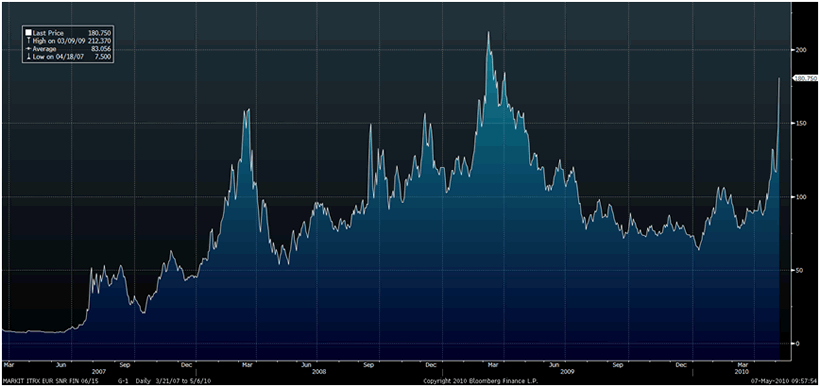
The Markit iTraxx Financial Index of credit-default swaps on European banks was last at 146 basis points compared with 107 basis points for the Markit iTraxx Europe Index of 125 investment-grade companies, a benchmark it traded an average 10 basis points below for three years, according to CMA DataVision. The three-month Libor-OIS spread, which widens as banks’ willingness to lend decreases, advanced to 19.09 basis points from 18.92 yesterday and 6 basis points on March 15.
The loan package for debt-laden nations including Greece is part of an attempt to stem a decline in the euro, which fell to a 14-month low last week, and stave off a sovereign default that would threaten recovery from the worst global recession since the 1930s. Banks’ potential losses stemming from the crisis are under scrutiny by investors concerned financial institutions are owed too much by Europe’s most-indebted countries.
“Sovereign risk hasn’t gone away in the slightest,” said Jim Reid, head of fundamental strategy in London for Deutsche Bank AG, Germany’s biggest bank. “What this package has done is massively reduced the tail risk in European markets without necessarily changing the medium- to long-term dynamics of financial markets.”
Investor ‘Euphoria’
Elsewhere in credit markets, the extra yield investors demand to own corporate debt instead of government securities fell 8 basis points to 169 basis points, or 1.69 percentage point, after soaring 28 basis points last week, according to Bank of America Merrill Lynch’s Global Broad Market Corporate Index. It peaked at 511 basis points on March 30, 2009, and dropped to as low as 142 on April 21. Average yields fell 0.5 basis point to 4 percent.
The cost of protecting Asia-Pacific bonds from default rose today as investor “euphoria” at the European measures abated, according to Fumihito Gotoh, head of Japan credit research for UBS AG in Tokyo.

China Slumps Into Bear Market

May 11 (Bloomberg) -- China’s stocks dropped, sending the benchmark index into a bear market, on concern the government will raise borrowing costs to combat inflation and unveil more measures to curb soaring housing prices.
Bank of China Ltd. and China Merchants Bank Co. dropped at least 1.7 percent after a government report showed consumer prices exceeded estimates. Poly Real Estate Group Co., China’s second-largest developer by market value, plunged 2.7 percent as property prices increased at a record pace in April.
“If inflation isn’t contained, the central bank will have to raise interest rates,” said Zhao Zifeng, who helps oversee about $10.2 billion at China International Fund Management Co. in Shanghai. “We’ll still need to gauge housing prices in the coming months as the previous crackdown measures were put in place not long ago. More tightening policies could follow.”
The Shanghai Composite Index, which tracks the bigger of China’s stock exchanges, fell 51.18, or 1.9 percent, to close at 2,647.57, the lowest in almost a year. The measure slid 21 percent from the close of 3,338.66 on Nov. 23, a sign analysts say is a bear market. The CSI 300 Index lost 2 percent today.
The Shanghai index has slid 19 percent this year, the world’s worst performer after Greece among the 93 gauges tracked by Bloomberg, on concern government will increase efforts to curb speculation in the property market, hurting economic growth.

Euphoria Short-Lived, European Bourses Fall As Optimism Wanes

I couldn't help but notice that the Dollar gained yesterday, closing higher, as the Euro slumped. The confidence-building capacity of the European Central Bank apparently lack credibility. Even a Fed intervention didn't help much. How ironic that it supposedly takes more Dollars to prop up the Euro!Even $1 trillion bailouts are falling short to prop up the house of cards.

May 11 (Bloomberg) -- The euro lost all of yesterday’s gains on concern the $1 trillion bailout will hurt European economic growth. Stocks fell, paring the MSCI World Index’s biggest advance in a year. Chinese shares entered a bear market.
The euro weakened 0.8 percent against the dollar at 10:41 a.m. in London, trading below the level it was at before the European Union-led aid package was announced early yesterday. The Stoxx Europe 600 Index fell 1.2 percent, after rising 7.2 percent yesterday. Futures on the Standard & Poor’s 500 Index dropped 1 percent. Copper traded below $7,000 a metric ton.
The European Union’s unprecedented bailout package is unlikely to be a “long-term solution” for the region, Marek Belka, the director of the International Monetary Fund’s European department, said in Brussels yesterday. Inflation in China accelerated to an 18-month high, the nation’s statistics bureau said today, increasing pressure on the government to raise interest rates in an economy that has been an engine of growth through the global financial crisis.
“The euphoria of 24 hours ago has passed,” Derek Halpenny, European head of global currency research at Bank of Tokyo Mitsubishi UFJ Ltd. in London, wrote in a report today. “We are in little doubt that steps taken will offer the euro little support and the aid package does not change the fact that Spain and Portugal in particular will still have to undergo further painful austerity measures.”
Yen, Treasuries Gain
The euro fell against 14 of its 16 most-traded peers, dropping as low as $1.2670, compared with the $1.2755 level at which it closed last week. The yen strengthened against all 16 of its major counterparts as investors sought the relative safety of the Japanese currency. The dollar advanced versus 13.
U.S. Treasuries rose, snapping a two-day decline, with the 10-year yield sliding 4 basis points to 3.5 percent and the two- year yield dropping 2 basis points to 0.86 percent. German 10- year bund yields fell 3 basis points to 2.92 percent, while two- year yields were also 3 basis points lower, at 0.58 percent.
Traders are betting the plan to rescue debt-laden governments from Greece to Portugal will fail to reverse the euro’s worst start to a year since 2000, forcing the European Central Bank will keep interest rates at a record low for longer. Economic growth in the nations that share the euro will lag behind the U.S. by almost 1.5 percentage points next year, Bloomberg surveys of economists show.

Monday, May 10, 2010

Stocks Rally, But Can't Follow Through

Dow futures opened nearly 400 points higher last night, but have lost ground since. It's a roller coaster today, as some investors aren't convinced. This is a manipulated market!

Market Not Buying Euro Defense Story

The Dollar Index is now higher for the day.

EU Kicks the Can With Nearly $1 Trillion Package

European policy makers unveiled an unprecedented loan package worth almost $1 trillion and a program of bond purchases as they spearheaded a global drive to stop a sovereign-debt crisis that threatened to shatter confidence in the euro.
Jolted by last week’s slide in the currency and soaring bond yields in Portugal and Spain, European Union finance chiefs met in a 14-hour session in Brussels overnight. The 16 euro nations agreed in a statement to offer as much as 750 billion euros ($962 billion), including International Monetary Fund backing, to countries facing instability and the European Central Bank said it will buy government and private debt.
The rescue package for Europe’s sovereign debtors comes little more than a year after the waning of the last crisis, caused by the U.S. mortgage-market collapse, which wreaked $1.8 trillion of global credit losses and writedowns. Under U.S. and Asian pressure to stabilize markets, Europe’s governments bet their show of force would prevent a sovereign-debt collapse and muffle speculation the 11-year-old euro might break apart.
“Europe wants to give the impression that they are not dealing with the crisis on a piecemeal basis and are addressing it in a comprehensive fashion,” Venkatraman Anantha-Nageswaran, who helps manage about $140 billion in assets as global chief investment officer at Bank Julius Baer & Co. in Singapore, said.
“It might temporarily calm nerves but questions will come back later on how they will pay for this package when all of them need fiscal consolidation,” Anantha-Nageswaran also said.
The euro headed for its biggest two-day rally since March last year, climbing 1.4 percent to $1.2930 as of 2:46 p.m. in Tokyo after advancing on May 7 on forecasts an agreement would be reached over the weekend.
Asian stocks also rallied, with Japan’s Nikkei 225 Stock Average rising 1.5 percent and the MSCI Asia Pacific Index up 1.3 percent. Futures contracts on the U.S. Dow Jones Industrial Average gained 243 points to 10,578.
“The message has gotten through: the euro zone will defend its money,” French Finance Minister Christine Lagarde told reporters in Brussels early today after markets punished inaction last week.
ECB policy makers said they will counter “severe tensions” in “certain” markets by purchasing government and private debt, and the bank restarted a dollar-swap line with the Federal Reserve.
“This truly is overwhelming force, and should be more than sufficient to stabilize markets in the near term, prevent panic and contain the risk of contagion,” Marco Annunziata, chief economist at UniCredit Group in London, said in an e-mailed note. “This is Shock and Awe, Part II and in 3-D.”
Treasuries tumbled on investors’ increased appetite for risk, with yields on benchmark 10-year U.S. notes rising to 3.57 percent from 3.43 percent at last week’s close. German bunds opened lower, sending 10-year yields up about 12 basis points.
The steps came after failure to contain Greece’s fiscal crisis triggered a 4.1 percent drop in the euro last week, the biggest weekly decline since the aftermath of Lehman Brothers Holdings Inc.’s collapse. European stocks sank the most in 18 months, with the Stoxx Europe 600 Index tumbling 8.8 percent to 237.18.
The ripple effect in the U.S., including a brief 1,000- point drop in the Dow Jones Industrial Average on May 6, prompted President Barack Obama to call German Chancellor Angela Merkel and French President Nicolas Sarkozy to urge “resolute steps” to prevent the crisis from cascading around the world.
Under the loan package, euro-area governments pledged 440 billion euros in loans or guarantees, with 60 billion euros more in loans from the EU’s budget and as much as 250 billion euros from the International Monetary Fund.
“They will have bought themselves a significant amount of time to do the right thing,” said Barry Eichengreen, an economics professor at the University of California, Berkeley.
Markets worldwide are reeling from Europe’s debt saga. Gold rose to a near-record of $1,214.90 an ounce in New York last week, and the MSCI World Index of equities dropped to a three- month low. Investors fleeing European markets parked money in U.S. Treasuries, pushing the 10-year note yield down 23 basis points to 3.43 percent.
In a step that skirts EU rules barring direct central bank lending to governments, the ECB said it will conduct “interventions” to ensure “depth and liquidity” in markets. The purchases will be sterilized, meaning they won’t increase the overall money supply in the financial system.
“This sets a precedent for the rest of the life of the Central Bank and will have likely surprised even the most seasoned observers,” said Jacques Cailloux, chief European economist at Royal Bank of Scotland Group Plc in London. “While the ECB’s intervention might attract bad press regarding its mandate and independence, we believe that this was necessary to short circuit the negative feedback loop which was getting more and more threatening for the global economy. ”

Sunday, May 9, 2010

What Really Happened When Stocks Plunged

NEW YORK (CNN) -- New York Stock Exchange efforts to stabilize Thursday's stock market had the opposite effect, triggering a momentary market collapse.
It wasn't a goof. It wasn't human error. Rather, it was an instant that displayed the hazard of new markets that handle billions of dollars' worth of trades each day.
During yesterday's fast-moving midday market, NYSE specialists -- who oversee trading in individual stocks -- used their authority to call a momentary time out. The idea was to bring together buyers and sellers, and get their prices more in line with each other.
It happened in five Dow stocks, including 3M (MMM, Fortune 500) and Procter & Gamble (PG, Fortune 500), according to the NYSE, and in a good number of the listed stocks. The NYSE did not have a tally of exactly how many.
Years ago, when the NYSE dominated trading, such "time-outs" worked well at stabilizing stock prices.
But today, the NYSE accounts for only about 25% of the volume in its listed stocks. Much of the rest comes from computerized markets run by private companies -- and some of those systems did not take a time out yesterday.
"The rest of the markets are free to trade around us," said NYSE CEO Duncan Neiderauer, "and that's what they did."
So, as the NYSE paused for a minute or two at about 2:40 p.m. ET, the off-exchange computers kept searching to execute trades. They hit the best bids still standing, which in many cases were far below the prior price.
And in some cases, the off-exchange computers found no bids at all. When that happens, market-making computers see a zero bid, then offer a penny higher to capture the trade and collect a commission -- hence the trades of just one cent for several stocks, including Accenture (ACN), Boston Beer (SAM), Exelon (EXC, Fortune 500).
"Computers are looking for the best bids. The real best bids shut themselves down," one trader told CNNMoney.com.
"You had penny prints. The bid was zero. The algorithms were designed to penny the bids," said another trader.
The NYSE argues Thursday's sudden plunge shows its model is best suited to maximize market stability.
"Yesterday's experience clearly demonstrates the value of retaining an element of human judgment in the market," said NYSE spokesperson Ray Pellecchia.
But the role of human judgment has been rapidly diminishing in the securities marketplace, placing individual investors at risk of such an instant market meltdown happening again. To top of page

U.S. Debt Debacle By 2013?

from Investor's Business Daily:
Spiraling debt is Uncle Sam's shock collar, and its jolt may await like an invisible pet fence.
"Nobody knows when you bump up against the limit, but you know when it happens it will really hurt," said fiscal watchdog Maya MacGuineas of the Committee for a Responsible Federal Budget.
The great uncertainty about how much debt is too much has tended to make fiscal discipline seem less urgent, rather than more. There is no obvious threshold beyond which investors will demand higher real yields for holding U.S. debt. Vague warnings from ratings agencies about the loss of America's 'AAA' status haven't added much clarity — until recently.
In the wake of the financial crisis and recession, Moody's Investors Service has brought new transparency to its sovereign ratings analysis — so much so that 2018 lights up as the year the U.S. could be in line for a downgrade if Congressional Budget Office projections hold.
The key data point in Moody's view is the size of federal interest payments on the public debt as a percentage of tax revenue. For the U.S., debt service of 18%-20% of federal revenue is the outer limit of AAA-territory, Moody's managing director Pierre Cailleteau confirmed in an e-mail.
Under the Obama budget, interest would top 18% of revenue in 2018 and 20% in 2020, CBO projects.
But under more adverse scenarios than the CBO considered, including higher interest rates, Moody's projects that debt service could hit 22.4% of revenue by 2013.
"While we see limited risk of a U.S. sovereign debt downgrade in the next 2-3 years, beyond that we cannot be so certain," wrote Societe Generale's economics team in a recent report.
The Moody's ratings framework is one that could have a significant influence on policy — particularly in a crisis.
Because debt levels and interest rates can't be lowered overnight, the obvious way of staying within the AAA limits set by Moody's would be to raise revenue.
"It would bias the remedy in favor of tax increases for countries that want to improve their bond rating," said Brian Riedl, budget analyst at the conservative Heritage Foundation.
Because economic growth is a key to fiscal health, Riedl argues that a ratings agency concerned about whether bondholders are repaid should bias spending cuts over tax increases.
Moody's says that its framework focuses on debt affordability rather than debt levels as a percentage of GDP. "The higher this ratio (interest/revenue), the more public debt constrains the formulation and delivery of other policies," Moody's analysts wrote in March.

Saturday, May 8, 2010

Default Swaps Soar to Lehman Levels

May 7 (Bloomberg) -- The cost of insuring against losses on European bank bonds soared to a record, surpassing levels triggered by the collapse of Lehman Brothers Holdings Inc., as the sovereign debt crisis deepened.
The Markit iTraxx Financial Index of credit-default swaps on 25 banks and insurers soared as much as 40 basis points to 223, according to JPMorgan Chase & Co. The index closed at 212 basis points March 9, 2009. Swaps on Greece, Portugal, Spain and Italy rose to or near all-time high levels.
Credit risk rose for a sixth day on concern the Greek debt crisis is spiraling out of control and triggering concern banks may face losses on their sovereign bond holdings. The Group of Seven plans to hold a conference call today to discuss the turmoil, after a global stock rout that briefly erased more than $1 trillion in U.S. market value.
“Financials are caught in a really bad place right now,” said Aziz Sunderji, a London-based credit strategist at Barclays Capital. “Investors are selling bonds, not just hedging with CDS. It shows investors are repositioning portfolios and there’s a more long-term repricing of peripheral risk.”
Pacific Investment Management Co.’s Mohamed El-Erian and Loomis Sayles & Co.’s Dan Fuss said Europe’s crisis may spread across the globe because of investor concern that governments have borrowed too much to revive their economies.
Portugal, Spain
Markit’s financial gauge was trading at 198 basis points at 2:30 p.m. in London, according to JPMorgan. Contracts on Spanish and Portuguese banks rose to records, according to CMA DataVision prices. Portugal’s Banco Comercial Portugues SA increased 53 basis points to 579 and Spain’s Banco Santander SA rose 12 basis points to 253.
In the U.K., swaps on Royal Bank of Scotland Group Plc jumped 41 to 229 after Britain’s biggest government-owned bank posted the only first-quarter loss among British rivals.
The spread between the three-month dollar London interbank offered rate and the overnight indexed swap rate, a barometer of the reluctance of banks to lend that’s known as the Libor-OIS spread, is at 18 basis points, up from 6 basis points on March 15 and near the highest level in more than five months. It’s still far from the record 364 basis points in October 2008, almost a month after Lehman’s bankruptcy.
Swaps on Greece surged 75 basis points to 1,008 before the advance was pared to 950. Portugal climbed 42 to 502 before falling to 430 and Italy rose 24 to 255.5 before dropping to 227 and Spain increased 14 to 288 before trading at 246, CMA prices show.
British Swaps
Contracts on the U.K. rose 8 basis points to 99, according to CMA. Britain’s election produced a parliament without a majority for the first time since 1974, stoking concern the new government will be too weak to rein in its record budget deficit.
European policy makers are under mounting pressure from investors and foreign officials to broaden their response to the Greek fiscal crisis after a 110 billion euro ($140 billion) bailout package failed to ease concerns.
“We do not see a clear sign that markets will calm down in the absence of decisive action by authorities, which so far have ignored the opportunity to convince investors that they are capable of battling the European sovereign debt crisis,” Markus Ernst, a credit strategist at UniCredit SpA in Munich, wrote in a note to investors.
Merkel Meeting
German lawmakers approved their nation’s share of loans to Greece worth as much as 22.4 billion euros before Chancellor Angela Merkel and other euro region governments meet in Brussels to review the bailout and look for ways to stop the burgeoning crisis. The leaders arrive in Brussels about 6:15 p.m. local time and the final press conference is slated for 10 p.m.
The cost of insuring against losses on corporate bonds also rose. Contracts on the Markit iTraxx Crossover Index linked to 50 companies with mostly high-yield credit ratings increased as much as 74 basis points to 625, JPMorgan prices show, the highest since September. The index pared its advance to 611.
The Markit iTraxx Europe Index of 125 companies with investment-grade ratings climbed as much as 29.5 basis points to 152.5, JPMorgan prices show, the highest since April 2009. It was trading at 139.
A basis point on a credit-default swap contract protecting 10 million euros of debt from default for five years is equivalent to 1,000 euros a year.
Credit-default swaps pay the buyer face value in exchange for the underlying securities or the cash equivalent should a company fail to adhere to its debt agreements. An increase signals deterioration in perceptions of credit quality.
The extra yield investors demand to own investment grade corporate bonds rather than government debt jumped 21 basis points from last week to 174, the largest weekly rise in a year, according to Bank of America Merrill Lynch index data. The gauge has also increased 10 basis points from yesterday, the biggest one-day increase since October 2008.

Stock Plunge Remains a Mystery!

What amazes me is that everyone seems to know the cause despite that there's no evidence of such. It strikes me as too convenient that they had a cause identified within minutes of the event, but days later, there still isn't the slightest hint of why, how, or evidence that such a glitch or error occurred. I don't buy any of it! It is more likely that it was some sort of intentional selling, or perhaps the collective selling of millions of worried people! Spin, spin, spin!

 from FT.com:
The day after $1,000bn was briefly wiped off the market value of US equities, traders were still trying to work out what caused share prices to plunge and then rebound so dramatically in a matter of minutes.
The conventional wisdom held that an incorrectly typed sell order – one that confused “billions” for “millions”, for example – was the likely culprit.
“The trigger for the sell-off was most likely some kind of errant order, a fat-finger typo, which set off a chain reaction of selling,” said Sang Lee, managing principal at Aite Group. “I would be shocked if that was not the case as the fall in stocks was so sudden and extreme.”
However, despite the persistence of this story, officials were struggling to idenfity a specific cause. “We still don’t know what was the initiating signal for the trading activity we saw on Thursday,” said Jeff Wecker, chief executive officer at Lime Brokerage. “The verdict is still out.”
What was clear was the ferocity of the fall. Just before 2.40pm on Thursday, the S&P 500 index, the US equity market’s benchmark, fell from 1,120. Inside six minutes, it bottomed at 1,065.79, a slide of nearly 5 per cent. By 3.00pm, the index was moving above 1,120, although still down 4 per cent on the day before, settling 3.2 per cent lower by the close.
Traders said the day had got off to a gloomy start, with fears that Greece could become the first eurozone country to default on its debt weighing down stock prices. Television images of fighting in Athens reinforced anxieties and encouraged investors to cut risk exposure.
“We already had a significant fear premium in the market and clearly there was some kind of incident which we need to understand,” said William O’Brien, chief executive officer at Direct Edge, one of the four main trading venues for equities.
When the plunge came, traders said it was exacerbated by the rapid-fire computer systems that post prices and execute trades in microseconds. Such trading accounts for the bulk of volume in US equity markets and it served to reinforce a downward move that saw some stocks trade for a penny or less.
Because computers also serve to link markets, the panic spread to currencies and bonds. The yen soared in value against the dollar and the euro. The demand for government debt, a traditional haven during a crisis, soared, pushing the yield on 10-year US Treasury bonds sharply lower.
The situation was made worse, many traders said, by NYSE Euronext’s decision to slow down trading on its trading floor, which sent orders to other venues and intensified the selling.
“This is not a day for the industry to be proud of and when only one exchange slows down or stops trading it does not improve the situation, it exacerbates it,” said Mr OBrien.
One government official said the activity reinforced worries that “the market has outpaced the ability of the infrastructure to handle it. We have detached finance from the real economy and created a monster.”
The selling overwhelmed the market for some stocks, as legitimate bids disappeared, leaving what is called a “stub bid”, or a buy order posted at a penny. In a machine-dominated market such token prices for stocks were duly executed.
Subsequently, the four main trading venues for US stocks – NYSE Euronext, Nasdaq, BATS Trading and Direct Edge – announced the cancellation of trades, executed between 2.40pm and 3.00pm, in which prices deviated sharply.
The Securities and Exchange Commission and the Commodities Futures Trading Commission said they would “review the unusual trading”. Hearings have been scheduled for Tuesday before the House financial services subcommittee on capital markets.
Hedge funds held conference calls to explain the situation to their investors. Algebris Investments in London, which is down 4.5 per cent this month, told clients it was scaling back its positions and adding to hedges by buying credit insurance on companies and taking short positions on European stock indices.

Not Pretty! World Economic Headlines

WASHINGTON (AP) - The U.S. economic recovery is on shakier ground.
The growing European debt crisis has sent stock markets on a wild ride. A weaker European economy could sap demand for U.S. exports and hurt sales by U.S. companies in Europe. U.S. banks that hold European government debt also could cut back on lending to conserve cash.
"The perception of risk has just changed in a major way," said Mark Vitner, senior economist at Wells Fargo Securities. "Business leaders now think there is more risk in the world economy than they did 30 days ago."
Wall Street endured a dizzying plunge Thursday, sending the Dow Jones industrials to a loss of nearly 1,000 points in less than half an hour. A computerized selloff possibly caused by a trader's mistake may have been responsible for the late-session plunge, and the Dow recovered two-thirds of the loss before the closing bell.
But the jitters over Europe remained and the selling spread to Asia on Friday. Markets in Japan, South Korea and China all posted steep losses, with Tokyo's benchmark Nikkei 225 stock average closing down 3.1 percent.
Vitner and other economists worry that Europe's debt crisis could tip the 16 countries that use the euro currency back into a recession. The euro area comprises the second-largest economy in the world, after the United States. And as in the United States, its economy has been slowly recovering from recession.
The likelihood that the U.S. would fall back into recession remains low, economists say. Still, a falling U.S. stock market could unnerve consumers and investors and cause cutbacks in spending. Consumer spending accounts for about 70 percent of U.S. economic activity.
"The stock market has been very important to our recovery because the market's gains over the past year had prompted high-income households to increase their spending," said Mark Zandi, chief economist at Moody's Analytics. "If stocks go south, then those consumers will not spend as much."
And a slowdown in consumer spending could make U.S. corporate executives less willing to hire and expand, Vitner said.
Economists say the situation is reminiscent of the collapse of Lehman Brothers in the fall of 2008. The resulting chaos caused banks to clamp down on lending. Nervous consumers stopped spending. Companies facing plummeting sales cut back on production and laid off millions of workers.
Some economists raise the prospect of a similar cycle in Europe.
"Europe feels like we did after Lehman Brothers," said Barry Eichengreen, an economics professor at the University of California, Berkeley. "No one has seen this kind of thing before ... and they are questioning the competence of their leaders to deal with it, and rightly so."
European consumers may soon cut back on purchases of new cars or appliances, Eichengreen said, "because they don't know what's next."
President Barack Obama's goal of doubling U.S. exports over the next five years is unlikely to be reached under these conditions, economists say.
Obama's plan "is completely off the table if the dollar remains strong and one of the leading economic areas enters a deep recession," said Eswar Prasad, an economics professor at Cornell University.
A $140 billion rescue package agreed to by the International Monetary Fund and European leaders has failed to resolve concerns in the financial markets that Greece might default on its debts.
The concerns are likely amplified, economists said, because memories of the 2008 crisis are still fresh. Before the recession, many experts, including Federal Reserve Chairman Ben Bernanke, said the fallout from the subprime housing bust wouldn't spill over to the broader economy.
"Remember, people thought the subprime mortgage crisis would go away, and it didn't," said Sung Won Sohn, an economics professor at the Smith School of Business at California State University.

Friday, May 7, 2010

Gold De-Couples From Dollar As Fear of Contagion Spreads

from Market Oracle:
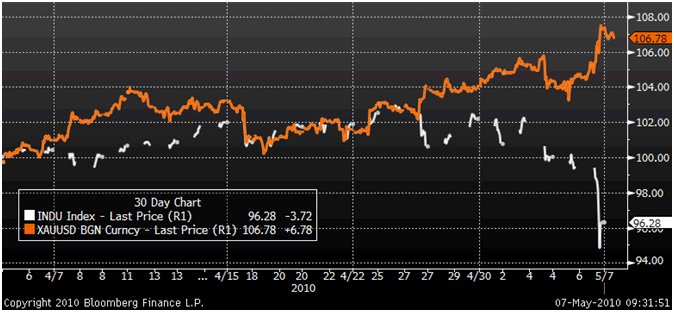
The sharp sell off on Wall Street and with equities internationally saw gold decouple and surge in all currencies yesterday. Oil, commodities and bonds also fell sharply in incredibly volatile trading.

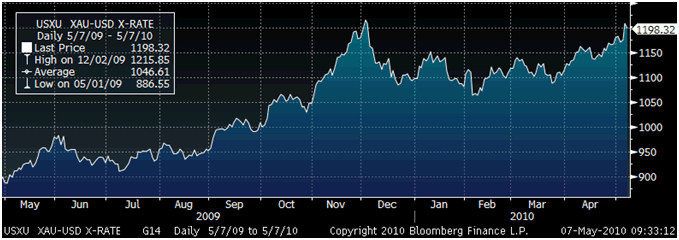
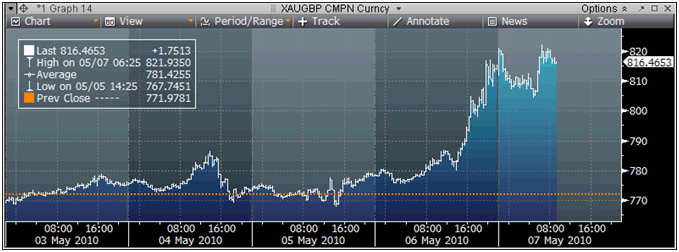
Gold was up by more than 2% in dollar terms and by more than 3.5% in euros and pounds as the euro and pound fell sharply on contagion fears, hung parliament and economic concerns respectively. Gold reached new record nominal highs in sterling, euros and Swiss francs and 27 year highs in Japanese yen, also reaching a five-month high in dollars. Given the scale of the international debt crisis, the December record (nominal) high of $1,226 per ounce (interday) could be reached in the coming days and respected analysts are now forecasting gold to rise to $3,000 per ounce (see News).

Gold Decouples - Gold and the Dow Jones - 30 Days
The massive intraday drop of nearly 1000 points in the Dow Jones also saw significant volatility in currency markets which may presage a euro currency crisis. There is the risk that the sovereign debt crisis could lead to an international monetary crisis as investors lose faith in fiat currencies most of which are saddled with very significant debt levels. Gold's debt free status and lack of counter party risk is making it an increasingly attractive diversification option - and this looks set to continue for the foreseeable future.

Gold in US Dollars Looks Set to Challenge the Record Nominal Daily High of $1,215 per ounce
The UK hung parliament or minority government will not help sentiment towards sterling. The incoming government will be faced with some of the most challenging economic challenges to be faced in modern history. The UK's public finances are in very poor shape and the UK's AAA credit rating is at risk. While the UK is no Greece, its fiscal challenges are extremely challenging and will involve considerable economic pain - possibly even austerity measures. Sterling may remain under pressure until the markets perceive that the incoming government means business about tacking the deficits.

Gold in GBP Surges 4% Yesterday on Political and Economic Concerns
With all the focus on the Greek and European sovereign debt crisis, many have yet to notice the growing risks of another Lehman Brothers style interbank cash market seize up. Sovereign debt contagion fears are feeding into interbank contagion fears as concerns about the solvency of some banks saw Libor rates rising sharply. Moody's warned of risk of contagion in the banking sector yesterday.
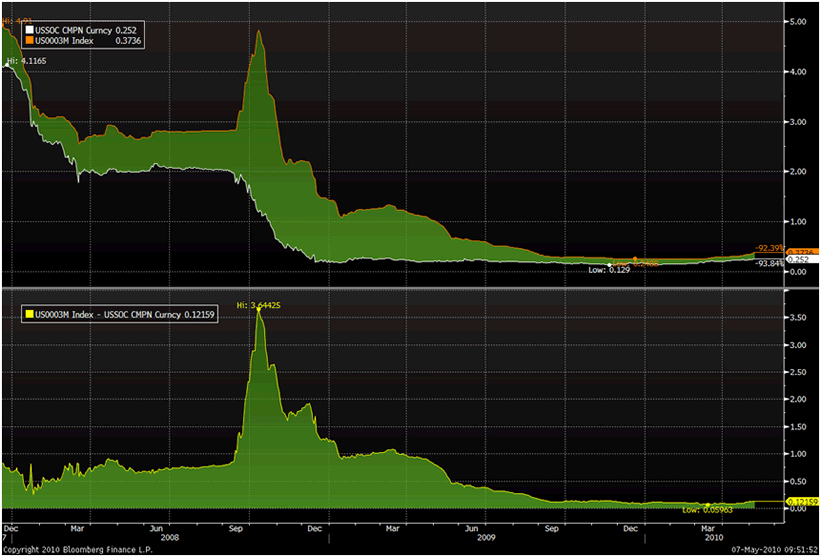
Important benchmarks of the health of the global banking system are again flashing red signals. The spread between three-month Libor and the overnight indexed swap rate, a key gauge of banks' reluctance to lend, rose to the most in more than five months yesterday, as concern deepened that the financial crisis in Greece is spreading to other nations (see chart below).

3 Month Libor and the Overnight Indexed Swap Rate
Another sign of 'Lehmanesque' problems recurring is that the Markit iTraxx Financial Index of credit-default swaps linked to the senior debt of 25 European banks and insurers soared as much as 40 basis points to an all-time high of 223. The cost of default protection on corporate debt in Europe rose to the highest since April 2009.

Markit iTraxx Financial Index of Credit-Default Swaps
Silver
Silver fell slightly in dollars yesterday to $17.47/oz but rose to new record highs in euros, British pounds and Swiss francs.
Silver remains less than half its nominal high of $50 per ounce 30 years ago and less than 20% of its inflation adjusted high of over $130 per ounce.
Platinum Group Metals
Platinum is trading at $1,660/oz marginally up and palladium is currently trading at $505/oz down another 1%. Rhodium is trading at $2,760/oz.
News
Respected analyst, David Rosenberg of Guskin-Sheff has forecast that gold will rise to $3,000 per ounce. Unlike Nouriel Roubini who has recently warned that the risk of deflation is abating and the growing risk was of inflation, Rosenberg remains a deflationist, but still thinks gold will continue to perform very well.
He argues that the breakdown of the euro is very bullish for gold. With the ECB being no Bundesbank and the Euro no D-Mark, gold is set to soar in euros and dollars.
Rosenberg warns that the Euro is less of a "hard currency" than its architects could have ever envisaged a decade ago. Now there is talk that the ECB is contemplating a quantitative easing plan. The case for gold heading to $3,000 an ounce is getting stronger by the day. The euro has already broken below 1.30 to the U.S. dollar and there is plenty of room for additional decline going forward. It's only at a one-year low - wait until it moves to a decade low.
Make no mistake - the problems in Greece are mirrored in places like Portugal and Spain - this is not about liquidity, like Bear Stearns and Lehman, it is a crisis in confidence (Banco Santander, widely seen as a barometer of financial health in Spain, cratered 7% yesterday). The FT reports today that there has been some market chatter that Spain has been "negotiating" with the IMF for assistance (€280bln) too. History shows that crises over confidence are tougher to repair over the near-term than liquidity crunches. The fact that Greek short- term bonds have collapsed in price even more - even though the country does not have to come to the market for the next few years so long as Germany comes through after the vote - is a case in point.
So contagion risks loom and there are simply not enough trees on the planet that can provide enough paper currency to backstop countries like Portugal and Spain. Moreover, what investors see is that if there is so much political foot- dragging in Germany and other EU countries to approve a bailout of tiny Greece, achieving a rescue plan for other large basket-cases will be even more arduous a task. Have a look at Martin Wolf's column on page 9 of the FT - A Bailout For Greece is Just the Beginning. What a tale of woe. And let's not forget about Italy - its public finances are less dire but still fragile (Business Insider).

CME Denies Rumors About 1000-Point Stock Drop

CME Group has issued a statement following rumors that erroneous or irregular trades by Citigroup Global Markets Inc may have been the cause for a more than 900 point drop in the Dow Jones Industrial Average during mid-day trading on Thursday:

“While our policy is not to comment on individual participation in our markets, in light of volatile market conditions, CME Group confirmed that activity by Citigroup Global Markets Inc. in CME Group stock index futures markets does not appear to be irregular or unusual in light of market activity today.”

Stock Market Stumble: Not Just a Computer Glitch

from Ritholz blog:
Good Evening: The major U.S. stock market averages were all down more than 3% today, but after our markets suffered a harrowing afternoon plunge and rebound, most investors will take it. Market participants were already on edge before trading even began, with the recent riots in Greece providing the backdrop to a rapidly deteriorating financial situation in Europe. When the European Central Bank (ECB) gave no indication this morning that it would soon inflate the equivalent of monetary life rafts for the peripheral EU nations that threaten to sink into the Mediterranean Sea, the stage was set for a substantial decline in risk appetites. Our capital markets duly responded, as equities and commodities fell while Treasurys and the dollar rose. What happened during a sudden and heart-thumping swoon cum comeback in the afternoon is anything but clear. It could even have been some mistakenly entered trades, but what is clear is that the underlying problems have not gone away.
Markets in Asia and Europe were under pressure overnight as investors awaited news from both Greece and the ECB. The Greek Parliament actually voted in favor of the austerity measures that gave rise to the deadly unrest in Athens this week, but it was the press conference after the ECB meeting that saw some jaws drop (see below). ECB president, Jean-Claude Trichet, all but dashed the hopes of those who wanted to see the ECB hose down the solvency fires burning in southern Europe with the liquidity of Quantitative Easing. Not only did Trichet just say no to QE, he announced the ECB wasn’t even lowering its policy rate, at least for now. Perhaps he was just trying to be stoic, and maybe he was just trying to act as a responsible steward of the euro currency, but it is an understatement to say his (in)actions didn’t help.
The euro slumped to new lows and European stock markets followed suit. After two straight down days, U.S. investors apparently were hoping what was happening in Europe would stay in Europe. Our index futures were only down mildly prior to the open in New York. Prices leaked steadily once trading began in earnest, however, and the major averages were off some 3% by mid afternoon. It all made sense until stocks suffered what can only be described as a “mini-crash” and equally frantic rebound during the 45 minute period between 2:30 and 3:15 edt. Different media sources are blaming the hair-raising action on erroneous trades in certain equities and equity index futures (see below). I have friends who work at Citigroup, and I was told that the rumors were false — that Citi was not asleep at the switch that represents their electronic trading efforts.
Something, somewhere went wrong, though, and the NYSE and NASDAQ are investigating a series of what they thought looked like “erroneous trades” during the time period cited above. To pick just one example, P&G was trading roughly unchanged ($62) at 2:38 edt. Ten minutes later, it traded below $40, and just a few minutes after that it was back above $62. The media can call action like this “panic selling” all they want, but it looks to me like some mistakes were definitely made. Stocks like PG haven’t traded like they did today since the days surrounding October 19, 1987. THAT was a crash; today was not. Today’s trading did expose just how fragile our markets can be, however, especially when bids disappear and momentum-driven trading programs take over.
By day’s end, and after indexes like the Dow saw trading ranges approaching 10%, the averages finished with losses ranging from -3.2% (Dow) to -3.7% (Russell 2000). Treasurys were a highly sought alternative as risk aversion peaked this afternoon, and yields fell between 12 and 21 basis points. As 2010 dawned, I said periods of falling risk appetites should be used to reduce Treasury exposure. This is one of those times. The dollar rose a stout 0.75%, and commodities understandably tumbled in sympathy with stocks. Without nice rallies in gold and silver due to the flight from managed currencies the CRB index would have fallen more than the 2% it did today.
Nothing so spoils the digestion of a long and late lunch quite like returning to one’s desk to find the markets sporting gaping holes in their price charts. Before I could even ascertain what was happening, the market closed and I decided to go back about my business. After work, I did some digging, made some calls, and came to the conclusion that most of the worst of today’s move was a mistake. Does that mean investors should buy with both fists tomorrow? No, though I think stocks could enjoy a nice snapback rally in the coming days. Nimble traders might chase the to and fro volatility, but long term investors should ask themselves whether the underlying causes have been resolved.
At the moment, the issue is a funding crisis for certain countries in Europe, but the real issue is debt itself. Far too much of it was taken on during the late, great credit bubble, and it was a global phenomenon. What started in subprime, then spread to other mortgage products, crushed the GSEs and sent LEH to the NYSE symbol graveyard, was a process arrested in this country only when the Fed opened up its balance sheet and financed almost everything. By effectively shifting what had been private sector obligations onto the public balance sheets of the Fed and Treasury Department, what we really accomplished was changing who was responsible for paying back much of this stranded debt. The U.K. did the same thing, and both nations monetized a hefty portion of these debt purchases. Nations in Europe can’t pull off the same trick because countries like Greece, Portugal, and Spain can’t print euros — only the ECB can do that.
The options open to these European nations are not good ones, and the investment implications vary with each path taken. Default, a reconstitution of the euro, and/or some QE/debt monetization by the ECB — none of them are optimal and all require various measures of pain. I think the best decision is to wait for some policy clarity out of Europe. Until that day comes, I’m quite content to keep some cash, own some stocks, have some hedges in place, and let the precious metals portion of the portfolio grow as other currencies tumble. The rally in gold, despite a rising dollar and despite falling commodity prices, may be telling us that the yellow metal is finally asserting itself as the world’s most desirable currency.
– Jack McHug

Jobs AND Unemployment Rise, U-6 Rises to 17.1%

Mixed bag! From Bloomberg:
May 7 (Bloomberg) -- Employment in the U.S. increased in April by the most in four years and the unemployment rate unexpectedly rose as thousands of people entered the labor force, indicating the recovery is becoming self-sustaining.
Payrolls jumped 290,000 last month, more than the median estimate of economists surveyed by Bloomberg News, after a revised 230,000 increase in March that was larger than initially estimated, figures from the Labor Department in Washington showed today. The jobless rate rose to 9.9 percent last month from 9.7 percent.

from Financial Sense:

Nonfarm payroll employment rose by 290,000 in April, the unemployment rate edged up to 9.9 percent, and the labor force increased sharply, the U.S. Bureau of Labor Statistics reported today. Job gains occurred in manufacturing, professional and business services, health care, and leisure and hospitality. Federal government employment also rose, reflecting continued hiring of temporary workers for Census 2010.
Despite the rosy numbers, the unemployment rate rose to 9.9%.  Census workers count for 48,000 and the CES Birth/Death Model registered 188,000 fictitious new jobs.  The real number of new hires is probably closer to 54,000.  In addition, the number of marginally attached workers rose by 177,000 and discouraged workers rose by 203,000.  I don’t call this a good report. 
Table U-6, which includes discouraged workers not counted in the headline figures, suggest the real unemployment percentage rose from 16.9% to 17.1%.

Thursday, May 6, 2010

Productivity Slows

WASHINGTON (MarketWatch) -- With major cost-cutting efforts now in the past, the productivity of U.S. nonfarm businesses slowed in the first quarter from 6.3% to a still-healthy 3.6% annual rate, the Labor Department estimated Thursday.
Even with the slowdown in the first quarter, productivity has risen 6.3% over the past four quarters, the fastest growth in 48 years and nearly three times its average growth rate.
In the first quarter, output increased 4.4% on an annualized basis, while hours worked rose 0.8%, the government estimated.

Wild Day on Wall Street

We were down nearly 1,000 points at one point! A rogue trade is being blamed, but I don't buy it. Citi, who was blamed for the trade, says its not true. I think it is just a way of dismissing the market's reaction to brainwash the public to ignore what happened!

Daily View

INflation, DEflation, HYPERinflation

from my friend Koot on Marketwatch. I will have to investigate and read more later, but wanted to record this.
sbenard, thanks for the kind words. I believe one of the articles that I posted was from Ron Hera of Hera Research LLC. Bernankes Delemma.
--------------------------------------------------------------
http://www.heraresearch.com/images/Bernankes_Dilemma_Hyperinflation_and_the_US_Dollar_20100309e.pdf

http://www.heraresearch.com/

"Rather than a crisis of confidence, hyperinflation results from a crisis of credibility.
Hyperinflation results when the social, legal and political structures that create the value of paper
money break down. When a government borrows excessively and its promises to repay are
contradicted by mathematical realities, the value of its currency cannot be maintained. If a
government so lacks credibility that it cannot issue bonds because there are no buyers other than
its own central bank, the value of its currency declines faster than money is printed to cover its
obligations. Perhaps the most important indicator of impending hyperinflation is whether the
statements of a government or of its central bank, e.g., with respect to the government’s budget or
the central bank’s balance sheet, are evidence based or ideological. If they are not evidence
based, the credibility of the government or central bank, and its currency, will weaken and
eventually fail."
----------------------------------------------------
There were other articles related to the difference between supply demand type inflation-deflation and loss of trust or credibility of government caused hyperinflation. Many people believe a country goes from inflation to hyperinflation but that is not what happens. What happens is a country goes from a credit crisis and loss in credibility of government type deflation directly into hyperinflation, Zimbabwe, Wiemar, et. al. Like Ron explained when people and other nations no longer trust the words or credibility of government or central banks currency, everyone seeks other places of holding their money even if the nation is in a depression.

Gold De-Couples From Dollar As Fear of Contagion Spreads

The sharp sell off on Wall Street and with equities internationally saw gold decouple and surge in all currencies yesterday. Oil, commodities and bonds also fell sharply in incredibly volatile trading.


Gold was up by more than 2% in dollar terms and by more than 3.5% in euros and pounds as the euro and pound fell sharply on contagion fears, hung parliament and economic concerns respectively. Gold reached new record nominal highs in sterling, euros and Swiss francs and 27 year highs in Japanese yen, also reaching a five-month high in dollars. Given the scale of the international debt crisis, the December record (nominal) high of $1,226 per ounce (interday) could be reached in the coming days and respected analysts are now forecasting gold to rise to $3,000 per ounce (see News).

Gold Decouples - Gold and the Dow Jones - 30 Days
The massive intraday drop of nearly 1000 points in the Dow Jones also saw significant volatility in currency markets which may presage a euro currency crisis. There is the risk that the sovereign debt crisis could lead to an international monetary crisis as investors lose faith in fiat currencies most of which are saddled with very significant debt levels. Gold's debt free status and lack of counter party risk is making it an increasingly attractive diversification option - and this looks set to continue for the foreseeable future.

Gold in US Dollars Looks Set to Challenge the Record Nominal Daily High of $1,215 per ounce
The UK hung parliament or minority government will not help sentiment towards sterling. The incoming government will be faced with some of the most challenging economic challenges to be faced in modern history. The UK's public finances are in very poor shape and the UK's AAA credit rating is at risk. While the UK is no Greece, its fiscal challenges are extremely challenging and will involve considerable economic pain - possibly even austerity measures. Sterling may remain under pressure until the markets perceive that the incoming government means business about tacking the deficits.

Gold in GBP Surges 4% Yesterday on Political and Economic Concerns
With all the focus on the Greek and European sovereign debt crisis, many have yet to notice the growing risks of another Lehman Brothers style interbank cash market seize up. Sovereign debt contagion fears are feeding into interbank contagion fears as concerns about the solvency of some banks saw Libor rates rising sharply. Moody's warned of risk of contagion in the banking sector yesterday.
Important benchmarks of the health of the global banking system are again flashing red signals. The spread between three-month Libor and the overnight indexed swap rate, a key gauge of banks' reluctance to lend, rose to the most in more than five months yesterday, as concern deepened that the financial crisis in Greece is spreading to other nations (see chart below).

3 Month Libor and the Overnight Indexed Swap Rate
Another sign of 'Lehmanesque' problems recurring is that the Markit iTraxx Financial Index of credit-default swaps linked to the senior debt of 25 European banks and insurers soared as much as 40 basis points to an all-time high of 223. The cost of default protection on corporate debt in Europe rose to the highest since April 2009.

Markit iTraxx Financial Index of Credit-Default Swaps
Silver
Silver fell slightly in dollars yesterday to $17.47/oz but rose to new record highs in euros, British pounds and Swiss francs.
Silver remains less than half its nominal high of $50 per ounce 30 years ago and less than 20% of its inflation adjusted high of over $130 per ounce.
Platinum Group Metals
Platinum is trading at $1,660/oz marginally up and palladium is currently trading at $505/oz down another 1%. Rhodium is trading at $2,760/oz.
News
Respected analyst, David Rosenberg of Guskin-Sheff has forecast that gold will rise to $3,000 per ounce. Unlike Nouriel Roubini who has recently warned that the risk of deflation is abating and the growing risk was of inflation, Rosenberg remains a deflationist, but still thinks gold will continue to perform very well.
He argues that the breakdown of the euro is very bullish for gold. With the ECB being no Bundesbank and the Euro no D-Mark, gold is set to soar in euros and dollars.
Rosenberg warns that the Euro is less of a "hard currency" than its architects could have ever envisaged a decade ago. Now there is talk that the ECB is contemplating a quantitative easing plan. The case for gold heading to $3,000 an ounce is getting stronger by the day. The euro has already broken below 1.30 to the U.S. dollar and there is plenty of room for additional decline going forward. It's only at a one-year low - wait until it moves to a decade low.
Make no mistake - the problems in Greece are mirrored in places like Portugal and Spain - this is not about liquidity, like Bear Stearns and Lehman, it is a crisis in confidence (Banco Santander, widely seen as a barometer of financial health in Spain, cratered 7% yesterday). The FT reports today that there has been some market chatter that Spain has been "negotiating" with the IMF for assistance (€280bln) too. History shows that crises over confidence are tougher to repair over the near-term than liquidity crunches. The fact that Greek short- term bonds have collapsed in price even more - even though the country does not have to come to the market for the next few years so long as Germany comes through after the vote - is a case in point.
So contagion risks loom and there are simply not enough trees on the planet that can provide enough paper currency to backstop countries like Portugal and Spain. Moreover, what investors see is that if there is so much political foot- dragging in Germany and other EU countries to approve a bailout of tiny Greece, achieving a rescue plan for other large basket-cases will be even more arduous a task. Have a look at Martin Wolf's column on page 9 of the FT - A Bailout For Greece is Just the Beginning. What a tale of woe. And let's not forget about Italy - its public finances are less dire but still fragile (Business Insider).

Tuesday, May 4, 2010

Global Warming - Not Just Faulty Data, But FRAUDULENT Data

from Gary Baise, a farmer and lawyer, at Farm Futures:
Agriculture has a lot at stake in the climate change or global warming debate. Troubling questions have been raised recently over the science supporting global warming.
As a corn and soybean producer and lawyer, I am always skeptical when someone like former Vice President Al Gore alleges he knows the complete story on global warming. In my opinion every story, like a pancake, has two sides.
The first story that got my attention refers to "Climategate," which began in November 2009 with an internet leak of thousands of emails and other documents from the University of East Anglia's Climate Research Unit. According to the university, the emails and documents were obtained through the hacking of a server. The emails were used to support widely-publicized allegations by climate change skeptics that the emails showed scientific misconduct and mishandling of Freedom of Information requests.
Now a story written in Environment & Climate News, May 2010, by James M. Taylor, describes a recent letter sent by the Institute of Physics, a London-based scientific charity with a membership of over 36,000 devoted to the understanding and application of physics. Taylor’s article declares that “The letter criticizes global warming alarmists at the heart of the Climategate scandal for manipulating data, abusing the scientific method and strong-arming the peer-review publication process.”
The Institute further advises the British Parliament that it is concerned that some of the research and emails may prove to be “…forgeries or adaptations [with] worrying implications aris[ing] for the integrity of scientific research in this field…”
Forgeries of data? This is a strong accusation!
It is clear that the Institute of Physics wants to learn the truth about activities of scientists involved with the United Nations Intergovernmental Panel on Climate Change (IPCC). The Institute’s Memorandum sets forth 13 assertions and requests to Parliament. The most important paragraph declares “The emails reveal doubts as to the reliability of some of the reconstructions and raise questions as to the way in which they have been represented; for example, the apparent suppression in graphics widely used by the IPCC of proxy results for recent decades that do not agree with contemporary instrumental temperature measurements.”
Fraud? In plain English, the scientists are suggesting, as many articles have suggested, that the truth is not being told about global warming issues. (In other words, it is fraud!!!)
The second story that caught my attention arose here in Virginia from the Attorney General, Ken Cuccinelli, who filed a Civil Investigative Demand against the Commonwealth’s flagship University of Virginia (UVa). The Attorney General is demanding UVa produce all its documents in connection with one of its scientists, Dr. Michael Mann, who was implicated in several stories regarding the Climategate scandal. Dr. Mann is one of the major advocates of the “hockey stick graph” which demonstrates that global temperatures have risen suddenly and with an unprecedented upward spike and looks like a hockey stick.
Both the Institute of Physics and the Attorney General of Virginia are seeking facts and truth regarding the alleged Climategate scandal. Of course, the reaction against these efforts has been widespread and full of condemnation.
I find this curious, as you should, that people are afraid to have documents paid for by taxpayer money made available for others to read.
The Attorney General of Virginia, not being an academic, is concerned about Virginia taxpayer money being used by UVa and Mann to develop data and conclusions which also may be questionable (or fraudulent) as they relate to climate change. Mann has been accused of manipulating climate data to support the idea of manmade global warming.
As a result, the Attorney General has commanded UVa to produce all information and documentary materials that might show possible violations by Mann of the Virginia Fraud Against Taxpayers Act.
Among the 10 requests for information from Mann include a request for all of the computer programs that were created or edited by Mann from January 1, 1999 to the present. The Attorney General wants all of Mann’s hard drives, floppy drives, tape drives, optical drives, desktop and laptop - well, you get the idea. The Attorney General wants the truth. (Dr. Mann is no longer at the University of Virginia and now works at Penn State.)
Serious questions As I said earlier, I do not know the truth, but I do know the Institute of Physics is raising a number of serious questions regarding the integrity of the scientific research related to global warming. I also know the Attorney General of Virginia is a sincere and tough lawyer, and he will not stop until he is convinced we have the truth about Mann’s work while at UVa working on convincing the world that global warming is real.
Producing these documents from all the scientists will help all of us understand whether global warming is real or manmade.
Agriculture has a major stake in finding out the truth about Climategate. Many organizations believe agriculture is a major problem and contributes to global warming. Data should not be used that might unfairly target agricultural operations.

As has been said: “Sunshine is the best disinfectant” - Justice Lewis Brandeis.

The Debt Contagion Begins to Spread

May 4 (Bloomberg) -- The euro slid to a one-year low against the dollar and stocks tumbled amid concern the European government debt crisis is spreading to Spain and Portugal. Commodities and shares of their producers slid on a slowdown in Chinese manufacturing and fallout from the BP Plc rig disaster.
The euro weakened below $1.31 for the first time since April 2009. The MSCI World Index of 23 developed nations’ stocks declined 1.8 percent at 9:37 a.m. in New York and the Standard & Poor’s 500 Index dropped 1.5 percent, erasing yesterday’s rally. BP Plc slumped to a seven-month low as the costs of containing an oil spill in the Gulf of Mexico mounted. Copper fell to its lowest level in nine weeks, while oil sank 2.8 percent to $83.75 a barrel as the dollar rose against 14 of 16 major counterparts.
Greece’s 110 billion-euro ($146 billion) bailout, approved by finance ministers over the weekend, is failing to ease speculation the debt crisis will spread to nations such as Portugal and Spain. A Chinese purchasing managers’ index declined to 55.4 from 57 in March, signaling government attempts to cool the world’s fastest-growing economy are working.
“There’s spillover effect from China,” said Stanley Nabi, New York-based vice chairman of Silvercrest Asset Management Group, which manages $9 billion. “Spain and Portugal are both endangered species. The attention could shift to one of those countries. In the U.S., it’s no longer news that earnings are better than expected. The stock market has had a great run. I’ve got a feeling that May is going to be a month of consolidation or even of backing down a little bit.”
The S&P 500 erased most of yesterday’s 1.3 percent rally triggered after Warren Buffett defended Goldman Sachs Group Inc. in the wake of fraud accusations against the firm, while reports on manufacturing and consumer spending signaled the economy is strengthening.
“The biggest concern today remains the European peripheral countries and Spain is the big one because there’s fear of another downgrade,” said Sal Catrini, a managing director for equities at Cantor Fitzgerald & Co. in New York. “That’s shaking things up today.”

Monday, May 3, 2010

CPI Explodes!

Americans saw prices rise two percent in the year to March according to the Commerce Department's personal consumption expenditures index published on Monday. The figure, which is closely watched by the Federal Reserve as a sign of broader inflation levels, is approaching the maximum the central bank normally considers sustainable.
Energy and food costs rose 18.7 percent against March 2009, up almost four percentage points compared with February.
Without food and energy spending the inflation level remained stable at 1.3 percent.
The Federal Reserve last Wednesday vowed to keep historically low interest rates for an "extended period," amid "subdued" inflation trends.
Pointing to a slightly quickening economic recovery, the Fed said labor and housing markets showed glimmers of improvement and spending had ticked up.
That impression was reinforced Monday by the Commerce Department, which said spending rose for the sixth consecutive month in March, up by 0.6 percent.
Seasonally adjusted figures showed spending, a key driver of the US economy, rose as Americans saved less.