from my friend Koot on Marketwatch. I will have to investigate and read more later, but wanted to record this.
sbenard, thanks for the kind words. I believe one of the articles that I posted was from Ron Hera of Hera Research LLC. Bernankes Delemma.
--------------------------------------------------------------
http://www.heraresearch.com/images/Bernankes_Dilemma_Hyperinflation_and_the_US_Dollar_20100309e.pdf
http://www.heraresearch.com/
"Rather than a crisis of confidence, hyperinflation results from a crisis of credibility.
Hyperinflation results when the social, legal and political structures that create the value of paper
money break down. When a government borrows excessively and its promises to repay are
contradicted by mathematical realities, the value of its currency cannot be maintained. If a
government so lacks credibility that it cannot issue bonds because there are no buyers other than
its own central bank, the value of its currency declines faster than money is printed to cover its
obligations. Perhaps the most important indicator of impending hyperinflation is whether the
statements of a government or of its central bank, e.g., with respect to the government’s budget or
the central bank’s balance sheet, are evidence based or ideological. If they are not evidence
based, the credibility of the government or central bank, and its currency, will weaken and
eventually fail."
----------------------------------------------------
There were other articles related to the difference between supply demand type inflation-deflation and loss of trust or credibility of government caused hyperinflation. Many people believe a country goes from inflation to hyperinflation but that is not what happens. What happens is a country goes from a credit crisis and loss in credibility of government type deflation directly into hyperinflation, Zimbabwe, Wiemar, et. al. Like Ron explained when people and other nations no longer trust the words or credibility of government or central banks currency, everyone seeks other places of holding their money even if the nation is in a depression.
Thursday, May 6, 2010
INflation, DEflation, HYPERinflation

Gold De-Couples From Dollar As Fear of Contagion Spreads
The sharp sell off on Wall Street and with equities internationally saw gold decouple and surge in all currencies yesterday. Oil, commodities and bonds also fell sharply in incredibly volatile trading.
Gold was up by more than 2% in dollar terms and by more than 3.5% in euros and pounds as the euro and pound fell sharply on contagion fears, hung parliament and economic concerns respectively. Gold reached new record nominal highs in sterling, euros and Swiss francs and 27 year highs in Japanese yen, also reaching a five-month high in dollars. Given the scale of the international debt crisis, the December record (nominal) high of $1,226 per ounce (interday) could be reached in the coming days and respected analysts are now forecasting gold to rise to $3,000 per ounce (see News).
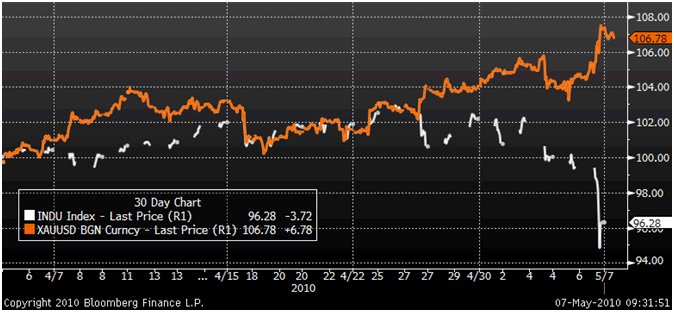
Gold Decouples - Gold and the Dow Jones - 30 Days
The massive intraday drop of nearly 1000 points in the Dow Jones also saw significant volatility in currency markets which may presage a euro currency crisis. There is the risk that the sovereign debt crisis could lead to an international monetary crisis as investors lose faith in fiat currencies most of which are saddled with very significant debt levels. Gold's debt free status and lack of counter party risk is making it an increasingly attractive diversification option - and this looks set to continue for the foreseeable future.
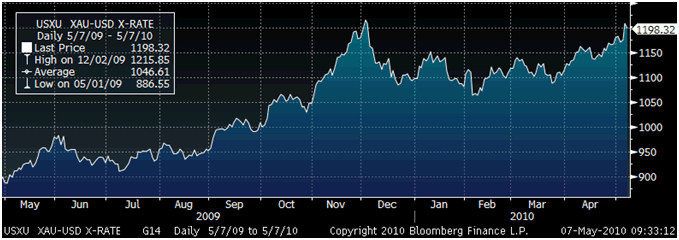
Gold in US Dollars Looks Set to Challenge the Record Nominal Daily High of $1,215 per ounce
The UK hung parliament or minority government will not help sentiment towards sterling. The incoming government will be faced with some of the most challenging economic challenges to be faced in modern history. The UK's public finances are in very poor shape and the UK's AAA credit rating is at risk. While the UK is no Greece, its fiscal challenges are extremely challenging and will involve considerable economic pain - possibly even austerity measures. Sterling may remain under pressure until the markets perceive that the incoming government means business about tacking the deficits.
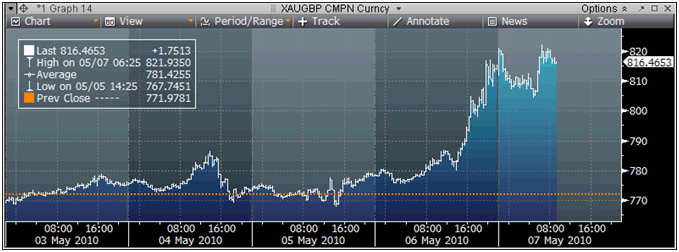
Gold in GBP Surges 4% Yesterday on Political and Economic Concerns
With all the focus on the Greek and European sovereign debt crisis, many have yet to notice the growing risks of another Lehman Brothers style interbank cash market seize up. Sovereign debt contagion fears are feeding into interbank contagion fears as concerns about the solvency of some banks saw Libor rates rising sharply. Moody's warned of risk of contagion in the banking sector yesterday.
Important benchmarks of the health of the global banking system are again flashing red signals. The spread between three-month Libor and the overnight indexed swap rate, a key gauge of banks' reluctance to lend, rose to the most in more than five months yesterday, as concern deepened that the financial crisis in Greece is spreading to other nations (see chart below).
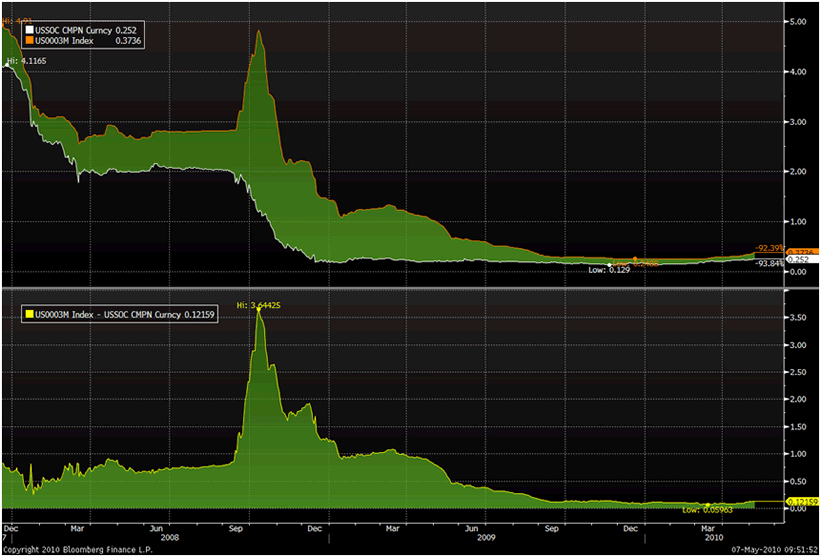
3 Month Libor and the Overnight Indexed Swap Rate
Another sign of 'Lehmanesque' problems recurring is that the Markit iTraxx Financial Index of credit-default swaps linked to the senior debt of 25 European banks and insurers soared as much as 40 basis points to an all-time high of 223. The cost of default protection on corporate debt in Europe rose to the highest since April 2009.
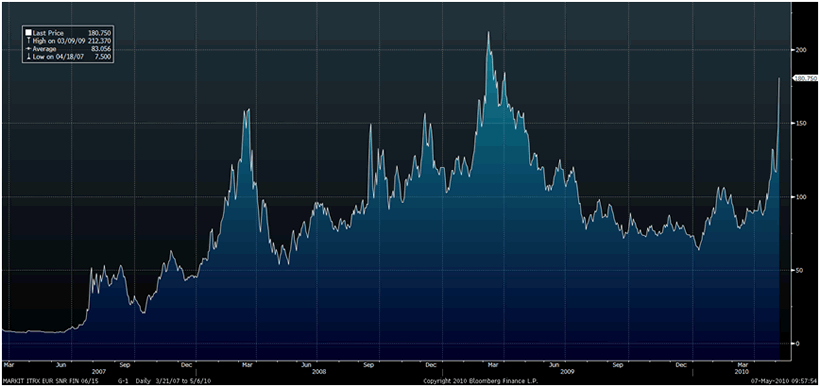
Markit iTraxx Financial Index of Credit-Default Swaps
Silver
Silver fell slightly in dollars yesterday to $17.47/oz but rose to new record highs in euros, British pounds and Swiss francs.
Silver remains less than half its nominal high of $50 per ounce 30 years ago and less than 20% of its inflation adjusted high of over $130 per ounce.
Platinum Group Metals
Platinum is trading at $1,660/oz marginally up and palladium is currently trading at $505/oz down another 1%. Rhodium is trading at $2,760/oz.
News
Respected analyst, David Rosenberg of Guskin-Sheff has forecast that gold will rise to $3,000 per ounce. Unlike Nouriel Roubini who has recently warned that the risk of deflation is abating and the growing risk was of inflation, Rosenberg remains a deflationist, but still thinks gold will continue to perform very well.
He argues that the breakdown of the euro is very bullish for gold. With the ECB being no Bundesbank and the Euro no D-Mark, gold is set to soar in euros and dollars.
Rosenberg warns that the Euro is less of a "hard currency" than its architects could have ever envisaged a decade ago. Now there is talk that the ECB is contemplating a quantitative easing plan. The case for gold heading to $3,000 an ounce is getting stronger by the day. The euro has already broken below 1.30 to the U.S. dollar and there is plenty of room for additional decline going forward. It's only at a one-year low - wait until it moves to a decade low.
Make no mistake - the problems in Greece are mirrored in places like Portugal and Spain - this is not about liquidity, like Bear Stearns and Lehman, it is a crisis in confidence (Banco Santander, widely seen as a barometer of financial health in Spain, cratered 7% yesterday). The FT reports today that there has been some market chatter that Spain has been "negotiating" with the IMF for assistance (€280bln) too. History shows that crises over confidence are tougher to repair over the near-term than liquidity crunches. The fact that Greek short- term bonds have collapsed in price even more - even though the country does not have to come to the market for the next few years so long as Germany comes through after the vote - is a case in point.
So contagion risks loom and there are simply not enough trees on the planet that can provide enough paper currency to backstop countries like Portugal and Spain. Moreover, what investors see is that if there is so much political foot- dragging in Germany and other EU countries to approve a bailout of tiny Greece, achieving a rescue plan for other large basket-cases will be even more arduous a task. Have a look at Martin Wolf's column on page 9 of the FT - A Bailout For Greece is Just the Beginning. What a tale of woe. And let's not forget about Italy - its public finances are less dire but still fragile (Business Insider).
Tuesday, May 4, 2010
Global Warming - Not Just Faulty Data, But FRAUDULENT Data
from Gary Baise, a farmer and lawyer, at Farm Futures:
Agriculture has a lot at stake in the climate change or global warming debate. Troubling questions have been raised recently over the science supporting global warming.
As a corn and soybean producer and lawyer, I am always skeptical when someone like former Vice President Al Gore alleges he knows the complete story on global warming. In my opinion every story, like a pancake, has two sides.
The first story that got my attention refers to "Climategate," which began in November 2009 with an internet leak of thousands of emails and other documents from the University of East Anglia's Climate Research Unit. According to the university, the emails and documents were obtained through the hacking of a server. The emails were used to support widely-publicized allegations by climate change skeptics that the emails showed scientific misconduct and mishandling of Freedom of Information requests.
Now a story written in Environment & Climate News, May 2010, by James M. Taylor, describes a recent letter sent by the Institute of Physics, a London-based scientific charity with a membership of over 36,000 devoted to the understanding and application of physics. Taylor’s article declares that “The letter criticizes global warming alarmists at the heart of the Climategate scandal for manipulating data, abusing the scientific method and strong-arming the peer-review publication process.”
The Institute further advises the British Parliament that it is concerned that some of the research and emails may prove to be “…forgeries or adaptations [with] worrying implications aris[ing] for the integrity of scientific research in this field…”
Forgeries of data? This is a strong accusation!
It is clear that the Institute of Physics wants to learn the truth about activities of scientists involved with the United Nations Intergovernmental Panel on Climate Change (IPCC). The Institute’s Memorandum sets forth 13 assertions and requests to Parliament. The most important paragraph declares “The emails reveal doubts as to the reliability of some of the reconstructions and raise questions as to the way in which they have been represented; for example, the apparent suppression in graphics widely used by the IPCC of proxy results for recent decades that do not agree with contemporary instrumental temperature measurements.”
Fraud? In plain English, the scientists are suggesting, as many articles have suggested, that the truth is not being told about global warming issues. (In other words, it is fraud!!!)
The second story that caught my attention arose here in Virginia from the Attorney General, Ken Cuccinelli, who filed a Civil Investigative Demand against the Commonwealth’s flagship University of Virginia (UVa). The Attorney General is demanding UVa produce all its documents in connection with one of its scientists, Dr. Michael Mann, who was implicated in several stories regarding the Climategate scandal. Dr. Mann is one of the major advocates of the “hockey stick graph” which demonstrates that global temperatures have risen suddenly and with an unprecedented upward spike and looks like a hockey stick.
Both the Institute of Physics and the Attorney General of Virginia are seeking facts and truth regarding the alleged Climategate scandal. Of course, the reaction against these efforts has been widespread and full of condemnation.
I find this curious, as you should, that people are afraid to have documents paid for by taxpayer money made available for others to read.
The Attorney General of Virginia, not being an academic, is concerned about Virginia taxpayer money being used by UVa and Mann to develop data and conclusions which also may be questionable (or fraudulent) as they relate to climate change. Mann has been accused of manipulating climate data to support the idea of manmade global warming.
As a result, the Attorney General has commanded UVa to produce all information and documentary materials that might show possible violations by Mann of the Virginia Fraud Against Taxpayers Act.
Among the 10 requests for information from Mann include a request for all of the computer programs that were created or edited by Mann from January 1, 1999 to the present. The Attorney General wants all of Mann’s hard drives, floppy drives, tape drives, optical drives, desktop and laptop - well, you get the idea. The Attorney General wants the truth. (Dr. Mann is no longer at the University of Virginia and now works at Penn State.)
Serious questions As I said earlier, I do not know the truth, but I do know the Institute of Physics is raising a number of serious questions regarding the integrity of the scientific research related to global warming. I also know the Attorney General of Virginia is a sincere and tough lawyer, and he will not stop until he is convinced we have the truth about Mann’s work while at UVa working on convincing the world that global warming is real.
Producing these documents from all the scientists will help all of us understand whether global warming is real or manmade.
Agriculture has a major stake in finding out the truth about Climategate. Many organizations believe agriculture is a major problem and contributes to global warming. Data should not be used that might unfairly target agricultural operations.
As has been said: “Sunshine is the best disinfectant” - Justice Lewis Brandeis.
The Debt Contagion Begins to Spread
May 4 (Bloomberg) -- The euro slid to a one-year low against the dollar and stocks tumbled amid concern the European government debt crisis is spreading to Spain and Portugal. Commodities and shares of their producers slid on a slowdown in Chinese manufacturing and fallout from the BP Plc rig disaster.
The euro weakened below $1.31 for the first time since April 2009. The MSCI World Index of 23 developed nations’ stocks declined 1.8 percent at 9:37 a.m. in New York and the Standard & Poor’s 500 Index dropped 1.5 percent, erasing yesterday’s rally. BP Plc slumped to a seven-month low as the costs of containing an oil spill in the Gulf of Mexico mounted. Copper fell to its lowest level in nine weeks, while oil sank 2.8 percent to $83.75 a barrel as the dollar rose against 14 of 16 major counterparts.
Greece’s 110 billion-euro ($146 billion) bailout, approved by finance ministers over the weekend, is failing to ease speculation the debt crisis will spread to nations such as Portugal and Spain. A Chinese purchasing managers’ index declined to 55.4 from 57 in March, signaling government attempts to cool the world’s fastest-growing economy are working.
“There’s spillover effect from China,” said Stanley Nabi, New York-based vice chairman of Silvercrest Asset Management Group, which manages $9 billion. “Spain and Portugal are both endangered species. The attention could shift to one of those countries. In the U.S., it’s no longer news that earnings are better than expected. The stock market has had a great run. I’ve got a feeling that May is going to be a month of consolidation or even of backing down a little bit.”
The S&P 500 erased most of yesterday’s 1.3 percent rally triggered after Warren Buffett defended Goldman Sachs Group Inc. in the wake of fraud accusations against the firm, while reports on manufacturing and consumer spending signaled the economy is strengthening.
“The biggest concern today remains the European peripheral countries and Spain is the big one because there’s fear of another downgrade,” said Sal Catrini, a managing director for equities at Cantor Fitzgerald & Co. in New York. “That’s shaking things up today.”
Monday, May 3, 2010
CPI Explodes!
Americans saw prices rise two percent in the year to March according to the Commerce Department's personal consumption expenditures index published on Monday. The figure, which is closely watched by the Federal Reserve as a sign of broader inflation levels, is approaching the maximum the central bank normally considers sustainable.
Energy and food costs rose 18.7 percent against March 2009, up almost four percentage points compared with February.
Without food and energy spending the inflation level remained stable at 1.3 percent.
The Federal Reserve last Wednesday vowed to keep historically low interest rates for an "extended period," amid "subdued" inflation trends.
Pointing to a slightly quickening economic recovery, the Fed said labor and housing markets showed glimmers of improvement and spending had ticked up.
That impression was reinforced Monday by the Commerce Department, which said spending rose for the sixth consecutive month in March, up by 0.6 percent.
Seasonally adjusted figures showed spending, a key driver of the US economy, rose as Americans saved less.
Federal Pension Insurance Fund Is Insolvent
Last November, the federal corporation charged with protecting Americans’ retirement funds issued an ominous public warning: the amount of pensions at risk inside failing companies had more than tripled during the recession.
The Pension Benefit Guaranty Corporation’s announcement signaled it might need tens of billions of new dollars to rescue traditional pensions paid by U.S. firms whose economic collapse left them unable to meet their retirement obligations to workers.
At the same time, however, the federally chartered corporation was receiving some bad news of its own: for the first time it was going to flunk an independent audit of the way it manages its finances.
On Nov. 12, 2009, PBGC’s outside audit firm and the corporation’s own internal watchdog jointly informed the federal body it was being cited for a “material weakness” in its internal financial controls, the accounting equivalent of an F grade.
“PBGC did not have effective internal control over financial reporting (including safeguarding assets) and compliance with laws and regulations and its operations,” Inspector General Rebecca Anne Batts wrote in a letter that has escaped public attention despite their potential importance to taxpayers.
Americans may expect such adverse audit findings for corporate bad actors, but the finding is more unusual for a government agency, especially one charged with cleaning up failed companies’ messes and rescuing workers’ pensions.
A Center for Public Integrity review of hundreds of pages of memos, audits and internal reports shows the pension guaranty corporation has been unable to make several guarantees about its own work — in some cases directly misleading Congress and its inspector general into believing long-simmering problems were resolved.
“Providing false information to OIG or Congress can be a criminal violation,” an angry Sen. Charles Grassley of Iowa, the senior Republican on the Senate Finance Committee, warned in a letter March 31 that was provided to the Center. The letter chided the corporation for its “apparent dishonesty” in erroneously reporting it had implemented solutions to past problems.
Created in 1974, PBGC is essentially the government’s insurance program for retirees, protecting the pensions of approximately 44 million workers and retirees in more than 29,000 private defined benefit pension plans that promise a fixed monthly payment to retirees for life. When a covered company’s pension plan defaults, PBGC swoops in and protects workers’ retirements.
The corporation receives no tax dollars, and is funded instead by insurance premiums paid by pension plan operators, investments and assets it recovers from companies whose pension plans needed to be rescued.
A Litany of Problems
Getting its story straight with Congress is just one of PBGC’s problems.Despite being the custodian of some of Americans’ most private data, PBGC suffers from such lax security that a contractor was able in 2008 to download the pension and Social Security numbers of 1,300 Americans to an unsecured electronic thumb drive that was then lost at an Ohio train station, according to documents and interviews.
The corporation also has been criticized for letting its contractors hire employees with inadequate experience or education, and has been cited repeatedly since 1997 for failing to create a unified financial management system to better safeguard its funds. It lacks the ability, for instance, to independently confirm the investment revenue figures reported by a contractor hired to engage in securities lending on its behalf, according to audit reports and interviews.
And its former chief executive was the subject of a year-long criminal investigation that ended in March with no criminal charges but a conclusion that his conduct raised “serious ethical concerns,” documents show.
“I am acutely aware that every dollar spent on a contractor who doesn’t provide the promised level of service or who doesn’t provide contract workers with the minimum qualifications needed to do the job is a dollar that is not available to pay the pension benefits of the workers that PBGC was created to protect,” Batts said in an interview.
Such systemic problems are equally concerning to lawmakers like Grassley and Democratic Sen. Herb Kohl of Wisconsin, the chairman of the Senate Aging Committee, particularly because the corporation’s own long-term financial outlook has worsened over the last few years.
Kohl, who is pressing for legislation to strengthen the PBGC’s oversight and governance, said the corporation’s “long-running problems …. should serve as a wake-up call to Congress.”
“Nearly one in six Americans relies on the PBGC to guarantee the pensions they’ve worked a lifetime for. The agency is far too important to let it operate without adequate oversight,” he said.
Working on Fixes
In an interview with the Center, PBGC Acting Director Vincent Snowbarger said the corporation is taking steps to fix the problems that led to the adverse audit finding as well as the communication gaps that led his agency to provide erroneous information to Congress and its inspector general.“Some of it is human error. Some of it is sheer sloppiness. And some of it is when an executive takes information from down below and doesn’t check its accuracy. All of it needs to, and will be, fixed,” Snowbarger said.
While fixing communication gaps should theoretically occur quickly, officials cautioned that addressing some of the systemic problems — like finishing a long-overdue unified financial management system or fortifying the agency’s information technology security — will take time, making it likely that PBGC will carry the stain of a material weakness finding on its audits for as many as three to five more years.
“What the IG has called to our attention are some things we can do better at,” Snowbarger said. “There also has to be the capacity within the organization to put all that in place. So we’re slowing down our implementation process on this. We’re trying to get more realistic about what we can get accomplished and when.”
PBGC officials said in the meantime the corporation is still able to perform its primary mission of making good on a growing number of pension obligations from companies that have collapsed.
“We’re not this rogue agency out there, about to fall off a cliff…. We have had no adverse results from this,” General Counsel Judith Starr said in an interview. “It’s all potential problems. We have to plug leaks so bad things don’t happen.”
Added Snowbarger, a former Kansas congressman who joined the corporation during the Bush administration: “We have been inundated by new participants and our primary responsibility is to make sure those people get paid… We’ve been sort of swamped from the intake process and that’s where resources naturally would go.”
Starr said senior executives agree that problems have “been going on long enough. We’ve been trying to fix this and we need to be much more comprehensive in our approach.”
Economic Repercussions
The corporation is also facing a variety of more basic financial challenges. At the end of the Bush administration, PBGC sought to change its investment strategy, switching away from secure bonds and toward more risky Wall Street investments that offered the potential for higher returns in good economic times.The Obama administration, however, put the plan on hold before it could be fully implemented, asking the corporation’s next chief executive, Joshua Gotbaum, to “prudently rebalance” its investment portfolio. Gotbaum’s nomination, though, has been pending for months.
When the recession struck, the corporation’s long-term financial position worsened in large part because the number of faltering U.S. companies with pensions that might need to be rescued ballooned.
PBGC reported in November that its deficit — the gap between its current assets and its future obligations — grew from $11.2 billion in fiscal 2008 to $21.9 billion in fiscal 2009, reversing several years of progress.
Meanwhile, the corporation reported its potential obligations to cover future pension losses from financially troubled companies more than tripled from $47 billion at the end of fiscal 2008 to about $168 billion at the end of last year.
Among the companies whose pensions PBGC have recently been forced to assume are the electronics retailer Circuit City, the IndyMac Bank, and the Lehman Brothers investment firm.
And General Motors’ and Chrysler’s continued losses leave their massive pension plans hanging in the balance, potentially adding $42 billion in auto industry retirement obligations to PBGC’s burden if they went under, the Government Accountability Office reported April 6. The automakers reported last month their condition is improving, but losses continue to accumulate.
Audit Policies
To ensure its own health, PBGC undergoes two audits each year. One determines if its books accurately reflect its financial state and the second reviews whether it has adequate internal controls over its finances to ensure it complies with laws and regulations and spends its money wisely.PBGC passed the first audit at the end 2009 with an unqualified or clean finding, the 17th straight year it has done so. But Batts and the outside auditor flunked the corporation on its internal controls, citing three serious deficiencies that they said amounted to a corporation-wide material weakness.
Batts’ auditors specifically cited the corporation’s failure to safeguard its sensitive data, and alleged it falsely claimed it had fixed problems. The auditors concluded that the problems not only left Americans’ personal data vulnerable to loss but also “impacted strategic decisions” the corporation made on how to spend its resources.
The Sarbanes-Oxley law passed after the Enron scandal required all public companies to conduct regular audits on their internal controls, seeing it as an essential safeguard for investors.
But the government does not require such an audit of all of its own agencies, leaving it instead for each agency to decide. Some address internal controls with a separate audit, and others evaluate internal controls as part of their financial statements. A handful, like the Department of Veterans Affairs, Treasury Department, and Agriculture Department, currently have at least one material weakness finding concerning internal controls.
PBGC, with its billions in assets and investments, conducts a formal internal controls audit each year. And after years of warning of problems that went unresolved, the auditing firm hired by inspector general Batts decided to cite the agency with its first material weakness.
“Internal controls over these operations are essential to ensure the confidentiality, integrity, and availability of critical data while reducing the risk of errors, fraud, and other illegal acts,” the auditors said in explaining the significance of their negative finding.
George Mason University professor Anthony B. Sanders, a financial accountability expert who has testified before Congress, said the PBGC’s inability to pass its own internal controls audit raises the question, “How can we rely on this corporation to successfully audit these failing pensions? It tells us they may not be up to the task.”
A bigger concern, Sanders said, is that politicians are not trying to address the inevitability of PBGC eventually being unable to meet its obligations. “We have to first be rethinking our whole approach to pension benefits because clearly that model is broken and cannot be sustained,” he said.
Snowbarger said PBGC faces no short-term cash flow problems, in part because the corporation has assumed cash and other assets from a large number of failed companies whose pension plans have been taken over. But those assets will run out over time, and lawmakers will be forced to decide whether the government assumes those liabilities.
The options for closing the gap are limited. Congress could raise the premium costs for companies who buy the pension insurance to close the gap, but it would likely cause an outcry from companies. It could increase the investment returns on the corporation’s current assets, but that would open it up to additional risks. It could change the entire approach and cover only a pro-rata share of defaulted pensions, or lawmakers could simply use tax dollars to close the gap when the corporation’s current assets run out.
“Right now, the way we are structured, we don’t have the full faith and credit of the U.S. government behind us,” Snowbarger said. “That is something Congress will one day have to wrestle with.”
Batts, who was hired two years ago as an independent watchdog by the PBGC’s board of directors, has been an unrelenting siren about the state of the corporation’s affairs. PBGC, her office’s memos show, was warned for years before November’s audit about weaknesses in its procurement processes, its internal controls over its accounting practices, and information technology security.
In fact, the IG disclosed in a letter April 26 to Congress that 201 proposed solutions to problems identified as far back as the late 1990s still have not been implemented. The culture in certain key departments, Batts said, simply allowed bad practices to be swept under the rug or to fester until they manifested themselves into more dramatic failures.
For instance, IG reports dating several years back warned PBGC that it lacked a comprehensive and secure information technology platform, a red flag for a corporation trusted with protecting Social Security numbers, personal account balances, and proprietary actuarial data from pension funds.
A Security Breach
So it came as no surprise to insiders when the infamous flash drive with sensitive pension data was lost.A Transportation Security Administration employee was heading home from work in 2008 when he spotted a computer thumb drive lying in the parking lot of a Cleveland, Ohio, commuter train station. The worker popped the thumb drive into a computer, and discovered it had Social Security numbers, account details from PBGC-protected pensions, and actuarial data from other private pension plans.
“Not exactly the sort of stuff you want lying on the ground of a public train station,” Batts said.
The worker managed to get the thumb drive back to the PBGC. Batts said she ultimately concluded that a supervisor and employee for a PBGC contractor downloaded unauthorized pension account data and Social Security numbers for 1,300 Americans. The information was stored on a flash drive with no encryption or password protection, leaving it totally exposed when it fell out in the train station lot. “These actions violated PBGC’s policy to protect sensitive information,” Batts concluded.
After the episode, Batts pressed PBGC anew to finally address its information security weaknesses.
The corporation reported back a few months later that it had implemented 45 of the 65 recommended security enhancements. And to address the case of the flash drive, PBGC reported both to Congress and the IG that it went to the offending contractor’s facility, provided additional security training, emphasized the need for greater care in handling sensitive data, and took other steps to ensure there would be no repeat.
The action plan sounded great — until Batts’ team went to check the fixes. She found they did not exist, according to documents and interviews.
“PBGC fabricated this follow-up action,” Grassley concluded in a March 31 letter to the corporation. “Other than providing routine annual security training, PBGC took no trips to the contractor’s facility, provided no additional IT security training, and to date has not ensured the contractor is adequately securing” sensitive data. Batts ultimately concluded that PGBC failed to implement any of the 65 “common security controls” it had promised.
Recent changes in the corporation’s information technology leadership have resulted in some progress in creating a more efficient, more secure technology system, according to both Snowbarger and Batts. PBGC’s former chief information officer left the corporation in November.
But the pattern of claiming fixes that didn’t occur has persisted. After Batts’ office raised concerns about two actuarial contracts with a Canadian firm that ballooned to $15 million in costs, corporation officials promised they had made changes to ensure the corporation could verify it got the services it paid for. The corporation even stated in writing that the corrective actions were “approved,” “in place,” and “effective,” according to Grassley’s letter.
Not true, Batts found, when she went back to check. In fact, there were a total of 17 fixes for procurement problems stemming from four separate audits that were inaccurately reported to be implemented. None of the corrective actions to make contracting safer had actually been taken, according to Batts and Grassley.
In an April 14 letter to Grassley, Snowbarger acknowledged a “number of shortcomings” and communication breakdowns but insisted that “any implication that PBGC employees have been fraudulent or dishonest in their dealings with Congress or the OIG is unwarranted.” Instead, Snowbarger said, the misinformation sent to Congress “involved failures of communication and/or good faith errors.”
A Controversial Former CEO
Sensitivities about PBGC’s procurement practices are also high in the aftermath of former chief executive Charles Millard’s tenure in 2007-09. Batts said Millard was the subject of a criminal investigation conducted by her office and the U.S. Attorney in Manhattan. Her office last month advised Congress that Millard would not face criminal charges.But the IG concluded that the former PBGC boss had ignored staff warnings and intervened in 2008 in the evaluation of major Wall Street firms, including Goldman Sachs Group Inc., JP Morgan Chase & Co., and BlackRock Inc., as they were bidding for contracts to invest or manage $2.5 billion of the corporation’s money. The probe found the CEO later sought personal job search help from an executive at one firm that had just won a PBGC contract to manage hundreds of millions of dollars in investments. Millard “had inappropriate contacts with bidders … and took actions incompatible with his role,” investigators concluded. The investigation ultimately located 29 e-mails between a senior Goldman Sachs executive and Millard involving the director’s request to assist him in his search for employment.
Millard did not reply to multiple e-mail messages seeking comment on the investigation. His attorney, Stan Brand, did not immediately respond to a phone message seeking comment.
Meanwhile, the audit documents discuss numerous other problems. For instance the IG concluded the corporation lacked written rules “from the highest level down” to govern the risks associated with securities lending it performs as part of its investment strategy. PBGC “is unable to independently calculate” the revenues its main contractor claims it is generating from the strategy, the internal watchdog warned.
PBGC said a new investment policy it is drafting will provide written guidance on ensuring the accuracy of securities lending figures.
Greece Bailout Is Insufficient, Will Fall Short
from WSJ:
BRUSSELS—The €110 billion ($147 billion), three-year bailout offered to Greece by euro-zone countries and the International Monetary Fund won't be enough to cover Greece's costs, an examination of Greek financial figures shows, setting Europe up for more tough choices if private markets don't start lending again.
The bailout announced here over the weekend will solve one pressing problem: Greece will have enough cash to repay an €8.5 billion bond that comes due in two weeks. But the bailout package is based on assumptions that by the end of 2011 Greece will be able to borrow again from capital markets.
Sunday, May 2, 2010
BIS Says Drastic Measures Required to Reduce Sovereign Debt
What are the chances that the US Government will deal with this before a crisis? Near zero!
This is from John Mauldin:
The paper looks at fiscal policy in a number of countries and, when combined with the implications of age-related spending (public pensions and health care), determines where levels of debt in terms of GDP are going. The authors don't mince words. They write at the beginning:
"Our projections of public debt ratios lead us to conclude that the path pursued by fiscal authorities in a number of industrial countries is unsustainable. Drastic measures are necessary to check the rapid growth of current and future liabilities of governments and reduce their adverse consequences for long-term growth and monetary stability."
Drastic measures is not language you typically see in an economic paper from the BIS. But the picture they paint for the 12 countries they cover is one for which drastic measures is well-warranted. I am going to quote extensively from the paper, as I want their words to speak for themselves, and I'll add some color and explanation as needed. Also, all emphasis is mine.
"The politics of public debt vary by country. In some, seared by unpleasant experience, there is a culture of frugality. In others, however, profligate official spending is commonplace. In recent years, consolidation has been successful on a number of occasions. But fiscal restraint tends to deliver stable debt; rarely does it produce substantial reductions. And, most critically, swings from deficits to surpluses have tended to come along with either falling nominal interest rates, rising real growth, or both. Today, interest rates are exceptionally low and the growth outlook for advanced economies is modest at best. This leads us to conclude that the question is when markets will start putting pressure on governments, not if.
"When, in the absence of fiscal actions, will investors start demanding a much higher compensation for the risk of holding the increasingly large amounts of public debt that authorities are going to issue to finance their extravagant ways? In some countries, unstable debt dynamics, in which higher debt levels lead to higher interest rates, which then lead to even higher debt levels, are already clearly on the horizon.
"It follows that the fiscal problems currently faced by industrial countries need to be tackled relatively soon and resolutely. Failure to do so will raise the chance of an unexpected and abrupt rise in government bond yields at medium and long maturities, which would put the nascent economic recovery at risk. It will also complicate the task of central banks in controlling inflation in the immediate future and might ultimately threaten the credibility of present monetary policy arrangements.
"While fiscal problems need to be tackled soon, how to do that without seriously jeopardising the incipient economic recovery is the current key challenge for fiscal authorities."
They start by dealing with the growth in fiscal (government) deficits and the growth in debt. The US has exploded from a fiscal deficit of 2.8% to 10.4% today, with only a small 1.3% reduction for 2011 projected. Debt will explode (the correct word!) from 62% of GDP to an estimated 100% of GDP by the end of 2011. Remember that Rogoff and Reinhart show that when the ratio of debt to GDP rises above 90%, there seems to be a reduction of about 1% in GDP. The authors of this paper, and others, suggest that this might come from the cost of the public debt crowding out productive private investment.
Think about that for a moment. We are on an almost certain path to a debt level of 100% of GDP in less than two years. If trend growth has been a yearly rise of 3.5% in GDP, then we are reducing that growth to 2.5% at best. And 2.5% trend GDP growth will NOT get us back to full employment. We are locking in high unemployment for a very long time, and just when some one million people will soon be falling off the extended unemployment compensation rolls.
Government transfer payments of some type now make up more than 20% of all household income. That is set up to fall rather significantly over the year ahead unless unemployment payments are extended beyond the current 99 weeks. There seems to be little desire in Congress for such a measure. That will be a significant headwind to consumer spending.
Government debt-to-GDP for Britain will double from 47% in 2007 to 94% in 2011 and rise 10% a year unless serious fiscal measures are taken. Greece's level will swell from 104% to 130%, so the US and Britain are working hard to catch up to Greece, a dubious race indeed. Spain is set to rise from 42% to 74% and "only" 5% a year thereafter; but their economy is in recession, so GDP is shrinking and unemployment is 20%. Portugal? 71% to 97% in the next two years, and there is almost no way Portugal can grow its way out of its problems.
Japan will end 2011 with a debt ratio of 204% and growing by 9% a year. They are taking almost all the savings of the country into government bonds, crowding out productive private capital. Reinhart and Rogoff, with whom you should by now be familiar, note that three years after a typical banking crisis the absolute level of public debt is 86% higher, but in many cases of severe crisis the debt could grow by as much as 300%. Ireland has more than tripled its debt in just five years.
The BIS continues:
"We doubt that the current crisis will be typical in its impact on deficits and debt. The reason is that, in many countries, employment and growth are unlikely to return to their pre-crisis levels in the foreseeable future. As a result, unemployment and other benefits will need to be paid for several years, and high levels of public investment might also have to be maintained.
"The permanent loss of potential output caused by the crisis also means that government revenues may have to be permanently lower in many countries. Between 2007 and 2009, the ratio of government revenue to GDP fell by 2-4 percentage points in Ireland, Spain, the United States and the United Kingdom. It is difficult to know how much of this will be reversed as the recovery progresses. Experience tells us that the longer households and firms are unemployed and underemployed, as well as the longer they are cut off from credit markets, the bigger the shadow economy becomes."
We are going to skip a few sections and jump to the heart of their debt projections. Again, I am going to quote extensively, and my comments will be in brackets [].Note that these graphs are in color and are easier to read in color (but not too difficult if you are printing it out). Also, I usually summarize, but this is important. I want you to get the full impact. Then I will make some closing observations.
[That makes these estimates quite conservative, as growth-rate estimates by the OECD are well on the optimistic side.]
"But the main point of this exercise is the impact that this will have on debt. The results plotted as the red line in Graph 4 [below] show that, in the baseline scenario, debt/GDP ratios rise rapidly in the next decade, exceeding 300% of GDP in Japan; 200% in the United Kingdom; and 150% in Belgium, France, Ireland, Greece, Italy and the United States. And, as is clear from the slope of the line, without a change in policy, the path is unstable. This is confirmed by the projected interest rate paths, again in our baseline scenario. Graph 5 [below] shows the fraction absorbed by interest payments in each of these countries. From around 5% today, these numbers rise to over 10% in all cases, and as high as 27% in the United Kingdom.
"Seeing that the status quo is untenable, countries are embarking on fiscal consolidation plans. In the United States, the aim is to bring the total federal budget deficit down from 11% to 4% of GDP by 2015. In the United Kingdom, the consolidation plan envisages reducing budget deficits by 1.3 percentage points of GDP each year from 2010 to 2013 (see eg OECD (2009a)).
"To examine the long-run implications of a gradual fiscal adjustment similar to the ones being proposed, we project the debt ratio assuming that the primary balance improves by 1 percentage point of GDP in each year for five years starting in 2012. The results are presented as the green line in Graph 4. Although such an adjustment path would slow the rate of debt accumulation compared with our baseline scenario, it would leave several major industrial economies with substantial debt ratios in the next decade.
"This suggests that consolidations along the lines currently being discussed will not be sufficient to ensure that debt levels remain within reasonable bounds over the next several decades.
"An alternative to traditional spending cuts and revenue increases is to change the promises that are as yet unmet. Here, that means embarking on the politically treacherous task of cutting future age-related liabilities. With this possibility in mind, we construct a third scenario that combines gradual fiscal improvement with a freezing of age-related spending-to-GDP at the projected level for 2011. The blue line in Graph 4 shows the consequences of this draconian policy. Given its severity, the result is no surprise: what was a rising debt/GDP ratio reverses course and starts heading down in Austria, Germany and the Netherlands. In several others, the policy yields a significant slowdown in debt accumulation. Interestingly, in France, Ireland, the United Kingdom and the United States, even this policy is not sufficient to bring rising debt under control.

[And yet, many countries, including the US, will have to contemplate something along these lines. We simply cannot fund entitlement growth at expected levels. Note that in the US, even by "draconian" estimates, debt-to-GDP still grows to 200% in 30 years. That shows you just how out of whack our entitlement programs are.
Sidebar: This also means that if we - the US - decide as a matter of national policy that we do indeed want these entitlements, it will most likely mean a substantial VAT tax, as we will need vast sums to cover the costs, but with that will come slower growth.]

[Long before interest rates rise even to 10% of GDP in the early 2020s, the bond market will have rebeled. This is a chart of things that cannot be. Therefore we should be asking ourselves what is the End Game if the fiscal deficits are not brought under control.]
"All of this leads us to ask: what level of primary balance would be required to bring the debt/GDP ratio in each country back to its pre-crisis, 2007 level? Granted that countries which started with low levels of debt may never need to come back to this point, the question is an interesting one nevertheless. Table 3 presents the average primary surplus target required to bring debt ratios down to their 2007 levels over horizons of 5, 10 and 20 years. An aggressive adjustment path to achieve this objective within five years would mean generating an average annual primary surplus of 8-12% of GDP in the United States, Japan, the United Kingdom and Ireland, and 5-7% in a number of other countries. A preference for smoothing the adjustment over a longer horizon (say, 20 years) reduces the annual surplus target at the cost of leaving governments exposed to high debt ratios in the short to medium term.

[Can you imagine the US being able to run a budget surplus of even 2.4% of GDP? $350 billion-plus a year? That would be a swing in the budget of almost 10% of GDP.]
That is enough for today. We will delve further next week.
Thursday, April 29, 2010
Roubini Sees Coming Sovereign Debt Defaults, Greece is "Tip of the Iceberg"
April 29 (Bloomberg) -- Nouriel Roubini, the New York University professor who forecast the U.S. recession more than a year before it began, said sovereign debt from the U.S. to Japan and Greece will lead to higher inflation or government defaults.
Almost $1 trillion of worldwide equity value was erased April 27 on concern that debt will spur defaults, derailing the global economy, data compiled by Bloomberg show. German Chancellor Angela Merkel and the International Monetary Fund pledged to step up efforts to overcome the Greek fiscal crisis, after bonds and stocks fell across Europe in the past week.
“The bond vigilantes are walking out on Greece, Spain, Portugal, the U.K. and Iceland,” Roubini, 52, said yesterday during a panel discussion on financial markets at the Milken Institute Global Conference in Beverly Hills, California. “Unfortunately in the U.S., the bond-market vigilantes are not walking out.”
Credit-rating cuts on Greece, Portugal and Spain this week are spurring investors’ concern that the European deficit crisis is spreading and intensifying pressure on policy makers to widen a bailout package. Roubini’s remarks underscore statements by officials such as Dominique Strauss-Kahn, managing director of the IMF, that the global economy still faces risks.
“The thing I worry about is the buildup of sovereign debt,” said Roubini, a former adviser to the U.S. Treasury Department and IMF consultant, who in August 2006 predicted a “painful” U.S. recession that came to fruition in December 2007. If the problem isn’t addressed, he said, nations will either fail to meet obligations or experience higher inflation as officials “monetize” their debts, or print money to tackle the shortfalls.
‘Tip of the Iceberg’
“While today markets are worried about Greece, Greece is just the tip of the iceberg, or the canary in the coal mine for a much broader range of fiscal problems,” Roubini, who teaches at NYU’s Stern School of Business, told attendees at the Beverly Hilton hotel. Increasing tax revenue won’t be enough to “save the day,” he said.
Greece “could eventually be forced to get out” of the 16- nation euro region, he said in a Bloomberg Television interview yesterday. That would lead to a decline in the euro and make it “less of a liquid currency,” he said. While a smaller euro zone “makes sense,” he said, “it could be very messy.”
The Stoxx Europe 600 Index fell 1.3 percent to 258.24, a six-week low, yesterday after Standard & Poor’s downgraded Spain’s debt by one step to AA. The euro traded near a one-year low against the dollar.
‘No Willingness’
“Eventually, the fiscal problems of the U.S. will also come to the fore,” he said during the panel discussion. “The risk of something serious happening in the U.S. in the next two or three years is going to be significant” because there’s “no willingness in Washington to do anything” unless forced by the bond markets.
Roubini, chairman and co-founder of Roubini Global Economics LLC in New York, said the U.S. probably will need a combination of increased tax revenue and lower government spending, while Europe needs to curb spending.
Both he and Michael Milken, the founder of the Milken Institute, supported a carbon tax on gasoline, with Roubini saying it would reduce American dependence on oil from overseas, shrink the trade deficit and carbon emissions, and help pay down the U.S. budget deficit.
Milken compared the excess debt of U.S. consumers, companies and government to the nation’s obesity problem, saying the “best solution” is to become more efficient instead of raising taxes or unnecessarily cutting expenditures.
Slimming Down
“If we could just get Americans to reduce their weight to the same as they weighed in 1991, we could save $1 trillion and the U.S. could create $1 trillion of value,” the junk-bond billionaire-turned-philanthropist said on the panel, moderated by Matt Winkler, editor-in-chief of Bloomberg News.
Roubini, who predicted a bubble in U.S. housing prices months before the market peaked in 2006, said the U.S. invested too heavily in housing during the past 20 to 30 years, and that spending on education and technology would be more beneficial in the long run.
Milken, 63, is the former high-yield bond chief from Drexel Burnham Lambert Inc. who was indicted on 98 counts of racketeering and securities fraud in 1989, ultimately serving about two years after a plea bargain and sentence reduction. For the past decade, he has focused on philanthropy and running the research institute, which seeks ways to generate capital for people around the world.
Wednesday, April 28, 2010
Smart Money, Hedge Funds Selling Equities

We also see that according to CFTC data, many hedgies have been adding to shorts in S&P futures. Whether they are simply selling longs to lock in some profit or making a market timing call, one thing is clear: hedge funds are definitely cautious in this market. We also got confirmation of this trend from David Einhorn's hedge fund Greenlight Capital. In their latest investor letter, Greenlight discloses that they were 100% long and 70% short, leaving them 30% net long for the first quarter. This is right along the lines of what we've seen across industry-wide data sets.
Turning now to other significant asset class moves from hedgies, we see that they were adding to longs in crude oil and pressing deep shorts in natural gas. Additionally, hedge funds continue to pound the euro short. In interest rates, we learn that for the third consecutive week, hedge funds have very crowded shorts in 10 and 30 year treasuries as they short the long end of the curve. Curve steepeners continue to be hedge fund land's favorite drug.
Lastly, we also get a performance update from BofA regarding their hedge fund generals list. This is a basket comprised of stocks widely owned by hedge funds. It is up 13% year-to-date for 2010 and for 2009, the HF generals index was up 69%. You can compare these figures against individual hedge funds in our first quarter performance numbers post.
Embedded below is Bank of America Merrill Lynch's latest trend report on hedge fund exposure levels:
You can download a .pdf here.
So, the trend remains much of the same across hedge fund land as of late. Hedgies are selling equities, shorting the long end of the yield curve, shorting the euro, and longing crude oil. You can view BofA's previous hedge fund trend report here and make sure to also check out their hedge fund generals list to see what stocks hedge funds love most.
--------------
I've noticed that stock market volume has shown liquidation for the past few weeks.
Spain's Debt Downgraded Too, Market Waits for Fed Statement
Stocks bobbed in and out of negative territory Wednesday after the S&P downgraded its debt rating on Spain. This follows downgrades on Greece and Portugal, which sparked a selloff in the prior session.
Tuesday, April 27, 2010
Orszag: "Houston, We Have A Problem"
WASHINGTON, April 27 (Reuters) - President Barack Obama's top budget adviser, Peter Orszag, said on Tuesday that the U.S. government must significantly alter its policies in order to tackle a growing mountain of debt.
Orszag warned that huge deficits could cause the market to lose confidence in a government's creditworthiness.
Out-of-control deficits could also "require increased borrowing abroad which will mortgage our future income to foreign creditors," Orszag told the first meeting of the 18-member National Commission on Fiscal Responsibility and Reform.
--------------------
Well, duh!
Contagion Spreads In Europe
ATHENS -- Ratings agency Standard & Poor's pushed Greece to the brink of a financial abyss Tuesday and downgraded Portugal's debt, too, fueling fears of a continent-wide debt meltdown in Europe.
Stocks around the world tanked when Greek bonds were lowered to junk status and investors saw that Greece's financial contagion was spreading to at least one other eurozone country.
Major European exchanges fell more than 2.5 percent, and on Wall Street, the Dow Jones industrial average finished down more than 200 points. The euro slid more than 1 percent to nearly an eight-month low.
"We have the makings of a market crisis here," said Neil Mackinnon, global macro strategist at VTB Capital.
Greece is struggling with massive debt, and with prospects for economic growth weak it could end up in default. Its 15 eurozone partners and the International Monetary Fund have tried to calm the markets with a euro45 billion rescue package, but it hasn't worked.
Standard & Poor's warned that holders of Greek debt could take large losses in any restructuring, but a greater worry is that Greece's debt crisis is mushrooming to other debt-laden members of the eurozone.
One bailout can be dealt with but two will be stretching it, and there are fears that other weak economies could be pulled down in the Greek spiral - including Europe's fifth-largest, Spain. Can Germany, Europe's effective paymaster, continue to bail out the weaker members of the eurozone?
The crisis threatens to undermine the euro and make it harder and more expensive for all eurozone governments to borrow money.
It has also disrupted cooperation between eurozone governments, with Germany resisting the idea of bailing out Greece unless strict conditions are met.
Many investors think Greece will have enough money to avoid default in the coming weeks, but the future is cloudier.
Both Standard & Poor's and the Greek finance ministry insisted that the country will have enough money to make the euro8.5 billion bond payments due on May 19.
Even if it does, Greece faces years of austerity with living standards sharply reduced. Standard & Poor's warned that the Greek economy was unlikely to be as big as it was in 2008 for another decade.
Junk status sinks Greece's hopes even deeper. Losing investment-grade status for its bonds means that Greece will have to pay higher costs to borrow if it taps debt markets again, and increases the chances that existing debt will have to be restructured.
"The latest developments mean that the chances of Greece solving this situation without restructuring its debts are now dim," said Diego Iscaro, senior economist at IHS Global Insight.
German Chancellor Angela Merkel reiterated her position that Greece should first conclude the current negotiations with the IMF and the European Union about austerity measures for the coming years before receiving the international loan package.
Speaking at an election rally Tuesday afternoon, Merkel said it is appropriate to tell Greeks, "You have to economize, you have to become fair, you have to be honest; if not, nobody can help you," according to the German news agency DAPD.
A government spokesman said Tuesday evening he could not tell if Merkel was at that point aware of the latest downgrade. He declined to be named in line with government policy.
The FTSE 100 index of leading British shares closed down 2.6 percent, Germany's DAX slid 2.7 percent and the French CAC-40 in France ended 3.8 percent lower.
Greek and Portuguese stocks were pounded - down 6.7 percent and 5.4 percent, respectively - while their market borrowing costs went through the roof. The interest rate for Greek two-year bonds jumped to a massive 18 percent.
The interest rate gap, or spread, between Portugese and benchmark German 10-year bonds rose about half a percentage point Tuesday to reach its highest point since the euro came into circulation. The higher the gap, the less confidence in Portugal; its bonds on Tuesday had an interest rate 5.86 percentage points higher than German bonds.
Both the Portugese and Greek governments have imposed budget cutbacks against political resistance from unions at home. Markets have been skeptical that they can push through enough cuts, given political resistance, to put their finances in order.
Both governments responded with alarm at the downgrades.
"This decision will not help markets to calm down, but will, on the contrary, contribute for their turbulence," Portugese Finance Minister Fernando Teixeira dos Santos said.
Greek Finance Minister George Papaconstantinou said the downgrade "does not reflect the real state of our economy, nor the fiscal situation, nor the ongoing negotiations which have the very realistic propects that they will be completed successfully in the next few days."
Papaconstantinou said Greece will pull through.
"One wishes that Europe had acted a little differently. Three and four months ago we were saying that the mechanism must be ready and it must be detailed, that the markets must know what exactly is going. Unfortunately, for a series of political reasons, we are down to the wire," he said.
The crisis has highlighted the eurozone's inability to keep governments from undermining the euro by running up big debts. Rules that limit deficits to 3 percent of gross domestic product have been widely flouted, and EU officials are talking about ways to strengthen them.
ATHENS -- Ratings agency Standard & Poor's pushed Greece to the brink of a financial abyss Tuesday and downgraded Portugal's debt, too, fueling fears of a continent-wide debt meltdown in Europe.
Stocks around the world tanked when Greek bonds were lowered to junk status and investors saw that Greece's financial contagion was spreading to at least one other eurozone country.
Major European exchanges fell more than 2.5 percent, and on Wall Street, the Dow Jones industrial average finished down more than 200 points. The euro slid more than 1 percent to nearly an eight-month low.
"We have the makings of a market crisis here," said Neil Mackinnon, global macro strategist at VTB Capital.
Greece is struggling with massive debt, and with prospects for economic growth weak it could end up in default. Its 15 eurozone partners and the International Monetary Fund have tried to calm the markets with a euro45 billion rescue package, but it hasn't worked.
Standard & Poor's warned that holders of Greek debt could take large losses in any restructuring, but a greater worry is that Greece's debt crisis is mushrooming to other debt-laden members of the eurozone.
One bailout can be dealt with but two will be stretching it, and there are fears that other weak economies could be pulled down in the Greek spiral - including Europe's fifth-largest, Spain. Can Germany, Europe's effective paymaster, continue to bail out the weaker members of the eurozone?
The crisis threatens to undermine the euro and make it harder and more expensive for all eurozone governments to borrow money.
It has also disrupted cooperation between eurozone governments, with Germany resisting the idea of bailing out Greece unless strict conditions are met.
Many investors think Greece will have enough money to avoid default in the coming weeks, but the future is cloudier.
Both Standard & Poor's and the Greek finance ministry insisted that the country will have enough money to make the euro8.5 billion bond payments due on May 19.
Even if it does, Greece faces years of austerity with living standards sharply reduced. Standard & Poor's warned that the Greek economy was unlikely to be as big as it was in 2008 for another decade.
Junk status sinks Greece's hopes even deeper. Losing investment-grade status for its bonds means that Greece will have to pay higher costs to borrow if it taps debt markets again, and increases the chances that existing debt will have to be restructured.
"The latest developments mean that the chances of Greece solving this situation without restructuring its debts are now dim," said Diego Iscaro, senior economist at IHS Global Insight.
German Chancellor Angela Merkel reiterated her position that Greece should first conclude the current negotiations with the IMF and the European Union about austerity measures for the coming years before receiving the international loan package.
Speaking at an election rally Tuesday afternoon, Merkel said it is appropriate to tell Greeks, "You have to economize, you have to become fair, you have to be honest; if not, nobody can help you," according to the German news agency DAPD.
A government spokesman said Tuesday evening he could not tell if Merkel was at that point aware of the latest downgrade. He declined to be named in line with government policy.
The FTSE 100 index of leading British shares closed down 2.6 percent, Germany's DAX slid 2.7 percent and the French CAC-40 in France ended 3.8 percent lower.
Greek and Portuguese stocks were pounded - down 6.7 percent and 5.4 percent, respectively - while their market borrowing costs went through the roof. The interest rate for Greek two-year bonds jumped to a massive 18 percent.
The interest rate gap, or spread, between Portugese and benchmark German 10-year bonds rose about half a percentage point Tuesday to reach its highest point since the euro came into circulation. The higher the gap, the less confidence in Portugal; its bonds on Tuesday had an interest rate 5.86 percentage points higher than German bonds.
Both the Portugese and Greek governments have imposed budget cutbacks against political resistance from unions at home. Markets have been skeptical that they can push through enough cuts, given political resistance, to put their finances in order.
Both governments responded with alarm at the downgrades.
"This decision will not help markets to calm down, but will, on the contrary, contribute for their turbulence," Portugese Finance Minister Fernando Teixeira dos Santos said.
Greek Finance Minister George Papaconstantinou said the downgrade "does not reflect the real state of our economy, nor the fiscal situation, nor the ongoing negotiations which have the very realistic propects that they will be completed successfully in the next few days."
Papaconstantinou said Greece will pull through.
"One wishes that Europe had acted a little differently. Three and four months ago we were saying that the mechanism must be ready and it must be detailed, that the markets must know what exactly is going. Unfortunately, for a series of political reasons, we are down to the wire," he said.
The crisis has highlighted the eurozone's inability to keep governments from undermining the euro by running up big debts. Rules that limit deficits to 3 percent of gross domestic product have been widely flouted, and EU officials are talking about ways to strengthen them.
Could Sovereign Debt Cause Run on Banks?
We ran this chart earlier, but it's worth running again, considering the Europe-wide carnage we saw today.
This is not just about sovereign debt. This is about a major freakout about the banking system.
The word from S&P is that Greek debt holders will take a major haircut on their holdings, and that means serious problems for banks. (See the full list of victims here)
Ths surging CDS of Portuguese and Spanish banks is a major red flag.
400 Days Without a Correction
from Chad Brand at Peridot Capital:
For several months I have been holding elevated cash levels (above 10%) in most client accounts, due to the fact that the stock market appears overbought and has gone a very long time without a standard 10% correction. In fact, we have now gone more than a year without a 10% drop which is a long time historically. I decided to look at the data to see exactly how overbought this market is relative to other bull markets.
It turns out that the current streak of more than 400 days without a correction represents only the 14th time this has happened since 1928. Of those instances, the current bull market (up more than 80% from the March 2009 intra-day lows) places fourth on the list. The three stronger bull market streaks (1953-1955, 1990-1996, and 2003-2007) ranged from +97% to +131%.
Depending on your time frame, the current streak could be either alarming or unimportant. One could argue that the fourth longest streak in 82 years indicates near term problems on the way, but one could also conclude that the last streak of this length was only a few short years ago, so maybe it is becoming more and more common.
I prefer to look at the longest set of data we have, which is why I continue to hold above-average cash levels. The fewer data points you consider, the less reliable the data will actually be. This can explain a lot of things in various topics, including why there is such a heated debate about global warming right now. If you look at the last 5 years you might conclude that global warming is no longer happening. Conversely if you look at the temperature trends over the last 100 years, it is pretty obvious that global warming is occurring.
Looking at historical stock market data tells me that the current bull market is near the top of the list historically, but of course that does not mean stocks are going to fall anytime soon. Just three years ago the S&P 500 went 4 years without a 10% correction. Today it has only been a little more than 1 year. As a result, I prefer to hold extra cash to use should the correction come, but still have most of my clients’ capital invested in attractively-priced stocks.
The Limits of Technical Analysis, part 1
from CSS Analytics blog:
My early education was quite typical: I went to business school to get my MBA in Finance and then tackled the CFA designation. I was typically instilled with the “Efficient Markets Hypothesis” and often could be found reading arcane issues of “The Journal of Portfolio Management.” That was also a distant time when I thought CAPM was the single greatest equation in finance. I started my career many years ago in equity research, and then moved on to a stint in wealth management and investment advisory. I had the unique benefit of spending most of early years without looking at technical analysis. I spent years doing both macro-economic and company research, and also invested heavily in research using fundamental scoring systems. My early heroes were Joel Greenblatt, Michael Price, and David Dreman–all pioneers in original fundamental research. While it may be unbelievable to loyal blog readers, I distinctly remember the days when I used to scoff derisively at anyone who begged me to look at a stock chart! Now, after becoming a technical analysis convert so to speak, I have a fair degree of perspective to share on what technical analysis can and cannot accomplish.
First, let me state a unique premise: without other market players believing in fundamental analysis, I believe that technical analysis would not work. Huh? Well the truth is, all major trends including both bull and bear markets are a function of the belief in some theory about fundamentals. Few individuals with serious wealth are willing to risk their own money on the basis of an interpretation of a chart pattern. Imagine telling a client that has given you $25 million to invest that you are going to be investing $5 million in China Telecom because “the chart looks good.” Or how about trying to tell that same person that you are going to increase your exposure to Citigroup in 2008 “because my indicators show that the stock has hit a bottom.” You better have a good reason to explain to this same person why you are risking their hard-earned money on a bunch of chart squiggles. For this reason, most of the money in the mutual fund and pension fund universe is invested using fundamental research and macro-economic theses about a specific stock, sector or commodity. Typical examples include statements such as: “the world is running out of oil”, or that “the internet is going to take over brick and mortar business.”
Not some, but nearly ALL major bubbles or parabolic moves are created by feedback loops that start with a few people believing in a given theory and end with the majority achieving a consensus that a theory is true.
One implication of this process is that the proximity to a long-term top or to a bottom can be better approximated using gauges of sentiment rather than classic technical indicators. Based on the theory postulated above, major moves will start occuring when the majority of people do not believe that a market will reverse course based on fundamental reasons. The smart/more informed money will often be placing their bets ahead of the crowd without moving the market. By extension, this also means that major turning points will be difficult to distinguish since the money flow into a given stock or market will likely be offset by the majority of investors betting in the opposite direction. No technical indicator in my experience is capable of telling you with any accuracy where the top or bottom is. I have never tested or seen anything that can accomplish this significant feat of prediction. Strangely, it seems that most newsletters and market pundits spend most of their time calling tops and bottoms. Perhaps this is why they always seem to underperform buy and hold or a simple 200-day moving average rule despite having arguably excellent knowledge of a wide variety of truly predictive indicators.
The reality is that the fallability of technical indicators is a major limit of technical analysis that cannot be addressed adequately by trying to be more precise. The sad fact is that this never-ending quest for precision is the undoing of many great chartists. Many technical analysts fall prey to “confirmation bias” after analyzing a market because they are desperately looking for some “non-confirming divergence” or other magical signs that they are still correct in their analysis. This same problem also affects quants that trade mechanically: no hidden mathematical transform of price and/or volume (or combination thereof) holds the key to predicting all markets with significant accuracy. At some point no matter how sophisticated you are in your analysis, you will reach a maximum bound of profitability that can be achieved by looking at prices and volume in isolation. This bound can only be surpassed by incorporating variables that are not multi-collinear with price-based indicators. Not only is it easier to improve your precision with other variables, but you also run a much lower chance of having a poor reward to risk ratio.
to be continued………
original story
Stocks Plunge on Fresh Worries of Sovereign Debt Contagion

Europe Debt Crisis Deepens
April 27 (Bloomberg) -- Most U.S. stocks fell, sending the Standard & Poor’s 500 Index down for a second day, as growing concern Europe’s debt crisis is spreading overshadowed better- than-estimated earnings and consumer confidence.
-----------
Fitch has just cut Portugal's debt rating. The Dollar is surging, the Euro is plunging, gold has risen $20 in ten minutes, and stocks are plunging also.
Monday, April 26, 2010
Americans Ignorant of Blessings of Modern Ag Techniques
It was truly a butt kicking. An old fashioned whipping. We lost the debate, and it wasn't even close.
I had been invited to New York City to debate the statement, "Organic food is marketing hype." We had 20% of the Manhattan audience on our side when the debate started and the same number on our side at the end. The undecided audience members at the beginning of the evening broke almost unanimously for the opposition. You can see the whole thing at In the window at the end of this blog.
The debate winner is the side that changes the most minds, and we were beaten like a rug. It will take a long time and much thought for me to come to final conclusions about the experience, but here are some first impressions.
Ferocious attacks I was totally unprepared for the ferocious attacks on conventional farming. One of our opponents said that one in eight children have birth defects, and strongly implied that my farm chemicals are the cause. The food critic for Vogue Magazine, who is a regular on the Food Channel, informed us that the days of the conventional farmer are numbered.
I was unprepared for the concentration on animal welfare. Sure, I expected they'd accuse farmers of being careless about the land we farm, but I never thought that I would be accused of "raping" the soil with the fertilizers I apply. 'Great Lakes-sized lagoons full of Poo?' What's this poo business? You can't say manure? Animal waste?
Actually, poo was much on the mind of the most effective debater on the other side. Poo fed to cows, poo falling on chickens' heads in cages, human poo prohibited as fertilizer for organic farmers, but used by conventional farmers.
Most of the poo in this debate was thrown against the wall by the other side, and a good deal of it stuck. They were more skilled, and more shameless. There are no fact-checkers in a debate, no editors, and no chance for a do-over. I've thought of a reply to most every claim…72 hours too late.
People in the audience laughed when I said that the application of science to farming had been a good thing; that it has been a boon for the human race that yields are increasing; that genetically modified seed and fertilizer and pesticides have helped feed the world; that we were richer because of modern agriculture.
They laughed when my team member pointed out that modern pig farming has actually lessened the chance of swine-to-human movement of flu viruses. The knowledge about actual food production in that auditorium was nonexistent. If we are to continue to engage our critics, we're going to have to start at the beginning. People really don't have a clue about on-the-ground facts of farming.
Better story-telling I'm not sure how we tell our story better. I'm not sure how we win this argument. It didn't seem adequate to point out that there are environmental costs to organic farming. (Our Vogue food critic informed us that organic farmers didn't till the soil, and that knee high weeds in the field didn't hurt yields.)
This audience, at least, wasn't particularly interested in the fact that people would be hungry if organic farming is so widely practiced that a quarter of U.S. crop ground is in legumes to provide nitrogen for the next years' corn or wheat crop. The fact that plants produce natural pesticides, and that many of those natural pesticides are carcinogenic, didn't change a single mind.
An audience member asked if there was a scientific test to determine whether a crop had been raised organically. Our opponents dodged the question, but it was clear that testing wouldn't show many discernible differences in quality. When one of our team members said there was a test that would show whether commercial fertilizers had been applied to a crop, the other side wasn't the least bit interested.
A cynic might say they were afraid that testing organic crops might prove that some food marketed as organic...isn't. It did seem odd to me that every restaurant, food stand, and small grocery in Manhattan advertised organic produce. If total organic production nationwide is only 3% of the supply, the market penetration in Manhattan is closer to 100%.
We have to learn what messages work, and what messages do not. I'd love to see a focus group study the debate, and find out if anything we said had an effect on the audience.
We conventional farmers have to get better at this, or we're headed toward some major changes in the way we farm. I don't want to face that future, and I don't think it's good for our nation, or the world. But we're losing this battle, and our debate was just one small indication of that terribly depressing fact.
ORGANIC FOOD IS MARKETING HYPE from Intelligence Squared US on Vimeo.
Economist Survey Says Stimulus Didn't Help
NEW YORK (CNNMoney.com) -- The recovery is picking up steam as employers boost payrolls, but economists think the government's stimulus package and jobs bill had little to do with the rebound, according to a survey released Monday.
In latest quarterly survey by the National Association for Business Economics, the index that measures employment showed job growth for the first time in two years -- but a majority of respondents felt the fiscal stimulus had no impact.
--------------
The stimulus package did only one thing -- dig us a bottomless pit of debt! Eventually, it will drag our economic vitality into that same bottomless pit.
Thursday, April 22, 2010
PPI Ramps Up Again in March to .7%
Modern-Day Greek Tragedy!
What irony! We are witnessing a modern-day Greek Tragedy!
But the saddest irony of all is that the same attitude that says that , "It can't happen in the USA" will be the hubris that ensures that it WILL happen here in America!
Years from now, we'll be doing case studies on how our pride and refusal to learn the sad lessons of others lead to our own downfall and destruction.
One big difference, though. We won't be reading about a GREEK Tragedy any more. We'll be reading about an AMERICAN one!
Monday, April 19, 2010
Dollar Gap Filled

"Reality set in last week that the EU bailout was not all it was cracked up to be. Remember the EU is now only as strong as its weakest link. The fall of the euro has begun and there is more downside ahead."