Tuesday, January 10, 2012

Mauldin: "No Good Choices"

"Happy New Year. We enter 2012 with a great deal of hope, but our hopes are not for more bailouts, or money printing, or any of the myriad policies that investors seem to hope will save bad investments and sustain elevated valuations. Instead, our hope is that in 2012, the market will finally "clear," in the sense that bad debt around the world will be recognized as bad and restructured; that overleveraged financials will be taken into receivership instead of forcing austerity on every corner of the global economy in order to make them flush again; that rates of return will rise enough to compensate and encourage saving – and high enough to encourage borrowers and other users of capital to allocate the funds productively. Of course, in order to restructure bad debt, someone has to accept a loss. In order for rates of return to rise, valuations must decline. In short, our hope is for events that will unchain the global economy from an irresponsible past and open the gates toward a prosperous future. Maybe that is too hopeful, but we are not entirely convinced that bailouts and 'big bazooka' will be as easily procured in the year ahead as a confused public has allowed in recent years."

– John P. Hussman, Ph.D. ( hussmanfunds.com
 
) 2012 will the year that the consequences of the choices made by nations of the so-called developed world will begin to truly manifest themselves in the economic realm. We are in the closing chapters of the current Debt Supercycle, with different countries strewn out along the path, some at more advanced stages than others but all headed for a destination that will force major decisions if politically painful actions are not taken. The longer that process takes, the fewer options that are available and the more painful the outcomes. Some countries (think Greece, et al.) have a choice between dire economic circumstances and disastrous. The option for merely difficult choices was passed long ago, and the rules are such that there is no going back to where you started without a different but equally painful outcome.
This is the time of year I think about the future, and foolishly opt to make predictions. This year I have decided to be especially foolish and to think about the next five years, especially for the US. Why five? Because I think by then the consequences of our past and immediate future choices will have been realized, the "reset button" as it were will have been pushed, and the economies of the developed world will be ready to move on to a brighter future. The question is, from what level will that new upward journey begin? It will be very different for different countries, depending on the paths they choose.
Let me presage my thoughts. Most countries are being faced with dual choices, which differ according to their own particulars, but all deal with what to do about the need to deleverage, both in the public and private sectors. The end of the Debt Supercycle is a tectonic plate shift of massive global economic proportions, unlike anything the world has seen for 70-80 years. It will cause all sorts of economic earthquakes, tsunamis, and volcanoes. While the choices each country makes are their own, the consequences of their choices will have a much larger effect upon the world, as global interconnectedness has landed us in a world where isolating the impact of a problematic country is no longer possible. The need for global cooperation is most paramount at a time when politicians will be more and more restrained by the exigencies of their local problems and voter angst.
Jumping ahead and, by way of example, taking a peek at the Greek newspapers, one would not think that the current Greek crisis is at root a problem of their own making. The culprits are those nasty Germans. Political cartoons depict Germans as saying they have finally won WW2. Not exactly the climate in which Greek politicians are able to make calm decisions or explain the need to accept a great deal of pain. And the German editorials and columns are awash with the question of why Germans should work longer and harder to pay for Greek retirements and "lavish" benefits while Greeks don't pay their own taxes.
But choices must be made to proactively deal with the problems, or have the market force a severe solution. It is not a choice between pain or no pain, but exactly which pain do we prefer and how much? And anesthetics are not available on the pain menu. This is pain that will be felt from head to toe of the various national economic bodies, worldwide.
The US, Europe (including most of Eastern Europe), Japan (a bug which will soon find that windshield!), and even (especially) China must all deal with the problems that come with deleveraging. To fully understand the nature of the choices and their consequences, we are going to start somewhat far afield with some thoughts about choices and path dependence, then look back at history to see if we can get some clues about what deleveraging looks like (warning: it is not pretty), then examine the choices faced by specific countries and make some guesses as to outcomes, where possible.
I should note that in spite of the rather dark tone of this introduction, I remain an unabashed long-term optimist. History shows that these periods end and new periods of growth and prosperity emerge. While for the moment the situation is stressful, the trick for individuals is to make the best possible choices, given the circumstances, with a view to that moment in the future when risk will once again be something to be wooed and willingly accepted, rather than avoided as much as possible. For nations, it is preferable to make the choices that will bring about a new equilibrium, even if doing so requires some pain. The longer that difficult choices are avoided, the greater the pain will be when the choices are either taken or forced upon us.
That being said, so many choices are made by people and nations who happily blunder forward into what proves to be a disaster, swept along by the tides of emotion and rationalization, thinking that by avoiding the consequences of the real problems, things will somehow turn out OK. I am reminded of the times when I told my children to clean their rooms before they went out to play, and was cheerfully told, "I did," as they poured out the door, only to have Dad find that they'd stuffed all the detritus that was on their floors into the closets, drawers, and under the bed. The appearance is that there is order and calm, while in the shadows and cubbyholes lurks the sad reality.
To be able to make wise choices means understanding and dealing with the real problems and not just the symptoms. In the US, the old joke was that doctors routinely told their patients to "Take two aspirin and see me in the morning" (which simply shows that I am old enough to remember an era when everyone had their doctor's home phone). And that was often the best advice, as most things do eventually take care of themselves, one way or another.
But if you are lying in a ditch bleeding on the side of the road, you need more than aspirin. The European interbank credit markets are screaming that the system is at risk of a cataclysmic failure. Think Bear Stearns and Lehman. On steroids. We are rapidly coming to the point where we can no longer stuff the dirty clothes and toys under the bed. There is no more room. We are going to be forced to actually deal with the mess. That means that we will have to put "playtime" off for a little bit, but Mr. Market is going to stand over us and force us to clean the room. Better to get on with it.

The Consequences of Path Dependency

Breathes there a parent who has not lectured his teenage children on the consequences of making good and bad choices? Who has not tried to help them learn to figure out their own path in life?
We make choices every day. What do we eat? What color shirt today? Do we take a new job, or ask for a raise? Almost everything is a choice or the result of a previous choice. There are whole genres of academic literature on choices and what drives us human beings to choose and do the things we do. Behavioral psychology and in particular behavioral economics is a topic oft discussed in this letter. But today I want to briefly focus on what might be thought of as the opposite of behavioral studies, and that is path dependency. These are not the choices that we think we make or that we would like to make, but the limited choices we have because of past choices and circumstances.
The classic studies of path dependence try to explain how the set of decisions one faces for any given circumstance is limited by the decisions one has made in the past, even though past circumstances may no longer be relevant. (I would encourage those interested to Google "path dependence" and spend an afternoon [or night] reading some of the research.) But now, let me dismay the academics among my readers and resort to anecdotes and analogies to set the stage for our analysis of the end of the Debt Supercycle and to open a view on what awaits us as we journey down that path.
There are several different types of path dependency. The simplest analogy is that we go down a path, come to a fork in the road, choose one direction, and go down that path until we are presented with another fork. If we decide we don't like that path we can always go back to some previous fork and take another path. Our only loss is the time we took and the energy (or money) we spent on that path, while we did gain some knowledge of the path we left, even if we ultimately decided not to go on.
How many of us went to school to study one topic and perhaps even got a degree that we now don't use? Or started all over again in a different course of study? How often do voters elect a different group of politicians, hoping for change or a new direction, only for a majority to become disenchanted with the changes and opt for yet another change, or go back to the old political party? We fall in love with a stock or investment and then lose that love over time, and either stick it out or find a newer, more interesting investment.
We can't change the past, but we often tell ourselves that we can change things back if we want to – we can always turn around and try again, we assure ourselves.
Often there are things that are somewhat in our control. We can change. We can decide to eat healthy and exercise, or to change careers if we are unhappy. Sometimes those changes are positive and sometimes we act, even though the new path is not an easy one or one that makes everyone else happy.

There's No Going Back

The problem is that there is another type of path, one that we cannot retrace. After we choose that sort of path, the way back is blocked, and we must go on dealing with the consequences of our chosen path. We may come to forks in the road and vary our directions on the path, but we can't turn back, no matter how much we would like to. We can choose other paths into the future, but the past will always be there.
If we make a bad investment, we will lose money. I can't ask the market to give me back my money if the stock I picked goes down. If I own a business that is dependent on one customer and I lose that customer, I am out of business. If a bank lends money to someone who can't pay the money back, it is going to take a loss (unless it is a subprime mortgage and they can find some pension fund in Europe to buy it because Moody's say a whole bunch of bad loans are now suddenly AAA).
If you are eight months pregnant, you can't go back to being just four months pregnant. It is better to make the wise, if harder, choice as soon as you can.
And then there is yet another category of paths, the ones that are chosen for us, whether by family, circumstances, or fate; and once on them we don't know what we may have missed on alternative ones. Parents move to a different town and take the kids with them. A "chance" meeting becomes a new business endeavor. A torn muscle forces a promising athlete into another career. War erupts and changes the plans of young men. Accidents happen.
Let's look at an example of a seemingly small choice that had large consequences much later. In 1953 some CIA types, with the blessing of senior US and British administrators, decided it would be a good idea to replace the elected prime minister of Iran with the Shah, who would more or less do what we asked and keep Iran from turning communist, which was a big deal in Western government circles at the time. And who really cared? We were focused on the Korean War and Russia and China, nuclear threats, and all sorts of other "distractions." It was a different time and culture. We trusted our government to do what was right to keep us safe. There was barely a mention of Iran in the papers.
And eventually (1979) we got the Iranian revolution and the rise of the Islamist parties, with Iranian support, throughout the Mideast. Fearing that an Islamist revolution might develop in some of its republics, Russia panicked and invaded Afghanistan. An otherwise low-profile Democratic Congressman from Texas named Charlie "Good Time" Wilson (he did like to party) decided to make the Afghanistan rebels his personal cause, and "traded" all sorts of favors to get what became massive secret funding for the Afghanis, who not only succeeded but turned into the Taliban and helped train and arm a young Saudi named Osama bin Laden. And then along came 9/11 and the wars in Afghanistan and Iraq. Could any of that have been foreseen in 1953? Is there a path-dependent link? You be the judge. What would have happened if we had not meddled? Perhaps things would have been better, or they might have been worse. We will never know. All we know is what did happen (or at least what we have been told).
We all have a lot of stories about the paths that we chose or the limits of our choices. The good choices we take credit for and the bad choices we blame on circumstances or find some way to rationalize them.
The "invisible hand" of the market is millions of people making their own individual choices. Do we choose to rent or buy a house because one choice is better for the national economy? Why do some companies or unions support trade barriers and tariffs? Because they know that given a free choice individuals will buy the products of companies from "foreign" sources, and they persuade politicians to limit the choices of consumers to protect their own incomes, either by forcing them to pay more for foreign products or to buy inferior, locally made products. "We need to protect our jobs, don't we?" Even if it means we all pay more for products.
And our choices add up. They become cumulative and create an economic tide. Policies and practices that initially seem small in the grand scheme of things can become much more significant when taken together and given a little time.

The End of the Debt Supercycle

And that brings us to the Debt Supercycle. Let me quote a few paragraphs from my book Endgame:
"When we mention The Endgame, you'll immediately want to know what is ending. What we think is ending for a significant number of countries in the "developed" world is the Debt Supercycle. The concept of the Debt Supercycle was originally developed by the Bank Credit Analyst. It was Hamilton Bolton, the BCA founder, who used the word Supercycle, and he was referring generally to a lot of things, including money velocity, bank liquidity, and interest rates. Tony Boeckh changed the concept to the simpler "Debt Supercycle" back in the early 1970s, as he believed the problem was spiraling private-sector debt. The current editor of the BCA, Martin Barnes, has greatly expanded on the concept. (And of course Irving Fisher talked about the long debt cycle in his famous 1933 article.)
"Essentially, the Debt Supercycle is the decades-long growth of debt from small and manageable levels, to a point where bond markets rebel and the debt has to be restructured or reduced. A program of austerity must be undertaken in order to bring the debt back to acceptable levels. While the focus of BCA has primarily been on the Debt Supercycle in the US, many of the countries in the developed world are at various stages in their own Debt Supercycle."
A Debt Supercycle is not some new thing. Rogoff and Reinhart write about 266 such events in the past few centuries in their epic work This Time Is Different. It seems to be part of the human condition. We increase the amount of debt in a system until there is too much debt. Each and every time, the people and leaders in a country convince themselves that "this time is different" and the debt is not a problem to worry about. And that is true until some moment in time when the markets lose confidence in the ability of governments or businesses to service the debt.
Professor John Cochrane of the University of Chicago has written a series of brilliant papers and articles on this problem, forcefully demonstrating the math that interest rates are partially a reflection of the risk that investors perceive concerning the potential for returns on their money. When they begin to lose confidence that a government (or business) will be able to raise enough revenue to pay off the debt at some point in the future, interest rates begin to rise. At first, there are all sorts of reasons given. Then there is a moment when the bond market simply walks away. Rogoff and Reinhart call it the "Bang Moment."
Once that confidence has been lost, it is not easily regained. "A program of austerity must be undertaken in order to bring the debt back to acceptable levels." Governments or businesses have to demonstrate that they can get their budgets under control in order to get renewed access to the bond market. And make no mistake, austerity is a path for slow growth and/or recessions.
We are used to countries like Argentina having their problems. But in the 1990s we saw what happened to both Canada and Sweden as they had to deal with that lack of confidence. While they had different answers, they came through their respective crises, although there were clearly economic costs, higher unemployment, losses, and very difficult decisions made. It is not just "banana republics" that have debt problems.
Only a few years ago, European regulators were allowing European banks to leverage as much as 40 to 1, gorging themselves on sovereign debt, because everyone "knew" that sovereign nations in a modern world would not – indeed could not! – default; so why worry about leverage on government debt? Until Greece and then Ireland and then Portugal and now Italy, etc. I was writing early last year that Greek bonds would lose 90% of their value. This week we read that Greece indeed wants private investors to agree to a 90% write-off. Soon it will be public bond holders like the ECB that will take haircuts.
No country starts borrowing money with the thought that they will keep on borrowing until there is an economic collapse. It all starts with good intentions. No bank lends money not expecting to have it returned. Then things change over time. Since there seemed to be no problem with the current level of debt (and spending), why can't we increase it a little more?
There are countries that can keep their budgets and debt under control (like Switzerland and others). But politicians like to promise benefits today and pay for them with debt that future generations must incur (like the US and countries all over Europe). Or they try to spend their way to prosperity and growth (like Japan).
And of course they promise that "in the very near future" they will get the deficits under control. "We will grow our way out of the problem. We will limit the growth of spending next year, when the economy is better. We can always raise taxes on the rich. Or increase consumption taxes. Or create some taxes somewhere." Whatever it takes to convince the bond market to keep on funding their spending.
And so the choices to provide this benefit and that program, each justified by some reason and desired by some group of voters, add up over time. Everything goes well until there is a recession. Then revenues go down and costs go up, because unemployment benefits rise. But because the natural business cycle leads to recovery and growth, things soon get better and the game continues.
But then the accumulated debt becomes too much to handle when the next recession comes along. And bond investors lose confidence and the Bang Moment has arrived. Cochrane shows that there is no magic number or formula, no way to know in advance when that moment will be. Unless a country chooses to deal with the pain of cutting spending and raising revenues, eventually there is a true crisis, resulting in massive dislocations and losses. Bond holders lose a large percentage (if not all) of their investments. That moment is often precipitated by a credit or banking crisis. And when the banking system freezes up, businesses lose access to capital, and the recession can turn into a depression if not dealt with aggressively. But that means pain.
Let's jump ahead to an illustration we will refer to again later. In the late '70s, inflation in the US rose to over 14%. I remember borrowing money at 18%. The stock market lost about 40% in just 18 months. Unemployment was high and rising.

It was the single largest failure of US monetary policy since 1950. While some blamed it on high oil prices, or speculators, or greedy businesses or unions, the fact was that the Fed printed money to allow the government to run large deficits. And US politicians supported the policy because it allowed them to spend money.
And then came Paul Volcker. He is now credited with almost singlehandedly forcing the inflation genie back in the bottle. He is everyone's hero. But back then there were plenty of people who did not like what he was doing, because he precipitated two major, back-to-back recessions, in 1980 and 1982 (as bad or worse than what we just went through). Unemployment climbed above 10%. The stock market got hammered even further. We look back now and say "It had to be done." That is great with hindsight, when we are long past the recessions. But it was tough in the middle of the recessions to explain just why we needed a tighter monetary policy in the face of 10% unemployment.
What if there had been no Volcker? No one to stand at the door of the Fed and say "No more!" What if the Fed had continued to print? Then inflation would have risen even more. 25%? Bank loans of 35%? Higher? Who knows?
At some point, the math, even for the US, does not work. There is a limit to what a government can borrow and a central bank can print without a total collapse of the economy. There would have been another depression at some point. There would have been no Reagan Revolution, because to cut taxes when inflation was 25% and deficits were higher would have been unthinkable. We would have stumbled from crisis to crisis, cutting spending and programs only to have revenues fall and costs rise. It becomes a debt spiral that always ends badly. Would Reagan have tried, anyway? I think so, as that was part and parcel of his philosophy. But he would have been blamed for the recessions, and not Volcker. And in the midst of a crisis, how do you get Congress (or any politician) to make the right decisions?
Volcker chose a hard path. But it was a better path than the one we'd been going down. He hit the reset button. But did it seem like a better path at the time to anyone who could not find a job? To those on a fixed income? To the business owners who lost everything? To investors who gave up faith in the stock market?

The Time for Hard Choices

Most nations in the "developed world" are coming to, or are already at, the end of their Debt Supercycle. They will soon lose their ability to borrow money at low rates, absent a demonstrated ability to control their budgets. An abilitythat almost none has shown. And when you look at the cost of the promises made to an aging population for healthcare and retirement benefits, the future costs are staggering. There is no way such promises can be kept. And one by one, with increasing frequency, countries will find their interest rates, the cost of servicing their debt, of getting people to buy their bonds, will rise to the point where, absent a central bank willing to print money in massive quantities, their budget and economy will collapse. Banks that have "invested" in huge amounts of sovereign debt will see their capital wiped out, seemingly overnight.
In Europe in the past few weeks, almost €500 billion has been deposited at the ECB for a return of 0.25%. The interbank market, when it functions, will pay 0.40%. Why would a bank take less money from the ECB? Because they can't get other banks to lend them the money. Banks no longer trust the ability of other banks to pay them back. UniCredit in Italy is raising money at a 40% discount to their already depressed stock price. They will not be the last to be forced into such choices. The credit markets are telling us there is a crisis in the making, on the scale of Bear Stearns or Lehman in 2008, except that now governments have less ability to step in and salvage the banks. Now, government debt is the problem.
Just as you can't solve the problem of being drunk with more whiskey, you can't solve a debt problem with more debt.
But that means hard choices. And the choice right now, is how long should this letter be? I think we are at a good breaking point, so next week we will look at why the choice in Europe is between recession now or depression later. We will take a look at periods of deleveraging in the US in the 19th century, and see what happened. While there were indeed massive dislocations of the economy and huge investor losses, a few good lessons were learned and applied, until recently. We will look at what choices countries can make. Some, like the US, still have a viable path to control their bond markets and avoid a depression or major recession; but there will be pain. Think Volcker. Others simply will get to choose between what type of depression they want: short and deep or long and exhausting.
Will the Greeks become debt slaves, working for an entire generation at reduced wages to pay their debt and remain in the eurozone, or will they leave and suffer very large currency losses and the loss of access to the credit markets? Not a very good set of choices, but that's all they have, unless they can convince German taxpayers to fund their deficits and rising costs ad infinitum. Good luck on that one.
We will find that the European crisis will create serious problems for the rest of the world. Global growth is set to slow rapidly. By the end of this year, we may be happy that there was any growth.
And next week we must address Japan, China, and the US. So much for the quick, easy forecast. But those you can get anywhere. Google "economic forecast 2012." There are 2.8 million hits. I'm sure you can find several that fit whatever mood you're in.
We will take the longer path, but when we finish we will have some idea of where we're going. Stay with me.

Tuesday, January 3, 2012

Crude Up Nearly $4

Stocks Leap Into 2012

And so do commodities! Grains, energies all leaping higher. Crude is up nearly $4 today!

Crude Hits $101, Up $2

Eurozone Economy Contracts Five Straight Months

...but stocks are higher in the new year. Yup! Makes perfect sense... to the delusional! 

from Marketwatch:

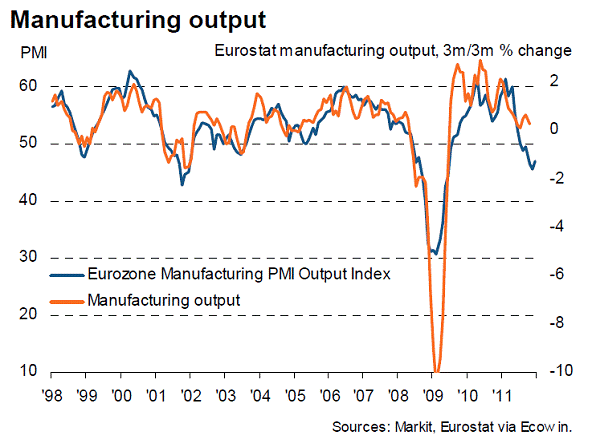
The final December reading of the Markit purchasing-managers index for the manufacturing sector rose to 46.9 from a 28-month low of 46.4 in November, matching an earlier estimate.

“Euro-zone manufacturing is clearly undergoing another recession,” said Chris Williamson, chief economist at Markit. “Despite the rate of decline easing slightly in December, production appears to have been collapsing across the single-currency area at a quarterly rate of approximately 1.5% in the final quarter of 2011.”

For the second month in a row, all nations covered by the survey reported a decline in output.

Williamson said it was particularly worrying to see new orders falling at a far faster rate than output. That indicates firms have relied on orders placed earlier in the year to sustain current production levels, he said.

Hussman: Hope for Change in 2012

Happy New Year. We enter 2012 with a great deal of hope, but our hopes are not for more bailouts, or money printing, or any of the myriad policies that investors seem to hope will save bad investments and sustain elevated valuations. Instead, our hope is that in 2012, the market will finally "clear," in the sense that bad debt will be recognized as bad and restructured; that overleveraged financials will be taken into receivership instead of forcing austerity on every corner of the economy in order to make them flush again; that rates of return will rise enough to compensate and encourage saving - and high enough to encourage borrowers and other users of capital to allocate the funds productively. Of course, in order to restructure bad debt, someone has to accept a loss. In order for rates of return to rise, valuations must decline. In short, our hope is for events that will unchain the global economy from an irresponsible past and open the gates toward a prosperous future. Maybe that is too hopeful, but we are not entirely convinced that bailouts and "big bazookas" will be as easily procured in the year ahead as a confused public has allowed in recent years.

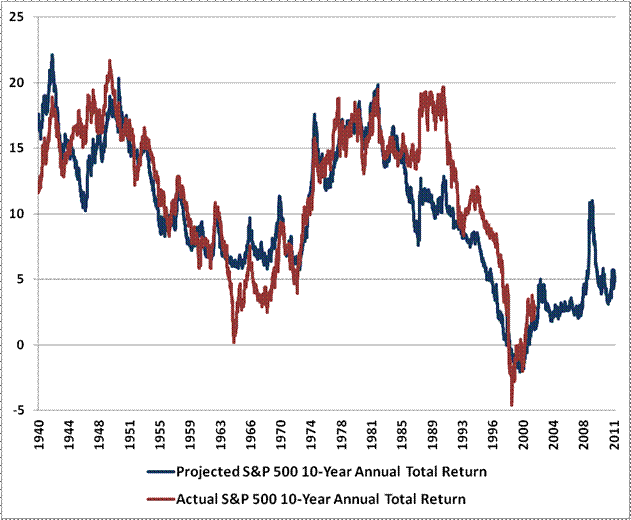
We begin 2012 with the S&P 500 priced at valuations from which we estimate 10-year total returns of just 4.9% annually. This figure would be less discouraging if it were not for the fact that valuations - properly normalized for the cyclicality of earnings - have been tightly related to subsequent returns as far back as one cares to look, and as recently as the past decade. It is true that rich valuations did not prevent the late 1990's bubble (corresponding to late 1980's 10-year total return projections), but the ultimate and predictable outcome of that bubble has been more than a decade of stagnant returns. Back in 2000, it seemed inconceivable that we could be projecting negative 10-year total returns, but that outcome was the natural result of the valuations we observed at the time. Weak returns over the coming decade (hopefully front loaded as a few years of negative returns, followed by normal or above-average returns in the out-years) are likely to be an equally natural result of present conditions.
With 10-year Treasury yields below 2%, 30-year yields below 3%, corporate bond yields below 4%, and S&P 500 projected 10-year total returns below 5%, we presently have one of the worst menus of prospective return that long-term investors have ever faced. The outcome of this situation will not be surprisingly pleasant for any sustained period of time, but promises to be difficult, volatile, and unrewarding. The proper response is to accept risk in proportion to the compensation available for taking that risk. Presently, that compensation is very thin. This will change, and much better opportunities to accept risk will emerge. The key is for investors to avoid the allure of excessive short-term speculation in a market that promises - bends to its knees, stares straight into investors' eyes, and promises - to treat them terribly over the long-term.
Again, we enter the year with great hope. But our hope is not for continued speculation and the maintenance of rich valuations (that only look reasonable because long-term cyclical profit margins are at a short-term peak about 50% above their historical norms). At present, we have a situation where saving is discouraged by desperately low interest rates, where unproductive uses of capital are not discouraged because the bar is so low, and where central banks recklessly facilitate economic stagnation by bridging the gap between a puddle of unrewarding savings and a mountain of unproductive speculations. So our hope this year is for a return to a proper investment opportunity set - where saving is encouraged and rewarded by sufficiently high prospective returns, and the cost of capital is high enough to discourage high-risk, low-return investments and unsustainable fiscal deficits. The longer policy makers wait to begin the orderly restructuring of bad debt and overleveraged financial institutions, the greater the risk of a disorderly restructuring.
Europe Update
The Eurozone Purchasing Managers Index (Markit) is already well into recessionary territory. Notably, production and new orders continued to hit fresh lows in the latest report - the slight uptick in the index reflects only a slowing in the rate of decline. The accompanying commentary observed "Production declined for the fifth consecutive month. The fall was less sharp than the 29-month record seen in November, though it remained steep compared with previous downturns prior to the financial crisis. Output and new business fell across the consumer, investment and intermediate goods sectors, with the latter reporting the strongest declines in both cases. For the second consecutive month, all of the nations covered by the survey reported lower levels of output... the fall in production at euro area manufacturers reflected a seventh successive monthly decline in new orders received." Markit's chief economist noted that the latest data "suggests that operating capacity will be slashed in coming months unless demand revives."
Meanwhile, the European Central Bank is more tapped out than we suspect investors recognize. The balance sheet of the ECB now stands at about $3.55 trillion (2.73 trillion euros), compared with EU GDP of about $16 trillion. This puts the European monetary base at about 22% of EU GDP, which is even greater relative to the economy than the Fed's balance sheet ($2.97 trillion on $15 trillion of GDP as of December 28, which works out to 21 cents for every dollar of GDP). Forget the "zero bound" - given the bloated size of the ECB balance sheet, combined with the lack of credible safe-havens in Europe, distrust of the banking system, and an apparent aversion to cash-stuffed mattresses, German 3-month debt is now sporting a yield of -0.17%, which means that investors pay the German government for holding their money.
As noted in Why the ECB Won't, and Shouldn't Just Print (see the section on inflation and the value of fiat currencies), this expansion in the central bank's balance sheet is not necessarily inflationary provided that market participants are firmly convinced that it is temporary. The value of one unit of currency stems from the stream of transactional and value-storage "services" that the currency unit is expected to throw off over time (as measured against the marginal value of other goods and services). If a large volume of new currency is created, but only for a short period of time, the expected long-term value of the existing currency stock is not seriously diluted, and you shouldn't expect to see inflation. It's when the currency creation is effectively permanent that you see large dilution of the value of existing currency units, which is another name for inflation. The ECB will not purchase unlimited amounts of distressed European debt precisely because nobody would expect the ECB to have the ability to reverse the transaction, and worse, if the debt were to default, the result would be immediate and rapid inflation because the money stock would suddenly be viewed as permanently high.
In lieu of printing euros to buy distressed debt, the ECB initiated a massive round of 3-year loans to European banks last month, taking securities from those banks as collateral. It's important to recognize that the ECB does not take credit risk by doing this. Regardless of how the collateral fluctuates in value, the ECB has a claim to repayment of the original loan, plus interest, and that claim stands ahead of the claims of existing bank bondholders and certainly stockholders.
While some observers hope that the massive round of ECB loans to European banks will spur bank purchases of distressed European debt in an attempt to "arbitrage" the higher interest rate on that debt against the 1% rate charged by the ECB, this really isn't what investors should expect. What's actually happening here is that European banks, already spectacularly over-leveraged against their own capital, can no longer successfully access the commercial paper markets for funds, so have had to turn to the ECB for this liquidity. The sheer size of the recent operation was not an indication of potential new bank demand for distressed European debt, but instead was an indication of how strapped the market for short-term and unsecured funding has become for European banks. Moreover, the whole "arbitrage" idea is flawed in the sense that it implies that the capital shortfall of European banks can reliably be bridged out of the pockets of the most distressed EU member countries.
Let's be clear about this - if European banks were to use the funds from the ECB to make significant new purchases of European debt, their capital ratios would become further strained, their portfolios would become more unbalanced, the market for new short-term and long-term bank funding would become even more deserted, and the timeline for European bank receivership and restructuring (a phrase that we prefer to "failure") would simply be accelerated.
I expect that we will see some further progress toward a "fiscal union" among European member states, but without explicit changes to the EU Treaties ratified by all of its members, we will not see any move toward unlimited ECB buying of European debt. At best, the ECB will act as a collateral-taking intermediary in an attempt to ease increasingly frequent liquidity strains in the banking system. On fiscal union, the real issue is credibility - how do you really impose fines and other penalties against countries who are already unable to pay their bills? In the end, hopefully sooner than later, it would be best for European member states to begin adding convertibility clauses into their debt, giving them the option to convert the debt from the euro into their legacy currencies. This would substitute credible market discipline for ineffective political sticks, and given that the average maturity of European debt is only about 7 years, much of it front-loaded, it would also remove the specter of massive sovereign defaults within a fairly short period of time.
That said, it is important to remember that the attempt to rescue distressed European debt by imposing heavy austerity on European people is largely driven by the desire to rescue bank bondholders from losses. Had banks not taken on spectacular amounts of leverage (encouraged by a misguided regulatory environment that required zero capital to be held against sovereign debt), European budget imbalances would have bit far sooner, and would have provoked corrective action years ago. The global economy has not been well-served by the financial companies that leaders are trying so desperately to protect. Our vote is for receivership and restructuring so that losses can be taken by those who willingly accepted the risk of loss, and the legacy of bad investments and poor capital allocation doesn't have to be converted into a future of suppressed economic growth.

Europe Could Go From Bad in 2011 to Even Worse in 2012

by Charles Forelle at WSJ:

Bouts of panic. Moments of elation. Vertiginous plunges. Markets lurching on the scantiest fragment of news from a Parliamentary committee in a minor-league country.
That was investing in Europe in 2011. Be prepared in 2012 for at least more of the same.
The rocky road was thanks to weakening economic performance across the continent and, most of all, to the euro-zone debt crisis.
The economic story is almost certain to be worse. Europe saw modest growth in the first quarter of 2011, and then the slowdown began. Most economists now project recession in 2012.
As for the debt crisis, it is far from over. At the end of 2011, European leaders all but gave up their bid to build a giant bailout fund—they just don't have enough cash—and instead scrambled to assemble the underpinnings of a tighter fiscal union, in the hope of giving a reluctant European Central Bank confidence to step in and offer support for government-bond markets.
But Europe has only touched its toe on the fiscal-union path, the faraway end of which is common debt issuance for the 17-nation bloc. A lot could go wrong before it gets there.
The peril starts in January, when euro-zone governments plan to issue a wall of debt. "It's going to be hard to take it all down," says Nick Firoozye, senior European rates strategist at Nomura Holdings Inc. in London.
Then come the fraught negotiations over Greece's debt restructuring. Euro-zone leaders and big creditors agreed in October that bondholders would take a 50% haircut, but the mechanics of the complex restructuring aren't finished. Greece may try to push for a better deal. "It's in Greece's interest not to reach an agreement," Mr. Firoozye says.
But there is pressure to complete a deal before mid-March, when Greece is scheduled to repay a €14.4 billion ($18.7 billion) bond. Any hiccups could unnerve markets.
Across asset classes, investors should expect volatility and uncertainty. Here's a guide:

Bonds
European government bonds have been the asset class most affected by the crisis so far. It has been "an environment punctuated by bit of optimism and bits of pessimism," says Nicholas Gartside, international chief investment officer for fixed income at J.P. Morgan Chase & Co.'s asset-management arm. "You've had both extremes, and our view is you are likely to see those extremes continue into the next year."
YE_EUROLOOK_pic
Reuters
After a year of stops and starts in trying to resolve the debt crisis, France's Nicolas Sarkozy and Germany's Angela Merkel, shown at a June meeting, face another year of without resolution.
The extremes in 2011 were dizzying. Like U.S. Treasurys, German government bonds rallied strongly as a safe-haven bet. But Italian yields spiraled into junk-bond territory.
Performance of "peripheral" euro-zone bonds—a category that probably now includes Italy, the third-largest economy in the bloc—is likely to be hugely volatile. The yields are enticing, but the investment isn't for the faint of heart.
The giant risk is a sudden stop in financing to Italy. The ECB has tried to prevent that with a modest program of bond buying and big injections of liquidity into the banking system. But many analysts are skeptical that banks will take that cash and finance Italy. Regulators are pressuring them to reduce their exposure to the wobbly periphery, not increase it.
At the same time, Mr. Gartside says the outlook remains bright for Germany. There is little visible threat from bond investors' two chief villains—inflation and higher interest rates—and Germany should continue to be a haven.
The Euro
One of the head-scratchers of the debt crisis so far has been how well the euro has held up amid all the frantic fretting about the dissolution of the currency zone. The euro started 2011 at $1.34 and ended it at $1.30 (with rounding). Yes, there have been ups and downs in between, but the common currency never broke $1.50 and only barely sank below $1.30.
YE_euro_zone
There are a few explanations. First, the fear of a schism in the euro zone is probably overblown. Second, currency rates are influenced by banal factors such as interest-rate differentials, crisis or no crisis. And even after a round of rate-cutting, the European Central Bank has a higher target rate than the Federal Reserve.
There are more-subtle factors. Stephen L. Jen, managing partner of London hedge fund SLJ Macro Partners and a currency watcher, says European banks and corporations have been repatriating overseas assets—helping to offset flight out of the euro zone. And much movement has been "south-to-north" migration, he says—investors pulling out of Greece, but piling into Germany and the Netherlands. That is neutral for the currency.
What to expect in 2012? A crucial dynamic will be the recession everyone expects is coming. If it is nasty, the ECB may cut rates and, some analysts believe, even hold its nose and adopt a quantitative-easing policy where it buys bonds to provide monetary stimulus to the economy. That would erode the interest-rate advantage the euro has over the dollar and implies a weaker euro.
Of course, the ECB isn't the only one with these concerns: If the U.S. Federal Reserve embarks on a third round of quantitative easing, or QE3, the pressures are potentially reversed.
And there is always the threat of policy stumbles by European leaders jolting the markets.
All in all, "trading euro-dollar will require a lot of care," Mr. Jen says.
Stocks
European equity investors probably wish 2011 were just a bad dream. The U.K.'s FTSE 100 was off 5.6%, Germany's DAX fell 15% and France's CAC-40 lost 17%.
Can investors hope to wake up in 2012? Maybe.
Domestic economic performance will likely be bad, but the big companies in Europe's major indexes are world-wide players, and they can benefit from a brighter picture in Asia and even the U.S.
"The rest of the world is in a much better place," says Nick Nelson, UBS AG's European equities strategist. "It's a European recession, not a global recession."
A somewhat weaker euro, he expects, will also aid the region's exporters.
The downside? The debt crisis has been an albatross for equities. Mr. Nelson notes that the price-to-earningsmultiple investors have been willing to pay for European stocks correlates inversely with an index of European sovereign credit-default swaps—a measure of the risk of government debt default. In other words, when the debt crisis rears up, investors are less likely to take a gamble on stocks.
That was on full display in August, when Italy tumbled into the maw of the crisis. The Milan exchange was pummeled, but so too were bourses in Paris and Frankfurt and London. The DAX had three days in August on which it fell by more than 5%; before August, the last such single day was in March 2009.
Mr. Nelson predicts a small rise in European indexes in 2012—but it is an outlook dimmed by uncertainty. "Volatility," he says, "is massive."

Cool Crude!

Company's Breakthrough Technology Uses Captured CO2 and Natural Gas to Make Ultra-Clean and Environmentally Friendly Synthetic Crude Oil
SANTA BARBARA, CA -- (Marketwire) -- 01/03/12 -- Carbon Sciences Inc. (OTCBB: CABN), the developer of a breakthrough technology to make liquid transportation fuels from natural gas and carbon dioxide, today announced that its breakthrough technology could also be used to make CarbonCrude™, the company's version of an ultra-clean and environmentally friendly synthetic crude oil.
The ultimate goal of most gas-to-liquids (GTL) operations is to produce finished liquid transportation fuels from natural gas. But in many situations, such as certain oil fields and offshore platforms, the associated natural gas stream is often too limited for conventional GTL fuel production, and too substantial to be released into the atmosphere. Flaring (burning) this excess gas, resulting in carbon dioxide emissions, is not politically acceptable in many parts of the world. Converting the associated natural gas into liquefied natural gas (LNG) is a costly process and requires LNG infrastructure that is not readily available near most oil field operations. Therefore, the existence of associated natural gas in oil fields often makes those reserves uneconomical to develop or costly to operate.
Byron Elton, CEO of Carbon Sciences, commented, "The company's CarbonCrude solution was developed for a small scale GTL operation that can convert oil field natural gas into CarbonCrude, our version of an ultra-clean and environmentally friendly synthetic crude oil. CarbonCrude can then be blended with natural crude oil from the field and transported to market using existing oil pipelines. Existing refineries can then process this blended crude oil into a variety of products, including transportation fuels." Mr. Elton continued, "Another benefit for oil field operators is that our CarbonCrude solution eliminates the need for separate natural gas infrastructure within the oil field operations."
The CarbonCrude process consists of two steps. The first step relies on the company's breakthrough natural gas reforming catalyst that consumes carbon dioxide to produce syngas. The carbon dioxide required for this step can often be found in the natural gas stream, by flaring some of the gas and capturing the CO2, or by capturing CO2 from local power generators. The second step is a low-intensity Fischer-Tropsch process that converts syngas into low cost CarbonCrude, instead of a high cost complete fuel.
Byron Elton concluded, "Associated gas is a big problem for resource holders and can negatively affect oil field economics. By converting this excess gas into synthetic crude oil using our low capital, clean-tech solution, we believe we can deliver both economic and social value to oil field operators. We intend to aggressively target oil field operators with our CarbonCrude solution."
About Carbon Sciences Inc. Carbon Sciences has developed a breakthrough technology to make liquid transportation fuels from natural gas. We believe our technology will enable the world to reduce its dependence on petroleum by cost effectively using natural gas to produce cleaner and greener liquid fuels for immediate use in the existing transportation infrastructure. Although found in abundant supply at affordable prices in the U.S. and throughout the world, natural gas cannot be used directly in cars, trucks, trains and planes without a massive overhaul of the existing transportation infrastructure. Innovating at the forefront of chemical engineering, Carbon Sciences offers a highly scalable, clean-tech gas-to-liquids (GTL) process to transform natural gas into transportation fuels such as gasoline, diesel and jet fuel. The key to this cost-effective process is a breakthrough, methane dry reforming catalyst that consumes carbon dioxide. Our proprietary catalyst is now undergoing rigorous commercial testing to meet the needs of the natural gas industry and will be available for use in pre-feasibility studies of new GTL plants. To learn more about Carbon Sciences' breakthrough technology, please visit www.carbonsciences.com and follow us Facebook at http://www.facebook.com/carbonsciences.

Friday, December 30, 2011

And Thus the Year Ends

Gaping Hole In Europe's Deficit Expectations

The Eurozone's Constitution requires countries to keep their deficits below 3% of GDP. Nearly all of them have deficits higher than this amount. Spain's is more than 2 1/2 times that amount!

The Pandemic of Corruption in the Financial Markets

Jim Puplava: Joining me as my special guest on the program today is Ann Barnhardt, formerly of Barnhardt Capital Management. And Ann, you were a commodity broker for eight years and then you formed your own independent brokerage for six years. A couple of weeks ago you made the painful decision to shut your doors because you felt your clients’ money and positions were no longer safe. What led you to draw those conclusions?
Ann Barnhardt: Well, obviously, it was the MF global collapse and more specifically the fall out after the MF Global collapse and the reaction by the CFTC, the SEC and most especially by the Chicago Mercantile Exchange [the “Merc”]. The actions, specifically by the Merc after the MF Global collapse were unprecedented, unfathomable and completely and totally intolerable. The Merc itself basically did the equivalent of sticking a nine millimeter in their mouth and pulling the trigger by not stepping forward, backstopping the MF Global client accounts and at the very least, the Merc should have allowed the MF Global customers to liquidate their accounts and then transfer to other firms. What the Merc did was the worst possible thing—they froze those people out of their accounts and didn’t allow them to liquidate while the markets continued to trade. And I cannot over-emphasize the importance of that, the risk that those people were exposed to in the cattle business (and my forte is cattle. I am actually a cash cattle person. My brokerage business was geared almost exclusively towards livestock and grade. I have a lot of contacts in the cattle industry who didn’t necessarily do their futures business with me but were contacts of mine who did do business through brokers that cleared through MF) who lost tens of thousands of dollars on hedge positions that they wanted to get out of but could not get out of in the week and a half after the MF Global collapse.
This has never happened before. This was a complete breach of fiduciary duty by the Chicago Mercantile Exchange itself to the point that it literally has destroyed the entire paradigm. I got to the point where I could no longer tell my clients that their free cash customer funds, not even exposed to the market place—just their cash sitting in their account, non-margined—was not safe. I couldn’t tell them that their money was safe. At that point it was morally incumbent upon me to get my client out of this completely dysfunctional, basically destroyed marketplace. Get them off of those railroad tracks and get them away from the risk. Now, I didn’t clear through MF, but with the European collapse and knowing what we know about how these financial entities are leveraged in European paper and the cascading nature of all of this I had to act before the proverbial poop hit the fan because if you sit around and you wait until after the poop hits the fan it is too late. You wouldn’t get anybody out. To me, it wasn’t really a painful decision. It was a complete no brainer.
Jim Puplava: In the past, when firms went under customer funds were intact and the exchanges would step in, as you mentioned earlier, to backstop everything to keep customers 100% liquid. And normally, a quick transfer from the bankrupt firm, the bankrupt firm would be immediately replaced. Why do you think they did not allow that to happen this time?
Ann Barnhardt: You tell me. I will use the word again, it is suicidal. What they did was suicidal. So you are absolutely right. Up until last month on Friday, October 31st, the customer segregation of funds rule was utterly sacrosanct. Even when Refco imploded and imploded quite dramatically in 2005, no customer funds were gone. It was on the prop trading side of the company but the customer funds were there, were accounted for, and it is the onus of the Mercantile Exchange to audit these FCMs [Futures Commission Merchant]. MF Global was under the auspices and under the supervision, of the auditing supervision, of the CME. And I believe that MF was audited not just annually, but quarterly. Also, there is the question of how in the world can the Merc miss the margin being posted. The Merc is supposed to be moving equity and doing margin wire transfers twice a day every day. How could those customer funds be “missing”. They aren’t missing. They were stolen. They were stolen by Jon Corzine and his cadre of associates at MF Global. So yes, again, to your listeners who may not fully appreciate the gravity of this, this has never, ever happened before. Nothing even close to this has ever even happened before and it is the function of the Mercantile Exchange itself—the reason why the exchanges exist is that they stand in the middle of every transaction and they act as the de facto counterparty to every single transaction so that, for example, my clients never had to worry about the credit worthiness of the other individual, whoever it might be, who is on the other side of any trade that they did.
Now, for every buyer there is a seller and it is a one-for-one, zero-sum game; but to ensure the credit worthiness and the integrity of the market, the function of the Mercantile Exchange itself is to stand in the middle of every transaction and be the guarantor. So a year ago when Terry Duffy held a press conference [watch it here] and said never in the history of the Mercantile Exchange has a customer ever, ever lost funds resulting from the collapse of a firm, he was telling the truth a year ago. Everything changed on Halloween of this year though. And that's why I had to shut the doors of my brokerage because I could not in good conscience continue forward knowing that the Mercantile Exchange was no longer going to fulfill their fiduciary duty.
Jim Puplava: In the futures market, which is highly leveraged, if you open up a futures contract you are usually leveraged 10-to-1, so they require an exceptional firm base on which to function. And the major integrity of the whole system is the segregation of customer funds. That was breached by MF Global. And let’s not sugar coat this, Ann, basically management stole all of the non-margin cash, invested it in highly speculative securities and what has astonished me has been the reaction of the exchange and regulators—where is the investigation into Jon Corzine?
Ann Barnhardt: Well that is the point of this. We are now living in a lawless, Marxist, Communist, usurped, what used to be a representative republic but is no more. This is no longer a nation of laws. This has now transformed into a nation of men. It doesn’t matter what crime you commit. In the case of Jon Corzine, this man has stolen in excess of a billion dollars. I think by the time it is all panned out it is going to be closer to $3 billion of customer funds that he stole. Why did he do it? Is he stupid? Well, of course he’s not stupid. This is a former head of Goldman Sachs. This man doesn’t have a low IQ per se. Why in the world would a man wake up in the morning one day and say you know what, I think I am going to steal all the customer seg funds in this FCM that I’m running, which is the biggest FCM in the country. Yeah, that sounds like a good plan. No. Why would a man like that even engage in a nefarious plot like this? Because he knew going into it he could get away with it. And the reason he could get away with it is he is in tight with the Obama regime. He is one of Obama’s highest fundraisers. Earlier this year Jon Corzine had a fundraiser dinner at his New York City apartment for Barack Obama where it was charged at $35,000 a plate. Okay? He bundled high six figures for Obama in one evening! He is a crony of the regime. This is Marxist Communism. There is no rule of law. And these people, these poor MF customers are just sitting out here helpless to do anything because there is no law enforcement because this is no longer a nation of laws. The rule of law no longer exists. There is no longer justice in this nation. And no nation, no culture, no society can survive if there isn’t a foundation of justice. That is why we are teetering on the precipice of collapse and I foresee civil war coming within the next several years.
Jim Puplava: You know, we had Gerald Celente on this program and he had an account with Lynn-Waldok, which was eventually taken over by MF Global, and he's been trading futures in gold. He had a plan when he built up enough he would eventually take delivery. Well, they stopped him out of his trade, sequestered his margin (or his cash) and forced him out of a trade and closed his account.

So what you are talking about—because the exchange did not backstop and then froze customer accounts—is they forced, would you say, millions if not hundreds of millions of dollars of losses on these customers?
Ann Barnhardt: Absolutely. If we are talking several billion in customer seg funds then the losses that were incurred could easily by the customers in that week, week and a half that they were frozen out could easily, easily get into the hundreds of millions it might even breach into the low billions. No question about that. And yeah, and even with options. You know, I talked to cattleman who have put options on as hedges to put a floor underneath the price of the cattle in case—so imagine this, you buy a put option four months ago, you pay the premium. You post that money. Then this happens, you are frozen out of your account. Your account gets transferred to another firm, without your consent. By the way, none of the customers were allowed any input into this. Their accounts were just sent to RJ O’Brien and other firms like that without their consent. And then once the positions were transferred, even if it was a risk limited position like a long put option, then the new clearing firm called them the next morning after the trade settled and said there was no equity in your account because all that money got stolen. So you are going to have to pay the premium for this put option again. So it's doubling the cost essentially for a lot of these people out here who are dealing in what is supposed to be the very risk limited paradigm of long options. The entire situation could not have been handled any worse. In fact, I would take it a step further. It was handled so poorly I can’t imagine that these people are that stupid at the Merc and at the CFTC and so forth. I can’t believe that the bankruptcy trustee is that stupid. This almost seems like it was so bad that it had to have been nefarious.
Jim Puplava: You know, Ann. You believe that MF Global is just the tip of the iceberg. That there is massive industry exposure to European sovereign debt. In fact, the day you and I are doing this interview the Fed just engineered a major swap with central banks. It was a central bank love fest on Wednesday of group money printing. That tells me that central banks acting in unison the way they did shows they are afraid that there's something big out there that is about to happen and that they are trying to maybe plug a hole in the dyke.
Ann Barnhardt: Well, if anybody out there understands fourth grade arithmetic you know from metaphysical certitude that Europe is done. Europe is mathematically impossible. It cannot be saved. You want to make a start. You even want to make a start at trying to bail out Europe we are talking $25 trillion just to start. And it would then—if you were going to bail out the entirety of Europe—you would now be talking about hundreds of trillions of dollars. Okay, people, there isn’t that much wealth or money on the surface of the earth. The total gross domestic product of the entire planet earth is I think just under $70 trillion. And we are talking about in excess of $100 trillion to bail out Europe? This is now mathematically impossible. These people have so leveraged themselves and so leveraged these governments in these countries giving their brain dead citizenry free hand outs and entitlements that it is now mathematically impossible to save the paradigm. It's not a matter of if the global financial system is going to collapse. Oh, it's going to collapse. You better trust and understand that. It's just a matter of when. And these piddling little maneuvers that these people are making that the Fed is doing. Oh, we are going to give Europe some money. Okay. What I saw this morning, what the Fed is getting ready to do in terms of Europe, is keep Europe going for another seven days. Well, fantastic. Thanks for that. That is literally the brain dead mindset of these politicians. All they are doing is looking to kick the can down the road. At first it was kick the can down another 10, 12 years. Then it is kick the can down the road for another year. And then it was well, let’s kick the can down the road for another few months. Now we're literally to the point where all we can do is kick the can down the road for a matter of a few days. It's not going to make it. I will be very surprised if we make it until Christmas.
Jim Puplava: You know, one would have thought Ann, after the 30 to 40:1 leverage leading up to the financial crisis of 2008, pre-Lehman, that financial firms would have learned. And especially a guy like Jon Corzine that saw Goldman have exposure to AIG with $13 billion in credit default swaps which we bailed him out 100 cents on the dollar. Apparently, this lesson was not learned at MF Global because the leverage, what was the figure? I think it was 100:1—it was just astounding.
Ann Barnhardt: The only lesson that these criminal degenerates learned from the 2008 situation was that they could do anything they want and that pimp daddy government would bail them out. You have to understand, people like Jon Corzine, these are evil, evil people. He went into MF Global looking to rape that company personally for his own good. And that's what the motivation of a lot of these people are. You have to get your heads around this. You have to get your heads around the fact that there are truly evil people in the world who do not give a crap about anyone or anything except themselves, their own personal wealth and their own personal power. And they would sell their grandmother to the Nazis for a nickel without hesitation if they thought they could get away with it. It's the same with people like Jon Corzine, and then we have talked about the fact that Jon Corzine is tied into the Obama regime. And we now know that the government is absolutely stuffed to the gills almost exclusively with this same type of moral degenerate culture. These people that are in the government—not just the Congress and Executive Branch but also in the bureaucracy—they are in it for themselves. They are in it for the money. And two weeks ago when we had the 60 minutes exposé on the insider trading, those of us who have been in the business have known intuitively that that was going on for a very, very long time. We knew that there was front running going on by politicians. A great example of this is someone like Harry Reid. When he entered Congress, Harry Reid had a low six-figure net worth. He now has an eight-figure net worth. And he's never done anything except be a United States Senator. The salary I think of which is something like $170,000 a year. How does that happen? How does a man with $170,000 a year salaried position go from having a six-figure net worth to an eight-figure net worth? That doesn’t make any sense unless he is doing nefarious, illegal, insider trading type deals.
It is obvious what's been going on. You have to start acknowledging these people for what they are, and that is moral degenerates who are basically sociopaths and psychopaths. Meaning they don’t feel any sympathy or empathy for other human beings. The only thing they care about is themselves. They will do anything. They will steal. They will lie. They will cheat. They will lie to your face. They will look in the camera with this tremendous earnestness and lie with fork tongues through their teeth in order to advance their wealth and power. And if we, as a people, don’t get real about this, if we keep having these Pollyanna visions that these people are all on our side and they are really looking out for us. And they are doing the best they can. We will be cork screwed into the ground and this nation will be reduced to a smoldering rubble. You've got to wake up.
Jim Puplava: I would like to go back to MF Global for a second. There is something even worse as you look into the details—it's been hinted and that there could be possible clawbacks. I’m wondering if you might explain that possibility and what a clawback means for, let’s say you had an account at MF Global and, I don’t know, you didn’t feel comfortable with the commodities market—the volatility. So you pulled the money out. There is a possibility they can go after you.
Ann Barnhardt: Oh, absolutely. Clawback is a fairly common tactic in bankruptcies. And what it is is looking at the bankrupt entity and looking at the money that went out of that entity in the time period immediately preceding the collapse. And I don’t know what time frame they would look at MF. I don’t know if it would be 30 days or 60 days or 90 days—I have no idea. But the trustee has in the last two weeks said that yes, clawback is on the table. So what that means is, let’s say for example, you are a savvy individual and you are a good steward of your money. And you are doing business with a firm that clears through MF Global. You are looking at MF Global’s publicly available bond yields. And you see in the six weeks before the collapse that their bond yields spiked parabolically [see chart here]. They went from 6% to 18%. That is a sure, sure sign of massive trouble. And so being an intelligent, informed, aware person who is a good steward of their wealth, what do you do? You say I’m getting out of this company. I am getting my money out of MF Global because something bad is about to happen looking at these bond yields. You can also do the same thing looking at the stock price. You could do the same thing looking at downgrades by the ratings agencies. There's all kinds of ways that you can come to these conclusions.
The other thing is if you're a hedger. If you are a bonafide hedger—if you had positions on and the market moves in favor of your hedge position on the futures side, you don’t leave that equity sitting in your account. What your broker like me does is they wire that money home because you are using that money probably to either offset a cash transaction or to pay down a revolving line of credit. You're not getting any interest on your money sitting at MF Global so you might as well get that equity out of there, send it home and pay down your line of credit so you are not paying interest on that money. So there would organically have been lots and lots of money flowing out of that company in the period immediately before the collapse. Either due to natural hedges, organic in and out functions or due to intelligent people looking at the bond yields and saying uh oh we better get out of here. The bankruptcy trustee can legally claw that money back. Say okay, I am going to go and I am going to dive into your pocket now. And I am going to claw back your money which you, in your responsibility and in your good stewardship pulled out of a company that you knew to be in trouble. Oh yeah, so these MF customers will essentially be raped three times—they will have their cash stolen out of their accounts, they were then locked out of their position so they couldn’t trade and were fully exposed to market risk, paralyzed, unable to do anything for excess of a week. And then, number three rape, is having the bankruptcy trustee come back and literally seize money out of your own personal checking accounts and business accounts and so forth. And clawing it back to feed this bankrupt entity. And you know what the cherry on top of the sundae of all this is? And this is what blows my mind—the bankruptcy trustee, right now, as this is being recorded on the 30th of November. The bankruptcy trustee is still allowing MF Global to trade proprietarily for itself, for the company proper.
It is unbelievable. The rule of law is dead in this country.
Jim Puplava: You know, adding to this just prior to that was the restructuring of Greek debt, where the derivatives association announced that it was a voluntary restructuring so therefore the bankers didn’t have to pay out on credit default swaps. So what you have here, Ann, I believe is a system where the government is protecting the too-big-to-fail at the expense of the customers. And with it, the rule of law is thrown out to protect Wall Street, what does that say about the integrity of the system? It is no wonder people are losing faith.
Ann Barnhardt: There is no integrity in the system. And let’s make it simple—it is not just about the government protecting the “too big to fail banks". It is about criminal oligarchs as individuals protecting each other. They don’t give a crap about the customers of JP Morgan or you know, Citi or Goldman or anything. What they care about is each other. The Obama regime is protecting Jon Corzine proper, the individual. Because he is one of them. He is one of these criminal oligarchs. And for your listeners who may not remember, Jon Corzine is a former congressman. But immediately preceding MF Global he was the Governor of New Jersey and he just cork screwed Jersey into the ground. It is Chris Christy who beat Jon Corzine to become the governor of New Jersey. So yes, this Republican, Chris Christy, was elected in New Jersey—uber liberal, blue state New Jersey—because Corzine financially destroyed this state. And again, this guy Corzine is former head of Goldman. He is not stupid. You have to stop thinking that these people are just misguided or that there is some sort of a difference of opinion on economic theory. These people are nefariously trying to destroy everything in this country. It's called the Cloward-Piven strategy. Go in and destroy and collapse the entire economy, everything and then rebuild a new Marxist, Socialist, fascist state out of the burning rubble of this destruction. This is intentional. This is nefarious. This is not a function of incompetence. It's a function of malice of forethought and conscientious theft and destruction.
Jim Puplava: What would you advice? I am a long term believer in the bull market in commodities, but how do you play commodities when the futures market is no longer secure? And what does this do to the proper functioning of the markets? In other words, now that you've closed your firm because you don’t believe in the integrity of the system and we just listed a series of reasons why—not honoring contracts, appropriating funds, not allowing trades to go off. Not one investigation, in fact, this goes even further than that. We had Bill Black on the program recently, who helped make prosecutions in the S&L scandal. And at that time, 2,000 individuals went to jail. There has not been one criminal charge brought by the justice department since the 2008 crisis. So given that this is where we are, what do you advise and what will you do personally?
Ann Barnhardt: Well get the hell out. Get out of all paper and it's not just the commodities markets. This is going to cascade through everything. It is going to get into the equities. It is going to get into 401ks and IRAs, it is going to get into pension plans and so on and so forth. Total systemic collapse. Get out! I don’t know how I can be anymore plain about this. I say this over and over and over again and then I get scads of emails saying, well I can’t get out of my 401k. Yes, you can. Yes, you can. Take the penalty and get the hell out of there. What would you rather do? Would you rather pay the 10% penalty or would you rather have it all go up in smoke? Because that's what we're staring down the barrel of. Number two, we seem to have this backwards. In terms of what I do, cattle and grain specifically, the futures markets are the derivatives. The futures markets are derived from the actual cash commodity market. Now, I am blessed because my area of expertise is actually in the physical cash market, actual cattle on the hoof. So I have a consulting firm and I'll continue to teach cattlemen how to trade actual physical cattle. But, yeah, to all the people out there listening—you are going to have to get away from paper and get back into physical commodities, the real deal. Anything that is on paper anything that involves a promise or a commitment is no longer valid because as we said there isn’t a rule of law anymore. People can steal from you. Your money can be confiscated. And think how easy now it is to confiscate people’s wealth. Most of our wealth in this society exists as zeroes and ones on a computer server. It takes no effort whatsoever to steal zeros and ones on a computer server. So what I have been telling people is you need to get into physical commodities. And the rule of thumb is if you can stand in front of it with an assault rifle and physically protect it, then it's real—it's a real commodity. That includes food, that includes water, that includes long guns and ammunition. That includes fuel. That includes precious metals—gold and silver coinage. Most especially silver coinage because silver is the metal of barter and transaction and currency. Gold is the storage metal because it's so valuable per ounce. And also, silver is extremely undervalued relative to gold because that market has been synthetically suppressed for the last several years by again, these nefarious actors. So yeah, reallocate into physical commodities.
Jim Puplava: How do you know that somebody like just as we saw in 2008 or recently with MF Global—that is somebody like a Goldman, a JP Morgan that is writing credit default swaps on European debt—how do you know if you have an account with this group that they pledge your assets for collateral or they comingle them with the firm’s assets and then what do you do?
Ann Barnhardt: Oh, exactly. Corzine isn’t alone in this. The reason the MF Global situation happened the way it did is as we eluded to earlier because Corzine had that company just suicidally leveraged. He took those customer funds and then leveraged it into European, sovereign, junk paper at about 100:1 ratio. Massive. Massive leverage. That is why his collateral call was the first one to come and why it took him out because he was so heavily leveraged. Don’t kid yourself. These other entities are doing the same thing. It is just that they are not as heavily leveraged as Corzine was. So yes, the entire paradigm is no longer trust worthy. There is no meaningful government or industry wide regulation and I have been saying this for years. That regulation in the financial industry in the United States both government based and private regulation—private industry regulation—is a monstrous, monstrous joke. The top tier of those organizations are evil, nefarious people. The mid level are halfway stupid, halfway evil who again, are just there to collect their salary paycheck and will say and do anything that they are told and who really don’t understand the business that they are trying to regulate. And then the lower level, the grunts, the actual auditors who go out on site, a lot of those people are super incompetent, affirmative action hires. And yes, I said it and I am not ashamed of it. They are affirmative action hires. They have no business being there doing what they are doing. They are also hiring a lot of kids 15 minutes out of college who are literally reading off the script and couldn’t audit a company if their life depended on it.
So what they do is they send these incompetent people out into the field and into lower management. And then when the poop hits the fan, they blame them. It is absolutely evil and it is a complete joke. And Madoff was the first proof of that. There have been other ponzi schemes since Madoff happened that haven’t gotten as much notoriety, but there was a big one in the futures industry that all of the FCMs were invested in. And the regulatory body of the futures industry the NFA, they audited that Ponzi scheme, they totally missed it. They even admitted that they signed off on it because they really didn’t understand what they were doing. I mean, that is the level of incompetence and evil that we are talking about in terms of these regulatory bodies. The only way to fix this is to shut the whole damn thing down and start from scratch. I am personally looking in the next decade for the emergence of a new exchange within the United States [that is, a replacement of the Chicago Mercantile Exhange]. Word on the street is it might happen in Dallas and I would be fully in favor of that. Start over from scratch.
Jim Puplava: Alright. Well the message: get physical and protect yourself. We have been speaking with Ann Barnhardt, formerly of Barnhardt Capital Management. Ann, I want to thank you for coming on the program and sharing your thoughts.
Ann Barnhardt: Thank you for having me, it's been a pleasure.

Thursday, December 29, 2011

Central Banking and the Destruction of Free Markets

Submitted by Jeffrey Snider of Atlantic Capital Management
Volatility Is The Price Of Real Progress
As we all ponder what may come at us in 2012, the ongoing volatility in almost every corner of every marketplace is certainly concerning, as it should be.  This record volatility has enormous implications for any investor, but especially those in leveraged ETF’s.  Volatility is the anathema to these vehicles, as has been well discussed, but that does not diminish their targeted usefulness.
As a portfolio manager I use leveraged inverse ETF’s as hedges against the dramatic downside.  They have a very narrow window and only perform when the market more or less moves in a straight-line down – just as it did in early October 2008, May 2010 or July/August 2011.  Other than those sustained sell-offs, they are a drag on portfolio performance, a cost of doing business in this risk-on, risk-off “marketplace”. 
I willingly pay that cost because I have no concrete idea when another fit of sustained selling will actually take place, but I have more than an inkling that it will.  Instead, this massive and growing volatility, even though it is costing me some short-term performance, is a good sign that there is actually progress being made.  What we are witnessing is a titanic battle between the world as it really is and the one central banks need you to believe it might be (if only you would set aside your own perceptions and self-interest).  The fact that volatility has risen is a clear indication that the central bank-inspired anesthesia is no longer as effective as it was in 2009, or even in the QE 2.0 inspired insanity of 2010.  Reality, and the free market, is being imposed – and that means there is a place for even narrowly-useful hedging vehicles.
The current market battle is nothing more than the extreme measures of the rational expectations theory and a form of the fallacy of composition, combined with the political aspirations of a century-old theoretical notion of how the economic system should be ordered.  Mainstream economic “science” has developed in a relatively straight line since the Great Depression, starting with the idea that the economy must be governed in emergencies.  Executive Order 6102 and the subsequent devaluation of the dollar solidified the place for the entire field of economic management, marking perhaps the last time it would be challenged by mainstream thought.
Without the guiding hand of the educated economist, capitalist, free market economies are believed to be wrought with the danger of total collapse, unable to escape from their own emotional whimsies.  At the most primal level of modern economics is a deathly fear of deflation, a fear that is best summed up by Fisher’s paradox.
In 1933, Irving Fisher published a paper in the Federal Reserve’s Econometrica circular that amounted to a point-by-point logical deduction of the string of events that led to the unusual collapse of the economic and banking systems.  The scale and pace of the disaster confounded “experts” of the era (it seems experts have trouble with inflections in every era), so his deduction offered a highly plausible, well-reasoned and “logical” explanation. 
For Fisher, the combination of over-indebtedness and deflation was the toxic mix from which the calamity grew.  But within that mix lay a paradox that formed a trap by which no self-made recovery was possible:

“…if the over-indebtedness with which we started was great enough, the liquidations of debts cannot keep up with the fall of prices which it causes.  In that case, the liquidation defeats itself.  While it diminishes the number of dollars owed, it may not do so as fast as it increases the value of each dollar owed.  Then, the very effort of individuals to less their burden increases it, because the mass effect of the stampede to liquidate in swelling each dollar owed.  Then we have the great paradox which, I submit, is the chief secret of most, if not all, great depressions:  the more the debtors pay, the more they owe.  The more the economic boat tips, the more it tends to tip.  It is not tending to right itself, but is capsizing.”
The lessons of this paradox are interwoven into the fabric of modern/conventional economics, that whenever deflation might be present a recovery has to be forced since it cannot start on its own.  But it is extremely curious that only one half of the equation was chosen as an outcast:  deflation.  Over-indebtedness has, obviously, been warmly embraced in the decades since Fisher’s proposition.  The development of the mainstream of economics has led to the belief that intentional inflation can always defeat deflation, and therefore debt can assume a role, even a primary role, within the schematic of economic stewardship.
Fisher’s paradox survives in many forms, but among the most important was a logical derivation, namely the idea that economic participants can do what they believe is best for themselves, but in doing so harm themselves through systemic processes.  This is known as a fallacy of composition; that what is good for individuals is not necessarily best for the whole.  It overturned the traditional economic notion of an economy at its most basic level, from the time of Adam Smith describing individual self-fulfillment.  Sure, this idea had been around for awhile before Fisher’s paper, but the Great Depression “proved” that the fallacy was real and potentially cataclysmic.  Originally it was confined to the narrow interpretation of depression economics, and so the evolution of unquestioned economic management started from there.
The economics profession truly believes that there exists economic states where individual self-maximization no longer benefits the larger societal association of economic actions, so it “logically” follows that some process (or entity) has to step in and enforce conditions contrary to individual notions of self-maximization.  In other words, there are times when people must be forced to do what they perceive is against their own best interest.
In the context of depression avoidance this seems to be rather innocuous, but in the displacement of political thinking since the 1930’s, it was a slippery slope.  What Fisher’s paradox essentially required was a benevolent authority to administer and visit a kind of beneficial tyranny upon the economic population.  In the constant forward roll of history, though, the slippery slope of needed benevolence has been applied to a larger and larger cohort of economic circumstances – emergencies breed human desire for such authoritarianism.
It is important to remember that the Federal Reserve was a secondary institution for much of the post-Depression period.  After the monetary debacles of the Great Depression, especially the unnecessary reserve requirement hike in 1936 that initiated the depression-within-a-depression in 1937, the Fed was relegated to being simply a monetary check-writer.  The Treasury Dept. was the economic powerhouse, especially during a time in which the dollar was the primary tool of economic management.  The Fed was consigned to managing the money supply around treasury debt auctions to ensure the federal government’s uninterrupted ability to borrow (in some ways things never change).  When that borrowing exploded in 1965, the money supply went with it and the seeds of the Great Inflation were embedded.
Paul Volcker changed this with his “heroism” in defense of the dollar, a dramatic departure from the previous era of Treasury Dept. domination.  Conventional wisdom posits that it was Volcker’s Fed that vanquished the inflation dragon, in doing so he “created” another pillar of the fallacy of composition (high interest rates were not good for individuals, but seemed to be good for the larger system).  The chastened Fed of 1965 that allowed inflation to begin building was dropped for the activist Fed of 1980 that could apparently do no wrong (the monetary history of the 1970’s was completely and conveniently ignored).  The Fed’s reputation soared with the perceived economic success of the 1980’s, handing Alan Greenspan an amount of power unparalleled in human history. 
But how much economic success in the 1980’s was earned?  Again, conventional wisdom sees the Great Inflation ending in 1982, giving way to the Golden Age of Economic kingship – the Great Moderation.  What I see is simply a transformation of inflation from consumer prices to asset prices.  Instead of overwrought money creation circulating within the real economy in the form of wages and higher consumer prices, new credit production capabilities allowed a secondary circulation of credit money into assets, indirectly feeding into the real economy – first as interest income, second as debt – as the notorious “wealth effect”.  The economy in this age would transform from one based on earned income to one based on paper movements of created money, with the irony of the “wealth effect” being its tendency to incrementally create economic activity without actually creating productive wealth.  The global economy was increasingly reliant solely on money creation, a transformation that cannot be understated and a prime cause for re-evaluating the whole of the Great Moderation.
We see this quite clearly in the consumerism of the period.  In 1975, household spending was still largely a function of wage income.  If we adjust Disposable Personal Income by subtracting asset income (interest and dividends), we see a modest deficit in spending sources of about 3.5%.  Households spent more than they brought in from wages, benefits, government transfers (net of taxes) and rental income. Consumer/household spending needed asset income to make up that small funding shortfall (and to go beyond to generate a positive savings rate).  By the midpoint of the Great “Moderation” in 1990, the spending deficit was a chasm, 19.3%.  Without the $898 billion (nominal dollars) in asset income there was no way that consumer spending would have grown so far so fast.
That interest/asset income was a leftover effect of the Great Inflation when monetary creation found its way into growing stockpiles of “safe” financial assets for the household sector.  By 1990, US households had accumulated $5.1 trillion in deposits and credit market assets (largely US treasury bonds) against only $3.6 trillion in debt (including mortgages).  But that was a huge “problem” for the growing acumen of an activist Federal Reserve.  As the 1980’s progressed, interest rates were declining with consumer inflation (and providing a helping hand to asset prices running wild with credit now focused in that direction).  The mainstream of economics took this as a sign of success, but it was really just a marked decrease in monetary efficiency since new money was now circulating heavily in asset prices (the junk bond bubble and the new, great bull market in equities).
Concurrently, economic management had evolved in the 1980’s with the innovation of the “rational expectations” theory.  It was hailed as a huge advancement in monetary thinking coming out of the Great Inflation.  In many ways it was an adjunct to the fallacy of composition.  The rational expectations theory holds that the economic children of modern society can be fooled into undertaking activity that might be against their own best interest if some benevolent authority simply makes it look like everything will be better in the not-too-distant future.  If the Fed screws with the price and cost of money (for debt accumulation), manipulates the price of gold (for inflation expectations), or “nudges” stock or real estate prices in the “right” direction (the notorious wealth effect), the population will act today on those conjured expectations of good times tomorrow.
By the end of the 1980’s, the S&L crisis (a stark warning that economic management might not have been all that it was advertised to be, a warning that has largely been ignored) threatened to plunge the world back into depression.  The Fed and Alan Greenspan feared the consequences of a banking crisis and any attendant deflation.  The Fed funds rate was pushed from around 8.25% in April 1990 to a ridiculous 3.25% by July 1992 – staying at that low level well into 1994.  Alan Greenspan was trying to save the entire banking system from the S&L crisis by reducing the cost of funds so dramatically (hoping to see an increase in bank profits, leading to higher retained earnings and therefore equity capital upon which to pyramid more debt).  The pressure on household spending because of the collapse in interest rates necessitated a marginal change in spending, but not back toward earned income.  Instead we got the wealth effect and the myth of Greenspan’s genius.
Despite a persistently weak recovery (just ask George HW Bush) from a relatively mild recession, the Fed’s management of the economy into a “soft landing” was hailed as a new form of a New World Order.  The business cycle could be smoothed (or even eliminated) by the marginal attraction to debt and the wealth effect.  If expectations were properly managed, the public would suppress their base emotional instincts and dance to the tune set by the monetary kingship. 
It was hubris of the highest order, of course.  By the time the tech bubble finally burst (another warning of the dangers of an artificial economy) the Fed doubled down to save itself and its primacy.  The results have been disastrous as the marginal economy progressed further and further away from the fundamental foundation of wages and earned income.  The savings rate fell to zero by 2005.  Worse than that, US households added $10 TRILLION (+269%) in debt between 1990 and 2007, with $7 TRILLION coming after 2002 alone.  The household funding deficit reached a high of 24%!  Even worse than that, households had shifted preferences out of “safe” credit market assets or bank deposits and into much riskier price assets simply because the systemic cost of risk was intentionally held artificially low.
The economic foundation of the Great Moderation was an illusion, nothing more than asset prices and debt; wealth effect and rational expectations.  None of this describes a free market, capitalist economy.
Central banks and economists love to talk about economic potential, spending so much time trying to calculate it with their complex modeling capabilities and elegant mathematical equations.  But the hard truth of economic overlordship is rather simple.  The Federal Reserve, in cooperation with global central banks, Wall Street and the interbank wholesale money marketplace, simply substituted credit for earned income.  And the reason is also very simple, because debt accumulation is far more easily manipulated.  As long as households remained attached to earned income and “safe” savings assets, economic management was nearly impossible.  The rational expectations theory needs a system more attuned by asset prices and malleable debt levels.  And so marginal consumer spending shifted away from the solid foundation of jobs and wages right into the hands of the fallacy of composition and the rational expectations theory.
It is more than a little ironic that the Fed so willingly embraced indebtedness in light of their history with Fisher’s paradox.  But mathematical advances in modeling along with a growing commitment to steady inflation allowed the Fed to really believe it could stave off deflation.  So they made a deal with the debt devil to obtain the keys to the marginal economic castle and its grand artificial economy, and in the process dangerously surrendered to the over-indebted part of the Fisher’s paradox equation.  Thus the housing bubble to mediate the tech bubble since the tech bubble had some potentially deflationary consequences.  Even today, everything the Fed has done since 2007 can be seen in these terms:  the fallacy of composition, rational expectations and the preservation of the benevolent stewardship of the economic, academic masters. 
Somewhere in all this transition from Fisher’s paradox to Greenspan’s genius to debt-slavery, the system ceased to function as a free-market, capitalist system.  The free market values the bottom-up dispersal and divergence of billions and billions of free opinions, freely associating together as unfettered price discovery.  A central bank devoted to the fallacy of composition and rational expectations is a top-down system committed to manipulating price discovery to achieve ends that seem to be, and very often are, contrary to the perceptions of the vast majority of doltish economic participants.  The monetarist system is forced upon the population, no matter how much they resist. 
Indeed, the idea of an economic fallacy of composition is itself a logical fallacy.  I have no quarrel with the idea of a fallacy of composition or any logical fallacy for that matter, but logic holds no special place in social interactions.  There are no logical deductions from economics no matter how much math is applied.  It is, and will remain, a subjective interpretation of events.  Even the vaunted Fed and its accumulation of Ivy League PhD’s performs no leaps of logic.  Like anyone else with an opinion, whatever fallacy of composition it thinks it sees is still just subjective interpretation. 
And that is the real danger.  Cloaked in the apparent objectivity of math, the economic elite have gained unlimited economic power.  When you stop and think about it, you can create a fallacy of composition pretty much anywhere (and write and enforce rules based on it) – from the steep tax on savers with five-plus years of zero interest rates to mandating everyone has to purchase health insurance even if they don’t have the need for it.
The volatility of today is nothing more than a fight between the active perceptions of participants trying to maximize self-interest within the classical, traditional concept of a free economy, and the opposing forces of overlordship of the landed economic elite, trying to get the uninitiated to simply follow orders.  The elite really believes that if everyone would gladly pile on even more debt and spend with reckless abandon, the Great Moderation would once again be within reach.  Consumers should only stop thinking for and of themselves since common sense is dangerous to the controlled economic system.  To get more debt “flowing” requires active price manipulation to make the world seem like it will be better in the near future so that people will start acting like it.
Economic potential to the Fed is the level of economic activity of 2006.  To them, this is a cyclical recovery from a cyclical interruption in their normal smoothing of the business cycle.  Sure it veered way off into panic, but that was just more confirmation that human emotion needs to be managed.  But if we view the economy from the historical perspective, the lack of a cyclical recovery is not at all surprising.  The Fed spent decades building up so much monetary inefficiency, so many artificial monetary channels for indirectly “stimulating” economic activity, that it will simply take an enormous amount of new money to get it all moving in the “right” direction again (Ben Bernanke and Paul Krugman at least have that part right). 
The fact that resistance is growing, that investors are not drinking the economic Kool-Aid as much as 2009 or late 2010 is a sign of growing discord.  The efforts in the realm of rational expectations are simply not working.  That is the ultimate danger because the entire central bank gameplan is based on only that.  Without willing adherents (useful idiots?) to the central authority of economic management, everything falls back to the true potential – earned income and boring cash flow of un-manipulated dollars or euros.  With such a massive chasm between marginal economic activity and earned income sources of spending, it is not likely to be a shallow or short transition (this explains most of the inability of the economy to create jobs – so many jobs in the central planning era were based on money creation and financial “innovation”).
That is both the opportunity and danger of a system reaching its logical end.  Put another way, there is a growing realization that while free markets are messy and somewhat unstable, central planning is not really a cure for those symptoms.  In fact, it has created more harm ($13 trillion in debt is only US households) than good, more illusion than solid results.  Volatility means that the free market is at least attempting to impose itself at the expense of central planning’s soft financial repression and control.  By no means is such a beneficial outcome assured; rather the other half of all this volatility (the risk-on days) is the status quo desperately trying to hang on through any and all means (even those less than legal, like bailing out Europe through cheapened dollar swaps).
So the cost of using leveraged ETF’s as insurance against the failure of soft central planning necessarily rises, but that just may mean their ultimate usefulness is closer to being realized.  Unless you know exactly when this transition might reach its conclusion, it is, in my opinion, a cost worth bearing.

Unemployment Shows Signs of Rising Again

from Zero Hedge:

Following 4 weeks of supposed improvements in the labor picture courtesy of declining initial jobless claims, even as we all know too well that Wall Street has been firing thousands and thousands of highly paid bankers and CNBC talking heads left and right (are bankers too good for that $400/week paycheck from Uncle Sam?) today initial claims for the week ended December 24 once again resumed their drift higher, printing at 381k, up 15k from the perpetually upward revised prior week total of 366K (previously 364K). And as usual, the Seasonal Adjustment process smoothed out a whooping jump in actual terminations of 69k, which rose from 421K to 490K. Continuing claims also rose by 34K, from 3567K (upwardly revised, duh) to 3601K. Finally, those on EUCs and Extended Benefits once again saw a net drop off from the 99 week cliff as more and more people fall out out of the workforce in perpetuity following 2 years of being unable to find a job. The total amount of jobless on extended claims is now down by 1 million from a year ago, down from 4.5 million to 3.5 million, and dropping. We for one, can't wait to hear what the media spin will be next month when employers put the pinkslipmobile on turbo boost next month and fire all those temp workers they has been stockpiling to help with the EOY inventory liquidations, and we get another 400K claims print.