from Robert Samuelson at Real Clear Politics:
WASHINGTON -- It is now conventional wisdom that the world has avoided a second Great Depression. Governments and the economists who advise them learned the lessons of the 1930s. When the gravity of the financial crisis became apparent in late 2008, the response was swift and aggressive. Central banks like the Federal Reserve and the European Central Bank dropped interest rates and lent liberally to threatened financial institutions and rattled investors. The United States and many countries approved "stimulus" programs of tax cuts and additional spending. Panic was halted. A downward spiral of falling private spending and rising unemployment was reversed. The resulting economic slump was awful. But it was not another Great Depression. The worst has passed.
Or has it? Greece's plight challenges this optimistic interpretation. It implies that celebration is premature and that the economic crisis has moved into a new phase: one dominated by the huge debt burdens of governments in advanced societies. Comparisons with the Great Depression remain relevant -- and unsettling. Now, as then, we may be prisoners of deep and poorly understood changes to the world economic system.
Historians increasingly attribute the Depression to broad geopolitical upheavals. World War I shattered the existing global economic order. Dominated by Great Britain, it fostered vibrant trade and rested on the gold standard. (Under the gold standard, paper currencies could be converted into gold coins or bullion.) The war also spawned huge international debts, reflecting German war reparations and large U.S. loans to Britain and France. It was impossible to reconstruct the prewar order. Britain was too weak, the gold standard was too constricting, and the debts were too heavy. But countries tried, because the prewar order had delivered prosperity. This futile effort brought on Depression. Only when economic hardship became unbearable were unrealistic goals (keeping the gold standard, repaying debts) abandoned.
There are eerie, if crude, parallels now. The welfare state is today's equivalent of the gold standard. With aging societies, advanced countries have promised more benefits than their tax bases can support. Hence, high government debt. Greece is merely the canary in the coal mine. But politicians resist cutting popular benefits except under extreme pressure. It takes a crisis. Greece, again. Another unsettling parallel is the global economy. The United States' leadership since World War II is eroding before China's ascent. There's a danger now, as then, of a power vacuum. Witness the long delay in coming to Greece's aid. No one country acted decisively, even as markets grew nervous.
Of course, these parallels do not preordain a second Depression. But they at least clarify today's confusing economic outlook. There's a tug-of-war. The normal mechanics of the business cycle signal recovery, while deeper economic weaknesses threaten it. In late 2008 and early 2009, fear and hysteria were almost palpable, especially in the United States. Consumers and companies cut spending anywhere they could. From September 2008 to June 2009, the U.S. economy lost 6 million payroll jobs. In 2009, American car sales were almost 40 percent lower than in 2007. Governments' frenetic interventions stabilized confidence. People and firms are opening their wallets again, here and abroad. The world economy will grow almost 4.3 percent in 2010 and 2011, with the United States expanding at an average of nearly 3 percent, reckons the International Monetary Fund.
But the deep-seated problems remain. Three stand out: first, the weight of the welfare state and aging populations; second, the burden of huge private debts (mortgages and consumer loans in America and elsewhere); and finally, huge imbalances in global trade, with some countries -- notably China -- running massive surpluses and others -- notably the United States -- having large deficits. Each threatens a vigorous recovery that could conceivably plunge the world back into a protracted slump.
To cope with big budget deficits, developed countries would cut spending or raise taxes. These steps would weaken recovery. The problem is that failing to do so might have the same effect by creating a financial crisis. Lenders, scared by mounting debt, would insist on higher interest rates. The value of older government bonds, issued at lower interest rates, would drop. Banks around the world, which are big holders of various countries' bonds, would suffer huge losses. So would other investors and financial institutions. The financial system might again seize up.
The dilemma posed by Greece isn't unique. It's different only in degree. In 2009, Greece's budget deficit was almost 14 percent of gross domestic product (GDP) -- its economy. Its accumulated debt was 115 percent of GDP. Meanwhile, Italy's deficit was 5 percent of GDP and its debt 116 percent of GDP. Spain's deficit was 11 percent of GDP and its debt 53 percent. Germany's deficit was 3 percent and its debt 73 percent. The U.S. deficit -- calculated slightly differently -- was 9.9 percent of GDP; the debt, 53 percent of GDP. Most developed countries, representing about half the world economy, are caught in the same trap.
The same is true, though to a lesser extent, of heavily indebted households in the developed world. As they pare back, or lenders tighten lending standards, consumer spending will remain subdued, depriving the recovery of another powerful propellant. It wasn't just Americans who enjoyed years of easy credit. In the United States, household debt reached 138 percent of disposable income in 2007, reports the Organization for Economic Cooperation and Development. Elsewhere, comparable figures were also high: 138 percent in Canada; 128 percent in Japan, 186 percent in Britain; 102 percent in Germany. There is no precise threshold as to what constitutes too much debt; but these levels suggest restraint and retrenchment, not exuberant spending.
On paper, the escape from these problems seems plain. China, India, Brazil and other "emerging market" countries would become the world's engine of growth. Their appetite for advanced goods from the developed world -- airplanes, power plants, earth-moving equipment, medical instruments -- would raise their living standards and sustain production and employment in advanced countries. This could be happening. The latest IMF forecasts have poorer countries ("emerging and developing economies") growing at about 6.5 percent in 2010 and 2011 compared with 2.4 percent for all developed countries. The trouble is that this shift requires that China and other Asian countries permanently renounce export-led growth. It's not clear that they can or will.
Everywhere countries face changes of policies, practices and habits that are deeply woven into their social, political and economic fabrics. Can developed countries gradually rein in their welfare states? Will Asia's relentless export economies shift to domestic-led growth? Will Americans save more and spend less -- and the Chinese do the opposite? As after World War I, reverting to what's familiar, comfortable and understood may be hazardous. It was the inability to see and adapt to change in the 1920s -- a process complicated by the war's animosities -- that fundamentally caused the Great Depression, economic historians Barry Eichengreen of the University of California, Berkeley, and Peter Temin of the Massachusetts Institute of Technology have argued.
The case that we have dodged a second Great Depression rests on a narrower notion: that the Depression was preventable; and that advances in economic knowledge allowed us to do so. If we knew then what we know now, governments could have averted the tragedy. Despite some disagreements, economic scholars subscribe to a broad consensus about what went wrong in the 1930s. Government central banks, like the Fed, were too passive. They didn't halt bank panics. Intervention at decisive moments (perhaps the failure of the Bank of the United States in late 1930 or Austria's Credit Anstalt in spring 1931) could have changed history. Instead, mounting unemployment and falling prices fed on each other. Debtors couldn't repay loans, leading to more bank failures, a contraction of credit and deposit losses. But this time the mistakes were not repeated. Despite criticism, banks were "bailed out." Money was pumped into credit markets to pre-empt a downward spiral.
By this reading, the world has bought itself time to deal with underlying problems. As the economic recovery strengthens and lengthens, the politics of confronting unstable export-led growth (for Asia) or unsustainable welfare spending (for developed countries) will grow easier. People will be more optimistic about the future; they will be more open to necessary, if not popular, adjustments. This could happen. The world may muddle through, making gradual and messy changes that ultimately defuse another large crisis.
But there is another more sobering reading of the Great Depression. It is that painful and once unthinkable changes are made only under the pressure of acute crisis. One reason that central banks were so passive is that they clung to the gold standard: Relaxing credit policies too dramatically to rescue banks might lead to a loss of gold; people would demand metal to replace paper money. Gold was abandoned in various countries only after it seemed untenable. Similarly, the post-World War I debt problem wasn't "solved" until repayment was impossible. As for Britain's place as global leader, the United States assumed that role only in World War II.
Against that backdrop, today's unresolved problems -- over the welfare state, leadership in the global economy -- become more ominous. They suggest that major adjustments won't be made until they're compelled by some sort of crisis. This possibility defines the present economic drama. Will the recovery encourage conscious changes? Or is recovery providing a false sense of security? The stakes are, of course, enormous, because -- as everyone knows -- the economic suffering of the Great Depression transformed many countries' politics for the worse and led to World War II.
Tuesday, May 18, 2010
Depression 2010?

The Death Spiral of the Welfare State
from Robert Samuelson at Real Clear Politics:
WASHINGTON -- What we're seeing in Greece is the death spiral of the welfare state. This isn't Greece's problem alone, and that's why its crisis has rattled global stock markets and threatens economic recovery. Virtually every advanced nation, including the United States, faces the same prospect. Aging populations have been promised huge health and retirement benefits, which countries haven't fully covered with taxes. The reckoning has arrived in Greece, but it awaits most wealthy societies.
Americans dislike the term "welfare state" and substitute the bland word "entitlements." The vocabulary doesn't alter the reality. Countries cannot overspend and overborrow forever. By delaying hard decisions about spending and taxes, governments maneuver themselves into a cul de sac. To be sure, Greece's plight is usually described as a European crisis -- especially for the euro, the common money used by 16 countries -- and this is true. But only up to a point.
Euro coins and notes were introduced in 2002. The currency clearly hasn't lived up to its promises. It was supposed to lubricate faster economic growth by eliminating the cost and confusion of constantly converting between national currencies. More important, it would promote political unity. With a common currency, people would feel "European." Their identities as Germans, Italians and Spaniards would gradually blend into a continental identity.
None of this has happened. Economic growth in the "euro area" (the countries using the currency) averaged 2.1 percent from 1992 to 2001 and 1.7 percent from 2002 to 2008. Multiple currencies were never a big obstacle to growth; high taxes, pervasive regulations and generous subsidies were. As for political unity, the euro is now dividing Europeans. The Greeks are rioting. The countries making $145 billion of loans to Greece -- particularly the Germans -- resent the costs of the rescue. A single currency could no more subsume national identities than drinking Coke could make people American. If other euro countries (Portugal, Spain, Italy) suffer Greece's fate -- lose market confidence and can't borrow at plausible rates -- there would be a wider crisis.
But the central cause is not the euro, even if it has meant Greece can't depreciate its own currency to ease the economic pain. Budget deficits and debt are the real problems; and these stem from all the welfare benefits (unemployment insurance, old-age assistance, health insurance) provided by modern governments.
Countries everywhere already have high budget deficits, aggravated by the recession. Greece is exceptional only by degree. In 2009, its budget deficit was 13.6 percent of its gross domestic product (a measure of its economy); its debt, the accumulation of past deficits, was 115 percent of GDP. Spain's deficit was 11.2 percent of GDP, its debt 56.2 percent; Portugal's figures were 9.4 percent and 76.8 percent. Comparable figures for the United States -- calculated slightly differently -- were 9.9 percent and 53 percent.
There are no hard rules as to what's excessive, but financial markets -- the banks and investors that buy government bonds -- are obviously worried. Aging populations make the outlook worse. In Greece, the 65-and-over population is projected to go from 18 percent of the total in 2005 to 25 percent in 2030. For Spain, the increase is from 17 percent to 25 percent.
The welfare state's death spiral is this: Almost anything governments might do with their budgets threatens to make matters worse by slowing the economy or triggering a recession. By allowing deficits to balloon, they risk a financial crisis as investors one day -- no one knows when -- doubt governments' ability to service their debts and, as with Greece, refuse to lend except at exorbitant rates. Cutting welfare benefits or raising taxes all would, at least temporarily, weaken the economy. Perversely, that would make paying the remaining benefits harder.
Greece illustrates the bind. To gain loans from other European countries and the International Monetary Fund, it embraced budget austerity. Average pension benefits will be cut 11 percent; wages for government workers will be cut 14 percent; the basic rate for the value added tax will rise from 21 percent to 23 percent. These measures will plunge Greece into a deep recession. In 2009, unemployment was about 9 percent; some economists expect it to peak near 19 percent.
If only a few countries faced these problems, the solution would be easy. Unlucky countries would trim budgets and resume growth by exporting to healthier nations. But developed countries represent about half the world economy; most have overcommitted welfare states. They might defuse the dangers by gradually trimming future benefits in a way that reassured financial markets. In practice, they haven't done that; indeed, President Obama's health program expands benefits. What happens if all these countries are thrust into Greece's situation? One answer -- another worldwide economic collapse -- explains why dawdling is so risky.
The Proper Role of Government Must Be Debated
from Robert Samuelson at Real Clear Politics:
WASHINGTON -- You might think that Europe's economic turmoil would inject a note of urgency into America's budget debate. After all, high government deficits and debt are the root sources of Europe's problems, and these same problems afflict the United States. But no. Most Americans, starting with the nation's political leaders, dismiss what's happening in Europe as a continental drama with little relevance to them.
What Americans resolutely avoid is a realistic debate about the desirable role of government. How big should it be? Should it favor the old or the young? Will social spending crowd out defense spending? Will larger government dampen economic growth through higher deficits or taxes? No one engages this debate, because if rigorously conducted, it would disappoint both liberals and conservatives.
Confronted with huge spending increases -- reflecting an aging population and soaring health costs -- liberals would have to concede that benefits and spending ought to be reduced. Seeing that total government spending would rise even after these cuts (more people would receive benefits, even if benefit levels fell), conservatives would have to concede the need for higher taxes. On both left and right, true believers would howl.
The lack of seriousness is defined by three missing words: "balance the budget." These words are taboo. In February, President Obama created a National Commission on Fiscal Responsibility and Reform (call it the Deficit Commission). Its charge is to propose measures that would reduce the deficit to the level of "interest payments on the debt" by 2015 so as "to stabilize the debt-to-GDP ratio at an acceptable level."
Understand? No? Well, you're not supposed to. All the mumbo jumbo about stabilizing "debt to GDP" and according special treatment to interest payments are examples of budget-speak. It's the language of "experts," employed to deaden debate and convince people that "something is being done" when little, or nothing, is being done. For example, Obama's target for 2015 would involve a deficit of about $500 billion, despite an assumed full economic recovery (unemployment: 5.1 percent). The commission is also supposed to "propose recommendations that meaningfully improve the long-run fiscal outlook, including changes to address the growth of entitlement spending," a mushy mandate. But actually balance the budget? There's no mention.
In a classroom, limiting government debt in relation to GDP can be defended. The idea is to reassure investors (aka, "financial markets") that the debt burden isn't becoming heavier so they will continue lending at low interest rates. But in real life, the logic doesn't work. Governments inevitably face deep recessions, wars or other emergencies that require heavy borrowing. To stabilize debt to GDP, you have to aim much lower than the target in good times, meaning that you should balance the budget (or run modest surpluses) after the economy has recovered from recessions.
Interestingly, Europe's experience discredits debt-to-GDP targets. The 16 countries using the euro were supposed to adhere to a debt target of 60 percent of GDP. Before the financial crisis, the target was widely breached. From 2003 to 2007, Germany's debt averaged 66 percent of GDP, France's 64 percent and Italy's 105 percent of GDP. Once the crisis hit, debt-to-GDP ratios jumped; by 2009, they were 73 percent for Germany, 78 percent for France and 116 percent for Italy.
The virtue of balancing the budget is that it forces people to weigh the benefits of government against the costs. It's a common-sense standard that people intuitively grasp. If the Deficit Commission is serious, it will set a balanced budget in 2020 as a goal, allowing time to phase in benefit cuts and tax increases. It will then invite think tanks (from the Heritage Foundation on the right to the Center on Budget and Policy Priorities on the left) and interest groups (from the Chamber of Commerce to the AARP) to present plans to reach that goal. Their competing visions could jump-start a long-overdue debate on government's role.
The odds seem against this. The Deficit Commission may embrace debt-to-GDP targets and aim for a "primary balance" (excluding interest payments), because it's easier politically. Consider. In 2020 the deficit will be $1.254 trillion on spending of $5.67 trillion, projects the Congressional Budget Office. Closing that gap would require steep tax increases or deep spending cuts. But $916 billion of the projected deficit represents interest payments. Ignoring them instantly "solves" three-quarters of the problem.
The message from Europe is that this approach ultimately fails. Intellectually elegant evasions are still evasions. Though financial markets may condone lax government borrowing for years, confidence can shatter unexpectedly. Lenders retreat or insist on punishing interest rates. Markets pressures then impel harsh austerity -- benefit cuts or tax increases -- far more brutal than anything governments would have needed to do on their own. We are, by inaction and self-deception, tempting that fate.
State Tax Collections Continue to Flounder
April tax collections are falling short of forecasts and even dropping below last year's depressed levels in a number of states, complicating budget troubles and prompting some governors to dip into rainy-day funds.
Following several months of modest improvement, the weak April revenue numbers are disappointing for states that hoped for economic recovery soon.
Based on reports from more than a dozen states, the figures suggest the recession may have taken a heavier-than-expected toll on employment last year, cutting into income taxes.
The shortfalls also are punching fresh holes in state budgets. Widening state deficits could in turn put pressure on the federal government to issue new stimulus funding; a 2009 cash injection from Washington has helped shore up battered state finances, but much of that will dry up by the end of this year.
April is the biggest revenue month for many states because it is when they collect a large portion of income taxes. The month's collections came up short of expectations in California by 26.4%, or $3.6 billion; in Pennsylvania by 11.8%, or $390.1 million; and in Kansas by 10.2%, or $65.3 million. More states will report in the next few weeks.
In some states—including a few where April tax collections fell short of forecasts—revenue actually increased slightly from the same month a year ago.
But even if the results topped last year's, states that received lower-than-expected income in April still may need to reduce spending to balance budgets. All states except Vermont have at least a limited requirement to balance their budgets, so must adjust to revenue shortfalls.
The weak tax revenue also could mask good news, such as improving sales-tax collections, said Donald Boyd, a senior fellow at the Nelson A. Rockefeller Institute of Government at the State University of New York. Sales taxes better reflect current economic conditions than some other revenue categories.

Meredith Whitney Points to Bleak Second Half of 2010
Meredith Whitney is concerned about financial reform that will punish banks just for the sake of doing something. This she says, will hamper small business lending right at a time state and local cutbacks will cost 1-2 million jobs.
The Wall Street Journal covers this in The Small Business Credit Crunch
Over the next 12 months, disappearing state and local government jobs will prove to be a meaningful headwind to an already fragile economic recovery. This is simply how the math shakes out. Collectively, over 40 states face hundreds of billions of dollars in budget gaps over the next two years, and 49 states are constitutionally required to balance their accounts annually. States will raise taxes, but higher taxes alone will not be enough to make up for the vast shortfall in state budgets. Accordingly, 42 states and the District of Columbia have already articulated plans to cut government jobs.Interview with Maria Bartiromo
So the burden on the private sector to create jobs becomes that much more crucial. Just to maintain a steady level of unemployment, the private sector will have to create one million to two million jobs to offset government job losses.
Herein lies the challenge: Small businesses continue to struggle to gain access to credit and cannot hire in this environment.
Unless real focus is afforded to re-engaging small businesses in this country, we will have a tragic and dangerous unemployment level for an extended period of time. Small businesses fund themselves exactly the way consumers do, with credit cards and home equity lines. Over the past two years, more than $1.5 trillion in credit-card lines have been cut, and those cuts are increasing by the day. Due to dramatic declines in home values, home-equity lines as a funding option are effectively off the table. Proposed regulatory reform—specifically interest-rate caps and interchange fees—will merely exacerbate the cycle of credit contraction plaguing small businesses.
If banks are not allowed to effectively price for risk, they will not take the risk. Right now we need banks, and particularly community banks, more than ever to step in and provide liquidity to small businesses. Interest-rate caps and interchange fees will more likely drive consumer credit out of the market and many community banks out of business.
It is important now to support any and all lending activities that would enable small businesses to begin hiring again. If the regulatory reform passes with rate-cap and interchange regulation amendments incorporated, small businesses will be hurt rather than helped.
In an interview with Maria Bartiromo, Meredith Whitney goes much further. She sees a double dip in housing, a bleak second half in the stock market and says European banks are in much worse shape than US banks.
Partial Transcript
Meredith: One of my biggest concerns over the last few years is you have a lot of regulatory change being crammed into the system, just at the time when you need more liquidity.
For example, banks obviously price for risk. But they have been told by the card act that they cannot effectively price for risk anymore. You have already seen $1.5 trillion in credit lines cut from the system. The proposed amendments are going to make it even more difficult to price for risk. ... I think you will see at least another $1.3 trillion sucked out of the system.
Maria: You write that massive job cuts at the state level between 1 and 2 million over the next 12 months could also be part of this.
Meredith: That's our estimate. You look at how grossly underfunded state and local budgets are 2.5 times what they were after the dotcom crash. There is no way to resolve this. ... We are going to have a really dangerous, chronically high unemployment situation on our hands for a very long time. This is exactly what politicians ought to be focused on, not jamming down last minute regulation to appear to be tough on banks.
Maria: What's your sense of the European banking situation? Would you put any new money to work in any of the European banks given this selloff?
Meredith: Not in a million years. The European banks are still underfunded, still carry assets that are worse marked than even the US banks. You have hundreds of billions of dollars of recaps that need to take place in Europe.
Maria: What kind of second half are you expecting for the stock market.
Meredith: I think it's going to be bleak. I think that you have really no end demand from the consumer. I think you are going to see the double dip in housing take place in the second half and it's going to be rocky sledding.
Strategic Mortgage Defaults Rise
In other words, these homeowners neglect their monthly principal and interest payments, but still pay other bills on time, including credit cards and auto loans.
The Morgan Stanley report estimates that 12% of mortgage defaults in February were strategic. Other reports estimate an even higher proportion of this type of loan default.
Growing social acceptance of this behavior could have ramifications not only for personal credit histories and the health of neighborhoods, but also for the future of mortgage lending, according to those studying the issue.
For one, there's a contagion effect: As more people watch their friends or neighbors choose to default, the more it becomes a viable option for homeowners who may otherwise wait years just to return to a positive equity position in their properties, said Sam Khater, senior economist for CoreLogic, a provider of consumer, financial and property information. The volume of foreclosures on the market today is also chipping away at the stigma that used to come with defaulting on a home loan.
"If you know someone who has defaulted strategically, you're more likely to declare you're willing to do it," said Luigi Zingales, professor of entrepreneurship and finance at the University of Chicago's Booth School of Business.
In areas where home prices are severely depressed, social acceptance of this decision could lead to pockets "where strategic default becomes the norm, versus the exception," Zingales said.
But look even farther in the future, and the repercussions of substantial strategic defaults could have a larger-scale effect.
"If it really does become a legitimate problem, the implications are pretty dramatic for anyone that wants to buy a home in the future," said Rick Sharga, senior vice president of RealtyTrac, an online marketplace of foreclosure properties. "The lenders would have to build this into their risk models with either larger down payments or higher interest rates."
Some owners 'mimic investors'
Many agree the ranks of people taking this route are growing, but putting a number on the trend isn't as easy. To measure the number of people who are strategically defaulting on their mortgage obligations, you have to assess borrower intent."Take all the numbers with a grain of salt, because it's one of those topics which is really difficult to get a firm grasp on," Sharga said. "The projections are based on limited sample sizes, and [people are] doing projections that have a lot of implications on societal behavior and political policy."
Researchers believe that being underwater on a loan is a prerequisite to strategic default, and the more underwater you are, the likelier you are to consider defaulting -- even if you can afford to keep making payments.
"In our data, what we've noticed is at about 25% negative equity, the behavior of owners begins to mimic that of investors -- they're more ruthless and rational, they're looking at it from a cash-flow perspective," Khater said. "The default rate rises as the negative equity gets deeper and deeper."
Here are some estimates of how big a problem strategic default is:
- Morgan Stanley's recent report examined the payment habits of 6.5 million borrowers with first-lien mortgages that originated in 2004 or later, and estimated that 12% of all mortgage defaults were strategic in February -- that is, the borrower who is underwater on his or her mortgage obligations and stops paying on that home loan, yet still meets other, "meaningful" non-mortgage obligations. The authors used data from TransUnion in their analysis. The report found that the incidence of strategic default is higher among those with higher credit scores and larger loan balances.
- Analysis from Experian and Oliver Wyman estimated that strategic defaulters made up about 18% of all borrowers who went 60 days past due on their mortgage in the fourth quarter of 2008; about 588,000 borrowers strategically defaulted in 2008, up 128% from 2007. Strategic default was also found to be most prevalent in areas that experienced steep price declines, including California and Florida, and among mortgages that originated in or after 2006, because those borrowers didn't experience home price appreciation before prices headed south.
- Research from the Chicago Booth/Kellogg School Financial Trust Index found a rising percentage of homeowners are willing to strategically default: The percentage of foreclosures perceived to be strategic was 31% in March, compared with 22% in March 2009. The data is collected through a survey of about 1,000 people.
"With more and more homeowners believing that lenders are failing to pursue those who default on their mortgages, there is a risk that a growing number of homeowners will walk away from their homes even if they can afford monthly payments," said Paola Sapienza, professor of finance at the Kellogg School of Management at Northwestern University and co-author of the report, in a news release. Zingales was a co-author.
People are also learning they often have one or two years before they get thrown out of a home after stopping payments, said Frank Pallotta of RH Reward, or Responsible Homeowner Reward, a program that works with lenders to provide financial incentives for borrowers who are at a high risk of strategically defaulting.
Getting above water
A recovery in home prices could give people hope to stick it out and stay in their homes, even if they're underwater, Zingales said. "If prices were to drop again, people might lose hope," he said.CoreLogic estimates that the typical underwater borrower is five to seven years away from regaining their lost equity.
Eventually, those who do stick it out will see their equity increase due to simple amortization: Over time, less of your payment is going to interest and more is going to the paying down of principal, Khater said. "If they remain current on their home, simply paying their loan will help drive them back to positive equity," he said.
But for some homeowners, that won't be enough.
"Strategic default will begin to pick up in numbers as the housing market begins to stabilize," Pallotta said. "Now you can almost quantify how long it is to see the light at the end of the tunnel."
If people figure they'll wait more than a decade before regaining the equity they've lost, they're much more likely to cut bait and leave, he said.
Monday, May 17, 2010
Bond Vigilantes Begin to Extract Their Pound of Flesh
Greece, with its cooked books and spendthrift ways, was an easy target for the vigilantes' guns, but Spain and Portugal also are under fire, and the bond-market masters are keeping a close eye on how the U.K. handles its finances. In fact, no government appears safe, not even the U.S.
"There's a tremendous clash between the bond vigilantes on one side and reckless governments on the other," said Ed Yardeni, president of Yardeni Research, an independent global-markets strategy firm. "The bond vigilantes are trying to establish some fiscal and monetary law and order."
Who, or what, are "bond vigilantes?" They are the bond market's heavy hitters, taking fiscal policy matters into their own hands. Yardeni coined the term in the summer of 1983, when Treasury holders smacked the U.S. over high deficits. Yardeni recognized these hedge funds, mutual funds, pension funds and other institutional investors as a fearsome mob, ready to pillory profligate politicians and lax central bankers.
"If the fiscal and monetary authorities won't regulate the economy, the bond investor will. The economy will be run by vigilantes in the credit markets," Yardeni noted then.
'Intimidate everybody'
Bond vigilante justice had its greatest reach in the early 1990s, when the Clinton Administration bowed to pressure over federal spending. Clinton adviser James Carville famously quipped at the time that he'd like to be reincarnated as the bond market, because "you can intimidate everybody."Today, a new breed of bond vigilantes has saddled up. Using leverage and rapid, electronic trading, these buyers and sellers shoot first, ride on and don't look back. Their blunt message to governments: Clean your fiscal house or pay bondholders more for the money you need -- that is, if you can get it.
In addition to slipshod governments, vigilantes vilify the credit-rating agencies, which grade bonds' quality and risk, for failing to do their job properly.
Bill Gross, the co-chief investment officer of U.S. bond powerhouse Pimco and manager of the world's largest bond mutual-fund, Pimco Total Return (NASDAQ:PTTAX) blasted the rating services earlier this month, mocking Standard & Poor's Inc. for downgrading Spanish government debt one notch to AA and warning Spain of another possible downgrade.
"Oooh -- so tough!" Gross wrote with undisguised sarcasm in his May monthly commentary. "And believe it or not, [rating agencies] Moody's and Fitch still have [Spain's debt] as AAAs. Here's a country with 20% unemployment, a recent current account deficit of 10%, that has defaulted 13 times in the past two centuries, whose bonds are already trading at Baa levels, and whose fate is increasingly dependent on the kindness of the [European Union] and the [International Monetary Fund] to bail them out. Some AAA!"
European leaders tried to downplay these bond-market assaults. After snubs from the European Central Bank and the EU, the vigilantes cracked their whip, savaging Greek, Spanish and Portuguese government debt and raking the euro, which is still under strain.
European politicians and policymakers, fearing the vigilantes could spark a continent-wide meltdown in credit and stocks, hastily cobbled a $1 trillion rescue package with IMF help that's being called "Euro-TARP," in reference to the Treasury rescue hatched in late 2008 to contain the U.S. financial system's meltdown.
Bridging the gap
Does Euro-Tarp placate the vigilantes? For the moment, perhaps, but not for long."Markets stop panicking when policymakers start panicking," wrote Michael Hartnett, chief global equity strategist at Bank of America Merrill Lynch, in a recent report on Europe's market turmoil.
"Bond-market vigilantes are glad that something was done, but clearly everything hasn't been resolved," added Zane Brown, a fixed income strategist at investment manager Lord Abbett. "If the EU thinks it's all one big, happy family, the vigilantes are telling them there are clear differences among EU members."
Those differences seem to resonate louder with European officials. Bridging the gap between the richer and poorer economies of the euro zone is a key to stabilizing the common currency, and a concern that German Chancellor Angela Merkel addressed this weekend.
"We've done no more than buy time for ourselves to clear up the differences in competitiveness and in budget deficits of individual euro zone countries," Merkel was quoted as saying on Saturday. "If we simply ignore this problem we won't be able to calm down this situation."
Indeed, while the Euro-TARP may be more stop-gap than solution, the EU is betting it will keep Greece from defaulting on its debt and act as a firewall against contagion.
Spain and Portugal, for instance, aren't waiting around; their governments are cutting public-sector wages and raising consumption and corporate taxes, with further and sharper austerity measures expected.
"Spain and Portugal saw what would happen, and they started acting," said Roger Aliaga-Diaz, a senior economist at mutual-fund giant Vanguard Group.
Added Yardeni, the market strategist: "Portugal and Spain have been given a stay of execution."
The bond market, meanwhile, is, in a word, vigilant. Pimco executives stated in April that the firm is investing in countries with stable debt, including Australia, Brazil, Canada and Germany, and have shunned Greece, Spain, Portugal and other countries on the euro zone's periphery -- known as "Club Med" or, more derisively, "PIIGS."
Moreover, there's growing apprehension that Europe's massive bailout will stoke inflation, crush the euro, and threaten the region's stalwarts. The feverish rush to own gold is directly related to investors' anxiety that the cost of rescuing Greece and other Mediterranean countries from default, coupled with stimulus spending in the U.S. and other developed nations, will wash the world with money and lead to inflation and higher interest rates.
"Policymakers are now forcefully using the balance sheets of the EU (ultimately Germany) and ECB to compensate for the debt excesses in the periphery (particularly Greece) and the related overexposure of European banks, Mohamed El-Erian, Pimco's chief executive, wrote in a mid-May commentary.
"An even larger use of central bank balance sheets, if it were to materialize, would provide only a temporary respite," added El-Erian, who shares the firm's chief investment officer title with Gross, "and the collateral damage and unintended consequences would be serious, including the impact on inflationary expectations."
Muscles flexed, bond vigilantes are also turning their sights on the U.K. and the newest resident of 10 Downing Street. "The bond vigilantes are going to see whether this new government, without a majority in Parliament, is going to be able to cut spending and the deficit," Yardeni said. "The U.K. may be next in line for some discipline by the bond vigilantes if the policymakers can't get their act together soon enough."
In some ways, though, Europe's sovereign debt crisis is a problem of the bond-market's own making. Consider that in March 2005, 30-year Greek bonds commanded a yield just 0.26 percentage points over considerably higher-quality German debt of similar maturity, where in a pre-euro world, the spread was expressed in double-digits. It's no stretch to say that bond buyers wrote a blank check to Greece and other questionable sovereign borrowers, which spent that money with a "play now, pay later" attitude.
But while there may be blame enough to go around, the situation is well past the tipping point.
"The vigilantes are going to keep all of this on a very short leash," said Marilyn Cohen, president of Envision Capital Management, a Los Angeles-based bond-investment manager. "They're emboldened and they juiced up rates on Greek debt until it was excruciating. They've slammed the euro until everybody is questioning its viability. This is going to be a market thriller, and I don't mean that in a good way."
Todd Harrison: Here Comes the Contagion
Times are tough and those struggling to make ends meet have focused their efforts close to home.
That’s a natural instinct but it doesn’t change the fact that problems on the other side of the world affect us all. To fully understand the depth and complexity of our current conundrum, we must appreciate how we got here.
It is widely accepted that grieving arrives in five stages: denial, anger, bargaining, sadness, and acceptance. If we apply that psychological continuum to the financial market construct, it offers a valuable lens with which to view this evolving crisis.
Denial
In April 2007, policymakers assured an unsuspecting public that housing and sub-prime mortgage concerns were “well contained.” Minyanville took the other side of that trade and argued that the nascent contagion extended all the way around the world. (Read more in Well Contained?)
In August 2007, as the Dow Jones Industrial Average traded near an all-time high, Canadian officials told investors it would “provide liquidity to support the stability of the Canadian financial system and the continued functioning of the financial markets” before systemic contagion ensued. (See also The Credit Card)
In March 2008, Alan Schwartz, CEO of Bear Stearns appeared on CNBC to assuage concerns that his firm was facing a liquidity crisis. “Some people could speculate that Bear Stearns might have some problems since we’re a significant player in the mortgage business,” he said, “None of those speculations are true.”
On January 28 of this year, Greek Prime Minister George Papandreou offered that Greece was being victimized by rumors in the financial markets and denied seeking aid from European partners to finance the country’s budget deficit, according to Bloomberg. As we know, European issues are now staking claim as the next phase of the financial crisis.
Anger
Two of my Ten Themes for 2010 are relevant to this discussion. The first is the “tricky trifecta,” or the migration from societal acrimony to social unrest to geopolitical conflict. Populist uprising, the rejection of wealth, and an emerging class war are symptomatic of this dynamic, as is the unfortunate fact economic hardship traditionally serves as a precursor to war.
The other theme is the notion of “European Disunion,” as I wrote in early January:
The European Union is committed to the regional and economic integration of 27 member states, with sixteen countries sharing a common currency. That was a fine idea when it was first founded but the economic fallout of the financial crisis will put loyalties to the test.
Look for the Union to adopt more stringent guidelines in the coming year, including but not limited to distancing itself from the weaker links such as Greece and Ireland. Sovereign defaults, as a whole, should jockey for mind-share. This could conceivably spark a rally in the US Dollar, which could have ominous implications for the crowded carry trade.
European discontent continues to simmer with labor strikes and social strife as efforts are made to map an amenable plan before €20 billion ($28 billion) in Greek debt comes due in April and May. While that amount is far smaller than what financial firms faced in September 2008, the dynamic is earily reminiscent. (Read also Pirate’s Booty)
Bargaining
By the time it was evident sub-prime mortgage woes weren’t contained, the damage already occurred. Our government reactively responded to the crisis by consuming the cancer in an attempt to stave off a car crash. (See also Shock & Awe)
The bulls will offer that corrections must feel sinister if they're to be truly effective. They’re right, of course, but I will remind you of a salient point made by Professor Peter Atwater on Minyanville. If sovereign lifeguards saved corporations when the financial crisis first hit, who is left to save the lifeguards?
Over the last few weeks, we’ve seen significant widening in overseas credit spreads, including Hong Kong, Switzerland, Indonesia, Malaysia, Portugal, and New Zealand. As markets are fluid and policy takes time, the lag must be factored into the fragile equation, particularly as the European Union is structurally interlinked.
Sadness
We can talk about how the capital market construct forever changed, how our constitutional rights have been challenged or how the lifestyles of the rich conflict with the struggle to exist. While those dynamics remain in play, they miss an entirely more relevant point for purposes of this discussion. (See The Declaration of Interdependence)
Social mood and risk appetites shape financial markets. One of the greatest misperceptions of all time was that The Crash caused The Great Depression when The Great Depression actually caused The Crash.
It’s been a full year since Minyanville fingered Eastern Europe as a modern day incarnation of a sub-prime borrower. The question is therefore begged, what if Greece is Fannie Mae, Portugal is Freddie Mac, Spain is AIG, Argentina is Wachovia Bank, and Ireland is Lehman Brothers? (Also read Eastern Europe, Subprime Borrower)
Contagion, by definition, arrives in phases and we must remember that Greece is a symptom of the problem, not the problem itself. Regardless of what IMF or Euro Zone "cross border solution" we see, it'll simply buy time, much like the bearded nationalization of Fannie and Freddie pushed risk out on the time continuum.
Given the trending direction of social mood and the discounting mechanism that is the market, the perception that defines our financial reality must remain front and center in the mainstream mindset.
Acceptance
In September 2008, we offered that the government invented fingers to plug the multitude of holes that sprang open in the financial dike. That imagery would again apply if there were viable fingers attached to a healthy and able arm.
While many dismiss the notion that Greece or Portugal “matter” in the global financial construct, I’ll explain why they might. Concerns in the Euro Zone could manifest through a “flight to quality” in the US Dollar, as it has to the tune of 8% in the dollar index (DXY) since the December low.
Those hoping for a stronger greenback should be careful for what they wish, much like the "lower crude will be equity positive" crowd learned in 2008. In an “asset class deflation vs. dollar devaluation” environment, a weak currency is a necessary precursor to -- but no guarantor of -- higher asset class prices. (Se Hyperinflation vs. Deflation)
The hedge fund community currently has the carry trade on in size. If the greenback continues to strengthen, the specter of an unwind increases in kind. Should that occur, asset class positions financed with borrowed dollars would come for sale across the board.
The point of recognition will eventually arrive that our debt issues are cumulative; when that happens, the contagion will no longer be contained. In the meantime, as we edge from here to there, be on the lookout for the unintended consequences of European austerity initiatives, including but not limited to social unrest and the abatement of risk appetites.
Risk management over reward chasing as we together find our way.
Sunday, May 16, 2010
Todd Harrison: They've Declared War on Capitalism
While calmer heads are quick to put the panic into perspective -- the S&P 500 (MARKET:SPX) is a mere 5% from fresh 18-month highs -- the system broke, if only for a short period of time. That, by definition, is a crash.
As I wrote last week, there are a few ways to view what happened, ranging from the obvious to the conspiratorial to the nonsensical. At the end of the day -- and from this day forward -- the takeaway has little to do with the "why" and everything to do with the "what." Read Minyanville's "The 1000-point plunge."
Politicians were quick to declare war on the perceived culprits; German Chancellor Angela Merkel lashed out, saying "speculators are our adversaries" and she's "resolved to win the battle against markets." Senator Chris Dodd, chairman of the Senate Banking Committee, said on Sunday that high-frequency trading created a "casino environment" where "finance is getting detached from the real economy."
To be sure, there is plenty of blame to go around. As we've long posited in Minyanville, the spectrum of culpability stretches from over-extended consumers to institutions that financially engineered the markets to policymakers complicit by acceptance. While the system collapsed during the first phase of the financial crisis and snapped anew last week, those events were not the cause of concern -- they were simply the effect.
Long-time readers of Minyanville understand the causal elements of cumulative imbalances and the societal ramifications of percolating class wars, as well as the potential pitfalls inherent in a finance-based, derivative-laced global economy. Those are among the reasons why we warned of "a prolonged period of socioeconomic malaise entirely more depressing than a recession" in the summer of 2006.
Emergency measures; deja vu!
We've long drawn the distinction between drugs that mask the symptoms and medicine that cures the disease, as well as the difference between a legitimate economic recovery and debt-induced largess.Over the weekend, taking a page from the stateside playbook, the European Union crafted a $962 billion emergency loan package with hopes of containing the contagion. Read Minyanville's "A Five-Step Guide to Contagion."
While these numbers are obscene -- by some accounts, ten-fold the size of what was expected -- the reality is that this has been the grand plan for nearly a decade, an attempt to buy time and push obligations out on the time continuum. The more things change the more they stay the same; the more they stay the same, the greater the forward risk. Read Minyanville's "Anatomy of a Recession."
Entering September 2008, with $871 billion in corporate debt coming due in the financial complex, we warned that one of two things would happen. Either markets would experience a cancer that spread through industry sectors or the system, as a whole, would experience a cataclysmic car crash.
The U.S. government took a wait-and-see approach before attempting to "buy the cancer" and "sell the car crash." When they finally bit the bullet, passing TARP on October 3rd, 2008, the S&P fell 500 points -- over 4,000 Dow points -- before finding it's footing five months later.
Last Wednesday, when the specter of "proactive" measures by the ECB kept a tentative bid under a very nervous market, we openly asked if the European Union would take the necessary steps to snuff out the fuse of contagion. Read Minyanville's "Will Europe Order a Code Red?"
The next morning, ECB President Jean-Claude Trichet effectively blew off percolating market concerns by adopting a "What, Me Worrry?" attitude at the ECB meeting and the stage was set for the global fret.
It remains to be seen if this new structural backstop will achieve the desired results -- or if it's logistically feasible -- given the European crisis is but one of many global concerns. Let's not forget that U.S. states are in a similarly dire financial condition, as are many of its citizens. And there's the matter of the crash itself.
The question we must wrestle with is one of psychology, which is "why" the events last Thursday pales in comparison to "what" actually transpired.
Unintended consequences
Faith in the system and the credibility of our leaders has long been fingered as the issue at hand for markets at large.Decisions made in a state of panic tend to have serious repercussions. We witnessed this dynamic evolve during the last 18 months as the unintended consequences of government intervention manifested. From moral hazard to record profits -- and bonuses -- at financial institutions to the attendant class war and shifting social mood, risk wasn't destroyed; it simply changed shape.
What if high-frequency trading actually provides liquidity in the marketplace? It's conceivable that Thursday's 1,000-point swoon was triggered by computerized models "pulling bids" at precisely the same time. If that's the case -- I'm not saying it was, I'm simply posing the possibility -- banning the robots would lead to more, not less, market volatility.
What if "naked CDS" are banned, as we've long suspected might happen? The knee-jerk reaction would likely be a melt-up in the equity space, but we could then see "counter-party contagion" given the $500 trillion dollars of notional derivatives tying the world together.
If you think there was confusion Friday when Mom and Pop couldn't get a handle on their exposure, imagine the domino effect if J.P. Morgan Chase (NYSE:JPM) , Goldman Sachs Group (NYSE:GS) , Bank of America Corp. (NYSE:BAC) , Citigroup (NYSE:C) , and Morgan Stanley (NYSE:MS) suddenly have billions of dollars of unidentified risk.
And what if the reaction to last week's crash causes investors -- many of whom have been burned multiple times during the last decade -- to lose faith in the system, if only for a spell? While psychology can be manipulated for extended periods of time, free will can never be caged. If you doubt that for a moment, read Victor Frankl's "Man's Search for Meaning."
The reaction to the EU Emergency Fund will be entirely more telling than the Fund itself, and while markets feel euphoric thus far this week, there is cause for pause.
According to Jason Goepfert at Sentimentrader.com, there have been six other instances when the market gapped up more than 4%, as it did Monday.
In every single case, the "gap" was eventually filled, and usually very quickly. For purposes of clarity, the downside vacuum in the current marketplace resides under S&P 1,150 (which, if breached, "works" to S&P 1,110) and Nasdaq (NASDAQ:COMP) 1,925 (which, if breached, "works" to NDX 1,850).
While technical context could provide utility in the battle for the few percent, it pales in comparison to the war of words and the monetary mortars flying overhead. Make no mistake, in the eyes of our leaders, the stability and fragility of the global financial markets is a matter of national security and they'll fight to the end to defend their turf.
While speculators and hedge funds are currently in the political crosshairs, widely perceived to be acceptable casualties of the current conflict, the future of free-markets hangs in the balance. Let's just hope that in the quest to win the war on capitalism, we don't lose something entirely more profound in the process.
Saturday, May 15, 2010
IMF: USA Faces One of World's Worst Fiscal Disasters
--------------------
from Edmund Conway at the UK's Telegraph:
Earlier this week, the Bank of England Governor, Mervyn King, irked US authorities by pointing out that even the world’s economic superpower has a major fiscal problem -“even the United States, the world’s largest economy, has a very large fiscal deficit” were his words. They were rather vague, but by happy coincidence the International Monetary Fund has chosen to flesh out the issue today. Unfortunately this is a rather long post with a few chunky tables, but it is worth spending a bit of time with – the IMF analysis is fascinating.
Its cross-country Fiscal Monitor is not easy reading and is a VERY big pdf (17mb), so I’ve collected a few of the key points. The idea behind the document is to set out how much different countries around the world need to cut their deficits by in the next few years, and the bottom line is it’s going to be big and hard (ie 8.7pc of GDP in deficit cuts around the world, which works out at, gulp, about $4 trillion).
But the really interesting stuff is the detail, and what leaps out again and again is how much of a hill the US has to climb. Exhibit a is the fact that under the Obama administration’s current fiscal plans, the national debt in the US (on a gross basis) will climb to above 100pc of GDP by 2015 – a far steeper increase than almost any other country.


But level of debt isn’t the only problem. Then there’s the fact that the US has a far shorter maturity of government debt than most other countries, meaning that even if it weren’t borrowing any extra cash it would have to issue a large chunk of new stuff each year as things are. The killer table to show you that is this one, which shows a country’s “gross financing needs” – in other words how much debt it has to issue in the coming years to keep itself functioning.

What does this mean? Basically with a large financing need, you are particularly vulnerable if the market suddenly decides it doesn’t want your debt, since those extra interest rates they charge you mount much more quickly. Japan, by the way, is the one with a real problem on this front. It could hardly be any more vulnerable to a sudden drop in investor demand, and many over there fear that the moment domestic savers stop buying JGBs, the country is doomed to Greek-style collapse (though it doesn’t share Greece’s current account deficit and, crucially, has its own currency, so I don’t know about that).
On the flip side, unlike Japan or Britain, the US does not have a central bank with quite such a large stock of government debt. Both the Bank of England and Bank of Japan have done so much quantitative easing (buying bonds with printed money) over the past few years that they have the power to cause a fiscal shock if they decided they wanted to sell off their bonds at once. This table shows you that America, while not entirely guiltless on this front, has less of a shadow hanging over it.


So does all of this mean the US is Greece? The answer, you might be surprised to hear, is no. Now, it is true that the US has some similar issues to Greece – the high debt, the need to roll over quite a lot of debt each year, the rising healthcare costs and so on. But it has two secret (or not so secret) weapons. The first is that unlike Greece it is not trapped in a monetary union. The US, like Britain and Japan, can independently control its monetary policy; it can devalue its currency. These are hardly solutions in and of themselves, but they do help make the adjustment a lot easier and more gradual. Second, the US has growth. It remains one of, if not the, world’s most dynamic economies. It is growing at a snappy pace this year (in comparison to other countries). And a few percentage points of GDP make an immense difference, since they make those debts much easier to repay.
Finally, some might be tempted at this point to cite the fact that the US has the world’s reserve currency in the dollar as another bonus. I am less sure. There is no doubt that this has made the US a safe haven destination (people buy US bonds when freaked out about more or less anything), and has meant that America has been able to keep borrowing at low levels throughout the crisis. However, the flip side of this is that because it has yet to feel the market strain, the US also has yet to face up properly to the public finance disaster that could befall it if it does not do anything about the problem. America is not Greece, but if it does not start making efforts to cut the deficit within a few years, it will head in that direction. The upshot wouldn’t be an IMF bail-out, but a collapse in the dollar and possible hyperinflation in the US, but it would be horrific all the same. America has time, but not forever.
Rising Re-Defaults
51.5% of all homes that have received loan modifications re-default within 9 months! That is only prolonging the inevitable!
Friday, May 14, 2010
Commodities Crumble Too
Crude Oil Crumbles -- after hitting nearly $90 last week, just $75 and change today.


Stocks Crumble On Fresh EU Debt Worries
Worry, worry, worry!

The Standard & Poor’s 500 Index declined 1.8 percent at 11:04 a.m. in New York and the Stoxx Europe 600 Index slumped 3.1 percent. Crude oil retreated 2.3 percent and copper dropped 3.1 percent as the euro weakened to near $1.24, a level not seen since November 2008. The yield on the 10-year German bund decreased 8 basis points, while the 10-year Treasury yield lost 10 basis points to 3.43 percent. The cost of insuring against a default by Greece rose and gold slipped from a record.
Deutsche Bank AG Chief Executive Officer Josef Ackermann said Greece may not be able to repay its debt in full, and former Federal Reserve Chairman Paul Volcker said he’s concerned the euro area may break up. Sony Corp., the world’s second- largest maker of consumer electronics, said it may suffer a “significant impact” if Europe’s deficit spreads, while Chinese Premier Wen Jiabao said the foundations for a worldwide recovery aren’t “solid” as the sovereign-debt crisis deepens.
“It’s a classic risk-off trading day,” said Win Thin, senior currency strategist at Brown Brothers Harriman & Co. in New York. “Commodities are down, stocks are down, emerging markets are down. Europe still has problems. The euro breakup is not a base-case scenario, but I have to acknowledge that everyone else is talking about it. There’s concern that if Europe implodes, the global recovery is jeopardized.”
Stocks Crumble On Fresh EU Debt Worries
Worry, worry, worry!

The Standard & Poor’s 500 Index declined 1.8 percent at 11:04 a.m. in New York and the Stoxx Europe 600 Index slumped 3.1 percent. Crude oil retreated 2.3 percent and copper dropped 3.1 percent as the euro weakened to near $1.24, a level not seen since November 2008. The yield on the 10-year German bund decreased 8 basis points, while the 10-year Treasury yield lost 10 basis points to 3.43 percent. The cost of insuring against a default by Greece rose and gold slipped from a record.
Deutsche Bank AG Chief Executive Officer Josef Ackermann said Greece may not be able to repay its debt in full, and former Federal Reserve Chairman Paul Volcker said he’s concerned the euro area may break up. Sony Corp., the world’s second- largest maker of consumer electronics, said it may suffer a “significant impact” if Europe’s deficit spreads, while Chinese Premier Wen Jiabao said the foundations for a worldwide recovery aren’t “solid” as the sovereign-debt crisis deepens.
“It’s a classic risk-off trading day,” said Win Thin, senior currency strategist at Brown Brothers Harriman & Co. in New York. “Commodities are down, stocks are down, emerging markets are down. Europe still has problems. The euro breakup is not a base-case scenario, but I have to acknowledge that everyone else is talking about it. There’s concern that if Europe implodes, the global recovery is jeopardized.”
IMF: USA Will Be #3 for Highest Debt in 4 years!
I haven't found the story online yet. Fox News reported this morning that based upon a new report by the IMF, by 2015, the USA will have the highest debt-to-GDP ratio behind only Greece and Italy. UK would be #4. I'm surprised Japan wasn't high on the list.
Dollar Rockets to New High
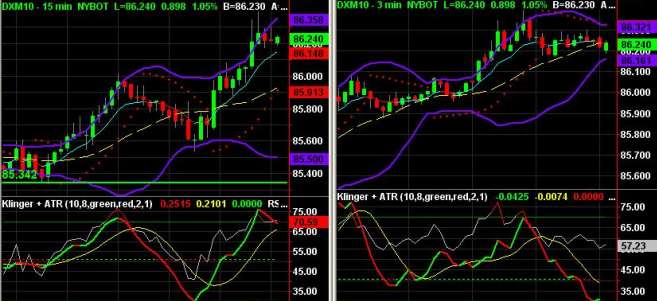
TOKYO (Fox News/Reuters)--The euro steadied near 14-month lows against the dollar on Friday on concerns that rigorous fiscal tightening in Europe would dampen an already-weak recovery.
The New Zealand dollar was on the defensive after sluggish retail data reaffirmed expectations of a subdued recovery in the country, which will temper expected interest rate rises from the central bank this year..
The battered euro was at $1.2545, up 0.1% from levels seen in New York on Thursday. The single-currency is on the way to ending a volatile week in negative territory against the dollar after a massive $1 trillion emergency rescue package reached on Monday boosted it to near $1.31.
Traders said euro buying has been coming in when the euro nears the $1.25 level in Asian trade, where players suspect some large option barriers are in place.
It hovered around 1.4010 Swiss francs, holding above a record low of 1.3997 francs hit on trading platform EBS on Thursday.
Still, the outlook for the euro was bearish with investors nervous over the commitment and resolve of EU member states to make significant inroads into consolidating fiscal positions.
"While some euro zone members' efforts to cut fiscal spending are welcomed, investors are wondering how long efforts will be sustained," said an FX trader at a major Japanese bank.
"Investors are also worried that fiscal tightening will hamper growth in Europe."
France Threatens to Pull Out of Euro
President Nicolas Sarkozy slammed his fist on the table and threatened to pull France out of the euro at a meeting of European leaders deciding Greece's aid package last Friday, according to Spain's El Pais newspaper.
The newspaper cited comments by Spanish Prime Minister Jose Luis Rodriguez Zapatero to members of his party on Wednesday as relayed by people present at that meeting.A spokesman for the Spanish Prime Minister's office confirmed the meeting between Zapatero and other socialist party members on Wednesday, but could not immediately confirm what was said at the meeting.
Sarkozy demanded a "commitment from everyone to suppport Greece...or France would reconsider its position in the euro," according to one source cited by El Pais.
Another source present at the meeting between Zapatero and his party members and cited by the paper said: "Sarkozy ended up banging his fist on the table and threatening to leave the euro...This forced Angela Merkel to give in and reach an agreement."
----------
If I were Angela Merkel, I'd say, "Go ahead, Mr. Sarkozy. Make my day!"
The Debt Storm Menace Grows
The impact on markets has been severe. The euro has slumped more than 12% against the dollar since the sovereign debt crisis flared in southern Europe. Gold has marched to new highs as investors seek a safe haven and, perhaps most alarming, it is now more expensive to buy insurance against national default than it is to insure against corporate failure.
"The sovereign debt crisis spun out of control in the past week, and we see no easy way to resolve it," said Madeline Schnapp, director of macroeconomic research at TrimTabs Investment Research.
Some investors and analysts are increasingly concerned that governments may be no more capable of repaying their debts than the banks and insurance companies they saved. And, they warn, if a major country comes close to default, it could trigger a financial meltdown that would eclipse the panic that followed the bankruptcy of Lehman Brothers in 2008.
The world has seen sovereign debt crises before. Latin America, Africa and Asia have all experienced upheavals sparked by excessive debt. These crises were all accompanied by stunted economic growth, inflation and weak stock market returns, which make it even harder to pay off debts. As investors and government officials ponder the current state of affairs, they see ominous signs that the developed world may be facing a similarly bleak future.
"The problem of the western world is that we have too much debt," said Daniel Arbess, who manages the Xerion investment strategy at Perella Weinberg Partners. "Rather than reducing our debt, we've been moving it from one balance sheet to another."
"All we're doing is shifting chairs on the deck of the Titanic," he added.
Europe's bailout
Some governments have started to respond to market pressure, with the U.K. pledging billions of pounds in spending cuts this week. Spain and Portugal also unveiled austerity measures. But the problem is so big that investors remain wary.Stock markets plunged and credit markets shuddered last week on concern Greece and other indebted European countries like Portugal and Spain might default.
"What's happened on a corporate level is now happening on a national level. The first nation to experience this is Greece, but other nations will, too," Schnapp said.
To stop Greece's debt troubles turning into a run on the euro and a global stock market rout, the European Union unveiled an unprecedented package of almost $1 trillion in emergency loans, stabilization funds and International Monetary Fund support on Sunday.
In the days that followed, the European Central Bank bought the government debt of Greece and other countries on the periphery of the region's single-currency zone, such as Portugal, Spain, Italy and Ireland, investors said. Such intervention, known as quantitative easing, has been shunned by the ECB until now.
"Temporarily the crisis in terms of liquidity has been averted, but the underlying problem hasn't gone away," Schnapp added. "Giant debt and expenditures by governments are still there."
TrimTabs cut its recommendation on U.S. equities to neutral from fully bullish on Sunday, in the wake of the European bailout.
Protection
The sovereign crisis has been brewing for months.For much of the financial crisis, investors worried about financial institutions defaulting, rather than sovereign nations. But that pattern has been upended.
In early February, the cost of insuring against a sovereign default in Western Europe exceeded the price of similar protection against default by North American investment-grade companies. That was the first time this had happened, according to data compiled by Markit from the credit derivatives market.

Since then, the cost of insuring against sovereign default in Western Europe has climbed further, hitting a record of 169 basis points on May 7.
The European bailout pushed that down to 120 basis points on Tuesday. But that's still more expensive than default protection on North American corporate debt which cost 100 basis points on Tuesday. (In the credit derivatives market, 100 basis points means it costs $100,000 a year to buy default protection on $10 million of debt for five years).
'100%'
Market Edge: Debt Crisis Enters Second Phase
The global debt crisis is in its second stage as governments deal with the debt absorbed from the private sector, and record gold prices have been reflecting these worries, according to SCM Advisors strategist Max Bublitz. Laura Mandaro reports."Looking beyond the immediate crisis in Europe, I am particularly worried about the next stage involving the U.S., the U.K. and Japan," Xerion's Arbess said.
Debt to GDP ratios in the world's advanced economies will top 100% in 2014, 35 percentage points higher than where they stood before the financial crisis, the IMF estimated last month.
Three percentage points of this increase came from government bailouts of financial institutions, while 3.5 percentage points was from fiscal stimulus. Another four percentage points has been driven by higher interest on government debt and 9 points came from revenue lost from the global recession, according to the IMF.
"Public finances in the majority of advanced industrial countries are in a worse state today than at any time since the industrial revolution, except for wartime episodes and their immediate aftermath," Willem Buiter, chief economist at Citigroup (NYSE:C) and former member of the Bank of England's Monetary Policy Committee, wrote in a recent note on sovereign risk.
Even though the current epicenter of the crisis is focused on the euro zone, the overall fiscal position of the single currency area is stronger than that of the U.S., the U.K. and Japan, he noted.
"Unless there is a radical change of course by those in charge of fiscal policy in the U.S., Japan and the U.K., these countries' sovereigns too will, sooner (in the case of the U.K.) or later (in the case of Japan and the U.S.) be at risk of being tested by the markets," Buiter said.
Ultimately, these countries face the risk of being "denied access to new and roll-over funding, that is, of being faced with a 'sudden stop,'" he warned.
Economic drag
Once government debt levels approach 100% of GDP, things can get tricky.That's because a lot of a country's income from taxes and other sources has to be spent on interest payments.
John Brynjolfsson, chief investment officer at global macro hedge fund firm Armored Wolf LLC, illustrated the point with a simple example. With debt at 100% of GDP, interest rates at 3% and real economic growth of 3%, all the extra income collected by a country would be used to pay interest on its debt.
If a lot of government debt is owned by foreigners, like the U.S., the money leaves the country rather than being invested in more productive ways. This dents economic growth.
A study published this year by economists Carmen Reinhart and Ken Rogoff found that, over the past two centuries, government debt in excess of 90% of GDP produced economic growth of 1.7% a year on average. That was less than half the growth rate of countries with debt below 30% of GDP.
"Most lenders realize that once growth disappears, there's little reason to lend more," Brynjolfsson said. "That's because new lending is just going towards paying off old debt, not investment in productive activities."
U.S.
The U.S. government has spent more than $1 trillion bailing out financial institutions like American International Group (NYSE:AIG) and rolling out fiscal stimulus programs to bolster the flagging economy.In 2009, the government took in about $2.1 trillion in taxes and other revenue and spent more than $3 trillion, according to TrimTabs' Schnapp. The gap, or deficit, is made up by borrowing more money through sales of Treasury bonds and notes.
In coming years, U.S. government debt will exceed 100% of GDP, according to economists at Exane BNP Paribas and elsewhere.
In the next 20 years, if fiscal policies aren't changed, U.S. debt to GDP will exceed 150%, putting the country in the same league as Greece and Portugal, according to recent research led by Stephen Cecchetti, head of the Monetary and Economic Department at the Bank for International Settlements in Switzerland.
And the official data don't tell the whole story, Buiter says.
Fannie Mae (NYSE:FNM) and Freddie Mac (NYSE:FRE) have been the responsibility of the U.S. government since the mortgage giants were placed into conservatorship by the Federal Housing Finance Agency during the financial crisis in 2008, he noted.
Fannie and Freddie's liabilities at the end of last year's third quarter were almost $1.8 trillion, according to Buiter. This equals 13% of U.S. GDP and should be included in measurements of the country's general government debt, he added.
U.K.
The U.K. government committed 850 billion pounds ($1.25 trillion) to bailing out banks including Royal Bank of Scotland (LSE:UK:RBS) and Lloyds Banking Group (LSE:UK:LLOY) and providing guarantees and insurance to the sector, according to the country's National Audit Office.The U.K.'s debt to GDP ratio will soon reach 100% and could top 200% in the next two decades if fiscal policies aren't changed, according to Cecchetti's research.
The country's new coalition government, which came to power this week, called for 6 billion pounds in spending cuts starting this fiscal year. Bank of England Governor Mervyn King applauded the plan.
"We are still halfway through the world's worst financial crisis ever," King warned. It's "imperative that our own fiscal problems are dealt with sooner rather than later." Read about his comments.
Japan
Japan's government debt to GDP, at over 200%, already dwarfs the U.S. and the U.K., a hangover from its own financial crisis at the end of the 1980s."The perfect example of sovereign risk that is contained today but could be dramatic in the future is Japan," Pierre-Olivier Beffy, chief economist at Exane BNP Paribas, wrote in a recent note to investors.
Such high debt levels aren't a problem now because Japanese people save so much and invest a lot of that money in the country's bonds. Financial institutions in the country are also big buyers.
With more than 90% of all Japanese government debt purchased domestically, interest payments get funneled back into the country, helping to support economic growth.
However, Japan's population is getting a lot older. At some point, savers may stop buying government bonds and start spending their money in retirement. If that happens, the government may be forced to pay higher interest rates when it borrows.
Rates on 10-year Japanese government bonds are below 1.4%. So, despite huge debt, interest payments aren't too cumbersome. But if rates climb, that would change with painful consequences.
"Japan, as an economy, has never admitted its mistakes. Twenty years ago they transferred the bad private assets to the public balance sheet, while nominal GDP has gone nowhere for 20 years," Kyle Bass, managing partner at global macro hedge fund firm Hayman Capital, said during an April industry roundtable run by Opalesque Ltd.
"When your biggest holders turn into sellers overnight, what do you do? You have to finance yourself at G7 rates," he added. "If they borrow where Germany borrows at a bit over 3%, they are out of business."
Bass is betting on higher Japanese interest rates, similar to positions that other hedge fund firms including David Einhorn's Greenlight Capital and John Paulson's Paulson & Co. have put on. Read about Einhorn's views.
'Final chapter'
How will all this debt be repaid? Brynjolfsson discusses the three main alternatives.Developed nations could generate strong productivity gains, while rising exports from their pharmaceutical, technology and financial-services industries could generate better-than-expected income. Combined with "frugality, sacrifice and good fortune," there could be enough money to repay debts, he explained. This may include lower government spending and higher taxes.
Countries could also default, either because they can't pay or won't, Brynjolfsson said. In this scenario, lenders would likely agree to a reduction, or haircut, on the amount of money they're owed -- either voluntarily or after courts impose a settlement.
A third outcome may be inflation, Brynjolfsson said. Sovereign debts would be honored but would be repaid in currency that's worth a lot less than when the debt was sold.
"The sovereign debt problems encountered by most advanced industrial countries are the logical final chapter of a classic 'pass the baby' (aka 'hot potato') game of excessive sectoral debt or leverage," Buiter said.
"First excessively indebted households passed part of their debt back to their creditors - the banks. Then the banks, excessively leveraged and at risk of default, passed part of their debt to the sovereign," he explained. "Finally, the now overly indebted sovereign is passing the debt back to the households, through higher taxes, lower public spending, the risk of default or the threat of monetization and inflation."
Inflation
Brynjolfsson and other investors are in the inflation camp.One tell-tale sign of potential inflation is that the U.S. Treasury Department is trying to extend the average maturity of its debt from about 48 months to roughly 84 months, Brynjolfsson said.
"That makes me a little uncomfortable and suspicious," he added.
With lots of short term debt, it's hard to inflate the debt away. That's because interest rates should rise quickly to adjust for higher inflation expectations and investors will charge a higher rate when it comes time to refinance the bonds.
But the longer the maturity of government debt, the easier it is for inflation to kick in before bonds need to be refinanced, Brynjolfsson explained.
Berkshire Hathaway (NYSE:BRK.A) (NYSE:BRK.B) Chairman Warren Buffett said this month that he's bearish about the ability of all currencies to hold their value over time because of massive deficits being run up by governments in the wake of the financial crisis.
The U.S. will never default on its debt because the dollar is the world's reserve currency. But the country may print more dollars to repay with devalued currency, he suggested. Check out Buffett's take on currencies and inflation.
The European Central Bank's actions this week added to inflation concerns. The bank has been in the market buying the government debt of Greece and other indebted European countries, according to Brynjolfsson. Such quantitative easing could devalue the euro and produce inflation, investors worry.
Xerion's Arbess sees "a round of devaluations of a lot of different currencies."
"That will be accompanied by inflation in the price of non-renewable assets like gold, other precious metals and industrial commodities," he said. "People start to hold on to things that they think will retain value."
Gold hit a record Wednesday. Read about why prices rose.
Thursday, May 13, 2010
And the Deficit Grows
(Reuters) - The United States posted an $82.69 billion deficit in April, nearly four times the $20.91 billion shortfall registered in April 2009 and the largest on record for that month, the Treasury Department said on Wednesday.
It was more than twice the $40-billion deficit that Wall Street economists surveyed by Reuters had forecast and was striking since April marks the filing deadline for individual income taxes that are the main source of government revenue.
Department officials said that in prior years, there was a surplus during April in 43 out of the past 56 years.
The government has now posted 19 consecutive monthly budget deficits, the longest string of shortfalls on record.
For the first seven months of fiscal 2010, which ends September 30, the cumulative budget deficit totals $799.68 billion, down slightly from $802.3 billion in the comparable period of fiscal 2009.
Outlays during April rose to $327.96 billion from $218.75 billion in March and were up from $287.11 billion in April 2009. It was a record level of outlays for an April.