Tuesday, July 26, 2011
Thursday, June 30, 2011
Thursday, May 5, 2011
Thursday, February 3, 2011
Cotton Knows No Limits!
from Zero Hedge:
It seems like so long ago that we noted that cotton was up over 17% year to date. Alas it was yesterday. Yet the time-lag effect is not surprising considering that less than 24 hours following our initial report cotton is now up 23% YTD, or a 5% pick up in one day! This was yet another limit up day for one of the world's most popular commodities, which closed at $169.72, a 150 year high. The reason, per Reuters, for the relentless surge in cotton's price is Asian mills: "It's basically mills panicking," said Lou Barbera, a cotton analyst for brokerage VIP Commodities. "Overseas mills are getting the ball rolling." In reality, mills are just one part of what is rapidly becoming a perfect storm for a commodity which will soon destroy margins for all mid-tier retailers: "Powerful cyclone Yasi in Australia also worried the market because it would hit prime cotton-growing areas. Losses there could further crimp supplies in Asian markets, dealers said. Sharon Johnson, senior cotton analyst at brokerage Penson Futures in Atlanta, said it is "possible there's a squeeze" in the U.S. cotton market."
And as if that was not enough, here are the catalysts for the immediate future, which may well continue pounding cotton limit up day after day:
On Thursday, the market will look at the U.S. Agriculture Department's weekly export sales report to gauge demand for U.S. cotton.No matter what the reason, we wonder how long before the Fed realizes that its CPI indicator is a complete joke when juxtaposed witch charts such as these:
The market will then turn its attention to industry group the National Cotton Council of America which will release its annual plantings survey for cotton at its annual meeting in San Antonio, Texas on Friday.
A Reuters survey at the Beltwide Cotton conference this month had forecast U.S. 2011 cotton plantings from 12.48 million to 12.53 million acres, a 5-year high and an increase of around 15 percent from last year's cotton sowings of 11.04 million acres.
And YTD:
Wednesday, January 19, 2011
Wednesday, January 12, 2011
Grain Stocks Paper Thin
from various tweets regarding the USDA's grain report this morning:
US soybean stocks at 140 mln bu equates to a 15.2-day supply - the tightest of the past 40 years!
China buys 40k tons US soyoil
USDA's tight soybean stocks est was only achieved by "assuming" that prices would ration beans available for domestic crush
Global corn stocks fall to just a 55.4-day supply; 2nd tightest of past 35 years; 2nd only to 54.9-day supply 4 yrs ago
Today's USDA #s are bullish long-term, altho we could see profit taking if buying int wanes today
Today's USDA data means that corn needs 93 mln and soybeans need 79 mln acres w little margin for bad weather
USDA tightens stocks leaving no room for error in next season's plantings and will require rationing of ethanol demand
from Futures Knowledge:
Cotton prices ended the day limit bid and are trading near limit gains this morning. The USDA January supply/demand report was supportive for cotton but was quite bullish for grains and soybeans which is causing cotton to rally. For the US, USDA raised US production of cotton by 50,000 bales to 18.32 million bales. Raised Use by 100,000 bales to 3.6 million and left exports at 15.75 million bales. And left ending stocks at 1.90 million bales. For the world, USDA lowered production by 70,000 bales to 115.46 million bales, raised World Use by 280,000 bales to 116.58 and reduced World ending stocks by 550,000 bales which puts them at 42.84 million bales. Whenever world ending stocks are reduced it is bullish on its face. The USDA left production unchanged in Australia, India, and China though they are likely to lower those estimates later. They raised Brazil’s production by 100,000 bales to 8.2 million. USDA raised India’s cotton consumption by 500,000 bales to 21.5 million. USDA lowered soybean ending stocks by 25 million bushels to 140 million. USDA lowered wheat ending stocks by 40 million bushels to 818 million. USDA lowered corn ending stocks 87 million bushels to 745 million. Today, the US Dollar Index is down 38 points at 80.75. Crude oil is up 55 cents at $91.65. March soybeans were up 14 cents overnight at $13.71. March corn was up 5 1/2 cents overnight at $6.12 ½. July wheat was up 11 ½ cents overnight at $8.19 ¾. China’s cotton futures and forwards were higher overnight.
Saturday, January 1, 2011
Tight Supplies for Soft Commodities
from WSJ:
NEW YORK—A scarcity of commodities such as cotton, sugar and coffee that propelled prices to historic highs late in 2010 is expected to continue into 2011, and it could mean more prices increases for consumers.
Cotton, sugar and coffee are seen remaining in recent high price ranges as supplies remain low.
Cotton broke a post-Civil War record in December, as supplies from top producers failed to keep up with demand, particularly China's voracious appetite for the fiber. Cotton futures gained 91.5% for the year; the March contract closed 2010 on the InterContinental Exchange at $1.4481 a pound on Friday.
Tuesday, December 28, 2010
Commodities Surge to New Highs
Grains have hit new 2010 highs today, especially corn and soybeans. Gold is above $1400/ounce again, and silver is also surging. Sugar just hit a new 29-year high. Cotton, after a limit down move yesterday, just erased all those losses! Copper just hit a new high also. Livestock futures are setting new records today also. Inflation is here, like it or not!
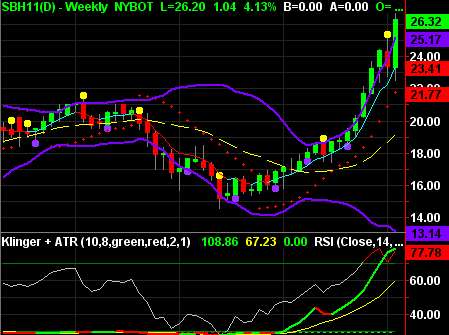
NYBOT weekly, daily chart:
NYBOT monthly chart -- higher than 2008 high!
Monday, December 20, 2010
Commodities Blast to new Record Highs
from Bloomberg Commodities:
Raw sugar rose to a 29-year high in New York on speculation supplies from India and Brazil, the world’s largest growers, won’t be enough to avoid a third consecutive annual shortage. Cocoa prices resumed gains.
Global output will lag behind demand by almost 3 million metric tons in the marketing year that ends Sept. 30, ABN Amro Bank NV and VM Group said Dec. 10, reversing an earlier forecast for a surplus. C. Czarnikow Sugar Futures Ltd. also forecasts a deficit. Raw sugar prices have jumped 23 percent this year.
NYBOT -- new 2010 high
Sugar -- new 29-year high
Cotton -- limit up, new all-time record high
Sunday, December 5, 2010
No End In Sight for Higher Cotton Prices
"The rise in price is due to the growing need in the world market, at a time when Chinese and American reserves are low," explains Adam Nashiru, president of the Peasant Farmers' Association in Ghana.
"Every day we get calls from all over the world asking to buy cotton," he says, "and that has led to growth in government support in the sector."
In contrast, higher prices are causing misery among garment manufacturers, who are caught between higher raw material costs and pressure from the global fashion industry to keep the costs of production low.
The steep rise in prices has created both dismay and celebration.
I am convinced that the situation will remain like this for another five or six years”
It has been welcomed in Africa, where it is hoped farmers will return to growing more cotton after the bad years of low prices and falling production.
"This is an advantage to us. The prices we have negotiated with the cotton ginneries are fantastic," says Mr Nashiru.
"Many more farmers are now turning to growing cotton. In some regions of Ghana, cotton is the only foreign exchange earner and 45% of people in those regions are engaged in the production of cotton," he explains.
But in a world where markets are volatile, there are concerns that investing to produce cotton might not be such a wise idea if the price goes down.
"I am convinced that the situation will remain like this for another five or six years," Mr Nashiu says, "I went to China and saw that it will take time to replenish their stocks."
He says that he had Chinese buyers offering any price for all the cotton the farmers in Ghana could produce.
"All over the world, business tycoons are getting involved with cotton and we need to take advantage of that," he adds.
One country's blessing is another country's curse, however.
There have been recent reports from Pakistan that factories have shut and workers have been laid off, while in China, the surge in prices has pushed many Chinese textile companies to the brink of bankruptcy.
Bangladesh has 4,000 garment factories which export goods to companies such as Wal-Mart, Gap and Levi Strauss.
Its workers are among some of the lowest-paid in the world and the cotton price is threatening the security of their jobs.
Anisul Huq, president of the South Asia Chambers of Commerce, who runs two garment factories in Bangladesh, says the rise in the price of cotton over the past three months has totally shaken the industry.
We are negotiating prices which are only valid for 24 or 48 hours. If a deal is agreed, I buy the fabric the next morning”
"Manufacturers in garment factories negotiate deals three months in advance, so when prices suddenly change, it completely shakes the market," he says.
"Two months ago, I negotiated a polo shirt. I took the fabric price at $1, but when I went to the market to buy the yarn, the price had increased by 45-50%," he laments.
He maintains that everybody from the manufacturer to the customer is faced with a problem and it is jeopardising profits.
"We are telling customers, the big brands who order from us, that they will have to change the price for production, but that is not easy because they have also costed and fixed a final price," Mr Huq says.
"We are negotiating prices which are only valid for 24 or 48 hours. If a deal is agreed, I buy the fabric the next morning."
Bangladesh is particularly hard hit, because it does not grow cotton and has to import it.
Some smaller manufacturers are being compelled to close, at least for the time being.
That will also be reflected in exports, so the anticipated growth of 17-18% for 2010 may not materialise.
Mr Huq believes that will have a multiple effect, not only on profitability, but also in a lot of other areas.
There is evidence that the soft and fluffy cotton fibre was grown, spun and woven into cloth at least 5,000 years ago.
But it was the Industrial Revolution in England, and the invention of the modern mechanical cotton gin in the US, that really gave the commodity a boost.
This mechanisation enabled the mass production of cotton - and within 10 years, the American crop rose in value from $150,000 to $8m.
The increase in production also brought a significant rise in slavery.
Before the cotton gin was invented, there were about 700,000 slaves in the Southern US states. By 1850, there were nearly 3.5 million - and slavery had enabled US cotton producers to undercut prices from elsewhere in the world.
By the time of the American Civil War in the 1860s, the South supplied two-thirds of the world's total cotton.
Today, most of it is grown in the US, Pakistan, Uzbekistan, China and India, although it is also produced in 85 other countries.
The world market in cotton is worth around $12bn a year and over the past 30 years, Africa's slice of that market has doubled.
Cotton was the most widely used natural fibre of the last century and, even though synthetic alternatives have been created, its popularity looks set to continue.
Friday, December 3, 2010
Tuesday, November 16, 2010
Friday, November 12, 2010
Wednesday, November 3, 2010
Monday, November 1, 2010
Friday, October 22, 2010
Friday, October 15, 2010
Cotton Shows Sharp Reversal
Thursday, October 14, 2010
Monday, October 11, 2010
Friday, October 8, 2010
This Is Either a Bubble or Budding Hyperinflation!
Sugar and cotton today skyrocketed. Sugar is now priced higher than at the peak of the 2008 commodity bubble, and cotton is very close to that level. Cotton has been limit up two days in a row!
NYBOT CCI Commodity Index daily, intraday
NYBOT CCI Commodity Index monthly - the prior peak was the 2008 commodity bubble!
Sugar daily -- 30% higher than the 2008 bubble!
Sugar weekly
Cotton daily