The outcome of years of yield-seeking speculation induced by central banks is that investors across the globe have now locked in zero prospective total returns in virtually in every asset class for the coming decade... We actually view this period as the extended top-formation of the third speculative bubble in the past 16 years, not as a representative sample of things to come. -- Dr. John Hussman, PhD, August 15, 2016
Showing posts with label speculation. Show all posts
Showing posts with label speculation. Show all posts
Monday, August 15, 2016
Stock Valuations At Bubble Levels

Monday, May 9, 2011
Government Itself Is the Bigger Market Manipulator
by Chris Powell at Journal Inquirer:
As gasoline prices passed $4 per gallon in Connecticut, Sen. Richard Blumenthal and Rep. Joseph D. Courtney joined President Obama in denouncing "speculators" and urging investigation of manipulation in the oil market. There are a few problems with this.
First is that such investigations have been undertaken before, including investigations by Blumenthal himself during his 20 years as Connecticut's attorney general, and they never found anything more than the OPEC oil producer cartel's public but uneven efforts to support the oil price. Anti-competitive as its activity is, OPEC's formation a half century ago was only a defensive response to the rigging of the currency markets by Western central banks and particularly by the U.S. Treasury Department and Federal Reserve, which were manipulating the value of the world reserve currency, the dollar, the international means of payment for oil, long before OPEC began to try to manipulate the oil price.
The second problem is that there are always speculators in all major markets. There were speculators in the oil market when gasoline last went to $4, in the summer of 2008, again when it crashed to $1.65 at the end of that year, and ever since then as it has risen back to $4. Big players in commodity markets can get away with a lot of manipulation because regulation by the U.S. Commodity Futures Trading Commission is so weak, but as the biggest players are investment banks allied with the government, which wants lower commodity prices, much of that manipulation is actually downward.
Third, and most important, the value of the U.S. dollar as measured in other currencies has fallen about 13 percent over the last year, hitting its lowest point since the dollar's last link to gold was broken in 1971. The dollar's fall reflects the U.S. government's long mismanagement of its finances and the nation's economy.
Any review of market manipulation should start with the biggest manipulator -- the U.S. government itself. With nearly complete secrecy, the Federal Reserve lately has been funneling hundreds of billions of dollars to private financial institutions, purportedly to stabilize markets. Congress and the public have little idea of what actually has been done with this money, nor any idea at all of the private understandings the Fed and Treasury Department have with investment houses like J.P. Morgan Chase that often act as government agents in the markets.
Further, federal law long has established an office in the Treasury Department whose very purpose is market manipulation: the Exchange Stabilization Fund. While it originally was intended to stabilize the dollar against foreign currencies, the fund is authorized to intervene in any market at the discretion of the treasury secretary and president. The law says the fund's decisions "are final and may not be reviewed by another officer or employee of the government."
The Fed and the Treasury Department routinely refuse to answer questions about their secret market interventions. Now that the government bond market is admittedly and almost entirely a Fed operation, even reputable market observers suspect that the government's market intervention has become comprehensive as the government's financial mismanagement has worsened -- that not just the bond market but the dollar and equity markets as well are being held up only because of secret government intervention.
So congressional investigation of market manipulation should start with the government itself -- if members of Congress aren't too scared of what they might find.
Sunday, April 24, 2011
The Fed Sends the Message That It Wants Speculation
by Bruce Krasting
So the president of the United States has ordered the Attorney General to go after the speculators who have been drive up the price of oil and therefore gas. What can I say about this? Does the President think the American people are stupid? No one is going to fall for this line of crap.
Up front, let me acknowledge my guilt in this matter. I’m a speculator. I try my best at it. Some of my best friends are speculators. Many of my readers are speculators. In one-way or the other we are all speculators. Those that don’t think they speculate are actually speculators.
My local oil delivery company let’s me play in the big casino. I bought an option at a fixed price for 5,000 gallons of heating oil. The premium for the option was 20 cents a gallon. So I paid them $1,000 cash. That was sort of gambling money. If the cash price were to fall I’d get the lower price. If it rises, my cost is locked in. Last I looked I was 70 cents in the money. My option cost was 20 cents so I’m “up” 50 cents on 5,000. That’s $2,500 so I’m feeling good on this spec.
It’s not hard to find ways to make money in a rising energy market. I don’t have the balls to trade Brent futures. I overweight energy names in the global stock market. It’s worked pretty well.
I have some investments with funds that do trade energy futures (a “macro” directional fund). They’ve been doing great. I have nothing to do with their market bets, but since I (and many others) provide the equity I have to take some responsibility for their actions.
So if the AG is looking for someone who’s hands are “dirty”, well, I guess I’m on the list. If he did look me up, I would tell him that it was the Ben Bernanke that told me to do it. If the Justice Department wants to lean on me they also have to lean on the Fed.
If the AG, Eric Holder, bothered to look it wouldn’t be too hard for him to see that the blame for all this speculating can be laid at the feet of the Fed. Mr. Holder will not need a PhD in Economics to make this conclusion. All he has to do is read the FAQ’s on the home page of the Federal Reserve. From the FAQ (link):
Monetary policy also has an important influence on inflation. When the federal funds rate is reduced, the resulting stronger demand tends to push wages and other costs higher.
Ah! This is easy. When the Federal Funds rate is low, inflation rises. The price of goods rise! So what is the policy on Federal Funds? Also easy. It has been ZERO for the past two and a half years! What’s the outlook for ZERO interest rates being maintained? That’s easy too!! The Fed tells us every six weeks or so:
Interest rates will be kept exceptionally low for an extended period of time.
So the Fed is telling us in its FAQ that they want goods to go up in price. Now all they have to do is push me into action as a speculator. More from the FAQ:
policy actions can influence expectations about how the economy will perform in the future, including expectations for prices
To me, this is pretty clear, hopefully Holder will agree. The Fed has succeeded in its effort to change my expectations of the future of my energy costs. With my expectations being influenced, it is only natural that I would react. When I pay $1,000 to lock in a price to heat my home it is exactly what Bernanke would want me to do. I’m the best evidence that he has that his policy is “working”.
I think most Americans understand that we import half our oil and that the value of the dollar is a big factor in the price we pay for crude. A weak dollar causes the price of oil to rise. So what's the Fed’s policy on the dollar? Once more from the FAQ:
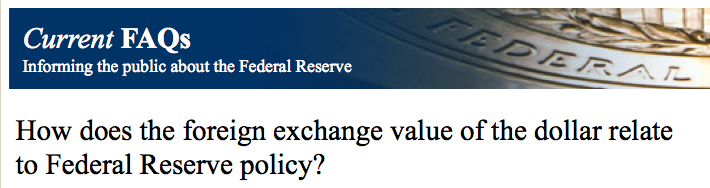
movements in the exchange value of the dollar represent an important consideration for monetary policy--such movements exert influence on U.S. economic activity and prices
Bingo! The desired consequence of the Fed’s monetary policy is to devalue the dollar in order to increase economic activity. But that same action also results in higher imported prices for crude. The only conclusion that I can come to is that higher oil prices are the desired consequence of Fed policy. Bernanke has brought me to the water and strongly suggested I should drink some. It's all spelled out in the FAQs. Its not hidden in some obscure language. Shame on me (and the President) if I had ignored such an obvious outcome.
The President and the AG need to determine why folks like me are speculating rather than just blaming me for high prices. When they look at the facts they can’t help but see that it is Bernanke that’s behind all that high priced gas. The speculators like me are just the mechanism that Bernanke uses to achieve his ends.
Friday, April 1, 2011
Looking to the End of QE2
John Hussman gave me this perspective on the likely outcome of QE2 as it reaches an end:
Last week's stock market advance placed prevailing conditions firmly back to an overvalued, overbought, overbullish, rising-yields syndrome that has historically been hostile for stocks, on average. Our investment stance considers not only these factors, but also reflects the (present) accommodative stance of monetary policy, as well as a broad range of measures such as market internals, credit spreads, and economic statistics. I've noted before that as rules of thumb go, "the trend is your friend" historically performs better, with much smaller drawdowns, than "don't fight the Fed" (regardless of how that rule is defined operationally). While the market tends to perform better when both are true, the exception is the overvalued, overbought, overbullish, rising-yields syndrome, which is uniformly negative regardless of the random subset of historical data one examines. There is certainly a tendency for "unpleasant skew" featuring a persistent series of marginal new highs for some period of time, but on average, those are ultimately overwhelmed by steep and abrupt losses that finally clear this syndrome.
It's important to recognize that our present investment stance reflects these observable conditions, and is not driven by our views about the underlying state of mortgage debt, fiscal challenges, economic forecasts, expectations of credit strains, or any view about the appropriateness of Fed intervention. We do try to look ahead to some of the risks that may emerge in the quarters ahead, but our investment stance is not driven by this analysis. If we can clear some component of the observable, hostile syndrome of market conditions - probably either the overbought or overbullish feature - without a substantial breakdown in market internals (which would take us "out of the frying pan and into the fire"), we expect to quickly establish a moderately constructive investment stance. Our concerns regarding larger economic risks can be sufficiently expressed by holding a continued line of index put options to defend against any unanticipated continuation, but again, barring a breakdown of market internals (which would suggest a larger and possibly more durable shift toward investor risk aversion), I expect that clearing the present, hostile syndrome will be sufficient to accept a greater exposure to market fluctuations.
Our longer-term analysis remains that the S&P 500 is priced to achieve poor 10-year total returns, but that in itself doesn't resolve into the requirement to carry a persistently defensive position over the short- and intermediate-term. Even if the market remains overvalued and economic risks persist for a long time, we do expect that the "ensemble" solution to the "two data sets" problem we struggled with in recent years will result in more frequent periods of moderate investment exposure than we observed during that period. Still, our dominant investment horizon remains the full market cycle, so our usual "anti-marketing" applies - the Hussman Funds are not appropriate for investors who have a strong desire to track market fluctuations or whose investment horizon is shorter than a full bull-bear cycle. That said, even for investors who prefer to track the market up and down to a reasonable degree, it is worth emphasizing that combining a long-only approach with less correlated approaches that still compete well over the full cycle can significantly improve the return/risk profile of the portfolio over time.
QE2 - Apres Moi, le Deluge
Last week, a number of Fed officials came out in tandem with essentially the same message - the Fed's policy of quantitative easing is likely to end with QE2. It's important to think carefully about the implications of this for the markets. My impression is that investors are still in something of a "momentum" mentality both with respect to the market and the overall economy, and it's not clear that they've pieced out the extent to which this has been reliant on various stimulus measures that are now drawing to a close.
It is clear that the effect of QE2 has not been to lower interest rates, or to materially expand credit. Rather, QE2 has been built on two blunt forces. The first is that increasing the stock of non-interest bearing money in the economy toward $2.4 trillion, all of which has to be held by somebody, the Fed has created a market environment that has raised the prices and lowered the returns on all competing assets in order to accommodate that equilibrium. As asset prices are bid up, their expected future returns fall, and the process stops at the point where on a risk-adjusted basis, no asset is expected to achieve returns that compete meaningfully with cash (at least over some horizon of say, a year or two). The second force has been purely rhetorical. The opening salvo in QE2 was Bernanke's public endorsement of risk-taking in the Washington Post. Strikingly, he has seemed to eagerly take credit for the speculation in the stock market, particularly in small cap stocks, while denying any culpability for the commodity hoarding and dollar weakness that predictably results from driving real short-term interest rates to negative levels.
In our view, quantitative easing has been a reckless policy, not only because it has fueled what Dallas Fed president Richard Fisher calls "extraordinary speculative activity," but because aside from a burst of short-term optimism, the historical evidence is clear that fluctuations in stock prices have very little impact on real spending (the so-called wealth effect is on the order of 0.03-0.05% for every 1% change in stock prices). People consume off of perceived permanent income, not off of fluctuations in the prices of volatile assets. Now, it's true that QE2 has probably been good for a fraction of 1% in additional GDP, which should be sustained over a period of a year or two, and though we haven't observed real activity or actual industrial production that matches the optimism of survey-based measures such as the ISM indices, it's clear that some pent-up demand was released. Still, the links between monetary base expansion, stock values, and GDP growth are tenuous at best. The most predictable outcome was commodity hoarding, where our expectations have been fully realized, with awful consequences for the world's poor, not to mention for geopolitical stability.
So for our part, we'd be happy to see the termination of QE simply because it is misguided, reckless policy. In contrast, most of the Fed officials pulling back on their enthusiasm for QE argue along the lines that "the economy is strong enough now to do without it," which is unfortunate because it leaves the door open to continue this sort of lunacy should the economy weaken again. A few quotations from various Fed officials last week:
Charles Evans (Chicago Fed) "Following through on that to the tune of $600 billion, like we've said, I think is appropriate. I personally don't see as many needs for a further amount, as I probably thought last fall."
James Bullard (St. Louis Fed): "The economy is looking pretty good. It is still reasonable to review QE2 in the coming meetings, especially this April meeting, and see if we want to decide to finish the program or to stop a little bit short."
Charles Plosser (Philadelphia Fed): " If this forecast is broadly accurate, then monetary policy will have to reverse course in the not-too-distant future and begin to remove the massive amount of accommodation it has supplied to the economy. Failure to do so in a timely manner could have serious consequences for inflation and economic stability in the future. I don't think that is necessarily imminent, but we have to be very careful we don't get behind the curve. I worry about us getting behind the curve. "
Richard Fisher (Dallas Fed): "In essence what we have done as a central bank is to monetize the entire US debt through the end of June. Had I been a voter last year, which I am this year, I would have joined Hoenig and would have voted against what is known as QE2. In my opinion, no further accommodation is needed after June -- either by tapering off the bottom of the purchases of Treasuries, or by adding another tranche of purchases outright. In my view it is unlikely that we will have or need more accommodation by the central bank. I think we've done our job."
While the possibility of ending QE2 early may come up in the FOMC's April meeting, I doubt that the Fed will stop short. Regardless of the lack of meaningful "wealth effect" from stocks to GDP in the historical data, it's clear that Bernanke views a speculative stock market as a good thing, and my impression is that he would consider the risk of disappointing the markets as too great. Instead, the Fed will have enough on its hands simply removing the expectation of the market for QE3, not to mention telegraphing the potential for the Fed to eventually reverse course.
Still, barring a surprise early-conclusion to QE2, there are two important issues for the market as we look ahead to gradual changes in Fed policy.
First, what happens when QE2 is complete? From our standpoint, it is incontrovertible that the primary factor behind the market's recent advance has been speculation based on the belief, explicitly encouraged by Bernanke, that the Fed would provide a backstop for risk-taking. Investors clearly took Bernanke at his word. But without yet another round of QE, not to mention the potential for an unwinding of existing QE, a decline in speculative enthusiasm will likely have the identical effect as an increase in risk aversion.
Second, how likely is it that economic growth will be successfully "handed off" to the private sector as fiscal policy tightens and monetary policy becomes less aggressive? It is clear that the economy is enjoying some surface economic progress - the most notable being a gradual drop in new claims for unemployment. But the real fiscal "cliff" for states and municipalities doesn't hit until about mid-year, which is the same time that QE2 comes off. What we're observing at present is decidedly still fiscal- and monetary-induced growth. It is not enough that the data have improved gradually. The real question is whether it would have, or will, improve without that stimulus.
My intent is not to argue strongly that the economy cannot continue to expand as fiscal and monetary stimulus comes off, but instead to at least ask why this should be expected as a foregone conclusion. On the basis of leading indices of economic activity, we observe more indications of economic slowing worldwide than we observe growth. Moreover, strong periods of employment growth have historically been preceded by high, not low, real interest rates. This is far from a perfect relationship, but it is clear that historically, high real interest rates are far more indicative of strong demand for credit, new investment, and new employment than low real interest rates are.
The belief that low real interest rates are helpful is the result of confusing the demand curve with equilibrium itself. Yes, strictly from the demand curve, lower real interest rates are associated with greater demand for capital investment and so forth. But if we want growth, then what we really desire is a persistent outward shift in the demand curve. We want increased desire for real investment and employment at every level of real interest rates. Meanwhile, on the supply side, higher real interest rates help to induce a shift from consumption toward savings that can be directed to finance that new investment. In equilibrium, then, what generally precedes strong economic growth is an upward movement in real rates. Trying to engineer low real rates, which is what the Fed seems to want, is an attempt to move along the existing demand curve, which can never, in itself, be the source of sustained growth, and harms savers at the same time (as the Fed's Richard Fisher observed last week, it only works to "continue the injustice against the virtuous.")

On the employment front, it is important to recognize that while the annual growth of non-farm payrolls averaged about 2% and higher prior to the 1990's, each cycle of U.S. economic expansion and recession has resulted in slower and slower long-term employment growth. The chart below shows what I would characterize as a series of "vicious cycles" - particularly the most recent experience. On the chart, business cycles move counter-clockwise, with expanding year-over-year employment growth gradually improving the 10-year average, followed by a slowdown and eventually a contraction in employment growth that since the 1960's has dragged long-term employment growth to progressively lower levels in each successive business cycle. Given the high level of unemployment, the "mean-reversion benchmark" would normally be about 200,000 jobs monthly. We should sustain that for a few more months, but the likely effect of reduced policy stimulus should not be ignored looking out further.
The bottom of the chart is where we are at present. In my view, the poor performance of the U.S. economy from an employment standpoint cannot be separated from the Fed's attempts, for more than a decade, to make easy monetary policy a substitute for the accumulation of real savings and investment. All that we've done is to finance a huge stream of consumption, which we have quietly paid for by selling off claims on our assets and future output to foreign savers such as China and Japan. The Fed has surely helped us to build that indebtedness without pain from an interest rate standpoint, but the volume of claims is increasingly onerous. Unlike Japan, which has a high debt-to-GDP ratio but finances the bulk of it with its own savings, our debt is increasingly external, which means that someone else has a claim to our future output. Speculating and consuming off of cheap credit may feel better than saving, but the long-term results are profoundly different.

The problem for the financial markets here, in my view, is that the benefits of the speculation are now largely behind us. Our valuation models do assume that long-term growth in GDP and earnings will persist at the same roughly 6.3% peak-to-peak growth rate across economic cycles that has characterized the earnings channel for nearly a century. Yet given the level of stock valuations to normalized earnings - which better reflect the long-term stream of cash flows that investors can expect to receive - our present 10-year total return estimate for the S&P 500 is only about 3.4% annually (and to Mish, yes, the historical skew to these returns easily includes zero in the confidence interval).
None of this rules out further positive market returns over shorter periods, and we remain willing to accept moderate periodic exposures even here, provided that we can clear some component of the overvalued, overbought, overbullish, rising-yields syndrome we presently observe. But as Charles Dow said a century ago, "to understand values is to understand the meaning of the market." Occasional prospects for moderate exposure notwithstanding, I continue to view the long-term prospects for equities as weak. This is largely because we continue to rely on band-aids and overwhelming policy interventions to keep interest rates low and market valuations elevated, in preference to lower valuations (and commensurately higher interest rates and prospective equity returns) which would offer proper incentives to save and allocate capital for productive long-term uses.
Market Climate
As of last week, the Market Climate for stocks reflected a continued hostile syndrome of conditions that holds us to a well hedged investment stance in both the Strategic Growth Fund and the Strategic International Equity Fund. In bonds, the Market Climate remained characterized by relatively neutral yield levels as well as neutral yield pressures. The Strategic Total Return Fund continues to carry a duration of just over 4 years, with about 10% of assets allocated to precious metals shares. As I've noted before, very shallow corrections in gold followed by moves approaching the $1500 level would be consistent with increasing hazard risk, so I would expect that we'll tend to lighten our holdings on any "range expansion" moves in precious metals shares (large leaps in price that have a wider overall range than that of preceding weeks). For now, we're moderately constructive in both bonds and precious metals. We are defensive in stocks, but that would change on a decline sufficient to clear overbought, overbullish conditions without being severe enough to materially damage market internals (which would signal more a more significant shift toward investor risk aversion). As always, we'll respond to changes in market conditions as they emerge.
Sunday, January 30, 2011
Finally, Someone Connects the Food Dots
Here's just one more dot to connect: the Fed's disastrous monetary policy is the partial cause of food inflation, and thus a trigger for food riots all over the developing world!
by Ambrose Evans-Pritchard
If you insist on joining the emerging market party at this stage of the agflation blow-off, avoid countries with an accelerating gap between rich and poor. Cairo’s EGX stock index has dropped 20pc in nine trading sessions.
Events have moved briskly since a Tunisian fruit vendor with a handcart set fire to himself six weeks ago, and in doing so lit the fuse that has detonated Egypt and threatens to topple the political order of the Maghreb, Yemen, and beyond.
As we sit glued to Al-Jazeera watching authority crumble in the cultural and political capital of the Arab world, exhilaration can turn quickly to foreboding.
This is nothing like the fall of the Berlin Wall. The triumph of secular democracy was hardly in doubt in central Europe. Whatever the mix of aspirations of those on the streets of Cairo, such uprisings are easy prey for tight-knit organizations – known in the revolutionary lexicon as Leninist vanguard parties.
In Egypt this means the Muslim Brotherhood, whether or not Nobel laureate Mohammed El Baradei ever served as figleaf. The Brotherhood is of course a different kettle of fish from Iran’s Ayatollahs; and Turkey shows that an ‘Islamic leaning’ government can be part of the liberal world – though Turkish premier Recep Tayyip Erdogan once let slip that democracy was a tram “you ride until you arrive at your destination, then you step off."
It does not take a febrile imagination to guess what the Brotherhood’s ascendancy might mean for Israel, and for strategic stability in the Mid-East. Asia has as much to lose if this goes wrong as the West. China’s energy intensity per unit of GDP is double US levels, and triple the UK.
The surge in global food prices since the summer – since Ben Bernanke signalled a fresh dollar blitz, as it happens – is not the underlying cause of Arab revolt, any more than bad harvests in 1788 were the cause of the French Revolution.
Yet they are the trigger, and have set off a vicious circle. Vulnerable governments are scrambling to lock up world supplies of grain while they can. Algeria bought 800,000 tonnes of wheat last week, and Indonesia has ordered 800,000 tonnes of rice, both greatly exceeding their normal pace of purchases. Saudi Arabia, Libya, and Bangladesh, are trying to secure extra grain supplies.
The UN’s Food and Agriculture Organization (FAO) said its global food index has surpassed the all-time high of 2008, both in nominal and real terms. The cereals index has risen 39pc in the last year, the oil and fats index 55pc.
The FAO implored goverments to avoid panic responses that “aggravate the situation”. If you are Hosni Mubarak hanging on in Cairo’s presidential palace, do care about such niceties?
France’s Nicolas Sarkozy blames the commodity spike on hedge funds, speculators, and the derivatives market (largely in London). He vowed to use his G20 presidency to smash the racket, but then Mr Sarkozy has a penchant for witchhunts against easy targets.
The European Commission has been hunting for proof to support his claims, without success. Its draft report – to be released last Wednesday, but withdrawn under pressure from Paris – reached exactly the same conclusion as investigators from the IMF, and US and British regulators.
“There is little evidence that the price formation process on commodity markets has changed in recent years with the growing importance of derivatives markets”, it said.
As Jeff Currie from Goldman Sachs tirelessly points out, future contracts are neutral. For every trader making money by going long on wheat, sugar, pork bellies, zinc, or crude oil, there is a trader losing money on the other side. It is a paper transfer between financial players.
You have to buy and hoard the vast amounts of these bulk commodities to have much impact on the price, which is costly and difficult to do, though people do park crude on floating tankers sometimes, and Chinese firms allegedly stashed copper in warehouses last year.
But that is not what commodity index funds with $150bn are actually doing with food, base metals, and energy. Only governments have strategic petroleum and grain reserves big enough to make a difference.
The immediate cause of this food spike was the worst drought in Russia and the Black Sea region for 130 years, lasting long enough to damage winter planting as well as the summer harvest. Russia imposed an export ban on grains. This was compounded by late rains in Canada, Nina disruptions in Argentina, and a series of acreage downgrades in the US. The world’s stocks-to-use ratio for corn is nearing a 30-year low of 12.8pc, according to Rabobank.
The deeper causes are well-known: an annual rise in global population by 73m; the “exhaustion” of the Green Revolution as the gains in crop yields fade, to cite the World Bank; diet shifts in Asia as the rising middle class switch to animal-protein diets, requiring 3-5 kilos of grain feed for every kilo of meat produced; the biofuel mandates that have diverted a third of the US corn crop into ethanol for cars.
Add the loss of farmland to Asia’s urban sprawl, and the depletion of the non-renewable acquivers for irrigation of North China’s plains, and the geopolitics of global food supply starts to look neuralgic.
Can the world head off mass famine? Yes, with leadership. The regions of the ex-Soviet Union farm 30m hectares less today than in the Khrushchev era, and yields are half western levels.
There are tapped hinterlands in Brazil, and in Africa where land titles and access to credit could unleash a great leap forward. The global reservoir of unforested cropland is 445m hectares, compared to 1.5 billion in production. But the low-lying fruit has already gone, and the vast investment needed will not come soon enough to avoid a menacing shift in the terms of trade between the land and the urban poor.
We are on a thinner margin of food security, as North Africa is discovering painfully, and China understands all too well. Perhaps it is a little too early to write off farm-rich Europe and America.
The surge in global food prices since the summer – since Ben Bernanke signalled a fresh dollar blitz, as it happens – is not the underlying cause of Arab revolt, any more than bad harvests in 1788 were the cause of the French Revolution.
Yet they are the trigger, and have set off a vicious circle. Vulnerable governments are scrambling to lock up world supplies of grain while they can. Algeria bought 800,000 tonnes of wheat last week, and Indonesia has ordered 800,000 tonnes of rice, both greatly exceeding their normal pace of purchases. Saudi Arabia, Libya, and Bangladesh, are trying to secure extra grain supplies.
The UN’s Food and Agriculture Organization (FAO) said its global food index has surpassed the all-time high of 2008, both in nominal and real terms. The cereals index has risen 39pc in the last year, the oil and fats index 55pc.
The FAO implored goverments to avoid panic responses that “aggravate the situation”. If you are Hosni Mubarak hanging on in Cairo’s presidential palace, do care about such niceties?
France’s Nicolas Sarkozy blames the commodity spike on hedge funds, speculators, and the derivatives market (largely in London). He vowed to use his G20 presidency to smash the racket, but then Mr Sarkozy has a penchant for witchhunts against easy targets.
The European Commission has been hunting for proof to support his claims, without success. Its draft report – to be released last Wednesday, but withdrawn under pressure from Paris – reached exactly the same conclusion as investigators from the IMF, and US and British regulators.
“There is little evidence that the price formation process on commodity markets has changed in recent years with the growing importance of derivatives markets”, it said.
As Jeff Currie from Goldman Sachs tirelessly points out, future contracts are neutral. For every trader making money by going long on wheat, sugar, pork bellies, zinc, or crude oil, there is a trader losing money on the other side. It is a paper transfer between financial players.
You have to buy and hoard the vast amounts of these bulk commodities to have much impact on the price, which is costly and difficult to do, though people do park crude on floating tankers sometimes, and Chinese firms allegedly stashed copper in warehouses last year.
But that is not what commodity index funds with $150bn are actually doing with food, base metals, and energy. Only governments have strategic petroleum and grain reserves big enough to make a difference.
The immediate cause of this food spike was the worst drought in Russia and the Black Sea region for 130 years, lasting long enough to damage winter planting as well as the summer harvest. Russia imposed an export ban on grains. This was compounded by late rains in Canada, Nina disruptions in Argentina, and a series of acreage downgrades in the US. The world’s stocks-to-use ratio for corn is nearing a 30-year low of 12.8pc, according to Rabobank.
The deeper causes are well-known: an annual rise in global population by 73m; the “exhaustion” of the Green Revolution as the gains in crop yields fade, to cite the World Bank; diet shifts in Asia as the rising middle class switch to animal-protein diets, requiring 3-5 kilos of grain feed for every kilo of meat produced; the biofuel mandates that have diverted a third of the US corn crop into ethanol for cars.
Add the loss of farmland to Asia’s urban sprawl, and the depletion of the non-renewable acquivers for irrigation of North China’s plains, and the geopolitics of global food supply starts to look neuralgic.
Can the world head off mass famine? Yes, with leadership. The regions of the ex-Soviet Union farm 30m hectares less today than in the Khrushchev era, and yields are half western levels.
There are tapped hinterlands in Brazil, and in Africa where land titles and access to credit could unleash a great leap forward. The global reservoir of unforested cropland is 445m hectares, compared to 1.5 billion in production. But the low-lying fruit has already gone, and the vast investment needed will not come soon enough to avoid a menacing shift in the terms of trade between the land and the urban poor.
We are on a thinner margin of food security, as North Africa is discovering painfully, and China understands all too well. Perhaps it is a little too early to write off farm-rich Europe and America.
Wednesday, January 19, 2011
Back to "Blame the Speculators"!
my post on Zero Hedge this morning:
I guarantee that will cause HIGHER prices, not lower ones. Speculation is not the root cause; it is a symptom of problem, not the root cause. If you hack at the branches (speculators), the root cause (Fed's easy money) remains intact. History shows that by shrinking the size and liquidity of the market, it also shrinks the supply. This eventually results in HIGHER prices. Hugo Chavez has tampered endlessly with attempts to lower food prices in Venezuela, but supplies keep shrinking and prices keep going higher. The antidote to speculative influence is to increase the size and liqudity of the market, not shrink it.
The Hunt Bros' attempt to corner the silver market was a good example. When the market was small, their wealth could easily manipulate the market. But as prices rose, more and more people entered the market. Even housewives were selling their silver at pawn shops. But as the market size and liquidity rose, the Hunts lost control and the market crashed.
History shows that speculators are among the first to perceive an overbougght market and short it. CFTC and other studies have also repeatedly shown that speculators FOLLOW the market, not lead it. CFTC studies have also repeatedly shown that speculators constitute only about 12-18% of total trading volume, even during the commodity boom of 2008. In fact, CFTC studies showed that speculative trading during 2008 was LESS than during 2006, when commodity prices were supressed, as a percentage of total open interest. Studies have also repeatedly shown that non-exchange traded commodity prices rise HIGHER than non-futures traded commodities. If the presence of speculative funds were the real cause, this would not be the case. Those who blame speculators for high prices also forget that by necessity, speculators MUST offset their positions with an opposing position in order to exit the market and take profits. Hedgers don't because they take physical possession. Thus, by definition, speculators negate their effect on the market when they exit their positions. They have no choice! They have to!
The true net cause of high commodity prices is still the Fed's easy money policies that buoy up all risk assets. As long as the Fed is ramping up the stock market, commodity prices will too! Fed policy doesn't just increase the supply of funds. It is also suppressing interest rates that would otherwise give investors a viable alternative and reasonable returns. By denying investors these reasonable returns, it forces them to buy more speculative assets like commodities in order to try to preserve the value of their capital in an inflationary, dollar devaluative environment. Fed policies literally feed the inflationary monster by incentivizing risk assets more than would otherwise be warranted.
By shrinking the size and liquidity of commodities markets, we shoot ourselves in the foot because large investors -- the blue whales of the investment world -- will have GREATER influence on markets, and they will simply move their funds to other commodities exchanges in other countries, where their money is welcome. This thus causes capital flight, thus devaluing the Dollar even more, and thus amplifying the very effect that caused prices to rise in the first place. A blue whale has a lot more influence in a fish pond than the Pacific Ocean. It's the same in the financial markets. The larger and more liquid the market, the less influence the blue whale has. Limiting the market size and participation will drive prices HIGHER, not lower.
These are only a few of the reasons why all attempts to control prices by controlling markets lead to HIGHER prices, not lower ones!
The Hunt Bros' attempt to corner the silver market was a good example. When the market was small, their wealth could easily manipulate the market. But as prices rose, more and more people entered the market. Even housewives were selling their silver at pawn shops. But as the market size and liquidity rose, the Hunts lost control and the market crashed.
History shows that speculators are among the first to perceive an overbougght market and short it. CFTC and other studies have also repeatedly shown that speculators FOLLOW the market, not lead it. CFTC studies have also repeatedly shown that speculators constitute only about 12-18% of total trading volume, even during the commodity boom of 2008. In fact, CFTC studies showed that speculative trading during 2008 was LESS than during 2006, when commodity prices were supressed, as a percentage of total open interest. Studies have also repeatedly shown that non-exchange traded commodity prices rise HIGHER than non-futures traded commodities. If the presence of speculative funds were the real cause, this would not be the case. Those who blame speculators for high prices also forget that by necessity, speculators MUST offset their positions with an opposing position in order to exit the market and take profits. Hedgers don't because they take physical possession. Thus, by definition, speculators negate their effect on the market when they exit their positions. They have no choice! They have to!
The true net cause of high commodity prices is still the Fed's easy money policies that buoy up all risk assets. As long as the Fed is ramping up the stock market, commodity prices will too! Fed policy doesn't just increase the supply of funds. It is also suppressing interest rates that would otherwise give investors a viable alternative and reasonable returns. By denying investors these reasonable returns, it forces them to buy more speculative assets like commodities in order to try to preserve the value of their capital in an inflationary, dollar devaluative environment. Fed policies literally feed the inflationary monster by incentivizing risk assets more than would otherwise be warranted.
By shrinking the size and liquidity of commodities markets, we shoot ourselves in the foot because large investors -- the blue whales of the investment world -- will have GREATER influence on markets, and they will simply move their funds to other commodities exchanges in other countries, where their money is welcome. This thus causes capital flight, thus devaluing the Dollar even more, and thus amplifying the very effect that caused prices to rise in the first place. A blue whale has a lot more influence in a fish pond than the Pacific Ocean. It's the same in the financial markets. The larger and more liquid the market, the less influence the blue whale has. Limiting the market size and participation will drive prices HIGHER, not lower.
These are only a few of the reasons why all attempts to control prices by controlling markets lead to HIGHER prices, not lower ones!
Monday, December 27, 2010
Spec Sell-Off to Come?
from John Hussman:
Why are Treasury yields rising despite hundreds of billions of Treasury purchases by the Federal Reserve? There are two possibilities in the current debate. One is that the Fed's policy of purchasing Treasuries has scared the willies out of the bond market on fears of higher inflation, and that the policy is a failure. The other is that the policy has been such a success at boosting the prospects for economic growth that interest rates are rising on anticipation of a better economy.
From our standpoint, neither of these explanations hold much water. On the inflation front, the recent bond selloff has hit TIPS prices as well as straight Treasuries, which isn't something you'd expect to see if inflation expectations were being destabilized. And although precious metals and other commodity prices have been pressed higher, the commodity run can be more accurately traced to negative real interest rates at the short-end of the maturity curve, coupled with a downward trend in long-term yields that has now reversed dramatically (more on that below). I've long argued that unproductive government spending and profligate fiscal policy are ultimately inflationary (regardless of how the spending is financed, and particularly if it is monetized), but I continue to view persistent inflation as a long-term, not near-term concern. A rise in T-bill yields of more than 15-25 basis points would change that assessment. Until then, velocity can be expected to collapse in direct proportion to changes in the monetary base, with little impact on prices.
As for the notion that the Fed's targeted Treasury purchases have directly aided the economy, the argument requires bizarre logical gymnastics. It demands one to believe that although the purchases were intended to stimulate the economy by lowering rates, they have been successful without lowering them, and in fact by raising them, because the expectation of lower rates was so stimulative that it caused rates to rise, so that the higher rates can be taken as evidence that lowering rates without lowering them was a success. Oh, brother.
It's clear that we've seen some firming in various indicators such as the Purchasing Managers Index, the ECRI Weekly Leading Index and weekly claims for unemployment. The question is whether these can be traced to lower yields and greater availability of liquidity. On the interest rate front, the answer is clearly no, as Treasury and mortgage rates are even higher than they were before QE2 was announced. On the "liquidity" front, the additional reserves have simply added to an existing pile of well over a trillion dollars of idle reserve balances in the banking system. And while we did see a pop in consumer credit in the latest report, it was entirely due to Federal loans to students (arguably people displaced from the labor force and seeking an alternative). Other forms of consumer credit have collapsed at an accelerating rate.
So neither side typically taken in the debate over the Fed's Treasury purchases is particularly satisfying. Fortunately for fans of logic, there is a third explanation that is much more plausible, and has the benefit of having data behind it. Despite my extreme criticism of Fed actions in recent years, I would argue that QE2 has in fact been "successful" over the short-term, but not through any monetary mechanism. Rather, QE2 has been successful a) by creating a burst of enthusiasm that released some pent-up demand in the same way that Cash for Clunkers and the new homebuyer tax credit did, and b) by encouraging investors to believe that the Fed has provided a "backstop" for stocks and other risky assets, creating a speculative blowoff in these securities, to the detriment of what investors perceive as "safe" assets, which ironically includes Treasury securities.
In short, the main effect of QE2 has not been monetary but has instead been rhetorical - and that rhetoric may very well be nearly empty.
The key event related to QE2 wasn't its formal announcement, but was instead the Op-Ed piece that Ben Bernanke published a few days later in the Washington Post, which essentially advanced the argument that the Fed was targeting a "wealth effect" in stocks and other risky assets, in hopes of getting people to consume off of that perceived wealth. At that moment, Bernanke unleashed a speculative bubble in risky assets, and a selloff in safe ones. This has rewarded risk-seeking and punished risk-aversion, but it has also unfortunately driven the markets into an overvalued, overbought, overbullish, rising-yields condition that has historically ended in steep and abrupt losses.
Ned Davis Research tracks a set of "factor attribution" portfolios, which measure the performance between the top 10% of stocks ranked by a given factor, and the bottom 10% of stocks as ranked by that factor. The factors are things like market beta, dividend yield, 26-week momentum, and so forth. Essentially, the these factor portfolios track the return of hypothetical portfolios that are long the top 10% and short the bottom 10% of stocks based on any given variable.
The performance of these 133 factor portfolios over the past 13 weeks offers tremendous insight into the extent to which the Federal Reserve has encouraged speculative risk. Investors are chasing stocks with the greatest exposure to market fluctuations, commodities, credit risk, small-cap risk and volatility. Conversely, securities demonstrating reasonable valuation, stability, quality, or payout have been virtually abandoned by investors. Here is a sampling:
FACTOR | FACTOR GROUPING | 13-WEEK RETURN |
Market Beta | Risk | 17.80% |
Raw Materials Beta | Commodity Sensitivity | 17.47% |
Credit Spread Beta | Macro Economic Sensitivity | 14.66% |
Small vs. Large Beta | Style Sensitivity | 12.54% |
Silver Beta | Commodity Sensitivity | 10.87% |
Sigma Risk (Volatility) | Risk | 10.73% |
Operating Cash Flow Yield | Valuation | -4.02% |
EPS Stability | Quality | -5.56% |
Value vs. Growth Beta | Style Sensitivity | -5.87% |
Return on Invested Capital | Profitability | -6.61% |
Dividend Yield | Valuation | -9.34% |
10-Year T-Note Beta | Macro Economic Sensitivity | -9.55% |
High vs. Low Quality Beta | Style Sensitivity | -15.70% |
For us, the past few months have felt like our own miniature equivalent of a bear market. The Strategic Growth Fund has pulled back by several percent, and though our occasional drawdowns have been a fraction of those experienced by the S&P 500 over time, the past four weeks have felt relentless on a day-to-day basis. During this period, the strongest four factors have been: Market Beta (8.98%), Sigma Risk (8.50%), Small vs. Large Beta (8.05%), and Cyclical vs. Consumer Beta (7.75%). Meanwhile, factors such as High vs. Low Quality Beta (-2.18%), Dividend Yield (-3.07%), and EPS Stability (-5.16%) have been particularly unrewarding.
The problem with this outcome is that the speculative factors being rewarded over the short-term have nothing to do with the characteristics that have historically been rewarded over the long-term. Despite various periods where valuation is out-of-favor, value has been the clear winner over time. Moreover, it has been destructive to discard valuation in preference for chasing momentum and relative strength after the fact. In contrast, chasing high beta or momentum has conferred no durable benefit for investors. Here is a sampling of 10-year factor returns:
FACTOR | FACTOR GROUPING | 520 WEEK RETURN |
Operating Cash Flow Yield | Valuation | 20.26% |
Sales / Price | Valuation | 19.68% |
Market Cap | Liquidity and Size | 19.10% |
EBIT / Enterprise Value | Valuation | 15.00% |
Free Cash Flow / Enterprise Value | Valuation | 10.49% |
Market Beta | Risk | 1.55% |
Silver Beta | Commodity Sensitivity | -1.04% |
Relative Strength | Risk | -7.49% |
26-Week RSI | Trend | -15.46% |
26-Week Momentum | Momentum | -15.99% |
52-Week Stochastics | Momentum | -23.79% |
From a stock selection perspective, we've found it most effective over the long-term to maintain a discipline favoring cash-flow based valuation, supplemented by measures of price/volume behavior, overweighting or underweighting individual sectors to the degree that they overlap our selection criteria. So we're perfectly happy holding cyclical stocks, technology stocks, or other sectors, but we hold those stocks because they exhibit characteristics that have historically been rewarding. What we don't do is speculate on a given industry when its component stocks are clearly overvalued, or chase a given sector just because it happens to be the favorite momentum concept of the quarter. I should note that market action can be useful as a component of a stock selection approach, but it has historically been a dangerous sign when investors chase speculative momentum while at the same time penalizing favorable valuation and quality, which is what we see at present.
We've seen this movie a few times now, and the ending never changes. As the market approached the peak of the last market cycle, I noted that the performance of value managers has often been least impressive when the market was approaching a long period of dull and often negative returns. Following that piece (When Value Mavens Lag - November 18, 2006), the S&P 500 actually advanced for another 14 weeks, gaining nearly 4% in that period. It then dropped about 6% in the next few sessions. The market would eventually recover about 15%, before losing the gain in the next 13 weeks, and then falling in half from there. While the current speculative run may be shorter or longer, I doubt that any of the returns of recent months will prove to be any more durable. We've introduced some changes into our Market Climate approach that will allow us to accept moderate exposures to market fluctuations more frequently than we have in recent years, but our stock selection approach remains unchanged, despite the recent discomfort.
In the "Value Mavens" piece, I made some observations about Berkshire Hathaway's long-term record under Warren Buffett: "Though Berkshire's stock price has historically been much more volatile than its book value, they have soared together over the long run. That's not to say that they've grown every year – they haven't. But over time, price has followed value. That says something. It says that the attention of a good investor should be on the worth of the underlying businesses. If those are solid and growing, market prices will come to reflect that over time. In my view, a good fund manager spends a lot of time thinking about the underlying value of the businesses that are owned on behalf of shareholders, and doesn't gamble a great deal of shareholder capital when the only merit is speculative momentum. The responsibility is to own assets and claims on probable future cash flows, not just hot air. If the underlying values in the portfolio have a solid foundation (and particularly if investor sponsorship supports that assessment, as evidenced by price-volume behavior), market prices generally come to reflect the underlying values over time."
In short, we are observing what can only be described as a Fed-induced speculative blowoff. While this has been avidly encouraged by the Fed, it is important to recognize that there is no actual economic mechanism at play here other than words. Investors are chasing stocks because Ben Bernanke told them to, and despite the fact that we have seen two plunges of more than 50% each over the past decade, investors are at least temporarily willing to believe that the Fed will "backstop" their risk-taking by preventing the market from falling. As for any "transmission mechanism" attributable to QE2 itself, Treasury yields and mortgage rates have increased sharply since the Fed first announced QE2, and the additional reserves created by Fed purchases have simply added to the already massive and idle pool held by banks. Unless one twists logic into a pretzel so that up is down, one can identify nothing of substance in the Fed's policy that is supporting the markets. Stocks are being buoyed solely by a combination of words, sentiment and superstition. As Stevie Wonder put it, "When you believe in things that you don't understand, then you suffer."
From a longer-term perspective, the simple fact is that Fed-induced bubbles do not change the long-term mathematics of investment returns, which are based on deliverable cash flows. Over the short-term, Fed actions can undoubtedly postpone market declines. But as we've repeatedly observed, the Fed can do so only by making those losses far worse when they arrive.
Valuation Update
On the valuation front, the consensus estimate from the strongest models we track indicates that the S&P 500 is most likely priced to achieve 10-year total returns averaging about 3.6% annually. Given the inverse relationship between the Russell 2000/S&P 500 ratio and subsequent relative returns for the Russell 2000, I expect that returns will most likely be negative for small-cap stocks over the coming 4-year period, even without the assumption of renewed economic weakness.

As the market approached its 2007 peak, I published a piece titled Fair Value - 40% Off (not a forecast, but don't rule it out) where I noted that stocks were grossly overpriced not only on the basis of earnings-driven models, but also based on discounted dividends (including the impact of repurchases):
“Suppose we look back over history, and at each date, add up all the dividends the S&P 500 actually delivered over the subsequent years, discounted at a long-term rate of return of 10%. We could literally check whether investors got what they paid for. Of course, the more recent the date, the more we'd have to project some future dividends. But that's not a terribly difficult matter. As it turns out, the average dividend growth rate since 1900 has been about 5%, the average since 1940 has been 6%, and the highest growth rate for any 30-year period has been 6.4%. We also know that S&P 500 earnings growth has displayed a very, very durable 6% growth rate measured from peak-to-peak across economic cycles. So assuming anything between 6% to 7% long-term dividend growth will give us a very robust series of likely future dividends.”
As it turned out, the "40% off" valuation assessment was actually optimistic, as the S&P 500 lost more than half of its value over the next two years. Below, I've updated the chart that appeared in that study. Even if we assume a future dividend growth rate of 6.7%, which is the fastest growth rate observed over any 25-year span during the past century (and again, includes the impact of share repurchases), the S&P 500 would currently have to stand at 748 in order to be priced to achieve long-term total returns of 10% annually.

Of course, with the S&P 500 at about 1256 despite a contraction in dividends over the past few years, this analysis would imply that fair value is again about 40% below present levels. It would be nice to be able to rule that conclusion out. Then again, it would have been nice to rule it out in 2007, not to mention in 2000, when our 10-year total return projection for the S&P 500 was negative based on every historically consistent assumption we could make about terminal valuations.
What's interesting today is that a projected 3.6% annual total return for the coming decade, compared with a "normal" 10-year return of 10% annually, implies roughly the same level of overvaluation as indicated by discounted dividends - putting fair value roughly 40% below present levels. On that note, I was struck by Alan Abelson's latest piece in Barron's, where he offered:
"The latest calculation by Andrew Smithers, the smart Brit who runs the eponymous London-based investment firm Smithers & Co., is that U.S. equities are more than 70% overpriced, according to q, his favorite yardstick and essentially a measure based on replacement value.
"Just to put you at ease, we haven't quite lost our minds, nor Andrew his. The market, rest assured, isn't about to vanish into the void. And Andrew is quick to point out that by his reckoning, stocks are well below their valuation peaks of 1929 and 1999, but more or less even-steven with the highs of 1906, 1937 and 1968.
In the chart below - courtesy of Doug Short - the historical norm for Q is 0.70, which is nearly 40% below the recent Q ratio of 1.12. Equivalently, the recent level is nearly 70% above the historical norm.

Abelson continues, "For all his wariness for the long pull, he doesn't see share prices suffering a steep fall so long as the Federal Reserve keeps pumping liquidity into the system and Washington stalls on meaningful deficit reduction. Frankly, although we greatly esteem Andrew's perspicacity, we aren't so sure he's right. Not least because so many market mavens now share his view, which suggests to us, as the old Street cliché has it, it probably has already been discounted in the latest bump up in equities."
With advisory bullishness back to 2007 extremes and equity put/call ratios at similarly extreme levels, I have to agree with Alan on that point.
So that is where valuations stand. I recognize that the conclusions seem implausible. I would not be inclined to share this data if it didn't have a strong historical record. The first criticism of these valuation implications is undoubtedly that they imply P/E ratios on forward operating earnings that seem far "too low." On this note, it's important to recognize that profit margins are currently about 50% above the historical norm. Moreover, while a multiple of 15 may be appropriate for trailing net earnings on normalized profit margins, it is a wholly inappropriate multiple to apply to forward operating earnings on elevated margins.
It is one thing to factor that reality into valuations - if margins can remain 50% above the norm for a full decade before contracting, it's easy to show that stocks should be valued about 15% higher than otherwise. But it is entirely another thing to assume that profit margins will remain 50% above historical norms forever, ignoring every bit of historical evidence that they revert to the norm over time. Analysts who blindly apply a multiple that "feels right" to next year's projected operating earnings are implicitly assuming that margins will remain permanently elevated at record levels. The common practice of blindly applying an arbitrary multiple to the coming year's projected earnings is an error that reflects profound misunderstanding of how securities are priced.
The second criticism of course, is that 10% may not be an appropriate discount rate, given 30-year Treasury yields at 4.5%. On this, I'll make two observations. The first is that in post-war data, the projected long-term total return for stocks has averaged about 4.25% more than long-term Treasury bonds. So if one believes that long-rates will remain at 4.5% forever, it's probably appropriate to bring the discount rate down, which would make stocks less overvalued, but highly vulnerable to any interest rate surprise. The second observation is that the S&P 500 has historically carried an average duration of about 30 years (if you work through some calculus, the duration of stocks turns out to be roughly equal to the price/dividend ratio), so the appropriate benchmark would normally be a 30-year zero coupon bond. Presently, the S&P 500 has a duration upward of 53 years. In order to price it properly, you can't simply refer to the current, depressed 10-year yield on a coupon-bearing Treasury. You have to think of the rate of return investors will demand 5 years, 10 years, 20 years, 30 years, and even 40 years from today. A 10-year Treasury has a duration of roughly 7 years. There's neither a theoretical nor historical basis (if you actually test it, which most people don't) for using the 10-year Treasury as a benchmark return for equities.
We focus on valuation models where the deviation from fair value is strongly correlated with subsequent market returns over the following 5-10 years. We hear a lot of "valuation" calls from analysts who seem to believe it is unnecessary to subject their models to historical tests. But investors should demand no less than a 7th grade math teacher does - "Please show your work." We're certainly open to alternative models that have a testable historical record. We're not interested in making a bullish case or a bearish case - our objective is to estimate prospective returns accurately. From where we stand, the evidence is presently not encouraging.
To say that fair value is far below present levels does not imply that the market will revert quickly to that level - only that long-term total returns are likely to be tepid as prices grow slower than fundamentals for an extended period. Moreover, to say that stocks may not revert quickly to our estimates of fair value means that we will need to have some willingness to accept market risk even in periods when stocks are still overvalued from a longer-term perspective. As I've noted in recent weeks, we've broadened the range of Market Climates we define in a way that we believe is robust, and will allow us to accept moderate exposures to market fluctuations more frequently than we have in recent years. In short, while we are not enthusiastic at all about market valuations, we've also improved our ability to play the hand that the market deals us as we move forward.
Market Climate
As of last week, the Market Climate for stocks continued to be characterized by an overvalued, overbought, overbullish, rising-yields conformation that has historically been very hostile to stocks. That said, this Climate is also characterized by what I've frequently called "unpleasant skew" - if you think of day-to-day market returns as being drawn from a sort of "bell curve," the highest probability area of the bell is actually a small positive gain, but there is also a shortened right tail (a lower-than-normal likelihood of large gains) and a fat left tail (a much higher-than-normal likelihood of steep losses). So the average outcome is negative, but the most frequent "draw" is actually a small gain.
To offer a basic feel for this, below is a sample path of 100 draws from a probability distribution where there is a 98% chance of a 0.2% gain, coupled with a 2% chance of a 9.8% loss. Clearly, real-world distributions are more subtle, but my concern about this Climate should be evident.

Both Strategic Growth and Strategic International Equity are fully hedged. With option volatilities extremely depressed, we have a "staggered strike" position in Strategic Growth, which tightens our hedge by raising our put option strikes closer to the level of the market.
In bonds, the Market Climate was characterized last week by relatively neutral yields and unfavorable yield pressures. The Strategic Total Return Fund continues to carry a defensive duration of just under 2 years.
On the precious metals front, it's useful to recognize how important falling Treasury bond yields and negative short-term interest rates have been in the recent commodities run. Historically, the Philadelphia gold stock index (XAU) has advanced at a 23.0% annual rate when the 10-year Treasury bond yield has been below its level of 6 months earlier, but has declined at a -5.9% annual rate when Treasury yields have been rising. With respect to short-term real interest rates, the XAU has advanced at a 16.1% annual rate when 3-month Treasury bill yields have been below the year-over-year CPI inflation rate, and just 4.1% otherwise. Put falling Treasury yields together with negative short-term real rates, as we've seen during much of the recent commodity price run, and you'll find that the XAU has historically advanced at a 33.9% annual rate. Notably, Treasury yields have recently reversed course, and are now above their levels of 6 months ago. While real short rates are still negative, this has historically not been enough to overcome rising bond yields and produce positive returns in the XAU, on average, except when the Gold/XAU ratio has been well above 7.
In short, my impression is that investors chasing commodities have not paused to recognize that one of the major supports for this run - falling Treasury bond yields - has been knocked away from them. There may be some pure momentum remaining for commodities, but this is now purely speculative. A much better environment for gold stock holdings would include falling Treasury yields, negative real rates at the short-end of the maturity curve, reasonable valuations of gold stocks to the bullion (which is presently still the case), and some amount of downward economic pressure, such as a Purchasing Managers Index below 50. The present Market Climate for precious metals shares isn't terrible by any means - it's just not positive anymore.
Thursday, September 2, 2010
Long or Short Commodities
by Jeff Nielson:
Given the decades of rampant manipulation of the precious metals markets on the “short” side of trading, it is more than ironic that as the U.S. CFTC (“Commodity Futures Trading Commission”) ponders restrictions on commodities markets, it has expressed the most public concern about “speculators” on the “long” side of investing.
This comes with HSBC (HBC) sitting with the largest concentrated-position in the gold market in history (“short”), while JP Morgan (JPM) sits with the largest concentrated-position in the history of the silver market (also “short”). Furthermore, these concentrations (in proportionate terms) are far larger than anything seen in the history of all commodities markets.
Nonetheless, we continue to hear endless rhetoric about “speculators” disrupting markets (especially the crude oil market) – through “competing” with the buyers who actually consume these commodities through their own operations. Such “disruptive speculation” is often referred to (disparagingly) as “hoarding”.
Before I get into a direct analysis of this economic phenomenon, it would be helpful to review some basic economic fundamentals, and then first apply those fundamentals to the “short” side of commodities trading. Regular readers will be familiar with one of my economic mantras on commodities markets: anything which is under-priced will be over-consumed.
In fact, this isn’t really “economics”, but merely an expression of common sense. If chocolate bars were suddenly re-priced at a dime apiece, store shelves would be cleaned-out in days. Manufacturers’ inventories would then quickly be drained. This would soon be followed by acute shortages in the global cocoa market, and very possibly the sugar market as well.
At some point, not too far down the road, such warped pricing (totally against economic fundamentals) would create utter havoc in these markets – as acute shortages occurred – leading (inevitably) to a massive price-shock, not only to the chocolate bar market, but also with the cocoa market, and likely the sugar market, too. These price-shocks, in turn, would cause serious disruptions in other markets which rely upon these commodities.
In short, excessively low prices are at least as damaging and disruptive to markets as excessively high prices – and arguably much more so, since they lead to two massive distortions to markets: first over-consumption (which depletes inventories and stockpiles), followed by a massive price-shock (the only way to curb demand to a sustainable level).
If we replace the words “chocolate bar” (in our example) with the word “silver”, we see what utter havoc has been created in this market, through JP Morgan being allowed to accumulate and hold the largest, concentrated (short) position in the history of commodities market.
Noted silver authority Ted Butler has estimated that 90% of global stockpiles of silver have been used-up, thanks to decades of this market-manipulation by JP Morgan – along with smaller, but equally nefarious allies in this market. With decades of manipulation behind us, and global inventories and stockpiles already decimated, we have gone through the period of “over-consumption” and are rapidly approaching the massive price-shock – which became inevitable the day that JP Morgan (and fellow banksters) embarked upon this permanent-manipulation scheme. It is the years of ceaseless manipulation, combined with JP Morgan misrepresenting their activities in this market which makes this more than merely "illegitimate", but also illegal.
Not surprisingly, growing numbers of investors are gravitating toward this market. They are investing in a commodity which has become genuinely “scarce”, due to the nefarious (and illegal) manipulation of this market by JP Morgan and allies. How is the brain-dead media reacting to these market events?
Far from condemning the indefensible conduct of the bankers (on the short side), it is silver investors who are depicted as “speculators” – which as I explained earlier, is a “four-letter word” in the eyes of the U.S. regulator. And rather than describing the activity of these “speculators” as the very sensible decision to stock-up on a commodity in short supply, the media depicts this activity as “hoarding” – yet another term with negative connotations.
To display how this attitude is not simply “warped”, but totally mistaken, let’s back-up a bit. JP Morgan attempts to “justify” its illegal manipulation of the silver market as part of the legitimate activity of “hedging”. Simple arithmetic proves JP Morgan is lying. By definition, hedging is an activity to help restore balance to a market – through offsetting long positions in that market.
More importantly, the mechanism through which hedging restores balance is price. At this point, analysis becomes simple: if the hedging is legitimate it will produce a price which leads to balance between supply and demand in this market. The simple fact that the (supposed) “hedging” (i.e. shorting) by JP Morgan led to a 90% drop in global stockpiles, and a corresponding 90% plunge in global inventories (in just 15 years) is – by itself – conclusive proof that JP Morgan’s short-position could not possibly represent legitimate hedging.
JP Morgan created the severe imbalance in this market, through overly depressing the price with its manipulative shorting. This has led (directly) to destruction of stockpiles, which also leads (directly) to the massive price-shock toward which we are heading. Let’s compare this activity to the (long) “speculation” which the CFTC has mistakenly identified as a more serious problem.
Let’s assume that the level of long-investment (i.e. “speculation”) leads to tightening supplies for a particular commodity. Let’s go even further, and raise the level of “speculation” to the point where there is a serious “spike” in the price of that commodity. What happens then?
The spike in price causes demand to plummet. This causes the price to fall (rapidly) irrespective of the conduct of “speculators”. After bouncing-around a bit (as the pendulum swings back and forth), the price returns to an equilibrium level – and there has been only one disruption to this market.
Conversely, with the excessive shorting of JP Morgan (et al), first this leads to over-consumption. In the case of a metal like silver, with countless useful chemical/metallurgical properties, this means numerous businesses incorporate silver into their business/production model (at a price which cannot possibly be sustained over the long-term). Thus, when the inevitable collapse in supply occurs (and a default, or severe supply disruption in this market), far too many businesses have not only become dependent on silver, but dependent upon cheap silver.
This means that the original supply-crunch will have an horrendous impact on these businesses. However, that impact is nothing compared to the harm of the massive price-shock – made inevitable by excessive consumption. Because under-pricing led/leads to massive over-consumption, demand would have been (artificially) pushed to grossly excessive levels – maximizing the total damage from the price-shock.
Conversely, in a market which only has long-speculation, there is no artificial demand created first. What this means is that a price-shock created by “over-speculation” must (as a matter of simple arithmetic/logic) cause less problems than an imbalance caused by excessive-shorting.
Let’s reinforce the distinction that “hoarding” is the noble activity, while “shorting” is the evil which must be controlled. This can be easily illustrated by looking at the “supply” of various species of animals, in the animal kingdom. Here, the concept of hoarding does not even exist. Rather, we encounter a word with a much different connotation: “conservation”.
When a particular species of animal becomes “endangered” due to “over-consumption”, the people who protect the supply of such species are widely viewed as heroes. We can easily export this analysis to the world of commodities, by simply reviewing the evolution of the silver market.
First, JP Morgan engages in grossly-excessive (and illegal) shorting of the silver market. This causes the price to drop to a totally artificial level (which is what causes over-consumption). Thus, what the market needs is higher prices – to push demand back down to sustainable levels. Enter the silver investors.
The moment that these investors start buying-up significant amounts of silver, this causes the price to rise (and curbs demand) sooner than without the intervention of these investors. What this means is that the price-shock occurs sooner than without this investing and (as a result) there is more silver remaining in global stockpiles than without the virtuous influence of these investors. This analysis is by no means unique to the silver sector, but can be applied to any/all commodity markets.
This analysis should also serve to provide readers with proper perspective regarding the individuals (and groups, such as GATA) who have laboured for years to expose the illegal manipulation of the gold and silver markets. The clueless media have depicted these people as a collection of “Don Quixotes”, who are supposedly wrong about both the existence of manipulation in these markets and the urgent need to stamp-out such manipulation ASAP.
Any valid analysis of these markets instantly vindicates these people (and their efforts), while it is the “shorts” (and their defenders in the media and regulatory bodies) whose conduct cannot withstand the slightest analytical scrutiny.
In short, we could easily devise an “I.Q. test” for all would-be “regulators” of the CFTC. We can test them on their understanding of (and the distinction between) hoarding and shorting. Given the rhetoric emanating from this severely-tarnished institution, most if not all of the CFTC’s current “leadership” would flunk such a simple exam – with a similar lack of comprehension to be expected should we test media “experts” on commodities.
Readers must “shun the herd” when it comes to commodities analysis – as there are few signs of intelligent-life here. While silver investors are unlikely to be awarded “medals” for their virtuous conduct, at least we can go to sleep at night knowing that we won’t “burn in Hell” like the silver-shorts of JP Morgan.
Disclosure: I hold no position in JP Morgan or HSBC.
Sunday, August 29, 2010
Main Street Awakened... and Ran for the Exits
from Zero Hedge and Financial Times:
When Zero Hedge first admonished our readers in June of 2009 to stay away from markets in light of a general deterioration in market structure, which included a regulator-authorized form of structural frontrunning in the form Flash trading (not to be confused with the imminently following Flash crash), an unprecedented mismatch between stock valuations and economic reality, and Wall Street continued attempts to reflate the ponzi merely for the sake of proving that it can be done, we never expected that retail would take to our warning with the ensuing solemnity. Yet with 16 consecutive outflows from domestic equity mutual funds, shut downs by legendary hedge fund managers such as Druckenmiller and Pellegrini (and many more Tiger derivative blows up to be disclosed soon, once the full extent of the carnage of the flattening of the steepener bandwagon trade is fully appreciated), virtually everyone is asking themselves how did Wall Street not only get it all so wrong, but how on earth is the primary business of the post-facelift Wall Street, which is no longer investment banking, but merely trading (with or without flow-facilitated prop frontrunning) going to sustain the recent record headcount levels (hint: it won't, and many more banks will soon let go thousands of additional staffers as key revenue sources have now disappeared forever), and most importantly, why is this time different? Why did the "dumb money" for the first time ever, not bite on the Wall Street siren song lure of an economic "rebound", but instead has hunkered down, proving that not only is Wall Street nothing more than a pure-play enabler of the ponzi regime's status quo, but that all those who were warning that the economy is far more dire than Wall Street represents, were proven right. These same individuals (and bloggers), first validated in predicting the downward direction of the economy, will see their pessimistic forecasts about stocks validated next. Yet while that happens, all those who still somehow find this a surprising development, are now left proposing hypothesis as to what went wrong. Such as the following piece by the Financial Times.
Deep into the dog days of August, a rather unpleasant scenario is unfolding among the ranks of professional investors on Wall Street.Like Odysseus, the successful return to the Ithaca of market efficiency (i.e., the purging of Wall Street's siren songs of capital destruction), will ultimately require continued resistance to the temptation of a relapse into the Ponzi. Yet we are rather confident that having gone far beyond merely a contrarian indicator, the recent divergence of fund flows out of equities and into money markets (to a small extent, and a 180 degree shift from patterns established earlier in the year), but mostly in fixed income, the case is now that with the demographic shift accelerating to the point where few if any are hoping for "double baggers" (and are willing to allocate capital to trades which have worse odds than playing blackjack in Las Vegas), the attempt to front run the dumb money has failed. What this means is that the proverbial bagholder is now Wall Street itself, namely the various prop trading desks, and assorted HFT non-overnight holding strategies (and yes, there are thousands of these). Thus instead of slowly, calmly and methodically selling to the last money in, Wall Street is now stuck in a Catch 22 of how much higher beyond fair value can the "Pig Farmers" (as defined by David Rosenberg) push stocks, before defection becomes the normative game theory mode, and the market crashes to unseen before levels, especially since prevalent short selling levels are now at near record lows, eliminating the natural buffer to a downside acceleration.
Against the backdrop of unusually low equity trading volumes, even for a typically sleepy August, continued strong flows out of equities into bonds, and high-profile hedge funds shutting down, a bitter truth is dawning for investment professionals.
Namely, that the ranks of retail investors, commonly derided as “dumb money” by the Street, have made the right call on US equity and bond markets in 2010.
As recently as July, much of Wall Street was awash with bullish research notes for the second half of 2010 calling for higher stocks and warning about low government bond yields.
Such bullish research is a staple of the industry and, flush with their bonuses from 2009, the Street simply thought the massive stimulus from the Federal Reserve and US government would translate into a sustainable recovery this year.
But since the eruption of the financial crisis in 2008, retail investors, like Odysseus, have stuffed their ears with wax so as to silence the allure of such sirens.
More from the FT:
Beyond the two big equity bear markets of the past decade, it’s no surprise that Main Street has soured on equities thanks to the Madoff scandal and the bail-out of Wall Street banks, followed by high bonuses paid out to bankers last year, all crowned by May’s “flash crash”.Of course, this is verbatim what we have been warning about for months and months and months. And just as we have warned about the economy tanking, which is now confirmed by even the biggest permabulls on Wall Street (and we note with a deliberate dose of gloating the even Morgan Stanley's "economists" have now stepped away from the Kool Aid punchbowl to their unquantifiable chagrin...and derision), the next leg down is stocks themselves, first as multiples collapse, and second, as all those corporate decisions to conserve cash (absent a few idiotic decisions by corp fin department ostensibly populated by crystal meth snorting monkeys such as those of HP and Dell), are finally seen for what they have been all along - prudent capital management in light of the next major downleg in the economy (and, yes, a major rise in corporation taxation) seen all too clearly by corporate Treasurers and CFOs, are all effectuated.
While retail investors ran from equities and piled record amounts of their cash into money market funds in 2008, what really hurts the Street is their failure to forget and come back.
The common punchline on Wall Street is that once the markets have rallied for a while, you wait for the “dumb money” to rush in for a slice of the action. Then the “smart money” sells out and sit backs as retail investors get hosed when the market falters.
Except this year, the dumb money has resolutely stayed away and kept buying bonds and foreign equities, leaving the professionals twisting in the wind. So far in 2010, $50.2bn has been pulled from US equity funds on top of the $74.6bn in outflows during 2009, while $152bn has flooded into US bond funds, according to EPFR Global.
Such flows aptly illustrate Wall Street’s sour mood. Talk to people in prime brokerage at big banks and they mutter darkly that many hedge funds are struggling to make money and risk big redemptions later this year. The recent decision by Stanley Druckenmiller to wind down his Duquesne hedge fund is the type of shot across the bow that people in the industry could well look back upon as a foreboding omen.
As for the winner out of this?
For many on Wall Street, the pain has been minimal, which perhaps underpins their usually bullish take on stocks and why they think the economy is currently experiencing a soft patch. The reality for Main Street, however, has been and remains a lot harsher. Unless the economy starts picking up speed, housing stabilises and unemployment abates, Wall Street stands to learn that the “dumb money” has a much better handle on the outlook for the economy and stocks.The dumb money also knows one other thing - that the Fed has now run out of all options to restimulate the economy (and prepare for the Fed's escalating appeal of the Pittman decision to the Supreme Court in the week before mid-term elections to take on a very contentious gravity from a political angle), absent for the nuclear option. That option, as Bernanke knows all too well, will do nothing to reflate leverage-heavy assets, and will merely shoot critical commodities like wheat, oil, cocoa (as recently demonstrated by deranged speculation) into the stratosphere, finally ending the lie of the Core-CPI "disinflation." Wall Street has yet to realize just how ahead of it the "dumb money" finally is - we have long said that Americans, especially those of financial decision-making relevance, are nowhere near as dumb as Wall Street would like to believe, and they just need the right pointers now and then.
Zero Hedge will continue to provide such "pointers", and will be more than happy to read additional validation as this particular FT article, which also confirms that unlike even moderately wise people, who are all too aware that they know nothing at all, Wall Street, being at the other end of this spectrum, believes it knows everything, when the reality is precisely the opposite. And now that the majority has finally been awakened to Wall Street's simplistic ploy to control capital markets, and the general economy, with nothing else up its sleeve than a confidence game, it will be time to finally pay for decades of outright lies to those whose interests Wall Street should have held in highest regard all these years.
Sunday, July 11, 2010
OECD: Speculators Help Commodities, Dampen Price Volatility
from Bloomberg:
Agriculture and oil futures markets are not driven by speculators and may help to dampen rapid price changes, according to a study done for the Organization for Economic Co-operation and Development.
“The most surprising result is the consistent tendency for increasing index fund positions to be associated with declining market volatility,” the Paris-based OECD said in the report. “This result is contrary to popular notions.”
The U.S. Commodity Futures Trading Commission is moving to impose limits on energy futures trading after oil prices rose to a record $147.27 a barrel in 2008. Rising food costs the same year threatened unrest in countries from Mexico to Indonesia and led governments in China and Russia to raise export taxes on foodstuffs, while India banned futures trading in commodities.
Index fund investment in commodities increased from $90 billion at the beginning of 2006 to about $200 billion at the end of 2007, according to the study, by Scott Irwin of the University of Illinois and Dwight Sanders of the University of Southern Illinois.
The “wave” of investment in the last five years “certainly represents a significant structural change in participation in these markets,” according to the report. The markets have shown a “remarkable ability” to take in the investment “with apparently minimal price impact.”
Thursday, May 27, 2010
Exchanges Say Don't Blame Speculators, The Evidence Doesn't Support It
(Reuters) - Government meddling in financial markets risks price distortion and under-investment, and political attempts to tackle "speculators" are misguided, commodity exchanges told Reuters Global Energy Summit.
Executives of the world's trading floors for oil and other raw materials say there is no evidence that speculators cause volatility such as the huge swings in oil in 2008 up to a record of almost $150 per barrel and down to a low of nearly $30.
"Effective regulation is great but any time a politician gets involved, frankly they will screw it up," Thomas Leaver, Chief Executive of the Dubai Mercantile Exchange, said.
"Any time anyone interferes with free and unfettered markets either through regulation, subsidies or through tariffs barriers ... it generates poverty, it generates dislocation," he said.
Leaver said attempts in the United States and elsewhere to limit trading in markets and curb influence of speculators were misguided because outside investors such as hedge funds and others had been blamed wrongly for recent volatility.
"There is no empirical evidence anywhere -- whether it be from us or the CME or ICE -- that (oil's) move up to $148 or the decline to $30 had anything to do with speculation," he said.
"GOVERNMENTS DON'T UNDERSTAND"
Julie Winkler, head of research and product development for CME Group (CME.O), which runs the New York Mercantile Exchange where benchmark U.S. light crude oil trades, agreed.
"There actually haven't been any studies that have proven that speculators were the cause of the price run-up," she said.
David Peniket, president and chief operating officer of ICE Futures Europe, part of IntercontinentalExchange Inc (ICE.N), which trades North Sea Brent crude oil, said there was no evidence that imposing position limits on traders would curb volatility or reduce price levels in oil markets.
"If they (position limits) are being used as a tool to reduce volatility or price levels, then we fear those who are using them will be disappointed," Peniket said.
"There have been a number of studies which demonstrate that speculation has not been a key factor in increasing oil prices."
Leaver said most investors these days did not trade outright, or "naked" positions, betting on a big move one way or the other, but instead tended to trade in spreads, which can be much less risky because markets are so volatile.
"Nobody takes naked longs or shorts any more -- or if they do I haven't met them. It is a much more risk managed business." Leaver said he was concerned that proposed new regulations could interfere with the participation in the DME, which trades futures in Oman crude.
"I think everybody is who is in markets at all whether it is participants, exchanges, everybody in concerned, and governments should be too because what I am afraid is happening is that governments don't understand what is going on," he said.
"They are throwing more regulation at markets rather than making more effective the regulation that have already got," he said. "I just don't think governments have got a clue. Speculators are the great scapegoat. They are easy to identify: the guy with the black hat in the corner."
Leaver said the result could be "distorted markets."
"Distorted markets send the wrong price signals and people make the wrong investments or inadequate investments in areas where there are food shortages or energy demand needs."
Subscribe to:
Posts (Atom)