Showing posts with label currencies. Show all posts
Showing posts with label currencies. Show all posts
Sunday, May 15, 2011
Friday, May 13, 2011
Prediction From One of Wall Street's More Accurate Prognosticators
from Bloomberg interview of John Taylor:
Higher-risk assets, such as equities, the euro and emerging market currencies, have either peaked or will do so by end of July, according to Taylor, who manages about $8.5 billion and uses statistical models to help predict future movements in assets. Global investors have tempered their optimism about the U.S. and world economies and plan to put more of their money in cash and less in commodities over the next six months, a Bloomberg survey released today found.
FX Concepts, whose returns last year were the company’s best since 2006, reaped gains in the first half of 2010 betting on a slide in the euro against the dollar and then profited by its rise the rest of the year. At present, the fund is short the common currency, which means it will profit if it declines.
Taylor, who predicted several times since 2010 that the euro will eventually fall to parity versus the dollar, boosted returns by wagering on short term swings higher in the shared European currency. FX Concepts, in a Jan. 27 note, said the euro would move higher in a medium-term trend and in April predicted the currency was poised to reach a technical target of $1.4925.
“There is absolutely statistically no way that Greece can survive,” said Taylor, who just returned from France. “There is a one in 10,000 chance; if the Germans give Greece their money to pay back their debt then they’ll be fine. But there is no way Germany will do that.”
Greek government bonds fell today, pushing the two-year note yield to a record high of 26.77 percent. The bonds have lost investors 11 percent this year.
“As the spread of Greek two-year debt goes absolutely crazy over German, it means that at some point we are going to have to have a crisis,” said Taylor, whose Global Currency fund gained 3.33 percent last month. “And I think it’s very soon.”

Friday, December 31, 2010
Venezuela to Devalue AGAIN!
from WSJ:
CARACAS—Venezuela will devalue its "strong bolívar" currency on New Year's Day, the government said Thursday, the second such devaluation within a year and at least the fifth major devaluation during the decade-long populist government of President Hugo Chávez.
News of the devaluation came just after the central bank said the Venezuelan economy contracted 1.9% in 2010, the second consecutive year of declining output in the oil-rich nation after a 3.3% decline in 2009.
Both pieces of news suggest Mr. Chávez is having an increasingly difficult time balancing his populist policies with economic reality, according to economists.
Worthless Pieces of Paper
We now live in a world where governments print worthless pieces of paper to buy other worthless pieces of paper that combined with worthless derivatives, finance assets whose values are totally dependent on all these worthless debt instruments. Thus most of these assets are also worth-less. -- Egon von Greyerz, Matterhorn Asset Management
Thursday, November 11, 2010
Greenspan Calls Out U.S. Policy of Weakening Dollar
from FT.com:
The US is pursuing a policy of weakening its currency which is driving up exchange rates in the rest of the world, according to Alan Greenspan, the former chairman of the Federal Reserve.
Writing in today’s Financial Times ahead of the G20 meeting in Seoul, Mr Greenspan argues that with China also holding down the renminbi, the upward pressure on currencies elsewhere risks a return to widespread trade protectionism. Mr Greenspan criticises China for continuing to prevent the renminbi strengthening, saying it reflects a misguided view that a weak currency is necessary for export growth and political stability. “China has become a major global economic force in recent years,” he writes. “But it has not yet chosen to take on the shared global obligations that its economic status requires.” More unexpectedly, Mr Greenspan adds: “America is also pursuing a policy of currency weakening.”
Tuesday, October 19, 2010
China Raises Rates, Impacts Currency Wars
NEW YORK (MarketWatch) — The U.S. dollar on Tuesday enjoyed its biggest one-day advance since August against a basket of rival currencies after a rate hike by China fueled worries that the world’s fastest-growing economy could restrain global growth.
The greenback got an earlier lift from Treasury Secretary Timothy Geithner’s pledge that Washington won’t devalue the currency. The dollar index /quotes/comstock/11j!i:dxy0 (DXY 78.22, +1.29, +1.67%) , a measure of the U.S. currency unit against a basket of major global currencies, rose to 78.041 from 76.922 in North American trading late Monday. It touched 78.276 at its best level, having advanced 1.8% — the biggest upward move since Aug. 11, according to FactSet Research.
People Are Losing Faith in Government
by Charles Hugh Smith at Business Insider:
Anyone who believes the foreclosure crisis can be contained is deluded, because the real issue in play is the citizens' trust in their government's ability to govern the nation's Financial Elites according to the rule of law. Clearly, our government has failed its citizens--utterly, completely, totally, at every level of governance (Federal, State, local) and at every level of oversight and regulation.
The bitter truth is that the nation's Financial Power Elites are not constrained by rule of law, and as a result of this revelation Americans' trust in their government and political class has been shattered.
Despite raising their voices 600 to 1 against the TARP and related bailouts of the nation's Financial Power Elites (who stripmined the nation's wealth from their investment banking and mortgage banking fortresses) in 2008, the government shoved trillions of dollars of bailouts and guarantees into private hands with pathetically little control in return.
In their rage at this abject, cowardly surrender of their government to the Financial Elites, the American people tossed the craven bankers-lapdogs Republicans out and replaced them with an untested young president who talked the talk and old-line Democrats.
All of whom proceeded to attach the same leash to their necks and become craven lapdogs of the Financial Elites. Less than two years after the inevitable meltdown of the Power Elites' stripmining operation and its unprecedented rescue by the Federal government, the Financial Power Elites are once again caught flouting the laws of land as if the U.S. were a "banana republic" in which laws are "only for the little people."
And now the inevitable calls are arising for a "Federal solution" which will bail the bankers out of the foreclosure crisis with their ownership of the political class and the nation's wealth firmly in hand.
The people have lost their trust in their government for good reason: it has betrayed their trust. The emotions being raised are beyond the understanding of the cowards and brown-nosers pulling the levers of governance: why are people so angry about some botched paperwork?
The emotions will be familiar to anyone who has been cheated on by a spouse or business partner: the Federal government has betrayed its people in the most profound way.
The Foreclosure crisis is only one moving part in a much larger machine bent on impoverishing the citizenry for the benefit of the Power Elites.
The story here is complex and interconnected, and in the days ahead I will endeavor to trace it out in a coherent manner.
As a brief sketch: Bernanke and the Fed are playing an unprecendented game on two tables at once. The games are interconnected: one is the domestic economy and the other is the global economy.
Here's the Fed's game plan in each game. In the domestic economy, the Fed aims to save its Overlords in the banking sector by giving them unlimited credit at zero interest (ZIRP). The banks are free to speculate with this money and earn a higher return. This dynamic--unlimited free money at zero interest--is designed to let the banks "earn" their way of their insolvency.
But that zero interest policy is robbing the citizenry of hundreds of billions of dollars annually. Banks were once required to pay 5.25% interest on all savings accounts. People who saved for retirement could expect to earn at least that on their capital. Thanks to the giveaway to the banks, they now earn basically nothing.
Zero interest is nothing but a transfer of wealth from the citizens to the Financial Power Elites in the money-center and investment banks. Please note the bankers divided up $144 billion in bonuses last year, despite their insolvency. That buys a lot of politicos--basically all of them.
Secondly, the Fed is destroying the nation's currency, the dollar, to drive money into the stock market. This is designed to create a facade of "prosperity" which gives some sort of credence to the government's claim that a "recovery" is underway. Since the Grand Stimulus has failed utterly and completely, then juicing the stock market is the only way left to bolster the illusion of "recovery."
Unfortunately for the incompetent toadies of the Fed, much of the "hot money" speculation they have incentivized is flowing into commodities, driving up the prices of food and fuel. Once again the Fed has engineered a policy which siphons money away from the citizenry in order to reward and enrich the Financial Power Elites.
While the dollar has plummeted since June, the stock market has raced ever higher, creating over $1 trillion in "new wealth" for the top 1% who owns most of the equities. The consequences of this irresponsible destruction of the dollar (via ZIRP and Quantititive Easing--QE2) are now apparent: commodities such as sugar and corn are skyrocketing everywhere in the world.
Recall that the U.S. is still roughly a third of the global GDP, and while $1 trillion has been "normalized" in the U.S. it is still a gargantuan sum fully capable of distorting any commodity market on the planet. As the Fed's trillions flow into private hands seeking speculative yields anywhere and everywhere, then "inflation"--price increases driven not by supply issues but by speculative demand for yield and "real goods"--is rising everywhere.
In a global market, the price of corn rises everywhere as the grain flows to the highest prices being paid.
The Fed is seeking a two-fer by destroying the dollar: it hopes to make U.S. goods cheap enough on the global market to boost exports. The Fed's rapid depreciation of the dollar has sparked a "currency war" in which other nations are watching their own currencies rise to the point that their own exporters can no longer make a profit.
It is widely known that Japan's exporters cannot turn a profit on U.S. sales if the Japanese yen drops below 90 to the dollar. It is now around 81. Japan's exporters will either lose vast sums or they will have to raise prices in the U.S.
The same can be said of other currencies being driven higher against the dollar.
The U.S. is in effect wielding the dollar, still the world's reserve currency, as a weapon to pound down everyone else's profitability.
But wait--there's more! Nations which are running trade surpluses with the U.S. have surplus dollars, and as the Fed destroys the dollar then those holdings are losing value. In terms of retaining liquidity and some measure of safety, buying U.S. Treasuries is practically the only game in town.
So exporting nations are funding the Fed's zero-interest policy by buying U.S. bonds, even as the Fed depreciates the value of their holdings. Talk about a rigged game.
The wild-card currency is the Chinese yuan, as it is a proxy for the U.S. dollar.Since the yuan is pegged to the dollar (6.8 to $1), then all these machinations of the Fed don't change the yuan's value. This is a frustration for the U.S., so the political lapdogs have been engaged to yap and bark noisily, demanding a devaluation in the yuan.
Weirdly, perhaps, the declining dollar is actually a plus for China, as its goods are now cheaper in Europe and Japan: as the dollar falls against other currencies, so too does the yuan.
This sort of currency hegemony is wearing thin around the world. So the Fed is not only perfectly happy to impoverish Americans via skyrocketing commodity prices and rising import prices, its dollar-destruction policies are driving the rest of the world into creating another reserve currency. The "free ride" the U.S. has enjoyed as holder of the only reserve currency will end, and the nation will have to live within its means.
The Fed's incompetence and ownership by the Financial Power Elites is painfully obvious. Which is more pernicious and destructive hardly matters, but it seems its incompetence adds a positive feedback to its servitude to the bankers.
Was propping up the stock market to give the ruling politicos a boost on November 2 worth the destruction of the dollar? Obviously not.
Wednesday, October 13, 2010
Why IMF Meetings Failed
Here's an excellent article by Michael Hudson. Michael Hudson is President of The Institute for the Study of Long-Term Economic Trends (ISLET), a Wall Street Financial Analyst, Distinguished Research Professor of Economics at the University of Missouri, Kansas City and author of Super-Imperialism: The Economic Strategy of American Empire (1968 & 2003), Trade, Development and Foreign Debt (1992 & 2009) and of The Myth of Aid (1971). Read more here. - Ilene
Why the IMF Meetings Failed
And the Coming Capital ControlsCourtesy of Michael Hudson
“Coming events cast their shadows forward.” – Goethe
What is to stop U.S. banks and their customers from creating $1 trillion, $10 trillion or even $50 trillion on their computer keyboards to buy up all the bonds and stocks in the world, along with all the land and other assets for sale, in the hope of making capital gains and pocketing the arbitrage spreads by debt leveraging at less than 1% interest cost? This is the game that is being played today.The outflow of dollar credit into foreign markets in pursuit of this financial strategy has bid up asset prices and foreign currencies, enabling speculators to pay off their U.S. positions in cheaper dollars, keeping the currency shift as well as the arbitrage interest-rate margin for themselves.
Finance has become the new form of warfare – without the expense of military overhead and an occupation against unwilling hosts. It is a competition in credit creation to buy foreign real estate and natural resources, infrastructure, bonds and corporate stock ownership.
Who needs an army when you can obtain monetary wealth and asset appropriation simply by financial means? Victory promises to go to the economy whose banking system can create the most credit, using an army of computer keyboards to appropriate the world’s resources.
U.S. officials demonize countries suffering these dollar inflows as aggressive ‘currency manipulators’ for what Treasury Secretary Tim Geithner calls “‘Competitive nonappreciation,’ in which countries block their currencies from rising in value.”[1A] Oscar Wilde would have struggled to find a more convoluted term for other countries protecting themselves from raiders trying to force up their currencies to make enormous predatory fortunes.
Competitive nonappreciation’ sounds like ‘conspiratorial non-suicide.’ These countries simply are trying to protect their currencies from arbitrageurs and speculators flooding their financial markets with dollars, sweeping their currencies up and down to extract billions of dollars from their central banks.
Their central banks are being forced to choose between passively letting these inflows push up their exchange rates – thereby pricing their exports out of foreign markets – or recycling these inflows into U.S. Treasury bills yielding only 1% with declining exchange value. (Longer-term bonds risk a price decline if U.S interest rates should rise.)
U.S. officials demonize foreign countries as aggressive “currency manipulators” for keeping their currencies weak. But these countries simply are trying to protect their currencies from arbitrageurs and speculators flooding their financial markets with dollars. Foreign central banks must choose between passively letting these inflows push up their exchange rates – thereby pricing their exports out of global markets – or recycling these inflows into U.S. Treasury bills yielding only 1% and whose exchange value is declining. (Longer-term bonds risk a domestic dollar-price decline if U.S interest rates should rise.)
The euphemism for flooding economies with credit is “quantitative easing.” The Federal Reserve is pumping liquidity and reserves into the financial system to reduce interest rates, ostensibly to enable banks to “earn their way” out of negative equity resulting from the bad loans made during the real estate bubble. This liquidity is spilling over to foreign economies, increasing their exchange rates. Joseph Stiglitz recently acknowledged that instead of helping the global recovery, the “flood of liquidity” from the Fed and the European Central Bank is causing “chaos” in foreign exchange markets. “The irony is that the Fed is creating all this liquidity with the hope that it will revive the American economy. … It’s doing nothing for the American economy, but it’s causing chaos over the rest of the world.”[1]
What U.S. quantitative easing is achieving is to drive the dollar down and other currencies up, much to the applause of currency speculators enjoying quick and easy gains. Yet it is to defend this system that U.S. diplomats and bank lobbyists are threatening to derail the international financial system and plunge world trade into anarchy if other countries do not agree to a replay of the 1985 Plaza Accord “as a possible framework for engineering an orderly decline in the dollar and avoiding potentially destabilizing trade fights.”[2]
The Plaza Accord derailed Japan’s economy by raising its exchange rate while lowering interest rates, flooding its economy with enough credit to inflate a real estate bubble. IMF managing director Dominique Strauss-Kahn was more realistic. “I’m not sure the mood is to have a new Plaza or Louvre accord,” he said at a press briefing on the eve of the IMF meetings in Washington. “We are in a different time today.” Acknowledging the need for “some element of capital controls [to] be put in place,” he added that in view of U.S. insistence on open, unprotected capital markets, “The idea that there is an absolute need in a globalised world to work together may lose some steam.”[3]
At issue is how long nations will succumb to the speculative dollar glut. The world is being forced to choose between subordination to U.S. economic nationalism or an interim of financial anarchy. Nations are responding by seeking to create an alternative international financial system, risking an anarchic transition period in order to create a fairer world economy.
Re-inflating the financial bubble rather than writing down debts
The global financial system already has seen one long and unsuccessful experiment in quantitative easing in Japan’s carry trade. After its financial and property bubble burst in 1990, the Bank of Japan sought to enable its banks to “earn their way out of negative equity” by supplying them with low-interest credit for them to lend out. Japan’s recession left little demand at home, so its banks developed the carry trade: lending at a low interest rate to arbitrageurs to buy higher-yielding securities. Iceland, for example, was paying 15%. So yen were borrowed to convert into dollars, euros, Icelandic kroner and Chinese renminbi to buy government bonds, private-sector bonds, stocks, currency options and other financial intermediation. Not much of this funding was used to finance new capital formation. It was purely financial in character – extractive, not productive.
By 2006 the United States and Europe were experiencing a financial and real estate bubble of its own. And after it burst in 2008, they did what Japan’s banks did after 1990. Seeking to help U.S. banks work their way out of negative equity, the Federal Reserve flooded the economy with credit. The aim was to provide more liquidity, in the hope that banks would lend more to domestic borrowers. The economy would “borrow its way out of debt,” re-inflating asset prices for real estate, stocks and bonds so as to deter home foreclosures and the ensuing wipeout of collateral on bank balance sheets.
Quantitative easing subsidizes U.S. capital flight, pushing up non-dollar currency exchange rates
Quantitative easing may not have set out to disrupt the global trade and financial system or start a round of currency speculation, but that is the result of the Fed’s decision in 2008 to keep unpayably high debts from defaulting by re-inflating U.S. real estate and financial markets. The aim is to pull home ownership out of negative equity, rescuing the banking system’s balance sheets and thus saving the government from having to indulge in a TARP II, which looks politically impossible given the mood of most Americans.
The announced objective is not materializing. Instead of increasing their loans against U.S. real estate, consumers or businesses, banks are still reducing their exposure. This is why the U.S. savings rate is jumping. The “saving” that is reported (up from zero to 3% of GDP) is taking the form of paying down debts taken out in the past, not building up liquid funds. Just as hoarding diverts revenue away from being spent on goods and services, so debt repayment shrinks spendable income. Why then would banks lend more under conditions where a third of U.S. homes already are in negative equity and the economy is shrinking as a result of debt deflation?
Mr. Bernanke proposes to solve this problem by injecting another $1 trillion of liquidity over the coming year, on top of the $2 trillion in new Federal Reserve credit already created during 2009-10. This quantitative easing has been sent abroad, mainly to the BRIC countries: Brazil, Russia, India and China. “Recent research at the International Monetary Fund has shown conclusively that G4 monetary easing has in the past transferred itself almost completely to the emerging economies … since 1995, the stance of monetary policy in Asia has been almost entirely determined by the monetary stance of the G4 – the US, eurozone, Japan and China – led by the Fed.” According to the IMF, “equity prices in Asia and Latin America generally rise when excess liquidity is transferred from the G4 to the emerging economies.”[4]
This is what has led gold prices to surge and investors to move out of the dollar since early September, prompting other nations to protect their economies.
Speculative credit from U.S., Japanese and British banks to buy bonds, stocks and currencies in the BRIC and Third World countries is a self-feeding expansion, pushing up their currencies as well as their asset prices. Their central banks end up with these dollars, whose value falls as measured in their own local currencies. U.S. officials say that this is all part of the free market. “It is not good for the world for the burden of solving this broader problem … to rest on the shoulders of the United States,”[5] insisted Treasury Secretary Tim Geithner on Wednesday, as if the spillover from U.S. quantitative easing and deregulation was not promoting the speculative dollar glut.
So other countries are obliged to solve the problem on their own. Japan is holding down its exchange rate by selling yen and buying U.S. Treasury bonds in the face of its carry trade being unwound as arbitrageurs pay back the yen they earlier borrowed to buy higher-yielding but increasingly risky sovereign debt from countries such as Greece. These paybacks have pushed up the yen’s exchange rate by 12% against the dollar so far during 2010, prompting Bank of Japan governor Masaaki Shirakawa to announce on Tuesday, October 5, that Japan had “no choice” but to “spend 5 trillion yen ($60 billion) to buy government bonds, corporate IOUs, real-estate investment trust funds and exchange-traded funds – the latter two a departure from past practice.”[6]
This “sterilization” of unwanted inflows is what the United States has criticized China for doing. China has tried more normal ways to recycle its trade surplus, by seeking out U.S. companies to buy. But Congress would not let CNOOC buy into U.S. oil refinery capacity a few years ago, and the Canadian government is now being urged to block China’s attempt to purchase its potash resources. Such protectionism leaves little option for China and other countries except to hold their currencies stable by purchasing U.S. and European government bonds.
The problem for all countries today is that as presently structured, the global financial system rewards speculation and makes it difficult for central banks to maintain stability without recycling dollar inflows to the U.S. Government, which enjoys a near monopoly in providing the world’s central bank reserves by running budget and balance-of-payments deficits. As noted earlier, arbitrageurs obtain a twofold gain: the margin between Brazil’s nearly 12% yield on its long-term government bonds and the cost of U.S. credit (1%), plus the foreign-exchange gain resulting from the fact that the outflow from dollars into reals has pushed up the real’s exchange rate some 30% – from R$2.50 at the start of 2009 to $1.75 last week. Taking into account the ability to leverage $1 million of one’s own equity investment to buy $100 million of foreign securities, the rate of return is 3000% since January 2009.
Brazil has been more a victim than a beneficiary of what is euphemized as a “capital inflow.” The inflow of foreign money has pushed up the real by 4% in just over a month (from September 1 through early October), and the past year’s run-up has eroded the competitiveness of Brazilian exports. To deter the currency’s rise, the government imposed a 4% tax on foreign purchases of its bonds on October 4.
“It’s not only a currency war,” Finance Minister Guido Mantega explained. “It tends to become a trade war and this is our concern.”[7] Thailand’s central bank director Wongwatoo Potirat warned that his country was considering similar taxes and currency trade restrictions to stem the baht’s rise. Subir Gokarn, deputy governor of the Reserve Bank of India, announced that his country also was reviewing defenses against the “potential threat” of inward capital flows.”[8]
Such inflows do not provide capital for tangible investment. They are predatory, and cause currency fluctuation that disrupts trade patterns while creating enormous trading profits for large financial institutions and their customers. Yet most discussions treat the balance of payments and exchange rates as if they were determined purely by commodity trade and “purchasing power parity,” not by the financial flows and military spending that actually dominate the balance of payments. The reality is that today’s financial interregnum – anarchic “free” markets prior to countries hurriedly putting up their own monetary defenses – provides the arbitrage opportunity of the century. This is what bank lobbyists have been pressing for. It has little to do with the welfare of workers in their own country.
The potentially largest speculative prize promises to be an upward revaluation of China’s renminbi. The House Ways and Means Committee is demanding that China raise its exchange rate by the 20 percent that the Treasury and Federal Reserve are suggesting. Revaluation of this magnitude would enable speculators to put down 1% equity – say, $1 million to borrow $99 million – and buy Chinese renminbi forward. The revaluation being demanded would produce a 2000% profit of $20 million by turning the $100 million bet (and just $1 million “serious money”) into $120 million. Banks can trade on much larger, nearly infinitely leveraged margins, much like drawing up CDO swaps and other derivative plays.
This kind of money has been made by speculating on Brazilian, Indian and Chinese securities and those of other countries whose exchange rates have been forced up by credit-flight out of the dollar, which has fallen by 7% against a basket of currencies since early September when the Federal Reserve floated the prospect of quantitative easing. During the week leading up to the IMF meetings in Washington, the Thai baht and Indian rupee soared in anticipation that the United States and Britain would block any attempts by foreign countries to change the financial system and curb disruptive currency gambling.
This capital outflow from the United States has indeed helped domestic banks rebuild their balance sheets, as the Fed intended. But in the process the international financial system has been victimized as collateral damage. This prompted Chinese officials to counter U.S. attempts to blame it for running a trade surplus by retorting that U.S. financial aggression “risked bringing mutual destruction upon the great economic powers.”[9]
From the gold-exchange standard to the Treasury-bill standard to “free credit” anarchy
Indeed, the standoff between the United States and other countries at the IMF meetings in Washington this weekend threatens to cause the most serious rupture since the breakdown of the London Monetary Conference in 1933. The global financial system threatens once again to break apart, deranging the world’s trade and investment relationships – or to take a new form that will leave the United States isolated in the face of its structural long-term balance-of-payments deficit.
This crisis provides an opportunity – indeed, a need – to step back and review the longue durée of international financial evolution to see where past trends are leading and what paths need to be re-tracked. For many centuries prior to 1971, nations settled their balance of payments in gold or silver. This “money of the world,” as Sir James Steuart called gold in 1767, formed the basis of domestic currency as well. Until 1971 each U.S. Federal Reserve note was backed 25% by gold, valued at $35 an ounce. Countries had to obtain gold by running trade and payments surpluses in order to increase their money supply to facilitate general economic expansion. And when they ran trade deficits or undertook military campaigns, central banks restricted the supply of domestic credit to raise interest rates and attract foreign financial inflows.
As long as this behavioral condition remained in place, the international financial system operated fairly smoothly under checks and balances, albeit under “stop-go” policies when business expansions led to trade and payments deficits. Countries running such deficits raised their interest rates to attract foreign capital, while slashing government spending, raising taxes on consumers and slowing the domestic economy so as to reduce the purchase of imports.
What destabilized this system was war spending. War-related transactions spanning World Wars I and II enabled the United States to accumulate some 80% of the world’s monetary gold by 1950. This made the dollar a virtual proxy for gold. But after the Korean War broke out, U.S. overseas military spending accounted for the entire payments deficit during the 1950s and ‘60s and early ‘70s, while private-sector trade and investment were exactly in balance.
By August 1971, war spending in Vietnam and other foreign countries forced the United States to suspend gold convertibility of the dollar through sales via the London Gold Pool. But largely by inertia, central banks continued to settle their payments balances in U.S. Treasury securities. After all, there was no other asset in sufficient supply to form the basis for central bank monetary reserves.
But replacing gold – a pure asset – with dollar-denominated U.S. Treasury debt transformed the global financial system. It became debt-based, not asset-based. And geopolitically, the Treasury-bill standard made the United States immune from the traditional balance-of-payments and financial constraints, enabling its capital markets to become more highly debt-leveraged and “innovative.”
It also enabled the U.S. Government to wage foreign policy and military campaigns without much regard for the balance of payments.
The problem is that the supply of dollar credit has become potentially infinite. The “dollar glut” has grown in proportion to the U.S. payments deficit. Growth in central bank reserves and sovereign-country funds has taken the form of recycling of dollar inflows into new purchases of U.S. Treasury securities – thereby making foreign central banks (and taxpayers) responsible for financing most of the U.S. federal budget deficit. The fact that this deficit is largely military in nature – for purposes that many foreign voters oppose – makes this lock-in particularly galling. So it hardly is surprising that foreign countries are seeking an alternative.
Contrary to most public media posturing, the U.S. payments deficit – and hence, other countries’ payments surpluses – is not primarily a trade deficit. Foreign military spending has accelerated despite the Cold War ending with dissolution of the Soviet Union in 1991. Even more important has been rising capital outflows from the United States. Banks lent to foreign governments from Third World countries to other deficit countries to cover their national payments deficits, to private borrowers to buy the foreign infrastructure being privatized or to buy foreign stocks and bonds, and to arbitrageurs to borrow at a low interest rate to buy higher-yielding securities abroad.
The corollary is that other countries’ balance-of-payments surpluses do not stem primarily from trade relations, but from financial speculation and a spillover of U.S. global military spending. Under these conditions the maneuvering for quick returns by banks and their arbitrage customers is distorting exchange rates for international trade. U.S. “quantitative easing” is coming to be perceived as a euphemism for a predatory financial attack on the rest of the world. Trade and currency stability are part of the “collateral damage” caused by the Federal Reserve and Treasury flooding the economy with liquidity to re-inflate U.S. asset prices. Faced with this quantitative easing flooding the economy with reserves to “save the banks” from negative equity, all countries are obliged to act as “currency manipulators.” So much money is made by purely financial speculation that “real” economies are being destroyed.
The coming capital controls
The global financial system is being broken up as U.S. monetary officials change the rules they laid down half a century ago. Prior to the United States going off gold in 1971, nobody dreamed that an economy could create unlimited credit on computer keyboards and not see its currency plunge. But that is what happens under the global Treasury-bill standard. Foreign countries can prevent their currencies from rising against the dollar (which prices their labor and exports out of foreign markets) only by (1) recycling dollar inflows into U.S. Treasury securities, (2) by imposing capital controls, or (3) by avoiding use of the dollar or other currencies used by financial speculators in economies promoting “quantitative easing.”
Malaysia used capital controls during the 1997 Asian Crisis to prevent short-sellers from covering their bets. This confronted speculators with a short squeeze that George Soros says made him lose money on the attempted raid. Other countries are now reviewing how to impose capital controls to protect themselves from the tsunami of credit flowing into their currencies and buying up their assets – along with gold and other commodities that are turning into vehicles for speculation rather than actual use in production. Brazil took a modest step along this path by using tax policy rather than outright capital controls when it taxed foreign buyers of its bonds last week.
If other nations take this route, it will reverse the policy of open and unprotected capital markets adopted after World War II. This trend threatens to lead to the kind of international monetary practice found from the 1930s into the ‘50s: dual exchange rates, one for financial movements and another for trade. It probably would mean replacing the IMF, World Bank and WTO with a new set of institutions, isolating U.S., British and eurozone representation.
To defend itself, the IMF is proposing to act as a “central bank” creating what was called “paper gold” in the late 1960s – artificial credit in the form of Special Drawing Rights (SDRs). However, other countries already have complained that voting control remains dominated by the major promoters of arbitrage speculation – the United States, Britain and the eurozone. And the IMF’s Articles of Agreement prevent countries from protecting themselves, characterizing this as “interfering” with “open capital markets.” So the impasse reached this weekend appears to be permanent. As one report summarized matters: “‘There is only one obstacle, which is the agreement of the members,’ said a frustrated Mr Strauss Kahn.”[10] He added: “The language is ineffective.”[11]
Paul Martin, the former Canadian prime minister who helped create the G20 after the 1997-1998 Asian financial crisis, noted that “the big powers were largely immune to being named and shamed.” And in a Financial Times interview, Mohamed El-Erian, a former senior IMF official and now chief executive of Pimco, said: “You have a burst pipe behind the wall and the water is coming out. You have to fix the pipe, not just patch the wall.”[12]
The BRIC countries are simply creating their own parallel system. In September, China supported a Russian proposal to start direct trading between the yuan and the ruble. It has brokered a similar deal with Brazil. And on the eve of the IMF meetings in Washington on Friday, October 8, Premier Wen stopped off in Istanbul to reach agreement with Turkish Prime Minister Erdogan to use their own currencies in tripling Turkish-Chinese trade to $50 billion over the next five years, effectively excluding the U.S. dollar. “We are forming an economic strategic partnership … In all of our relations, we have agreed to use the lira and yuan,” Mr. Erdogan said.[13]
On the deepest economic plane today’s global financial breakdown is part of the price to be paid for the Federal Reserve and U.S. Treasury refusing to accept a prime axiom of banking: Debts that cannot be paid, won’t be. They tried to “save” the banking system from debt write-downs in 2008 by keeping the debt overhead in place while re-inflating asset prices. In the face of the repayment burden shrinking the U.S. economy, the Fed’s idea of helping the banks “earn their way out of negative equity” is to provide opportunities for predatory finance, leading to a flood of financial speculation. Economies targeted by global speculators understandably are seeking alternative arrangements. It does not look like these can be achieved via the IMF or other international forums in ways that U.S. financial strategists will willingly accept.
Footnotes
[1A] Sewell Chan, ‘Currency Rift With China Exposes Shifting Clout,’ The New York Times, October 11, 2010.
[1] Fed, ECB throwing world into chaos: Stiglitz, Walter Brandimarte, via Reuters, Oct. 5, 2010, reporting on a talk by Prof. Stiglitz at Columbia University. Dirk Bezemer and Geoffrey Gardiner, “Quantitative Easing is Pushing on a String” (paper prepared for the Boeckler Conference, Berlin, October 29-30, 2010), make clear that “QE provides bank customers, not banks, with loanable funds. Central Banks can supply commercial banks with liquidity that facilitates interbank payments and payments by customers and banks to the government, but what banks lend is their own debt, not that of the central bank. Whether the funds are lent for useful purposes will depend, not on the adequacy of the supply of fund, but on whether the environment is encouraging to real investment.” (p.c., G. Gardiner)
[2] Tom Lauricella, “Dollar’s Fall Roils World: As Global Leaders Meet, Strains Rise Among Nations Competing to Save Exports,” Wall Street Journal, October 8, 2010, quoting Edwin Truman, a former U.S. Treasury official now a senior fellow at the Peterson Institute for International Economics.
[3] Alan Beattie Chris Giles and Michiyo Nakamoto, “Currency war fears dominate IMF talks,” Financial Times, October 9, 2010, and Alex Frangos, “Easy Money Churns Emerging Markets,” Wall Street Journal, October 8, 2010.
[4] Gavyn Davies, “The global implications of QE2,” Financial Times, October 5, 2010.
[5] Alan Beattie, “Global economy: Going head to head,” Financial Times, October 8, 2010.
[6] Megumi Fujikawa and David Wessel, “Central Banks Open Spigot,” Wall Street Journal, October 6, 2010.
[7] Jonathan Wheatley, “Investors calm over Brazil tax rise,” Financial Times, October 6, 2010.
[8] Alan Beattie, Joshua Chaffin and Kevin Brown, “Wen warns against renminbi pressure,” Financial Times, October 7, 2010.
[9] Alan Beattie, “Global economy: Going head to head,” Financial Times, October 8, 2010.
[10] Chris Giles and Alan Beattie, “Leaders pledge cooperation on currencies,” Financial Times, October 9, 2010.
[11] Chris Giles and Alan Beattie, “Global clash over economy,” Financial Times, October 10, 2010.
[12] Alan Beattie and Chris Giles, “IMF meeting dashes hopes for co-operation,” Financial Times, October 10, 2010.
[13] Joe Parkinson, “Turkey, China Shun the Dollar in Conducting Trade,” Wall Street Journal, October 8, 2010.
Sunday, October 10, 2010
New CME Currency Weighted Dollar Index Futures
Overview
CME Group and Dow Jones Indexes have created a new currency index and corresponding futures contract.
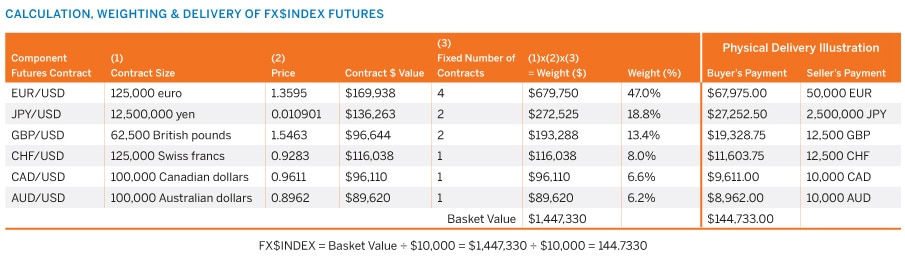
Launched July 26, 2010, Dow Jones CME FX$INDEX futures offer targeted risk management against a basket of major world currencies, all in a single contract. The contract focuses on the most frequently traded CME FX futures: the Euro FX, Japanese yen, British pound, Swiss franc, Canadian dollar and Australian dollar contracts, all traded against the U.S. dollar. The basket is weighted to reflect world trade but also refined to allow more precise hedging.
The index is quoted in U.S. dollars per foreign currency unit, in an inverse relationship. When the U.S. dollar strengthens against the basket of currencies, the Dow Jones CME FX$INDEX goes down, reflecting the relatively lower values of the currencies in the basket. When the dollar weakens against the basket of currencies, the Dow Jones CME FX$INDEX goes up, reflecting the higher values of the currency basket.
Dow Jones CME FX$INDEX Futures Weights
Specifically, 10 Dow Jones CME FX$INDEX futures reflect a basket of the following numbers of contracts:
4 EuroFX
2 Japanese yen
2 British pound
1 Swiss franc
1 Canadian dollar
1 Australian dollar
This Index is calculated as the basket value divided by $10,000. The numbers of contracts comprising the currency weights are fixed – they do not change.
A Well-Designed Index
Market participants have long shown interest in trading baskets of currencies against the U.S. dollar as a means of risk management. The U.S. dollar still remains the dominant currency for financial transactions, despite inroads by other currencies in recent decades, and this type of financial instrument can be a useful tool.
Other dollar index futures have been developed, usually based on factors such as competitiveness of U.S. goods on foreign markets. But these contracts lack the efficiency of the new Dow Jones CME FX$INDEX, as they were either pegged to a historic rather than a current marker, or needed to be hedged with odd numbers of futures contracts to balance or lay off risks.
Our new Dow Jones CME FX$INDEX is weighted by currency to reflect current economic realities as indicated by the Fed’s data on world trade. The futures contracts are designed to ensure that institutional traders, hedgers and market participants trading Dow Jones CME FX$INDEX futures can more precisely and conveniently lay-off risk against a basket of highly liquid CME FX futures contracts. Plus when integrated into a complete portfolio of CME FX futures and options, Dow Jones CME FX$INDEX futures allow for margin synergies with underlying products.
Benefits of Dow Jones CME FX$INDEX Futures
- More precise, convenient lay off of global FX market risk with a single index contract
- Access to over $100 billion in daily FX liquidity
- The safety and security of CME Clearing – more than 100 years without a default
- Transparent market pricing
- Electronic access around the world, around the clock on CME Globex
- Comprehensive portfolio management with CME FX Products
Physically delivered – “Hedgeable” Dow Jones CME FX$INDEX futures are satisfied through the physical delivery of 50,000 Euros; 2,500,000 Japanese yen; 12,500 British pounds; 12,500 Swiss francs; 10,000 Canadian dollars; and, 10,000 Australian dollars. The final settlement price is based on settlements in the six component currency futures. This provides institutional traders, hedgers and market participants with a more precise hedge than with previous U.S. dollar-based indexes, by matching 10 Dow Jones CME FX$INDEX futures vs. 4 EuroFX, 2 Japanese yen, 2 British pound, 1 Swiss franc, 1 Canadian dollar and 1 Australian dollar futures. Traders in “Hedgeable” Dow Jones CME FX$INDEX futures benefit from the liquidity of current CME FX futures, in turn offering a tighter market for our customers.

Enlarge
Wednesday, October 6, 2010
Simmering Currency Wars
by Patrice Hill at Washington Times:
While the United States has been fussing at China for gaining an advantage in trade by depressing the value of its currency, other nations — while agreeing about China — are increasingly focused on the falling dollar and concern that the U.S. may be doing the same thing.
Treasury Secretary Timothy F. Geithner on Wednesday stepped up U.S. demands that China stop closely controlling the value of its currency and allow it to rise against the dollar, suggesting that the Asian giant may be violating its pledge last year to move toward freer exchange rates with other Group of 20 economic powers.
"We have moved aggressively to do our part to help bring the world out of crisis," said Mr. Geithner, noting Congress' enactment of strict new regulatory reforms on Wall Street this summer, and a big drop in the U.S. trade deficit since 2008 as a result of greater savings and less spending by U.S. consumers.
While not mentioning China specifically in his speech to the Brookings Institution, Mr. Geithner pointed to what he described as other "major economies" with chronic large trade surpluses and undervalued currencies, in an unmistakable reference to the Asian giant.
European nations echoed Mr. Geithner's criticism in a separate forum with Chinese Premier Wen Jiabao in Brussels, and called on China to allow more rapid appreciation of its currency, the yuan or renminbi. That prompted a strong rebuke from the Chinese leader.
"Do not work to pressurize us on the renminbi rate," he said. "Yes, we are going to proceed with the reforms," but he suggested the bigger problem for the world economy was the recent large drop in the U.S. dollar, which is the world's main reserve currency.
Mr. Wen warned of dire consequences if China were to abandon its gradual currency reform and allow a rapid rise of the yuan.
"Many of our exporting companies would have to close down, migrant workers would have to return to their villages," he said. "If China saw social and economic turbulence, that would be a disaster for the world."
But the United States. received strong backing in its dispute with China from an important quarter — the International Monetary Fund. In a report Wednesday, the IMF urged China and other Asian nations with large trade surpluses to stop devaluing their currencies, rely less on exports for growth and encourage more consumer and business spending at home.
While the IMF expects the world economy to keep growing this year — led by double-digit growth in China and other developing countries — it warned that the resumption of distorted trade patterns that prevailed before the recession could undermine the economy once again.
The recovery is "neither strong nor balanced and runs the risk of not being sustained," said Olivier Blanchard, the IMF's chief economist. He added that the threat of a downward deflationary spiral in the United States, Japan and other developed nations remains viable.
Renewed economic weakness in the United States this summer — and the Federal Reserve's vow to fight a relapse into recession with even looser money policies — set off a rapid drop in the dollar against other free-floating currencies. Since August, the dollar has lost 8 percent of its value against the euro, and is down by 5 percent against major world currencies.
The dollar's rapid decline has provoked a chain reaction in other countries, ranging from a decision by Australia not to raise interest rates this week to a forceful intervention in currency markets to support the dollar by Japan and a dramatic move by the Bank of Japan to slash interest rates to zero this week.
Because the U.S. dollar is the world's dominant currency, it is taking center stage along with the spat with China at the run-up to an IMF meeting in Washington this weekend as well as a G-20 meeting planned in Seoul next month.
Brazil's finance minister created ripples in financial circles by suggesting last week that the decline of the dollar was setting off an "international currency war." Brazil itself has imposed taxes on hot money coming across its border in an attempt to stem the rapid rise of its own currency, the real.
With the U.S. and most other nations vowing to offset weakness in their own economies by trying to increase exports, some analysts fear that the kind of competitive devaluations that erupted during the Great Depression could be in the offing.
"Beggar thy neighbor is back," said Harm Bandholz, economist at Unicredit Markets. He said the U.S., Japan and United Kingdom are all deliberately weakening their currencies to try to gain an advantage in trade. The Obama administration has set the goal of doubling U.S. exports in five years.
But Raghav Subbarao, analyst at Barclays Capital, says he doesn't see a currency war on the horizon just yet, though he expects the G-20 meeting to be especially tense as nations sound off about their currency grievances..
"It would clearly be impossible for every country to follow a policy of competitive devaluations simultaneously," he said, but the temptation is there because the U.S. and other developed nations seem to have reached the limits of using fiscal and monetary policies to try to stimulate their economies.
With interest rate already at or near zero, "governments are increasingly turning to exchange rate policy as a means to maintain or improve their competitive positions," he said. That means the risks of a currency war, "although quite low, are increasing," he said.
Geithner Heats Up Election-Year Trade War Rhetoric

WSJ:
WASHINGTON—China's undervalued currency is triggering an international currency war that risks undermining the global economic recovery, U.S. Treasury Secretary Timothy Geithner said Wednesday.
"When large economies with undervalued exchange rates act to keep the currency from appreciating, that encourages other countries to do the same, and this sets off a dangerous dynamic," Mr. Geithner said.
He addressed two issues—exchange rates and fiscal strategies—expected to take center stage in ministerial meetings around the International Monetary Fund's annual gathering this week and ahead of the Group of 20 summits in coming weeks.
Mr. Geithner said more countries face stronger pressure over time to resist market forces pushing up the value of their currencies. The collective impact, the treasury secretary said, causes inflation and asset bubbles in emerging economies or else depressed consumption growth.
The U.S. House of Representatives has passed legislation that would slap tariffs on Chinese imports, while the head of the European Central Bank warned that the strong euro was threatening already anemic growth there.
Saturday, October 2, 2010
Chris Martenson: Emerging Trend May Shift Markets Rapidly
By my analysis, we are not yet on the final path to recovery, and there are one or more financial 'breaks' coming in the future. Underlying structural weaknesses have not been resolved, and the kick-the-can-down-the-road plan is going to encounter a hard wall in the not-too-distant future. When the next moment of discontinuity finally arrives, events will unfold much more rapidly than most people expect.
My work centers on figuring out which macro trends are in play and then helping people to adjust accordingly. Based on trends in fiscal and monetary policy, I began advising accumulation of gold and silver in 2003 and 2004. I shorted homebuilder stocks beginning in 2006 and ending in 2008. These were not ‘great' calls; they were simply spotting trends in play, one beginning and one certain to end, and then taking appropriate actions based on those trends.
We happen to live in a non-linear world; a core concept of the Crash Course. But far too many people expect events to unfold in a more or less orderly manner, with plenty of time to adjust along the way. In other words, linearly. The world does not always cooperate, and my concern rests on the observation that we still face the convergence of multiple trends, each of which alone has the power to permanently transform our economic landscape and standards of living.
Three such trends (out of the many I track) that will shape our immediate future are:
- Peak Oil
- Sovereign insolvency
- Currency debasement
History suggests that instead of a nice smooth line heading either up or down, markets have a pronounced habit of jolting rather suddenly into a new orbit, either higher or lower. Social moods are steady for long periods, and then they shift. This is what we should train ourselves to expect.
No smooth lines between points A and B; instead, long periods of quiet, followed by short bursts of reformation and volatility. Periods of market equilibrium, followed by Minsky moments. In the language of the evolutionary biologist Stephen Jay Gould, we live in a system governed by the rules of "punctuated equilibrium."
Complex Systems
Our economy is a complex system. The key feature of such systems is that they are inherently unpredictable with respect to the timing and severity of specific events. For the uninitiated, they can look enormously fragile and prone to flying apart at any minute; for the seasoned observer, there is an appreciation that the immense inertia of the economic system will almost always delay and dampen the eventual adjustments.Like everybody else, I have no idea exactly what’s going to happen, or precisely when. Anybody who says they do know should be greeted with a furrowed brow and a frown of suspicion. As my long-time readers know, I prefer to assess the risks and then take steps to mitigate those risks based on likelihood and impact.
Which means that although we cannot predict the size (exactly how much) or the timing (precisely when) of economic shifts or world-changing events, we can certainly understand the risks and the dimensions of what might happen. Just as we cannot predict when an avalanche will release from steep slope, or even where or how big it will be, we can readily predict that constant snowfall coupled with the right temperature conditions will lead to an avalanche sooner or later, and more likely in this gully than that one. Given certain conditions, we might expect one that is larger or smaller than normal. Although we don't know exactly when or how much, we do know that when snow accumulates, so do the risks of more frequent and/or larger avalanches.
Such is the nature of complex systems. While inherently unpredictable, they can still be described. The most important description of any complex system is that it owes its order and complexity to the constant flow of energy through it. Complex systems require inputs. This is one way in which we can understand them.
Given this view, one easy "prediction" is that an economy without increasing energy flows running through it will stagnate. To take this further, an economy that is being starved of energy becomes simpler in the process -- meaning fewer jobs, less items produced, and a reduced capacity to support extraneous functions.
Accepting "What Is"
The most important part of this story is getting our minds to accept reality without our passionate beliefs interfering. By ‘beliefs’ I mean statements like these:- “Things always get better and are never as bad as they seem.”
- “If Peak Oil were ‘real,’ I would be hearing about it from my trusted sources.”
- “Dwelling on the negative is self-fulfilling.”
Let's now examine more closely the three main events that are converging -- Peak Oil, sovereign insolvency, and currency debasement -- using as much logic as we can muster.
Peak Oil
Peak Oil is now a matter of open inquiry and debate at the highest levels of industry and government. Recent reports by Lloyd's of London, the US Department of Defense, the UK industry taskforce on Peak Oil, Honda, and the German military are evidence of this. But when I say “debate,” I am not referring to disagreement over whether or not Peak Oil is real, only when it will finally arrive. The emerging consensus is that oil demand will outstrip supplies “soon,” within the next five years and maybe as soon as two. So the correct questions are no longer, "Is Peak Oil real?" and "Are governments aware?” but instead, "When will demand outstrip supply?" and “What implications does this have for me?”It doesn't really matter when the actual peak arrives; we can leave that to the ivory-tower types and those with a bent for analytical precision. What matters is when we hit “peak exports.” My expectation is that once it becomes fashionable among nation-states to finally admit that Peak Oil is real and here to stay, one or more exporters will withhold some or all of their product "for future generations" or some other rationale (such as, "get a higher price"), which will rather suddenly create a price spiral the likes of which we have not yet seen.
What matters is an equal mixture of actual oil availability and market perception. As soon as the scarcity meme gets going, things will change very rapidly.
In short, it is time to accept that Peak Oil is real - and plan accordingly.
Sovereign Insolvency
Once we accept the imminent arrival of Peak Oil, then the issue of sovereign insolvency jumps into the limelight. Why? Because the hopes and dreams of the architects of the financial rescue entirely rest upon the assumption that economic growth will resume. Without additional supplies of oil, such growth will not be possible; in fact, we’ll be doing really, really well if we can prevent the economy from backsliding.Virtually every single OECD country, due to outlandish pension and entitlement programs, has total debt and liability loads that Arnaud Mares (of Morgan Stanley) pointed out have resulted in a negative net worth for the governments of Germany, France, Portugal, the US, the UK, Spain, Ireland, and Greece. And not by just a little bit, but exceptionally so, ranging from more than 450% of GDP in the case of Germany on the 'low' end to well over 1,500% of GDP for Greece.
Such shortfalls cannot possibly be funded out of anything other than a very, very bright economic future. Something on the order of Industrial Age 2.0, fueled by some amazing new source of wealth. Logically, how likely is that? Even if we could magically remove the overhang of debt, what new technologies are on the horizon that could offer the prospect of a brand new economic revival of this magnitude? None that I am aware of.
In the US, the largest capital market and borrower, even the most optimistic budget estimates foresee another decade of crushing deficits that will grow the official deficit by some $9 trillion and the real (i.e., “accrual” or “unofficial”) deficit by perhaps another $20 to $30 trillion, once we account for growth in liabilities. This is, without question, an unsustainable trend.
It’s time to admit the obvious: Debts of these sorts cannot be serviced, now or in the future. Expanding them further with fingers firmly crossed in hopes of an enormous economic boom that will bail out the system is a fool’s game. It is little different than doubling down after receiving a bad hand in poker.
The unpleasant implication of various governments going deeper into debt is that a string of sovereign defaults lies in the future. Due to their interconnected borrowings and lendings, one may topple the next like dominoes.
However, it is when we consider the impact of the widespread realization of Peak Oil on the story of growth that the whole idea of sovereign insolvency really assumes a much higher level of probability. More on that later.
For now we should accept that there's almost no chance of growing out from under these mountains of debts and other obligations. We must move our attention to the shape, timing, and the severity of the aftermath of the economic wreckage that will result from a series of sovereign defaults.
Currency Wars
We could trot out a lot of charts here, examine much of history, and make a very solid case that once a country breaches the 300% debt/liability to GDP ratio, there's no recovery, only a future containing some form of default (printing or outright).In a recent post to my enrolled members, I wrote:
The currency wars have begun, and the implications to world stability and wealth could not be more profound. Fortunately, all of my long-time enrolled members are prepared for this outcome, which we've been predicting here for some time.You can be nearly certain that every single country is seeking a path to a weaker relative currency. The problem is obvious: Everybody cannot simultaneously have a weaker currency. Nor can everybody have a positive trade balance.
When pressed, the most predictable decision in all of history is to print, print, print. So I can't take credit for a 'prediction' that was just slightly bolder than 'predicting' which way a dropped anvil will travel; down or up?
The only problem is, widespread currency debasements will further destabilize an already rickety global financial system where tens of trillions of fiat dollars flow daily on the currency exchanges.
If a country or government cannot grow its way out from under its obligations, then printing (a.k.a. currency debasement) takes on additional allure. It is the "easy way out" and has lots of political support in the home country. Besides the fact that it has already started, we should consider a global program of currency debasement to be a guaranteed feature of our economic future.
Conclusion (to Part I)
Three unsustainable trends or events have been identified here. They are not independent, but they are interlocked to a very high degree. At present I can find no support for the idea that the economy can expand like it has in the past without increasing energy flows, especially oil. All of the indications point to Peak Oil, or at least "peak exports," happening within five years.At that point, it will become widely recognized that most sovereign debts and liabilities will not be able to be serviced by the miracle of economic growth. Pressures to ease the pain of the resulting financial turmoil and economic stagnation will grow, and currency debasement will prove to be the preferred policy tool of choice.
Instead of unfolding in a nice, linear, straightforward manner, these colliding events will happen quite rapidly and chaotically.
By mentally accepting that this proposition is not only possible, but probable, we are free to make different choices and take actions that can preserve and protect our wealth and mitigate our risks.
What changes in our actions and investment stances are prudent if we assume that Peak Oil, sovereign insolvency, and currency debasement are 'locks' for the future?
I explore these questions in greater depth in Part II of this report (enrollment required)
Monday, September 27, 2010
Currency Wars: Brazil First to Admit It
from Financial Times:
Mr Mantega’s comments in São Paulo on Monday follow a series of recent interventions by central banks, in Japan, South Korea and Taiwan in an effort to make their currencies cheaper. China, an export powerhouse, has continued to suppress the value of the renminbi, in spite of pressure from the US to allow it to rise, while officials from countries ranging from Singapore to Colombia have issued warnings over the strength of their currencies.
“We’re in the midst of an international currency war, a general weakening of currency. This threatens us because it takes away our competitiveness,” Mr Mantega said. By publicly asserting the existence of a “currency war”, Mr Mantega has admitted what many policymakers have been saying in private: a rising number of countries see a weaker exchange rate as a way to lift their economies.
A weaker exchange rate makes a country’s exports cheaper, potentially boosting a key source of growth for economies battling to find growth as they emerge from the global downturn.
The proliferation of countries trying to manage their exchange rates down is also making it difficult to co-ordinate the issue in global economic forums.
In spite of Mr Mantega’s recent aggressive public statements, however, Brazil has so far held back from taking any action other than intervening in the local currency spot market.
The central bank bought as much as $1bn a day for much of the past two weeks – about 10 times its daily average in recent months – but this was largely to absorb money entering the country to take part in last week’s $67bn share issue by Petrobras, the national oil company.
Wednesday, September 1, 2010
Forex Volume Hits All-Time High
Forex volume has hit a new all-time high, even while stock market volume hits a fresh low. Forex on Friday hit a new high of $4 trillion in volume for a single day!
Sunday, June 20, 2010
China Says It Will End Currency Peg
from the Bank of China:
In view of the recent economic situation and financial market developments at home and abroad, and the balance of payments (BOP) situation in China, the People´s Bank of China has decided to proceed further with reform of the RMB exchange rate regime and to enhance the RMB exchange rate flexibility.
Starting from July 21, 2005, China has moved into a managed floating exchange rate regime based on market supply and demand with reference to a basket of currencies. Since then, the reform of the RMB exchange rate regime has been making steady progress, producing the anticipated results and playing a positive role.
Tuesday, June 1, 2010
German Finance Minister Reveals Fed Interventions In Forex Markets
I couldn't find a good article to clip and paste for this news story. I first learned about it on the Zero Hedge blog.
ECB Intervening in Forex Markets

from Zero Hedge blog:
With all the grace of a drunk Keynesian at an Austrian economists meeting, the Central Banks once again kill the EUR shorts and intervene to prop it up, for a ridiculous 250 pips intraday move. And thanks to Germany's Economics Minister Rainer Bruderle, we now know that the Fed is actively manipulating the FX pairs. Thank you Ben Bernanke for making sure that Atari has some confidence left in the manipulated market, as no humans are left any more.
Monday, May 10, 2010

Friday, May 7, 2010
Gold De-Couples From Dollar As Fear of Contagion Spreads
from Market Oracle:
The sharp sell off on Wall Street and with equities internationally saw gold decouple and surge in all currencies yesterday. Oil, commodities and bonds also fell sharply in incredibly volatile trading.

Gold Decouples - Gold and the Dow Jones - 30 Days
The massive intraday drop of nearly 1000 points in the Dow Jones also saw significant volatility in currency markets which may presage a euro currency crisis. There is the risk that the sovereign debt crisis could lead to an international monetary crisis as investors lose faith in fiat currencies most of which are saddled with very significant debt levels. Gold's debt free status and lack of counter party risk is making it an increasingly attractive diversification option - and this looks set to continue for the foreseeable future.

Gold in US Dollars Looks Set to Challenge the Record Nominal Daily High of $1,215 per ounce
The UK hung parliament or minority government will not help sentiment towards sterling. The incoming government will be faced with some of the most challenging economic challenges to be faced in modern history. The UK's public finances are in very poor shape and the UK's AAA credit rating is at risk. While the UK is no Greece, its fiscal challenges are extremely challenging and will involve considerable economic pain - possibly even austerity measures. Sterling may remain under pressure until the markets perceive that the incoming government means business about tacking the deficits.

Gold in GBP Surges 4% Yesterday on Political and Economic Concerns
With all the focus on the Greek and European sovereign debt crisis, many have yet to notice the growing risks of another Lehman Brothers style interbank cash market seize up. Sovereign debt contagion fears are feeding into interbank contagion fears as concerns about the solvency of some banks saw Libor rates rising sharply. Moody's warned of risk of contagion in the banking sector yesterday.
Important benchmarks of the health of the global banking system are again flashing red signals. The spread between three-month Libor and the overnight indexed swap rate, a key gauge of banks' reluctance to lend, rose to the most in more than five months yesterday, as concern deepened that the financial crisis in Greece is spreading to other nations (see chart below).

3 Month Libor and the Overnight Indexed Swap Rate
Another sign of 'Lehmanesque' problems recurring is that the Markit iTraxx Financial Index of credit-default swaps linked to the senior debt of 25 European banks and insurers soared as much as 40 basis points to an all-time high of 223. The cost of default protection on corporate debt in Europe rose to the highest since April 2009.

Markit iTraxx Financial Index of Credit-Default Swaps
Silver
Silver fell slightly in dollars yesterday to $17.47/oz but rose to new record highs in euros, British pounds and Swiss francs.
Silver remains less than half its nominal high of $50 per ounce 30 years ago and less than 20% of its inflation adjusted high of over $130 per ounce.
Platinum Group Metals
Platinum is trading at $1,660/oz marginally up and palladium is currently trading at $505/oz down another 1%. Rhodium is trading at $2,760/oz.
News
Respected analyst, David Rosenberg of Guskin-Sheff has forecast that gold will rise to $3,000 per ounce. Unlike Nouriel Roubini who has recently warned that the risk of deflation is abating and the growing risk was of inflation, Rosenberg remains a deflationist, but still thinks gold will continue to perform very well.
He argues that the breakdown of the euro is very bullish for gold. With the ECB being no Bundesbank and the Euro no D-Mark, gold is set to soar in euros and dollars.
Rosenberg warns that the Euro is less of a "hard currency" than its architects could have ever envisaged a decade ago. Now there is talk that the ECB is contemplating a quantitative easing plan. The case for gold heading to $3,000 an ounce is getting stronger by the day. The euro has already broken below 1.30 to the U.S. dollar and there is plenty of room for additional decline going forward. It's only at a one-year low - wait until it moves to a decade low.
Make no mistake - the problems in Greece are mirrored in places like Portugal and Spain - this is not about liquidity, like Bear Stearns and Lehman, it is a crisis in confidence (Banco Santander, widely seen as a barometer of financial health in Spain, cratered 7% yesterday). The FT reports today that there has been some market chatter that Spain has been "negotiating" with the IMF for assistance (€280bln) too. History shows that crises over confidence are tougher to repair over the near-term than liquidity crunches. The fact that Greek short- term bonds have collapsed in price even more - even though the country does not have to come to the market for the next few years so long as Germany comes through after the vote - is a case in point.
So contagion risks loom and there are simply not enough trees on the planet that can provide enough paper currency to backstop countries like Portugal and Spain. Moreover, what investors see is that if there is so much political foot- dragging in Germany and other EU countries to approve a bailout of tiny Greece, achieving a rescue plan for other large basket-cases will be even more arduous a task. Have a look at Martin Wolf's column on page 9 of the FT - A Bailout For Greece is Just the Beginning. What a tale of woe. And let's not forget about Italy - its public finances are less dire but still fragile (Business Insider).
Thursday, May 6, 2010
Gold De-Couples From Dollar As Fear of Contagion Spreads
The sharp sell off on Wall Street and with equities internationally saw gold decouple and surge in all currencies yesterday. Oil, commodities and bonds also fell sharply in incredibly volatile trading.
Gold was up by more than 2% in dollar terms and by more than 3.5% in euros and pounds as the euro and pound fell sharply on contagion fears, hung parliament and economic concerns respectively. Gold reached new record nominal highs in sterling, euros and Swiss francs and 27 year highs in Japanese yen, also reaching a five-month high in dollars. Given the scale of the international debt crisis, the December record (nominal) high of $1,226 per ounce (interday) could be reached in the coming days and respected analysts are now forecasting gold to rise to $3,000 per ounce (see News).
Gold Decouples - Gold and the Dow Jones - 30 Days
The massive intraday drop of nearly 1000 points in the Dow Jones also saw significant volatility in currency markets which may presage a euro currency crisis. There is the risk that the sovereign debt crisis could lead to an international monetary crisis as investors lose faith in fiat currencies most of which are saddled with very significant debt levels. Gold's debt free status and lack of counter party risk is making it an increasingly attractive diversification option - and this looks set to continue for the foreseeable future.
Gold in US Dollars Looks Set to Challenge the Record Nominal Daily High of $1,215 per ounce
The UK hung parliament or minority government will not help sentiment towards sterling. The incoming government will be faced with some of the most challenging economic challenges to be faced in modern history. The UK's public finances are in very poor shape and the UK's AAA credit rating is at risk. While the UK is no Greece, its fiscal challenges are extremely challenging and will involve considerable economic pain - possibly even austerity measures. Sterling may remain under pressure until the markets perceive that the incoming government means business about tacking the deficits.
Gold in GBP Surges 4% Yesterday on Political and Economic Concerns
With all the focus on the Greek and European sovereign debt crisis, many have yet to notice the growing risks of another Lehman Brothers style interbank cash market seize up. Sovereign debt contagion fears are feeding into interbank contagion fears as concerns about the solvency of some banks saw Libor rates rising sharply. Moody's warned of risk of contagion in the banking sector yesterday.
Important benchmarks of the health of the global banking system are again flashing red signals. The spread between three-month Libor and the overnight indexed swap rate, a key gauge of banks' reluctance to lend, rose to the most in more than five months yesterday, as concern deepened that the financial crisis in Greece is spreading to other nations (see chart below).
3 Month Libor and the Overnight Indexed Swap Rate
Another sign of 'Lehmanesque' problems recurring is that the Markit iTraxx Financial Index of credit-default swaps linked to the senior debt of 25 European banks and insurers soared as much as 40 basis points to an all-time high of 223. The cost of default protection on corporate debt in Europe rose to the highest since April 2009.
Markit iTraxx Financial Index of Credit-Default Swaps
Silver
Silver fell slightly in dollars yesterday to $17.47/oz but rose to new record highs in euros, British pounds and Swiss francs.
Silver remains less than half its nominal high of $50 per ounce 30 years ago and less than 20% of its inflation adjusted high of over $130 per ounce.
Platinum Group Metals
Platinum is trading at $1,660/oz marginally up and palladium is currently trading at $505/oz down another 1%. Rhodium is trading at $2,760/oz.
News
Respected analyst, David Rosenberg of Guskin-Sheff has forecast that gold will rise to $3,000 per ounce. Unlike Nouriel Roubini who has recently warned that the risk of deflation is abating and the growing risk was of inflation, Rosenberg remains a deflationist, but still thinks gold will continue to perform very well.
He argues that the breakdown of the euro is very bullish for gold. With the ECB being no Bundesbank and the Euro no D-Mark, gold is set to soar in euros and dollars.
Rosenberg warns that the Euro is less of a "hard currency" than its architects could have ever envisaged a decade ago. Now there is talk that the ECB is contemplating a quantitative easing plan. The case for gold heading to $3,000 an ounce is getting stronger by the day. The euro has already broken below 1.30 to the U.S. dollar and there is plenty of room for additional decline going forward. It's only at a one-year low - wait until it moves to a decade low.
Make no mistake - the problems in Greece are mirrored in places like Portugal and Spain - this is not about liquidity, like Bear Stearns and Lehman, it is a crisis in confidence (Banco Santander, widely seen as a barometer of financial health in Spain, cratered 7% yesterday). The FT reports today that there has been some market chatter that Spain has been "negotiating" with the IMF for assistance (€280bln) too. History shows that crises over confidence are tougher to repair over the near-term than liquidity crunches. The fact that Greek short- term bonds have collapsed in price even more - even though the country does not have to come to the market for the next few years so long as Germany comes through after the vote - is a case in point.
So contagion risks loom and there are simply not enough trees on the planet that can provide enough paper currency to backstop countries like Portugal and Spain. Moreover, what investors see is that if there is so much political foot- dragging in Germany and other EU countries to approve a bailout of tiny Greece, achieving a rescue plan for other large basket-cases will be even more arduous a task. Have a look at Martin Wolf's column on page 9 of the FT - A Bailout For Greece is Just the Beginning. What a tale of woe. And let's not forget about Italy - its public finances are less dire but still fragile (Business Insider).
Subscribe to:
Posts (Atom)