Showing posts with label hyperinflation. Show all posts

Sunday, October 16, 2011

John Mauldin on Hyperinflation

"By a continuing process of inflation, government can confiscate, secretly and unobserved, an important part of the wealth of their citizens.

- John Maynard Keynes, Economic Consequences of Peace
"Unemployed men took one or two rucksacks and went from peasant to peasant. They even took the train to favorable locations to get foodstuffs illegally which they sold afterwards in the town at three or fourfold the prices they had paid themselves. First the peasants were happy about the great amount of paper money which rained into their houses for their eggs and butter… However, when they came to town with their full briefcases to buy goods, they discovered to their chagrin that, whereas they had only asked for a fivefold price for their produce, the prices for scythe, hammer and cauldron, which they wanted to buy, had risen by a factor of 50."
- Stefan Zweig, The World of Yesterday, 1944.
The beginning of the end of the Weimar Republic was some 89 years ago this week. There is a stream of opinion that the US is headed for the same type of end. How else can it be, given that we owe some $75-80 trillion dollars in the coming years, over 5 times current GDP and growing every year? Remember the good old days of about 5-6 years ago (if memory serves me correctly) when it was only $50 trillion? With a nod to Bernanke's helicopter speech, where he detailed how the Fed could prevent deflation, I ask the opposite question, "Can 'it' (hyperinflation) really happen here?" I write this on a plane flying to NYC, with a tighter deadline than normal, so let's see how far we can get. More on where I'm heading at the end of the letter.
But first, let me quickly call to your attention a speaking engagement that I'm doing November 9 in Atlanta. It is for Hedge Funds Care, and it's a wonderful event for a children's charity. If you can make it, I hope to see you there. You can learn more and register at http://www.hedgefundscare.org/event.asp?eventID=74.

Can "It" Happen Here?

I was inspired for this week's letter by a piece by Art Cashin (whom I will get to have dinner with Monday). His daily letter always begins with an anecdote from history. Yesterday it was about Weimar, told in his own inimitable style. So without any edits, class will commence, with Professor Cashin at the chalk board.
An Encore Presentation
By Art Cashin
Originally, on this day (-2) in 1922, the German Central Bank and the German Treasury took an inevitable step in a process which had begun with their previous effort to "jump start" a stagnant economy. Many months earlier they had decided that what was needed was easier money. Their initial efforts brought little response. So, using the governmental "more is better" theory they simply created more and more money.
But economic stagnation continued and so did the money growth. They kept making money more available. No reaction. Then, suddenly prices began to explode unbelievably (but, perversely, not business activity).
So, on this day government officials decided to bring figures in line with market realities. They devalued the mark. The new value would be 2 billion marks to a dollar. At the start of World War I the exchange rate had been a mere 4.2 marks to the dollar. In simple terms you needed 4.2 marks in order to get one dollar. Now it was 2 billion marks to get one dollar. And thirteen months from this date (late November 1923) you would need 4.2 trillion marks to get one dollar. In ten years the amount of money had increased a trillion fold.
Numbers like billions and trillions tend to numb the mind. They are too large to grasp in any "real" sense. Thirty years ago an older member of the NYSE (there were some then) gave me a graphic and memorable (at least for me) example. "Young man," he said, "would you like a million dollars?" "I sure would, sir!" I replied anxiously. "Then just put aside $500 every week for the next 40 years." I have never forgotten that a million dollars is enough to pay you $500 per week for 40 years (and that's without benefit of interest). To get a billion dollars you would have to set aside $500,000 dollars per week for 40 years. And a…..trillion that would require $500 million every week for 40 years. Even with these examples, the enormity is difficult to grasp.
Let's take a different tack. To understand the incomprehensible scope of the German inflation maybe it's best to start with something basic….like a loaf of bread. (To keep things simple we'll substitute dollars and cents in place of marks and pfennigs. You'll get the picture.) In the middle of 1914, just before the war, a one pound loaf of bread cost 13 cents. Two years later it was 19 cents. Two years more and it sold for 22 cents. By 1919 it was 26 cents. [Double in value, or a "mere" 12% compound inflation –JM.] Now the fun begins.
In 1920, a loaf of bread soared to $1.20, and then in 1921 it hit $1.35. By the middle of 1922 it was $3.50. At the start of 1923 it rocketed to $700 a loaf. Five months later a loaf went for $1200. By September it was $2 million. A month later it was $670 million (wide spread rioting broke out). The next month it hit $3 billion. By mid month it was $100 billion. Then it all collapsed [as if a roughly 8 billion times rise in cost wasn't already collapse! Hint of irony here. – JM]
Let's go back to "marks". In 1913, the total currency of Germany was a grand total of 6 billion marks. In November of 1923 that loaf of bread we just talked about cost 428 billion marks. A kilo of fresh butter cost 6000 billion marks (as you will note that kilo of butter cost 1000 times more than the entire money supply of the nation just 10 years earlier).

How Could This All Happen?

In 1913 Germany had a solid, prosperous, advanced culture and population. Like much of Europe it was a monarchy (under the Kaiser). Then, following the assassination of the Archduke Franz Ferdinand in Sarajevo in 1914, the world moved toward war. Each side was convinced the other would not dare go to war. So, in a global game of chicken they stumbled into the Great War.
[Side note: So convinced were the bond markets that war was not possible that bonds were still selling at normal prices. War was simply inconceivable. Bad call. - JM]
The German General Staff thought the war would be short and sweet and that they could finance the costs with the post war reparations that they, as victors, would exact. The war was long. The flower of their manhood was killed or injured. They lost and, thus, it was they who had to pay reparations rather than receive them.
Things did not go badly instantly. Yes, the deficit soared but much of it was borne by foreign and domestic bond buyers. As had been noted by scholars….."The foreign and domestic public willingly purchased new debt issues when it believed that the government could run future surpluses to offset contemporaneous deficits." In layman's English that means foreign bond buyers said – "Hey this is a great nation and this is probably just a speed bump in the economy." (Can you imagine such a thing happening again?)
When things began to disintegrate, no one dared to take away the punchbowl. They feared shutting off the monetary heroin would lead to riots, civil war, and, worst of all communism. So, realizing that what they were doing was destructive, they kept doing it out of fear that stopping would be even more destructive.

Currencies, Culture and Chaos

If it is difficult to grasp the enormity of the numbers in this tale of hyper-inflation, it is far more difficult to grasp how it destroyed a culture, a nation and, almost, the world.
People's savings were suddenly worthless. Pensions were meaningless. If you had a 400 mark monthly pension, you went from comfortable to penniless in a matter of months. People demanded to be paid daily so they would not have their wages devalued by a few days passing. Ultimately, they demanded their pay twice daily just to cover changes in trolley fare. People heated their homes by burning money instead of coal. (It was more plentiful and cheaper to get.)
The middle class was destroyed. It was an age of renters, not of home ownership, so thousands became homeless.
But the cultural collapse may have had other more pernicious effects.
Some sociologists note that it was still an era of arranged marriages. Families scrimped and saved for years to build a dowry so that their daughter might marry well. Suddenly, the dowry was worthless – wiped out. And with it was gone all hope of marriage. Girls who had stayed prim and proper awaiting some future Prince Charming now had no hope at all. Social morality began to collapse. The roar of the roaring twenties began to rumble.
All hope and belief in systems, governmental or otherwise, collapsed. With its culture and its economy disintegrating, Germany saw a guy named Hitler begin a ten year effort to come to power by trading on the chaos and street rioting. And then came World War II.
That soul-wrenching and disastrous experience with inflation is seared into the German psyche. It is why the populace is reluctant to endorse the bailout. It is also why all the German proposals have each country taking care of its own banks. (It gives them more control.) The French plans tend to socialize the bailout. There's more disagreement in these plans than the headlines would indicate.
To celebrate have a Jagermeister or two at the Pre Fuhrer Lounge and try to explain that for over half a century America's trauma has been depression-era unemployment while Germany's trauma has been runaway inflation. But drink fast, prices change radically after happy hour.

What Causes Hyperinflation?

We spent a whole chapter writing about inflation and hyperinflation in Endgame, which I think highlights the topic rather well ( http://www.amazon.com/endgame). Let me quote a few paragraphs.
"We know that the world is drowning in too much debt, and it is unlikely that households and governments everywhere will be able to pay down that debt. Doing so in some cases is impossible, and in other cases it will condemn people to many hard years of labor in order to be debt-free. Inflation, by comparison, appears to be the easy way out for many policy makers.
"Companies and households typically deal with excessive debt by defaulting; countries overwhelmingly usually deal with excessive debt by inflating it away. While debt is fixed, prices and wages can go up, making the total debt burden smaller. People can't increase prices and wages through inflation, but governments can create inflation and they've been pretty good at it over the years. Inflation, debt monetization and currency debasement are not new. They have been used for the past few thousand years as means to get rid of debt. In fact, they work pretty well.
"The average person thinks that inflation comes from 'money printing.' There is some truth to this, and indeed the most vivid images of hyperinflation are of printed German Reichmarks being burnt for heat in the 1920s or Hungarian Pengos being swept up in the streets in 1945.
"You don't even have to go that far back to see hyperinflation and how brilliantly it works at eliminating debt. Let's look at the example of Brazil, which is one of the world's most recent examples of hyperinflation. This happened within our lifetimes. In the late 1980s and 1990s it very successfully got rid of most of its debt.
"Today Brazil has very little debt as it has all been inflated away. Its economy is booming, people trust the central bank and the country is a success story. Much like the United States had high inflation in the 1970s and then got a diligent central banker like Paul Volcker, in Brazil a new government came in, beat inflation, produced strong real GDP growth and set the stage for one of the greatest economic success stories of the past two decades. Indeed the same could be said of other countries like Turkey that had hyperinflation, devaluation, and then found monetary and fiscal rectitude.
"In 1993 Brazilian inflation was roughly 2,000%. Only four years later, in 1997 it was 7%. Almost as if by magic, the debt disappeared. Imagine if the US increased its money supply which is currently $900 billion by a factor of 10,000 times as Brazil's did between 1991 and 1996. We would have 9 quadrillion USD on the Fed's balance sheet. That is a lot of zeros. It would also mean that our current debt of thirteen trillion would be chump change. A critic of this strategy for getting rid of our debt could point out that no one would lend to us again if we did that. Hardly. Investors, sadly, have very short memories. Markets always forgive default and inflation. Just look at Brazil, Bolivia, and Russia today. Foreigners are delighted to invest in these countries.
"The endgame is not complicated under inflation/hyperinflation. Deflation is not inevitable. Money printing and monetization of government debt works when real growth fails. It has worked in countless emerging market economies (Zimbabwe, Ukraine, Tajikistan, Taiwan, Brazil, etc.). We could even use it in the US to get rid of all our debts. It would take a few years, and then we could get a new central banker like Volker to kill inflation. We could then be a real success story like Brazil.
"Honestly, recommending hyperinflation is tongue in cheek. But now even serious economists are recommending inflation as a solution. Given the powerful deflationary forces in the world, inflation will stay low in the near term. This gives some comfort to mainstream economists who think we can create inflation to solve the debt problem in the short run. The International Monetary Fund's top economist, Olivier Blanchard, has argued that central banks should target a higher inflation rate than they do at present in order to avoid the possibility of deflation. Economists like Paul Krugman, a Nobel Prize winner, and Olivier Blanchard argue that central banks should raise their inflation targets to as high as 4%. Paul McCulley argues that central banks should be 'responsibly irresponsible.'
"Peter Bernholz wrote the bible on inflation and hyperinflation, called Monetary Regimes and Inflation: History, Economic and Political Relationships. He writes about 29 periods of hyperinflation. What causes such a spectacular increase in prices? Bernholz has explained the process very elegantly.
"Bernholz argues that governments have a bias towards inflation. The evidence doesn't disagree with him. The only thing that limits a government's desire for inflation is an independent central bank. After looking at inflation across all countries and analyzing all hyperinflationary episodes, the lessons are the following:
1. Metallic standards like gold or silver standard show no, or a much smaller, inflationary tendency than discretionary paper money standards
2. Paper money standards with central banks independent of political authorities are less inflation-based than those with dependent central banks.
3. Currencies based on discretionary paper standards and bound by a regime of a fixed exchange rate to currencies, which either enjoy a metallic standard or, with a discretionary paper money standard, an independent central bank, show also a smaller tendency towards inflation, whether their central banks are independent or not.
"Bernholz examined twelve of the twenty-nine hyperinflationary episodes where significant data existed. Every hyperinflation looked the same. 'Hyperinflations are always caused by public budget deficits which are largely financed by money creation.' But even more interestingly, Bernholz identified the level at which hyperinflations can start. He concluded that 'the figures demonstrate clearly that deficits amounting to 40 percent or more of expenditures cannot be maintained. They lead to high inflation and hyperinflations….' Interestingly, even lower levels of government deficits can cause inflation. For example, 20% deficits were behind all but four cases of hyperinflation.
"Stay with us here, because this is an important point. Most analysts quote government deficits as a percentage of GDP. They'll say, 'The US has a government deficit of 10% of GDP.' While this measure makes some sense, it doesn't tell you how big the deficit is relative to expenditures. The deficit may be 10% the size of the US economy, but currently the US deficit is over 30% of all government spending. That is a big difference."

A Very Frank Idea

I am confronted all the time on the road by investors who want to know my basis for stating that we will not see hyperinflation in the US. I am good friends with many who believe it is the only way the US can end up, given the size of the current off-balance-sheet debacle. "End of America" Porter Stansberry, Doug Casey and David Galland (see below), Peter Schiff, Bill Bonner, and a host of gold bugs see no other way out. They look at history as written by Bernholz and see the proverbial writing on the wall. It is totally decipherable by them. I remain very unconvinced.
The US Federal Reserve system is different from most central banks, whether it is independent or not. It is composed of 12 separate regional banks, each of which has its own board, which appoints its regional president. The regions each get a certain number of rotating votes in the FOMC meetings, along with the appointed Fed governors. But they all get to participate in FOMC meetings and offer opinions. And the presidents certainly talk with each other. The last two meetings have seen the unusual circumstance of three dissenting votes.
These regional boards comprise local business leaders, some academics, and community leaders. They have to go back and work and live in their communities. They don't get to retire to an ivory tower and tenure, like many Fed governors. They see the real world, or at least their parts of it, and the boards have become very diverse over time.
Hyperinflation requires a central bank to willingly commit economic suicide. Typically, that happens at the behest of an authoritarian government. Under our current system, I can't see that happening. The hue and cry would be very loud and long and early. If you think Fisher et al. are vocal today, think about their response to really aggressive printing. I am not talking about something on the order of QE2, a BB gun as compared to a bazooka. I am talking about real printing.
It is not just a few vocal regional Fed presidents, of whom Fisher is the most eloquent. Even Bernanke has been talking about the limits of monetary policy and the need for the fiscal house to be put in order.
If Bernanke and his fellow Keynesians could whip up 4-5% inflation for a few years, would they do it? I think so, although they would publicly demur. But that is a far cry from 10% and even further from the 50% that would be needed to really ignite hyperinflation. I doubt they have the stomach for that, even in the face of a serious recession. The memories of the '70s are still part of our genetic make-up.
But could they print a whole lot more than one can imagine now, without unleashing the inflation demon? The simple answer is yes, and for that rationale we go back to the '30s and Irving Fisher, who gave us the classic equation of the link between money supply and inflation and the velocity of money (how fast money moves through an economy).
Inflation is a combination of the money supply AND the velocity of money. In short, if the velocity of money is falling, the Fed can print a great deal of money (expanding its balance sheet) without bringing about inflation. Remember the above instance, where workers wanted to get paid twice a day? That was a case of both rising money supply and rising velocity of money, a deadly combination. I have written several e-letters about the velocity of money, if you want more in-depth analysis. If this is something you do not understand, I suggest you take the time; otherwise you will not get the background of the argument. Here are a couple links to letters where I explain the velocity of money:
http://www.johnmauldin.com/frontlinethoughts/the-implications-of-velocity-mwo031210
http://www.johnmauldin.com/frontlinethoughts/the-velocity-factor-mwo120508
When do we see a seriously falling velocity of money? At the end of debt supercycles, where deleveraging is the order of the day. Which is where we are today in the US. Look at the graph below (from my friend Lacy Hunt at Hoisington Asset Management). Notice that the late '70s saw a rising money supply and rising velocity of money. And voila, we got inflation in the US. Notice that now velocity is falling and, as Lacy points out, the velocity is mean reverting over very long periods of time, so we can expect it to go lower. Also remember that the US government (at the federal level) has yet to really begin to get its fiscal house in order. (Although state and local government have combined to cut deficits $200 billion a year through a combination of spending cuts and tax increases, or over 1% of GDP, which has been a serious headwind with more cuts and tax increases to come.)

What could change my mind? If the (how to say this politely?) ill-conceived (stronger words come to mind) proposal by Financial Services Committee ranking member Barney Frank (D-Mass) were to see the light of day, I would get very concerned. According to Bloomberg and The Hill, Frank plans to submit a bill that would remove the votes of the five regional Federal Reserve presidents from the 12-member Federal Open Markets Committee (FOMC), which sets interest rates, and replace them with five appointees that would be nominated by the President and confirmed by the Senate.
Frank says "he is concerned that the process is undemocratic because the regional Fed presidents are not elected or appointed by elected representatives, and he believes that regional Fed presidents are overly likely to focus on guarding against inflation at the expense of more adequately tackling the country's unemployment crisis." (US News and World Report)
Basically, he wants the Fed to be subservient to the politicians. Under his proposal, the FOMC could lose what independence it has in a short time. This is part of a strain of thought that suggests that the decisions that affect all of us should be made by a few elite people who purport to understand what is going on, which coincidentally are government insiders and the academics who foster their agendas.
How did Weimar and other hyperinflation incidents occur? When power was in the hands of a few well-intentioned elites who did not understand the long-term consequences, or were acting in self-interest without transparency or any check on their decisions. The Fed is designed to be a system of checks and balances, with no one president getting to appoint all the governors (they have 14-year terms), in order to try to remove the process as much as possible from political interference. That does not mean they will make the right decisions, but in this I agree with the alarmists: history suggests that without some constraint (gold standards as an example) hyperinflations may occur.
A repeat of the '70s? That is within the realm of possibility, but it's certainly not a base-case scenario. Hyperinflation under our current system? I just don't see it.

But What About the $70 trillion in Off-Balance-Sheet Debt?

I am asked that question all the time. My answer is that it illustrates the power of "It Won't Happen." As in "if it can't happen it won't happen." That number will never be paid, either in terms of current buying power or actual numbers or actual benefits. It can't be. The money is not and will not be there.
The far more interesting question is what will happen when we reach the point of "won't happen." Will that be something we recognize before it happens and act proactively to avoid a cataclysmic event? Will we wait until the bond market jerks our chain about the fiscal crisis, which is massively stagflationary? Yes, the Fed can print to some degree, but not dealing with the crisis will ultimately force a huge restructuring of spending and taxes which, if not caught early enough, will propel us into a certain Second Great Depression. Which is why I think we will deal with it proactively in 2013, because to not do so would be folly of the worst sort. The consequences are unimaginable for the US and for the world. Think Greece, and then go downhill. All over the world.
I think more and more political leaders are beginning to understand that point. They are not happy about it. But I remain hopeful that in 2013 we can actually deal with the deficit and the debt in an orderly manner. If we do not, God help us all.

Tuesday, August 16, 2011

Headed for Hyperinflationary Depression?

"The world is now staring into the abyss and we are most likely entering the Dark Years which I wrote about two years ago. The consequences will almost certainly be unlimited money printing and a hyperinflationary depression." -- Egon Von Greyerz

Tuesday, May 31, 2011

Sunday, April 24, 2011

Why the Fed Must Cut Short It's QE2 Inflation Gamble

from Zero Hedge:

The Federal Reserve has lost all credibility on Wall Street, and most of the American public with the absolute refusal to recognize the dire effects on asset prices that QE2 has created. But the refusal is part of the problem. It reinforces the wide spread belief of investors that the Fed is out of touch with reality, and that they sit in their Ivory Tower implementing an exceedingly loose monetary policy, with the stated goal of inflating asset prices.

The Fed has refused to even acknowledge the possibility (rather than the indisputable facts) that not only have they inflated selected asset prices like S&P 500, the Dow indexes, but they also have inflated asset prices like food, energy, and clothing which would actually hurt the economy and consumers (See Chart).


Needed – Housing and Wage Inflation

Remember, overall inflation is actually being artificially under-reported by the numbers because housing and wages are not inflating. These are the two actual groups of assets that Americans in reality need the Fed to inflate. But Fed’s policies have been unable to help and seem to essentially be hurting the housing sector, as higher everyday living costs with stagnant wages tend to reduce disposable income and resources that could be otherwise allocated to saving towards a down payment to purchase a house, improving the real estate sector of the economy.

Inflation Exported Would Come Back To Haunt 

Furthermore, since most of these asset prices are priced in dollar, the fed has exported dire and extreme inflationary pressures on an already precariously balanced inflationary picture in the emerging market economies from China to India.

It is the proverbial throwing of jet fuel on a barbeque for most of the economies. Yes, Bernanke is right that these countries had inflationary problems before based upon their undervaluing currencies. Nevertheless, this is how their economies have been set up in the global trade role that has been 30 years in the making.

These countries just couldn`t revalue their currencies near enough to still keep their role as exporting, cheap labor manufacturers, without sending the entire region into a 10-year depression which would bring the entire world into a depression not seen since the Great Depression.

Unmanageable Inflation Elsewhere

Given the fact that these manufacturing exporting countries cannot meaningfully revalue their currencies, they are basically stuck with an endemic higher level of inflation compared with the developed economies, but it is still manageable. Now, with the US`s persistently loose monetary policies exacerbated by QE2, raising input costs for commodities used in abundance by these manufacturing, cheap labor economies like Oil, Copper, Cotton, and Iron Ore (See Chart), these policies are exporting additional inflationary pressures to these developing economies.


This results in making what would be a manageable level of inflation in China of around 3.5 to 4% an unmanageable level of inflation at 5.5 to 6%, and maybe even higher as the full effects of the inflation of commodity asset prices have not yet fully been incorporated and manifested in the Chinese manufacturing economy.

Long Live the Inflation Trade

The other area where Ben Bernanke`s stubbornness of acknowledging the effects of QE2 on food and energy prices, i.e., the rise in prices is due strictly to demand reasons, Middle East tensions, and product shortages and in no part to a loose monetary policy which encourages traders to make the following trade:
  1. Loose monetary policy is dollar negative (printing money, currency devaluation, etc). 
  2. Commodities like Oil, Gold, Silver, Wheat, Corn, Cotton, Copper are Dollar negative Hedges  
  3. Therefore, put on the following trade: Short the dollar, and go long commodities.
This is the famous inflation trade is has been going on and off for the past 10 years by fund managers around the world. This trade has been in the investing 101 handbook for 50 plus years. And the fact that Ben Bernanke never admits to knowing about these trade dynamics in the marketplace, and how his policy initiate of QE2 actually encourages, facilitates and even mandates that fund managers around the world put on this very trade is beyond a rational explanation.

Inflationary Effects Are Transitory?

In addition, it is even more incredulous of Bernanke and his failure to acknowledge any role whatsoever for the feds function in these higher commodity prices when their stated goal is to in fact inflate asset prices. Whenever he is interviewed about this very question he always uses the standard response that inflationary pressures are not due to the recent Fed policy of QE2.

I guess these are assets that the Federal Reserve has expressly forbidden traders to inflate. However, Bernanke also adds that these inflationary effects are transitory in nature--he has been saying “transitory” for over 6 months now. How long does it take for ‘transitory” to become “stuck in the economy, and cannot get rid of without a massive rate hike sledgehammer”?

Fed Out of Touch with Reality

It is starting to sound like a broken record, and it is completely divorced from the facts in the marketplace, or the facts on the ground for those not in the Ivory Tower. It is this main street denial that has reinforced the notion that Bernanke and his dovish colleagues with their incessant soft selling of inflation in their comments regarding inflation questions every week that they are out of touch with reality.

This “fed out of touch with reality” notion only goes to reinforce the very “Inflation /Currency Devaluation Trade” causing traders to pile even more capital into shorting the US Dollar and going long Commodities because it is only going to get worse down the line. This is what is referred to as inflation expectations.

Dovish Fed Undermines The Dollar 

The fed policies regarding QE2 are not near as damaging for the US Dollar as traders perceptions of the Fed policy of QE2, and judging by the rise in Silver alone will tell you, traders perceptions of QE2 is extremely negative. And that old adage perception is reality takes hold and traders do far more damage to the US Dollar than any actual currency devaluation due to QE2 by going heavily short the currency. Traders and their perceptions right now are what is really hurting the US Dollar and Bernanke has failed to realize this fact.

Another interesting question for Bernanke and his Dovish colleagues, and it appears that even the more hawkish members of the Fed are still to dovish in their market comments regarding inflation. Probably because they all are in the upper income bracket on a percentage basis compared with the average US consumer, and are largely immune to the ridiculous six month rise in food and energy prices felt by the average American citizen.

The Fed can change all that on the 27th of April with either a cutting short of QE2, or an equally hawkish wording of the fed statement with a nod towards tightening sooner than previously indicated in past policy statement wording.

Everyone Worries Except the Fed

The Fed might ask themselves the following question:
  • How come at every Speech where there is a question and answer session that you are asked about inflation?
  • Or how come every reporter when interviewing a fed member asks them about their role in causing inflation around the world and how this is contributing to political and social instability in emerging economies?
  • Is this just by coincidence, all these reporters and questions revolving around inflation effects? The answer is that these questions are being asked for a reason, and that alone is a problem for the fed.
Another question for Bernanke is how come every other country is worried about inflation, including developed economy neighbor Europe, while the US doesn`t have an inflation problem? It seems the US is the only country in the entire world where inflation isn`t a problem? Does this seem logical?  And if it is in fact the case, how long do you think it will stay this way, where the entire globe is experiencing inflation pressures but the US has a “transitory” inflation problem?

When Transitory Turns Self-Fulfilling

The problem for the Fed is that this goes beyond current inflationary effects in the economy, but future expectations of inflation in the economy. And none of these are transitory in nature once they get embedded in the psyche of investors and consumers. The only way they were doused in 2008 when they were at these exact levels was a near historic crash in the financial and housing markets.

Absent of some similarly extreme deflationary event, inflation and expectations of inflation are only going to feed on themselves and become even more firmly entrenched in the economy, negatively reinforcing investors and consumer’s asset allocation and spending habits.

This all becomes self fulfilling in nature, and the real nasty part about inflation is if you don`t head it off early, once it gets even a little momentum, it becomes much more difficult to control and manage. This is where the fed is right now; they are at the cusp of losing control of their handle on inflation with their incredibly dovish stance towards inflation.

End the Denial or Lose on Inflation

Bernanke and the current Federal Reserve Board have a credibility problem both with Wall Street traders and the American population. The sooner Ben Bernanke acknowledges his role in causing inflation, the better off we will be in fighting the battle of inflation. The longer the denial routine of “transitory’ responses continues, the increased chance that Bernanke loses what shred of remaining credibility he has on the inflation issue.

Then, the inflation battle is essentially lost without equally devastating policy responses that are almost similarly as bad as the inflation effects, i.e., you have to send the economy into a recession with an abundance of tightening measures that completely destroys growth to get a handle on prices.

Needed - Hawkish & Cut Short of QE2

Again, the Fed and Bernanke can change all this on the 27th of April, failure to do so basically dooms Bernanke`s legacy to be remembered by the initial moniker put on him when he initially was chosen as Alan Greenspan`s successor, when he was commonly referred to as “Helicopter Ben”!

During his first six months on the job as Fed chairman, he did everything possible to dispel such a label, but he has more than made up for that period during the last six months regarding his outright refusal to acknowledge the exceedingly negative side effects revolving around out of control food and energy prices related to his QE2 Initiative.

The average American citizen cannot withstand another two months of “Asset Inflating” on behalf of the Fed, enough is enough, time to cut the QE2 policy initiative short.

Sunday, March 6, 2011

Apres Nous, Le Deluge

From Egon von Greyerz of Matterhorn Asset Management
 
Apres Nous, Le Deluge

Happy days are here again! Stock markets are strong, company profits are up, bankers are making record profits and bonuses, unemployment is declining, and inflation is non-existent. Obama and Bernanke are the dream team making the US into the Superpower it once was.
Yes, it is amazing the castles in the air that can be built with paper money and deceitful manipulation of all economic data.  And Madame Bernanke de Pompadour will do anything to keep King Louis XV Obama happy, including flooding markets with unlimited amounts of printed money. They both know that, in their holy alliance, they are committing a cardinal sin. But clinging to power is more important than the good of the country.  An economic and social disaster is imminent for the US and a major part of the world and Bernanke de Pompadour and Louis XV Obama are praying that it won’t happen during their reign: “Après nous le déluge”. (Warm thanks to my good friend the artist Leo Lein).

Moral and financial decadence

A deluge of an unprecedented magnitude is both inevitable and imminent. The consequences of the economic and political mismanagement will have a devastating impact on the world for a very long time. And the consequences will touch most corners of the world in so many different areas; economic, financial, social, political and geopolitical. The adjustment that the world will undergo in the next decade or longer, will be of such colossal magnitude that life will be very different for coming generations compared to the current social, financial and moral decadence. But history always gives us lessons and the one that is coming will be necessary and eventually good for the world. But the transition and adjustment will be extremely traumatic for most of us.
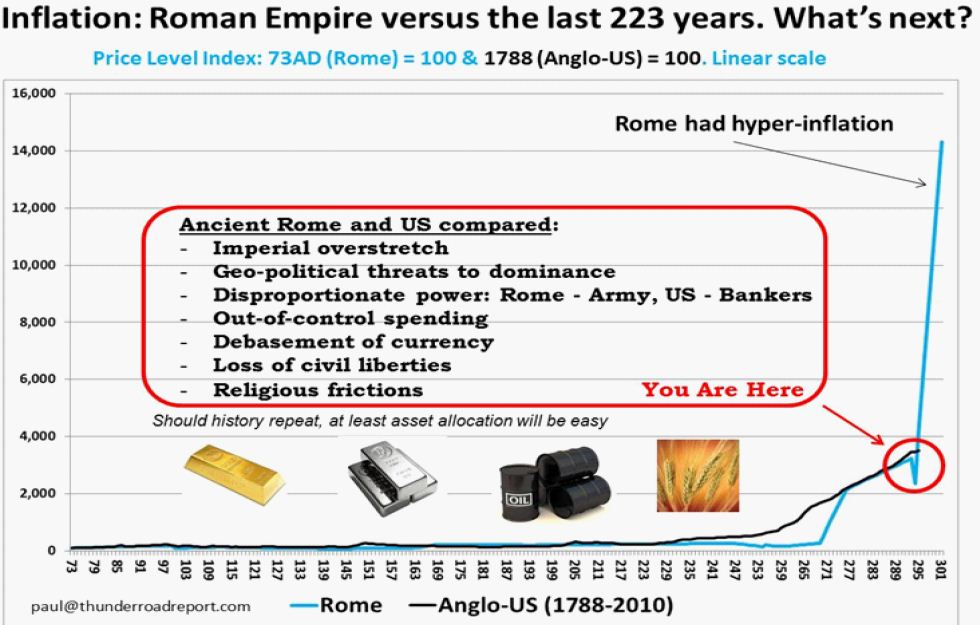
We have reached a degree of decadence that in many aspects equals what happened in the Roman Empire before its fall.  The family is no longer the kernel of society. More than 50% of children in the Western world grow up in a one parent home, either being born by a single mother or with divorced parents. Children are neither taught ethical or moral values nor discipline. Many children consider attending school as optional and education standards are declining precipitously.  Most families do not have a meal around the dinner table even once a week. Sex and violence are common place on television and in real life. Both press and television create totally false values and ideals. Everyone must be young and beautiful often enhanced by surgical or digital means. Old people have little value and their wisdom is not benefitting the younger generations.
The Golden Calf or materialism is the ultimate value that is worshipped and no means are eschewed to attain material goals. Since most of the prosperity that has been achieved in the last 40 years is based on printed money and debt, it is totally false and unsustainable. A major part of the Western world has improved their living standard, by exchanging services and swapping houses at ever rising prices financed by printed paper and credit. The perceived wealth that is created out of this is illusory and ephemeral. We have created a world economy which is based on debt and thin air.

The Gini coefficient of income and wealth is now reaching extremes in many countries. This measures the inequality between the rich and the poor. In the US the Gini coefficient is now at the same level as in the 1920s before the depression. In countries like the US, the rich are getting richer whilst 45 million people live below the poverty line, 43 million receive food stamps and over 700,000 are homeless. With a real unemployment rate of 22% and urban youth unemployment much higher, the US will soon experience social unrest.
But it is not only the US that will experience financial misery, famine and social unrest. This will also hit most European countries and in particular the UK, southern Europe, Eastern Europe and the Baltic States as well as African countries, the Middle East, Asia, yes in fact the whole world.

Are boom and busts inevitable?

Well if you listened to the former British Labour Prime Minster Gordon Brown, he proudly declared that he had abolished booms and busts and thus economic cycles. But he was expeditiously thrown out at the next bust which of course had nothing to do with him since he blamed the US sub-prime market for his ill-fated destiny.
Cycles or ebbs and flows are a natural part of both economic life and nature. And right at the point when something could be done to limit the damage, most nations seem to have the uncanny knack of selecting the political individuals who will put fuel on the fire and make the situation catastrophically worse.
Greenspan was one such individual. During his 19 years as Chairman of the Fed, he could have limited the economic and social damage that the US would suffer. Instead he took every single measure possible to ensure that there would be a catastrophe with uncontrollable consequences. But we shouldn’t just blame the incompetence of Greenspan. It was sickening to watch every sycophantic congressman and senator licking Greenspan’s boots and praising his wisdom. Because Greenspan’s money printing and incompetent interest rate management created one of the biggest financial bubbles in world economic history. But the politicians loved this. It made the stock market boom, and house prices surge. Thus the politicians were all loved by their voters who did not understand the dire consequences that were looming. And Bernanke de Pompadour is continuing the same disastrous policies of creating money out of thin air. When will they ever learn that creating money out of thin air and running astronomical deficits that never will be repaid with normal money leads to the road of total ruin? When will they ever learn? The very sad answer is that they won’t and therefore they are leading the world into a hyperinflationary depression that will have uncontrollable and cataclysmic consequences for current and future generations.

Empty stomachs are rioting

We have for years warned about hyperinflation leading to famine, misery and social unrest. Well, this is exactly what is happening in many parts of the world. The protests and overthrowing of regimes in Tunisia, Egypt and Libya are primarily due to a major part of the peoples of these nations having no job, no money and little food. It is their empty stomachs that are rioting. In addition they are protesting against the leaders of these countries stealing from the people.
It is virtually certain that these riots will spread to many countries in the Middle East, Africa and the developing world. This will lead to new regimes and new political orders that could either be far left or far right politically or religious extremists. But the new regimes will not be in a position to change the root of the problem which is famine and poverty.  In Egypt for example there has been a quiet military coup. It is unlikely that a democratic regime will take over from the military. So the people will protest again and again. And this will be the same in most countries. Eventually the people will take the law into their own hands since no regime will be able to give them the food that they need.

The hyperinflationary deluge is imminent

Although food and fuel inflation is rampant worldwide already, we are only seeing the very beginning. Massive oil price rises are likely to continue as a result of the geopolitical situation as well as peak-oil. The Middle East is a time bomb waiting to go off. Israel is in an extremely precarious position and the involvement or non-involvement of the US in this conflict would both have dire consequences for Israel and peace in the world. Food prices will continue to rise dramatically. Major parts of the world are living below the poverty line today and this will increase exponentially.
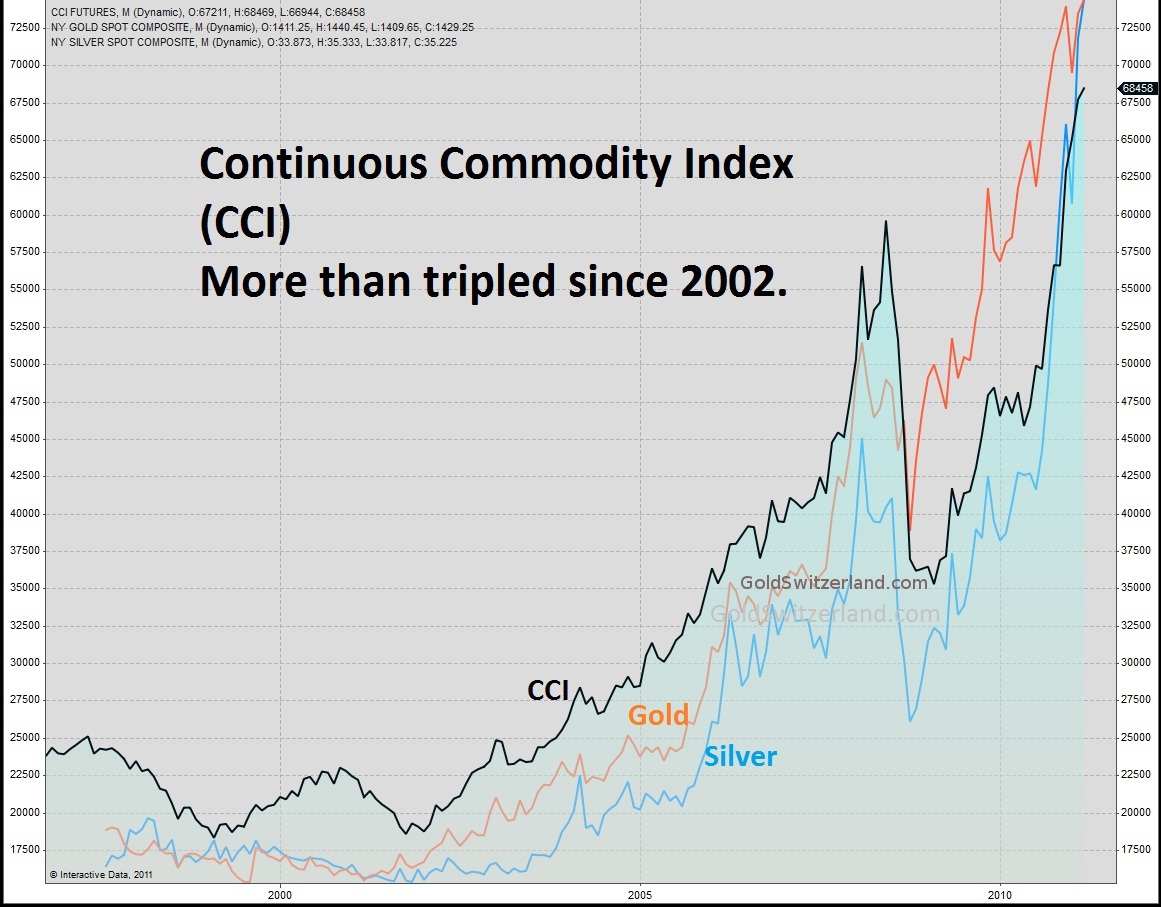
The lethal concoction of rising food and fuel prices is already affecting the Western world. The Continuous Commodity Index – CCI, (60% food, 17% energy and 23% metals) has almost doubled since the low in early 2009 and has gone up 42% in the last 12 months. The almost vertical rise of the CCI is one of the best indicators of hyperinflation being imminent. A catastrophe of astronomical proportions is looming. This will hit the world at a time when there is no capacity whatsoever to take any real measures that could alleviate the problems.
(Click image to enlarge)
Most countries are already running major deficits which will increase dramatically in the next few years. The banking system is bankrupt and is only holding together due to false valuations of toxic debt and derivatives. This is done with the blessing of governments since virtually no major bank could face an honest valuation of its assets. Unemployment and especially youth unemployment is currently a problem worldwide and it will get much worse. In 2010, the US government spent 60% more than its revenues. In order to balance the budget individual and corporate income taxes would have to double.
Never before in history has the world run out of real money as well as (affordable) food and fuel simultaneously. But his is exactly what is happening now and it will get substantially worse in the next few months and years.
Financial misery, famine and high unemployment combined with governments that will not be in a position to give real help are a recipe for disaster that will lead to social unrest and revolutions not only in developing countries but also in the West. Hungry people are desperate people and desperate people do desperate deeds. We could see already in 2011 food shortages, and riots both in Europe and in the US.

Hyperinflation Watch

The following are INDISPUTALBLE FACTS:
  • The US dollar is down 82% against gold since 1999
  • The US dollar is down 49% against the Swiss Francs since 2001
  • The Dow Jones is down 81% against gold since 1999
  • The Continuous Commodity Index is up 100% since 2009
The above facts are clear evidence of an economy that has been totally mismanaged. But more importantly most of these trends are now starting to accelerate – a clear sign that hyperinflation is just around the corner.
With years of negative net worth and negative cash flow, the US is bankrupt today. The Federal deficit is forecast to increase by at least another $ 5 trillion in the next 5-7 years.  Add to this the State deficits, the Municipal and City deficits that are rising at a galloping rate and we have a country that is going to haemorrhage to death in the next few years. One wonders when the totally ineffective and clueless rating agencies are going to fathom this. Not that it will matter if they once do.  One also wonders what Mme Bernanke de Pompadour and his court are thinking. “She” and her courtiers should have above average intelligence and could not possibly avoid seeing the facts that we all see today (of course, some of us have seen it coming for over a decade). But “she” has to please her master King Louis XV Obama and her devotion to the king goes above all reasonable common sense, or rationale. So the two of them will continue to crank up the printing press and drown their people and the world in worthless paper.

Stock Market

To believe that the current money printing liquidity boom is real and sustainable would be a very serious and expensive mistake. The temporary and illusionary pickup that we are now seeing in the economy and stock market is the normal initial phase of a hyperinflationary economy. It must not be mistaken for a real improvement in the economy.
The normal pattern at the beginning of a hyperinflationary period is that stock markets surge. This is the result of the increased liquidity and a flight to more inflation proof assets. This was the case in for example the Weimar Republic and Zimbabwe.  Just look at the chart below of the Zimbabwe stock exchange that went from 1,420 in January 2005 to 5.4 trillion in June 2008, a 3 billion per cent increase.  That was of course in Zimbabwe dollars. In US dollars the stock exchange went sideways with major volatility.  So in hyperinflationary terms stock markets could continue to rise initially thus making them a better investment than cash. However, measured against real money, the Dow has gone down 82% against gold since 1999 and 86% against silver since 2001 (see chart above). We are currently seeing a dead cat bounce but we expect the Dow to decline a further 90%, at least, against gold in the next few years. So even if stock market investments will initially give the illusion of protecting investors, it will be a very poor hedge against the ravages of hyperinflation in real terms.
ZIMBABWE STOCK INDEX 2007-2008

Bond market

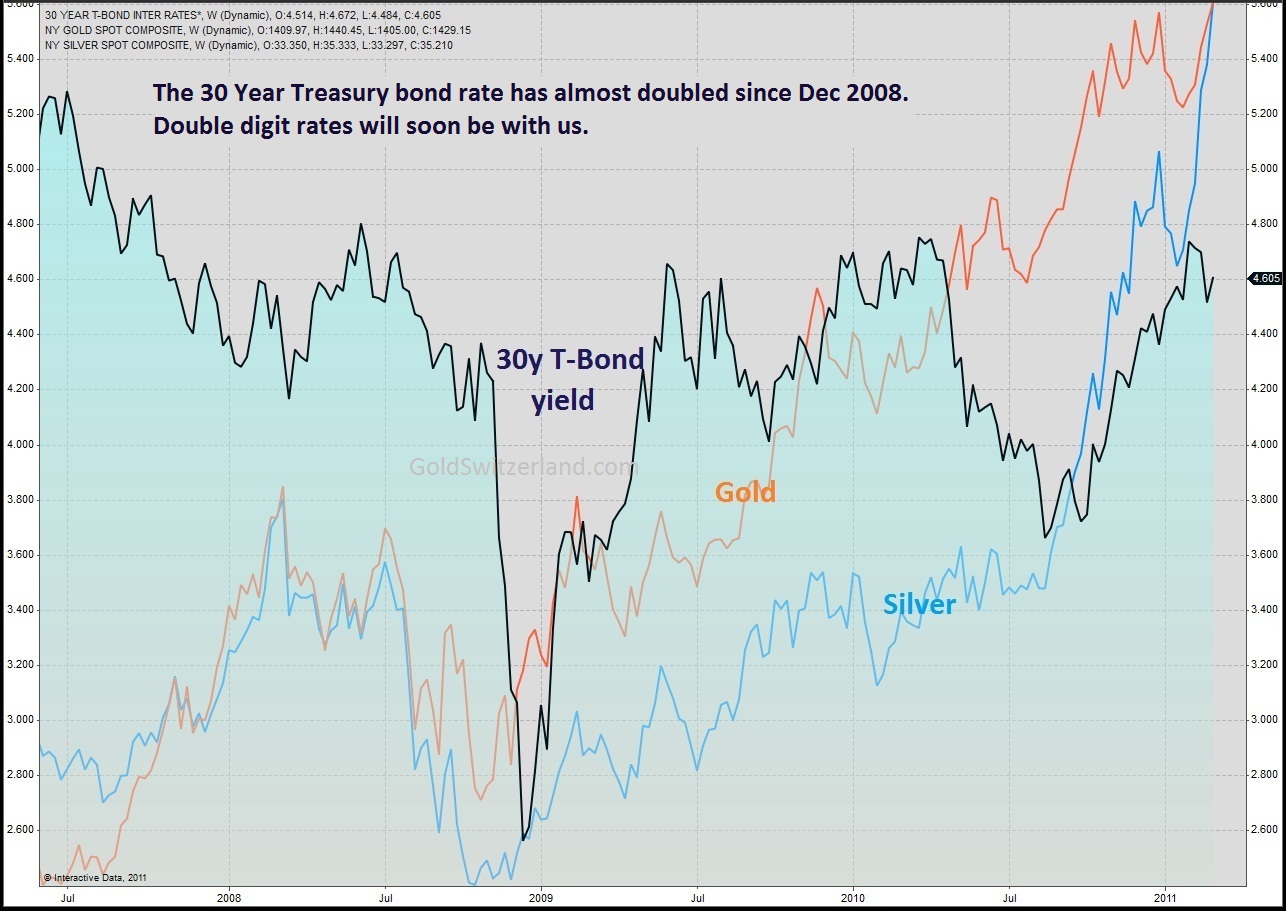
In January 2009, we warned investors that long term interest rates were bottoming. Since then the 30 year bond yield is up from 2.6% to 4.6% an 80% rise. But more importantly the 30 year is currently in the process of breaking a 17 year downtrend line which dates back to 1994. This confirms that rates will now start a major and rapid rise which is likely to reach the mid-teens or higher. Governments will attempt to keep short rates low due to weak economies but eventually the rising long rates will put strong upward pressure on the short rates.  So the flight to government bonds that we have seen in the last few years will soon reverse into a massive rush for the exit. This will coincide with rapidly increasing financing requirements by the US, UK, EU and many other governments. The poisonous concoction of rising rates and rising financing needs will create a vicious circle of collapsing bond markets and unsustainably high financing cost. This will continue to drive interest rates even higher which will further increase deficits and necessitate even faster running printing presses. Add to that a collapsing currency and the hyperinflationary picture is complete. It is our very strong view that investors should exit bond markets entirely if they want to avoid a total destruction of their assets.

Currency Market

As we have explained for many years, hyperinflation is created by the government destroying the currency as a result of money printing to finance deficits. This leads to the cost push inflation that we are now experiencing. Add to that, shortages in commodities worldwide, thus creating the perfect hyperinflationary scenario. The Dollar, the Pound, the Euro and many other currencies will continue to decline. They can’t all decline against each other at the same time so the market will take turns in attacking one currency at a time. But all currencies will continue to decline against gold. We believe that the dollar will soon start a very rapid fall against gold and against many currencies. Investors should exit the Dollar and also the Pound and the Euro. There is no currency better than gold or silver but for any small amounts of cash we prefer the Swiss Franc, the Norwegian Krone, the Singapore dollar and the Canadian dollar.

Wealth Protection


A hyperinflationary depression will destroy the value of money as well as most assets that were financed by the credit bubble (property, stock market).  Wealth protection is now critical and urgent. We see no better way of protecting assets against total destruction than physical gold and silver stored outside the banking system. Thereafter, precious metals, energy and food stocks are our preference.  But it must be remembered that any asset including stocks that is held through a bank is dependent on a sound and surviving banking system.
The real move in precious metals is still to come as we have outlined in many articles. Less than 1% of investors own gold. Before this economic cycle is over we are likely to see a mania in physical precious metals that will drive prices exponentially higher. And luckily for investors, this is a mania which is unlikely to end in a collapse since gold most probably will be part of a future reserve currency.
Finally we are again quoting von Mises who clearly understood that “le déluge” is inevitable:
“There is no means of avoiding a final collapse of a boom brought about by credit expansion. The alternative is only whether the crisis should come sooner as a result of a voluntary abandonment of further credit expansion or later as a final and total catastrophe of the currency system involved.” – Ludwig von Mises

Sunday, January 30, 2011

Black Swan Events and How to Hedge Them

from Zero Hedge:

With all the hoopla over Egypt some have forgotten that this is merely a geopolitical event (one of those that absolutely nobody, with a few exceptions, was talking about less a month ago, so in many ways this is a mainstream media black swan which once again exposes the entire punditry for the pseudo-sophist hacks they are), and that the actual mines embedded within the financial system continue to float just below the surface. Below we present the five key fat tail concerns that keep SocGen strategist Dylan Grice up at night, which happen to be: i) long-term deflation, ii) a bond market blow-up, iii) a Chinese hard-landing, iv) an inflation pick-up, and v) an Emerging Markets bubble. Far more importantly, Grice provides the most comprehensive basket of trades to put on as a hedge against all five of these, while also pocketing a premium associated with simple market beta in a world in which the Central Banks continue to successfully defy gravity and economic cycles. For all those who continue to trade as brainless lemmings, seeking comfort in numbers, no matter how wrong the "numbers" of the groupthink herd are, we urge you to establish at least some of the recommended trades in advance of what will inevitably be a greater crash than anything the markets experienced during the depths of the 2008 near-cataclysm.
But before we get into the meat of the piece, we were delighted to find that Zero Hedge is not the only entity that believes that providing traditional annual forward looking forecasts is nothing more than an exercise in vanity (and more often than usual, error).

At this time of the year we’re supposed to give our predictions for what’s in store for the year ahead. The problem is I don’t have any. Not because making forecasts is difficult. It isn’t. It’s just pointless. Instead, I suggest getting in touch with our inner Kevin Keegan, the hapless former England football manager who, facing the sack after a bad run of results famously lamented “I know what’s around the corner, I just don’t know where the corner is.” The more people construct portfolios on the assumption that they can see the future, the greater the opportunity for those building portfolios which are robust to the reality that we can’t.
That said, no matter how ridiculous the act of Oracular vanity ends up being, those who charge an arm and a leg for their "financial services" continue to do it, only to be among the first carted out head first when reality is imposed upon them and their blind belief that this time is different and the crowd is actually right. Few are willing to accept and recognize the humility that they really know little if anything about how a non-linear, chaotic system evolves. Which is once again why we believe that Grice is among the best strategists out there: in his attempt to hedge the stupidity of the crowd, he has coined a term that may well be the term that defines 21st century finance and economics: instead of foresight, Grice believes the far more correct term to explain the process of prognostication should be one based on foreblindness.
In financial markets, craziness creates opportunity. It affects only prices, not values. And one of the craziest afflictions I know of is our faith in our ability to see the future. Indeed, there isn't even an appropriate opposite to the word "foresight"  in the English language. So I'?m going to make one up. And rather than build a portfolio based on the pretense we have foresight, let's explore some ideas for building one that is robust to our foreblindness.
This is the kind of insight that one will never find from a TBTF "strategist"... And one wonders where all those softdollars go.
So now that we know that unlike the traditional cadre of sell side idiots who are always wrong in the long-run, Grice actually admits that he has no clue what will happen, which is precisely the reason to listen far more carefully to what he has to say.
Let's dig in:
Here are some things I think are true:
  • developed economy governments are insolvent
  • Japan is the highest risk developed market (DM) to an inflation crisis (though it might be Greece)
  • there is too much debt around
  • China?s economic model is biased towards misallocating resources
  • every country which has industrialized has experienced nasty bumps on the way
  • China and the US are in the early stages of an arms race
  • demographic trends suggest more conflict in the oil rich regions of the world
  • bottlenecks are developing in key commodity markets
  • the only thing central banks are good at is blowing the bubbles that cause the crashes which are used to justify their existence
  • market prices only reflect fair value by accident and in passing
  • most people don't think these things are important
  • they might be right.
Here are some things I know are true:
  • perceived uncertainty causes emotional discomfort which isn't conducive to good decision making
  • all the above situations have the potential to cause significant asset price volatility
  • I have no idea when.
What to do? To my mind, the ideal is not to make huge bets on particular events happening because failure of the expected event to materialize will materially endanger your capital. Instead, the ideal is purchase insurance at a price which won't materially pressure the returns from your core portfolio of investments if the event fail to materialize, but will protect capital from significant impairment if it does.

Is such an ideal attainable? By evaluating insurance and using the same valuation discipline you'd apply to anything else, I think it is. So what follows is not a list of recommendations here, or even any suggestions. Everyone should do their own homework. What follows is an illustration of why I think the macro research we've been doing is relevant and can be used to lower portfolio risk. The insurable risks I'm most worried about at the moment are:
  • long-term deflation
  • a bond market blow-up
  • a Chinese hard-landing
  • an inflation pick-up
  • an EM bubble
The first thing you?'ll notice is that these aren't all consistent with one another. It's difficult to get a Chinese hard landing and an EM bubble at the same time, for example. But internal consistency is overrated. It's only relevant for point-in-time forecasts, and the assumption underlying this entire exercise is that I haven't a clue if/when any of what follows is going to happen. At the risk of repetition, I'm interested in the possibility of building a profitable portfolio which is robust to my ignorance.
Let's take a look at the five fat tails in detail:
Long-term deflation
Not surprisingly, Grice gives the least amount of weight to the one thing most troubling to such economic disgraces as Ben Bernanke and Paul Krugman. Yet it should not be avoided. After all there are many deflationists out there, who believe that the Fed, which has now clearly telegraphed it is all in on reflating (or after the Fed, the monetary collapse deluge) may actually succumb to what has been ailing Japan for two decades.
According to economists the primary risk faced by economies is that a huge deleveraging spiral becomes self-fulfilling: deleveraging reduces demand, which lowers prices, which further lowers demand, and so on. The idea was first developed by Irvine Fisher in the 1930s to describe the great depression, and has been used to explain the ?First Great Depression? of the 1870s and Japan since the early 1990s.

Paul Krugman says everything has changed because we?re in a liquidity trap. The fear of prolonged deflation is what keeps poor old Ben Bernanke awake at night. And maybe that's the clue. At our London conference this year, James Montier said that Bernanke  as the worst economist of all time. Now, I'm not sure I agree with James on this one because I can't make up my mind, sometimes I think it's the Bernanke, other times I think it's the Krugman. But usually I think nearly all economists to be the joint worst economists of all time. So I have a lot of sympathy with the idea that if the consensus macroeconomic opinion is worried about something, it probably isn't worth worrying about. In fact, if they worry about deflation, I'm going to worry about inflation.
We couldn't have said it better ourselves.
So how does one trade deflation insurance?
More importantly though, deflation insurance is expensive. The following chart shows the price of 5y 0% US CPI floors to be trading for just under 200bps. The way these floors work is that they provide the owner of the contract with the right to payments equal to the rate of deflation. Since the floors in the chart have a five-year maturity, they entitle the owner to five annual payments. For example, if inflation was -1% in year one, the owner would receive 100bps of the notional value of the contract. If inflation was -1% in year two, he'd receive another 100bps. And if the rate of deflation remained at -1% for years three, four and five, he'd receive 100bp cash flow for each of those annual payments so that over the life of the contract he'd have received a total cash flow of 500bps. So if you're worried by the prospect of CPI deflation, this is the product for you.

And skeptical though I am of the debt deflation hypothesis, Western demographics worry me. Although we don?t know what aging economies look like, we know that the glimpse into the future provided by Japan isn't encouraging. So I do take the scenario seriously and would be happy to put the hedge on at the right price. The problem is, I don't think the price is right. I think this insurance should be sold, not bought.
Chinese Hard Landing
While Grice is obviously far less worried about a systemic deflation scenario arising out of events in the US, what may happen in China is obviously a far riskier proposition, and one that could generate deflation out of the proverbial "Hard Landing." Luckily there is an instrument with some wonderfully convex properties to hedge this...
Albert calls China a ‘freak economy.’ Certainly, running with an investment to GDP ratio of over 50% doesn't seem normal. Neither does keeping interest rates at 5% when the economy is growing by 15% in nominal terms each year. Such lax monetary conditions have helped land prices rise by 800% in the last seven years, according to NBER economists. And when you come to think of it, more recent examples of real estate inflation fueled by negative real interest rates: Ireland, Spain, the US didn't end too well. Jim Chanos says China is a shortseller's dream and that there's not one company he's looked at that passes the accounting sniff test. And if Jim Chanos, who built a very successful business around spotting accounting gimmickry says something like that, my guess is he's right.

Taking a step back though, as far as I?m aware all industrialized countries have experienced financial crashes. It seems a part of the maturing process. Why should China be any different? A credit crisis wouldn't necessarily mean the end of the China story any more than the panic of 1873 meant the end of America's, (though US demographic prospects were considerably more favorable at the end of the 18th century than China's are today). For the record, I think the Chinese have a bright future. My son is learning Mandarin. But when I look at the numbers I can't help but think there's going to be a crash and that it's going to be  quite unpleasant. It's just that my guess as to when it's going to happen is as good as Kevin Keegan's.
What happens if and when the inevitable crash happens? One word - Australia. Another word(s): 10x-20x payout.
When it does happen though, the Australian economy will be toast and its government bond yields will collapse. During the panic of 2008, AUD 10y swap rates fell around 3% to 4.40%.

The panic of 2008 was a "good crisis" for Australia though. A Chinese crash would be more serious.

And you can get pretty attractive odds on AUD rates collapsing. The following chart shows the payout available using AUD receiver swaptions prices with a three-year maturity, based on the 10y swap rate. Effectively, these are put options that pay out when rates fall below the strike price. The prices I've used here are from Bloomberg based on the swaptions striking at about 5.5% (i.e. 100bp below the current rate of 6.50%). What's interesting is that at current prices, if Australian swaps were to break their 2008 lows, you'd be making about 10x your premium (for the record, these swaptions are priced at about 120bps, or 40bps per year over three years, which is about the same as the annualized revenue you'd get if you sold the CPI floors discussed above). If swap rates fell by 300bps as they did during the panic of 2008 the rate would fall to 3.5% and you'd make nearly 15x your premium. To repeat the point I made earlier, this isn't a recommendation. It's just a starting point (my guess is that you'd find more attractive payouts as you went further out of the money with the strike price, and that  capital structures of Australian banks, property companies and levered resource stocks would be worth looking into too).
Asset Bubbles
Grice provides one of the best and most succinct explanations of bubble mentality we have read to date:
For reasons I won't go into now, but which are probably obvious from what I just wrote about China, I think EM is riskier than it seems. I'm not even sure I feel comfortable valuing EMs yet. So should EMs bubble up, the risk for investors sharing my concern is that they'll be faced with quite a nasty dilemma: do they buy something they don't feel sure is cheap because everyone else is and they're scared of underperforming, or do they stick to their principles and prepare themselves to take on the business and career risk of underperforming their competitors, seeing clients withdraw their funds, and possibly finding themselves out of work?

And the sad reality is that ultimately nearly everyone gets hurt during a bubble. Sceptics get hurt as it inflates, believers get hurt when it bursts. George Soros says when he sees bubbles he buys them. He?'s been pretty good at selling them at the right time too. But most of us aren't so clever.
Regardless of the psychology behind each and every bubble, the good thing is that there is a good way to hedge this risk outright.
One way to hedge the inflation of a bubble, rather than its bursting, is to buy out of the money call options on the equity indices. Calls are usually cheaper than puts ? I think because fear is a more powerful emotion than greed and the tails in equity markets tend to be on the downside. But the following chart shows that that difference (or skew, the difference in implied volatilities between puts and calls) is close to unprecedented highs, at around 4.5 vol points (the chart shows skew for the S&P500 though other equity indices show a similar picture).

In other words, the upside is close to unprecedentedly cheap relative to the downside. If you could get two year call options 30-35% out of the money for 130bps per year you?'d be getting good value (of course you could make this zero cost, or even ve cost by selling puts to fund the purchase, and you could do it in such a way that your downside risk would be similar to that of holding stock, but I'm no derivatives strategist- as usual, if you want to talk about this stuff to people who know more than I do, speak to your SG derivatives salesman, or ask me and I?'ll put you in touch).
Hyperinflation
A topic near and dear to many. Luckily, once again, one which can be hedged proximally in a form that generates massive returns should it transpire there where it most needed: no, not the US. Japan. In fact, if Grice is right about Japan, his proposed trade takes the returns generated by Paulson in shorting subprime... And magnifies them by about a million.
Historically, bankrupt governments have used inflation to alleviate their indebtedness. I doubt things will ultimately be different this time. And as regular readers know, I think Japan is the country closest to the edge. All DM governments have the same problems: they've made promises to their electorates which they're unlikely to be able to keep. But while there's time for European and US governments to fix the problem, for Japan I think it's already too late. John Mauldin says the Japanese government debt position is a “bug in search of a windshield”. I agree with him.

I've already written too much this week, so I don't want to rehash all the stuff I've already written on Japan and which regular readers will be familiar with. But if you chart past episodes of extreme inflations with how stock markets behaved during the episodes, you invariably find something similar to what happened to Israel in the 1980s.

In Steven Drobny's excellent “Hedge Funds Off the Record” (which I consider a must read - almost every interview oozes with profound risk-management wisdom), Steve Leitner talks about buying out of the money call options to hedge against such a hyperinflation. Buying 40,000 strike Nikkei calls with a ten- year maturity, with a payout in a strong currency can be done for around 40bps per year. And to give you an idea of how explosive that asymmetry might be, if Japan was to follow the Israeli experience from here, the Nikkei- currently 10,500 would trade at around 60,000,000 (sixty million). So putting even one-tenth of your notional into that kind of hedge would cost 4bp per year (for reference, the Nikkei currently offers in excess of a 2% annual yield, while some JREITS offer in excess of 4% - I'd argue that 40bp is a bearable burden, and 4bps certainly is).
Bond Market Blow-up
When a few weeks ago we presented Sean Corrigan's chart which we dubbed the Great Regime Change, few put two and two together, and realized the vast trading implications of this chart. And they are profound. As Grice rightfully observes, they stand at the base of nothing less than the hedge against that most critical of fat-tail events: a bond market blow up, one which is getting increasingly more probable with every single $X0 billion UST bond auctions (the bulk of which is now monetized directly by the Fed).
One obvious way to hedge against a bond market blow-up is to use the swaptions market as we did in the Australian market to hedge a Chinese crash, only this time buying payer swaps, which are effectively call options on rates. But I thought I'd show you something I think is a bit more interesting: the correlation between the S&P500 and bond yields.

Bonds represent poor value in my opinion, with little margin of safety to protect against the very real risk that governments try to inflate away their debts. But one good reason to continue holding them is that they protect risk asset positions during the '?tails'?. The following chart shows that over the last ten years the correlation has been volatile, but positive: when equities have fallen so have bond yields, offsetting losses in the equity portfolio as bonds benefit during "risk-off" events.

When inflation expectations were (probably) around zero (before the 1960s) the correlation between bonds and equities was zero too. But look what happened during the 1960s when inflation expectations broke (this was during the Vietnam war, as the Bretton-Woods system was coming under pressure and as the bear market in bonds was getting into full swing). The chart shows that the correlation went negative. When bond yields rose equities fell because government bonds were reflecting the same tensions that were pulling down equity valuations (fear of ever-higher inflation).

As the bond bear market reached its climax in the early 1980s, the correlation remained negative. But as the worm turned, and central banks across the developed world made new and credible commitments to stop printing money, a bond market rally was born. And as inflation expectations began to fall, what was good for the bond market was good for the equity market. Now, falling yields coincided with rising equity prices and so the correlation remained negative. But during the last ten years, inflation expectations have been roughly stable and, if anything, slightly biased towards the deflationary side. So what?s been good for bonds hasn't been good for equities, and the correlation between yields and equity prices has been positive to reflect that.

The point is this: if governments are insolvent, and the government bond market becomes a source of risk once again (as opposed to the nonsensical "risk-free" description it has somehow obtained in recent years) what's bad for the bond market will be bad for risk assets too. As yields rise, risk assets will fall. The correlation will go negative. Bonds will provide less protection against the tail events than they have done in recent years because they will be a source of the tail event.
For all those who figured this out based on the Corrigan chart, congratulations. This could well be the holy grail of the biggest black swan insurance trade of all. For those who haven't quite grasped it, here is some more from Grice:
This correlation is tradeable. Any bank with a derivatives operation must have an implicit correlation exposure between products they've sold options on. So for derivatives houses, correlation is a by-product in much the same way that molybdenum is a by-product of copper miners. and correlations like this trade in the IDM market. And sometimes that means you can get it for a very good price. I recently heard of a correlation trade between the S&P500 and the US 10y swap rate done at 40 correlation points, which seems a decent enough price to me (of course, selling at 50 points would give you even more margin of safety), although current pricing is at around 30 I believe. Pricing can be volatile though and waiting to sell in the 40-50 range seems sensible to me. It would hedge risk positions against a regime in which government bonds were seen as the source of risk, rather than the reliever of it.
Finalizing the Black Swan Insurance basket.
Let's add it all up and see how much it would cost to insure our portfolio. If we were to sell the 5y US CPI floors for 200bps (40bps annualized); buy the 3yr AUD receiver swaption for 120bps (-40bps annualized); buy 2yr 30% S&P500 calls for around 130bps (-65bps annualized) and bought one tenth of our notional on NKY calls for 40bps (-4bps annualised) the net upfront cost would be 90bps (200bps-120bps-130bps-40bps). If we wanted to hedge the risk of bond market turbulence with a correlation product, this would cost nothing upfront because it would be done on a swap basis with the bank. On a roughly annualized basis our cost would be 69bps each year.

Of course, we'd have a maturity mismatch because our hedges would have different time horizons. So we'd have to adjust them from year to year. We'd also be more vulnerable to deflation because we don't think the deflationary hedges offer value. So our portfolio wouldn't quite be bullet-proof because it would be tilted towards inflationary outcomes. But we'd have insurance against deflation with the Australian receiver swaption. And since the correlation swap hedges us against any bond market blow-up which also blows up the equity market, we can feel more comfortable allocating some capital towards bonds we think might offer good value (not that there are many, I'd say maybe about 20-30% in Australian and New Zealand bonds).

I'd put 10% in gold. I'll explain more in another note but for now, although I've said I'm not a fan of plain commodities as investment vehicles because buying commodities was equivalent to selling human ingenuity, I exclude gold from that logic. I prefer to see buying gold as buying into the stupidity of governments, policy-makers and economists, and I'm comfortable doing that.

With the exception of Japan (which we'd be hedged against anyway) I'm not so worried about "traditional" CPI inflation any time soon. At the moment, I think the first signpost on the way to that kind of crisis will be via the bond market, which the correlation swap should protect us against. That and my gold holdings would make me comfortable allocating 20%-25% cash. I still think risk assets are generally overvalued and cash is the simplest insurance "option", whose relative value rises proportionate to the decline in other assets. So let's say I'm 20% in cash,10% in gold, and 20% in mainly Australian and New Zealand government bonds. That leaves just under 50% of my capital for me to put into the equity market (the 69bps per year for my insurance bucket to be precise).

Which equities? I've always thought investing in index funds to be crazy, but nearly everyone does it and it's a part of the craziness we can use to our advantage. The EMH says that market prices are always broadly efficient because all market participants respond to all available information. But around 10% of the market is explicitly passive and probably another 50% is benchmarked and therefore implicitly passive. In other words, the overriding variable for the majority of equity investors is a company's weight in the index! Intuitively therefore, the prices can't fairly reflect fundamental value, which means that at any point in time, there will be lots of stocks which are mispriced.

The following chart shows two lines. The red line shows the cumulative return to buying stocks in the cheapest decile, while shorting stocks in the most expensive decile (I define value as the discount relative to the estimated intrinsic value - a methodology I've been meaning to write up in detail for several months now but which I will definitely do within the next few weeks). Using a monthly rebalance, the annualized return is 750bps. This shows that there is meaningful alpha in identifying and owning those stocks trading at a discount to intrinsic value. The black line shows the relative outperformance of the top decile against our wider stock universe. (In passing, note that this value strategy underperformed in the late 1990s during the tech bubble, and remember that this is the reason our hypothetical portfolio has out of the money call options.)

The relative outperformance of this long-only basket has been 330bps. If I expect a stock market return of 5% per year over the coming years, that 330bps outperformance is highly significant. It means we only need to put 60% of our capital into that basket of stocks to generate the same incremental return as a market portfolio would generate. So owning 50% isn't as cautious as it sounds.
The bottom line, and the reason why we think this is a great basket trade, is that it makes money in a normal environment while at the same time, providing great positional hedges to those 5 events which sooner or later are bound to happen.
In the sort of world in which everything is normally distributed, well behaved, and in which our insurance expires worthless (i.e. the sort of world most economists forecast), we'd still be making decent returns. And while there's no such thing as a truly bullet proof portfolio, we'd have done so with far less embedded risk. Because if any of the scenarios I've explored here come to pass we'd be in a much better position to take advantage of the distressed selling of others.
That said, and as Dylan would be the first to acknowledge, if and when everyone is positioned with precisely this hedge on their books, it will be something totally different that will cause the next great financial wipeout. But until then, those who step in first, will benefit from appreciating prices precisely on their hedges. At that point it will be up to the principal to decide whether to take profits or to hold off until the bitter end. The problem, however, at least the way we see it, is that should any of these five black swans occur, any currency that one generates as a result of a successful trade, no matter the P&I, will probably not be all that useful for the world that materializes at T+1.

Thursday, December 9, 2010

True Defict of $4-$5 Trillion/Year

"Eventually it is going to be a hyperinflationary great depression... The annual deficit is running $4-5 trillion a year, that includes the Y/Y change in the NPV of unfunded liabilities... There is no political will to deal with this." -- John Williams, economist, Shadowstats.com

Monday, December 6, 2010

Fact, Fiction, and the Fed

by Davos Sherman Okst at Unveiling the Economy blog:
Fiction: In this 60 Minutes clip Bernanke tells Scott Pelley, “The other concern I should mention is that inflation is very, very low…”
Fact: There is massive inflation!

the real cost of living
Fiction: ‘Unemployment is 9.8%, if we didn’t take these drastic measures it would be 25% like it was during the Great Depression.’
Fact: Unemployment is, once again at “depressionary” levels - pushing 25%.

unemployment rate
Fiction: In this video Bernanke says about the biggest bubble in the world (the housing bubble) which he never saw and still denies: “I guess I don’t buy your premise it’s a pretty unlikely possibility we’ve never had a decline in house prices on a nationwide basis.”
“…never had a decline in house prices on a nationwide basis.”
Fact: Housing prices have declined on a nationwide basis.
a history of home values
Hearing The Bernanke fiction that he is 100 percent certain he can stop hyperinflation was as reassuring as hearing his continued commitment to continue Quantitative Easing.
I know hyperinflation is ugly. I know stopping this train wreck years ago would have been the correct thing to do. The fact is – we are beyond any fix. Things like cutting government spending will only increase unemployment. We are bankrupt when: What we take in with taxes doesn’t pay the bills. When we borrow and that and the taxes still don’t pay the bills. Now we counterfeit so we don’t default.
Game over!
I know re-valuing the dollar would have been faster and less painful. But the facts are that we have a professor who studied the Great Depression and if he doesn’t know that housing prices declined, or that there is massive inflation now, or that unemployment is at “depressionary” levels - then we have to realize that correcting what he messed up isn’t going to happen.
The guy is either working for an elite few – or, more likely – he’s an economic imbecile.
Whatever the case is – I’m happy. The only way the economy is going to get fixed is if consumers (who make up 67% of GDP) consume. Right now consumers are either maxed out, working part time hours in their full time positions, or they are unemployed. Consumers have shed 600 billion in debt, 20 billion was of that was willingly. On a governmental level: Our debt – on and off balance sheet will choke the life out of any prosperity.
The clock MUST be reset. That is the ONLY fix.
The Bernanke just pulled the reset lever.
Gold and silver are still affordable. If you missed my read “Nobel Award in Darwin Economics” this chart should explain a lot.

like a thief in the night
If you think there will be deflation I’d encourage you to look at money as seashells and look at The Bernanke as the gold miners on pages 96 & 97 of “Mean Markets and Lizard Brains” book. Basically it explains that the habitants of the highlands of Papa New Guinea used seashells as a currency. Gold miners from Australia wanted to hire them to mine gold, the highlanders didn’t want paper money - they wanted shells. Plane loads of shells were flown in. Supply increased, their purchasing power crumbled, they experienced hyperinflation.
Our dollar will be re-valued vis-à-vis unstoppable hyperinflation. Old debt will be washed away. Consumers will once again be able to consume.
In Summary: My faith in the 5Gs: (G*(religious edit)d, Gold, Guns, Grub & The Government Will Continue to Screw It Up) remains strong.