Friday, July 15, 2016
Wednesday, June 15, 2016
Fed Leaves Rates Unchanged


Friday, June 10, 2016

Thursday, June 9, 2016
Bill Gross: Supernova of Debt Will Explode


Wednesday, June 8, 2016
Who's Buying All Those Bad-News Dips?
V-rallies everywhere! Who is buying all those dips as the news becomes more and more morose in recent months? Some suggest the Fed is behind it. After all, there is no limit to how much electronic money they can create out of thin air!

Another tell-tale sign of manipulation: the buying halts almost the moment stocks get to 2,100 on the S&P 500. At this point the manipulation ends. And because there are few REAL investors buying stocks at these levels, the market immediately retreats.
Could it be that the Fed or Plunge Protection Team is aware that earnings are collapsing… signaling that this stock market bubble is ready to burst? -- Phoenix Capital Research
Monday, June 6, 2016
Central Bank Delusions
"This is the market we have now: dominated by delusional, irrational central planners with unlimited powers to create money out of thin air to fund their manipulations.Read the rest here!
The only rational response is to trade accordingly: anticipate constant manipulation, anticipate constant bombastic propaganda of the "whatever it takes" variety, and anticipate massive selling of volatility to maintain the ever-so-important illusion that global risks have been disappeared by central banks and central planners.
Until the central planning madness destroys markets' ability to discover price and allocate capital. Then you end up with Venezuela: a failed state and a broken economy that can no longer feed its people despite the nation's vast oil wealth.
Volatility has been chosen as a "signaling device" by central planners. A low VIX signals all is well and risk is non-existent, so central planners suppress VIX.
In a world roiled by staggeringly large risks, can VIX be suppressed forever? That's a difficult question in a market dominated by irrational central planners." -- Charles Hugh Smith, Of Two Minds blog.
Thursday, June 2, 2016
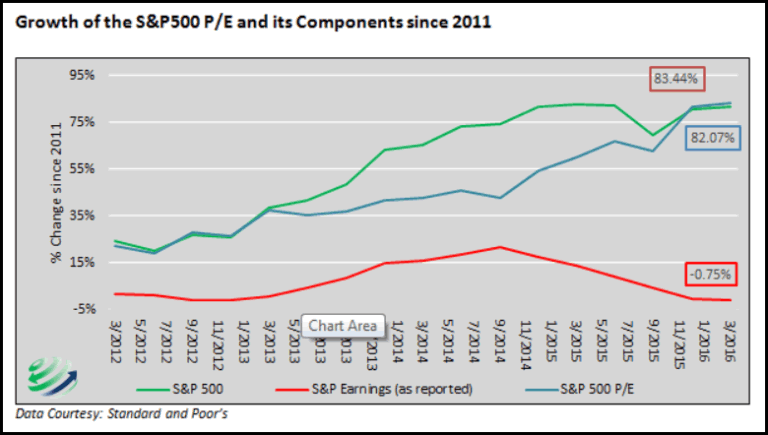
Growing Gap Between Earnings and Stock Valuations
According to Michael Lebowitz of 720 Global Research (quoted in the article):
Since October 1, 2011, the S&P 500 has risen 82% on the heels of a 0.75% decline in earnings. The price to earnings ratio over that time period has risen 83%, with price gains contributing 99% to the increase. Prices have risen substantially, while earnings have actually fallen. The chart below highlights the growing gap between earnings and the S&P 500.”
Wednesday, May 25, 2016
Services PMI Near Record Lows As Stocks Approach Record Highs

“A
deterioration in the survey data for May deal a blow to hopes that the
US economy will rebound in the second quarter after the dismal start to
the year." -- Chris Williamsen at Markit, commenting on this data.
Tuesday, May 24, 2016
Correlation Between USDJPY Currency Pair and Stocks
This correlation between the Japanese Yen and stocks has been demonstrated for a very long time. Does the Bank of Japan control the US stock market? It sure looks like it!

Richmond Fed Contracts Most Ever Recorded

Friday, May 20, 2016

Thursday, May 19, 2016

Tuesday, May 17, 2016
Another Sign of Stagflation
On Marketwatch this morning:

Low wages combined with high rents. Let's try a little math:
high rent + stagnating wages = stagflation
Industrial Production Stuck In a Slump... Even As Inflation Rises... And Wages Slide!!
This spells S-T-A-G-F-L-A-T-I-O-N to me!

But the central bankers are doing everything they can to increase inflation to meet their inflation GOAL! Yes, the Fed has an inflation GOAL! (They then doctor the inflation data to understate the actual inflation!)


Recession Lurks? A Word to the Wise...
Key indicators, especially the leading ones, have been flashing red for the past year. This headline today was on Marketwatch:

Suffice it to say... a word to the wise is sufficient!
Friday, May 13, 2016
The Equity Exodus
Marketwatch has an article today showing heavy volume among investors that are running for cover. Fear is back! And the price of Federal bonds confirms it also. Treasuries have been rising steadily since late April!


Sunday, May 8, 2016
Albert Edwards: "It ends badly."
"Let me tell you how all this ends.
"It ends with investors accepting that they can pretend no longer and profits are sliding into recession.
"It ends as the equity market spirals into a deep bear market as
company management reach the end of the road in the face of the
recessionary conditions and 'kitchen sink' years of EPS manipulation.
"It ends as corporate bond spreads explode as years of excess debt
accumulation lead to widespread corporate bankruptcies, making the
recession much deeper.
"It ends with social unrest and double digit budget deficits (again).
"It ends with investors losing faith with the Fed as the resumption of QE proves ineffective in reviving the economy.
"It ends in deeply negative interest rates, currency and trade wars, helicopter money and ultimately inflation.
"In a nutshell, it ends badly."
--- Albert Edwards, Societe Generale
Tuesday, April 26, 2016
Economic Headlines for April 26, 2016
Ouch all the way around. Let's begin with the doctored data from the Atlanta Fed:




Bank of America's largest institutional, private clients are net sellers:
"Bank of America's "smart money" (institutional, private and hedge funds) clients, simply refused to buy anything, and in fact had continued to sell stocks for a near-record 12 consecutive weeks. In fact, the selling continued despite what we said, namely that "at this point it was about time for the selling to stock, if purely statistically, otherwise said "smart money" would be sending the clearest signal yet that the market rally from the February lows is nothing but a huge gift to sell into.""BofAML clients were net sellers of US stocks for the thirteenth consecutive week last week—making it the longest uninterrupted selling streak in our data history (since 2008) as clients continued to doubt the market rally."
According to BofA, "net sales were $3.8bn, the biggest in three weeks but the sixth-largest in our data history (since ’08), with sales from hedge funds, private clients and institutional clients alike. This follows a week of net buying by hedge funds the prior week; institutional and private clients have both been consistent net sellers since February. Clients sold stocks in all three size segments, and year-to-date only small caps have seen cumulative inflows."
Friday, April 22, 2016
Global Anarchy Coming When Central Bankers' Shennigans Blow Up?
Societe Generale's Global Strategist Albert Edwards said today that he feels "utterly
depressed". He proclaims that he hasn't "one scintilla of doubt that these
central bankers will destroy the enfeebled world economy with their
clumsy interventions and that political chaos will be the ugly result. The
only people who will benefit are not investors, but anarchists who will
embrace with delight the resulting chaos these policies will bring!"
Wow!
Monday, April 18, 2016
Dow Tops 18,000 Even As Earnings Hit 12-Month Lows
Who needs an economy? Who needs jobs? In a world of digital money, who even needs reality? We have digital prosperity now!


Friday, April 8, 2016
Look Out Belooooow! Fed Slashes GDP Estimate!
Recession alert:
Last month, the Fed slashed the Q1 2016 GDP estimate from 1.2% to just .4%. Now today, it slashed it even further to just .1%! That's barely breathing!


Monday, April 4, 2016
Headlines for April 4, 2016


Sunday, April 3, 2016
The Illusion Continues, With Support By Central Bankers


And when will this happen? I don't know! My best guess is that it will occur during the next recession as the following happens:
1) Revenues to the US government collapse due to lay-offs and fewer people are working.
2) Demands for entitlement spending skyrocket, and more and more people require help with housing and food.
Of this I am certain:
1) The interest on US government debt is now about $1/2 trillion per year.
2) The US government will borrow an additional $1/2 trillion this fiscal year.
3) The Congressional Budget Office forecasts that by the end of the next president's first term of office, the US will be borrowing $1 trillion/year! That's about 1/4 of the budget!
This guarantees a debt crisis sometime in the next few years! It will collapse the bond market and the US Dollar. It will bring a depression that will dwarf the Great Depression of the 1930s. It will likely also bring horrible bloodshed as desperate people engage in desperate behavior to survive.
Tuesday, March 29, 2016
The Power of One Central Banker

Should any one person have that kind of power to manipulate the market? It doesn't change the magnitude of risk to investors. It only changes the perception of risk, and the willingness to take greater and greater risk. When investors are once again forced to acknowledge that risk, the consequences will be calamitous!
Tuesday, March 22, 2016
A US Government Debt Crisis Is Ineluctable!
I placed this comment on a finance website earlier today:
- US Government debt is growing more than 2 times faster than GDP. Q4 2015 GDP = 1.2%, debt growth this year is 2.6%.
- Interest alone on the debt is $.5 trillion this year! And that's with central bank interest rate suppression!
- The US CBO says that by the end of the next president's first term, the US will begin to incur $1 trillion debt per year -- indefinitely.
- If interest rates on the 2-yr bond return to just 2% per year, the interest will consume virtually ALL US government revenue just to pay the interest on the national debt.
- There are now more recipients of government assistance, than there are taxpayers paying for those benefits! And it's not even close!

Friday, March 18, 2016
The Bubble Is Back!


Thursday, March 17, 2016
Economic DIchotomy -- Stocks Soar As Earnings Crash
I couldn't help noticing the contradiction today between stocks, which just went positive for 2016, and both employment and corporate earnings! This is what a bubble looks like!


Wednesday, March 2, 2016

Tuesday, March 1, 2016


Hey Reuters! How About Some Propaganda?

Less than 2 hours later, it was revised to this:

The folks at Google caught on to the tomfoolery:

Thursday, February 18, 2016
Coming Cataclysm: Negative Interest Rates
This is a sign of desperation by central bankers that they would charge interest to bank depositors and government lenders. And they want to ban the use to cash to prevent runs on the banks. It's going to bring a calamity!


NEW HAVEN, Conn. (Project Syndicate) — In what could well be a final act of desperation, central banks are abdicating effective control of the economies they have been entrusted to manage. First came zero interest rates, then quantitative easing, and now negative interest rates — one futile attempt begetting another.
Just as the first two gambits failed to gain meaningful economic traction in chronically weak recoveries, the shift to negative rates will only compound the risks of financial instability and set the stage for the next crisis...
This could be the greatest failure of modern central banking...
...most major central banks are clinging to the false belief that there is no difference between the efficacy of the conventional tactics of monetary policy — driven by adjustments in policy rates above the zero bound — and unconventional tools such as quantitative easing and negative interest rates...
Two serious complications have arisen from this approach.
The first is that central banks have ignored the risks of financial instability.
Drawing false comfort from low inflation, overly accommodative monetary policies have led to massive bubbles in asset and credit markets, resulting in major distortions in real economies. When the bubbles burst and pushed unbalanced economies into balance-sheet recessions, inflation-targeting central banks were already low on ammunition — taking them quickly into the murky realm of zero policy rates and the liquidity injections of quantitative easing.
Second, politicians, drawing false comfort from frothy asset markets, were less inclined to opt for fiscal stimulus — effectively closing off the only realistic escape route from a liquidity trap. Lacking fiscal stimulus, central bankers keep upping the ante by injecting more liquidity into bubble-prone financial markets — failing to recognize that they are doing nothing more than “pushing on a string” as they did in the 1930s.
The shift to negative interest rates is all the more problematic. Given persistent sluggish aggregate demand worldwide, a new set of risks is introduced by penalizing banks for not making new loans. This is the functional equivalent of promoting another surge of “zombie lending” — the uneconomic loans made to insolvent Japanese borrowers in the 1990s.
Central banking, having lost its way, is in crisis. Can the world economy be far behind?
Read the rest here.
Monday, February 15, 2016

Subscribe to:
Posts (Atom)