Tuesday, January 14, 2014

The Bubble Lives!

Stocks shrug off yesterday's losses, and in typical bubble manifestation, rebound immediately, as investors once again reflexively buy the slightest dip.

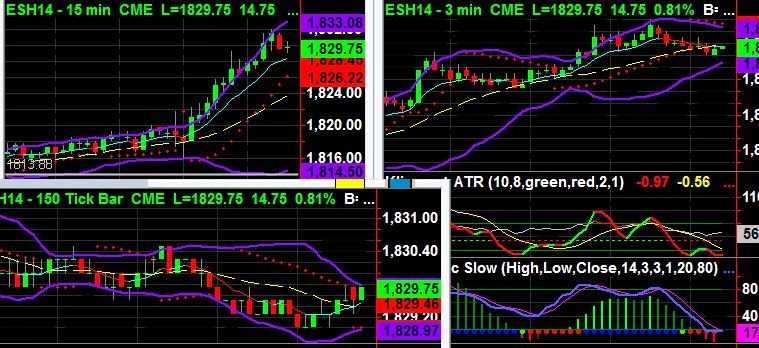
Stocks are no longer even pulling back to the 8-period exponential moving average any more. This represents the most advanced staged of a bubble.

Monday, January 13, 2014

Stocks Slide Nearly 200 Points


Goldman "Underweight" Casts a Pall On Earnings Season

U.S. equity markets fell Monday after Goldman cut American stocks to 'underweight' compared to other markets and traders awaited a slew of earnings this week.

Earnings season is here. It will be interesting!

Hussman: On the Edge of Steep Losses

I just love this guy! His Wile E. Coyote analogy is as insightful as it is hilarious!  He says we stand on the edge of an anvil-fueled cliff!

"In July 2011, just before the market lost nearly 20% (but also the last time it corrected materially), I observed “Like Wile E. Coyote holding an anvil just past the edge of a cliff, here we are, looking down below as if there is much question about what happens next.” In my view, the stock market is hovering in what has a good chance of being seen in hindsight as the complacent lull before a period of steep losses. Meanwhile, we would require a certain amount of deterioration in stock prices, credit spreads, and employment growth to amplify our economic concerns, but even here we can say that there is little evidence of economic acceleration. Broad economic activity continues to hover at levels that have historically delineated the border of expansions and recessions" John Hussman, PhD (January 13, 2014)

Baltic Dry Index Plunges Sharply

"At 1,395, the the Baltic Dry index, which reflects the daily charter rate for vessels carrying cargoes such as iron ore, coal and grain, is now down 18% in the last 2 days alone (biggest drop in 6 years), back at 4-month lows. The shipping index has utterly collapsed over 40% in the last 2 weeks."

Lockhart Speech Sparks Sell-Off

What a twisted world! Fed Gov. Lockhart gave an optimistic speech that has resulted in a sell-off! His views were confident, even buoyant. Why, then, would that spark a sell-off of 115 points (so far)? Shouldn't good news result in buying? Not in a Fed-distorted world!


Sunday, January 12, 2014

Fed Policy May Be Causing Deflation

By Christopher Whalen at Breitbart.com:

Last week’s job numbers suggest very strongly that the Obama Depression may be accelerating.
Economists of all stripes are trying to pretend that the numbers were not as ugly as they well and truly are, but some of the realists are pointing out the obvious, namely that the US economy continues to shed jobs and workers. David Zervos of Jeffries & Co puts the situation in plain terms:

The December payroll report does NOT suggest that labor market momentum is increasing. The modest 78k increase in payrolls, plus the 34k in positive revisions barely gets us half of what was expected. But the most concerning part of the report comes from the household survey where we saw another 347,000 people leave the labor force. And it was not just more retirees, or more youngsters going to college. The largest acceleration downward in the participation rate came from the 45-54 year old cohort – that rate fell 0.5 percent, from 79.6 to 79.1. In the early part of the crisis, the most important driver of a lower participation rate came from the younger cohorts. But these 16-19 and 20-24 year old groups have been stable in recent quarters, albeit at much lower levels. The "trouble" now is manifesting itself with the seasoned veterans!
The continued attrition of 45-54-year-olds in the workforce is cause for concern by itself, but with the other deflationary factors at work in the US economy, alarm bells ought to be ringing in Washington DC.
First, the velocity of money – the amount of times a dollar changes hands in a given year – continues to fall. Second, the banking and non-bank sectors continue to de-leverage, meaning that we are taking credit capacity out of the economy. Without more turnover in money and net growth in terms of credit, the outlook for growing jobs is small to none.
Sadly, the policies being followed at the Fed and White House are stifling job creation even as they encourage moral hazard and the growth of new bubbles in the financial sector. The slew of new regulations put in place in Washington since 2008 makes it virtually impossible for more than half of all adult Americans to qualify for a home mortgage. The fact of a weak jobs market and a net exodus of adults from the workforce also implies a smaller market for homes – even with the continued growth in the overall population. 
Yet newly installed Fed Chairman Janet Yellen tells Time magazine that the housing market recovery will continue. Does anyone on the Fed staff bother to read the press releases from CoreLogic which reveal that 18 of 20 cities in the Case-Shiller 20-city index were down in October? The demand-siders on the Federal Open Market Committee (FOMC) believe that ultralow interest rates help the US economy. Again writes Zervos:
The FOMC has told us they see slack, not slackers. Its why the SEP forecast for the end of 2016 has a 3 percent growth rate, a 2 percent PCE inflation rate, a 5.5 percent unemployment rate and 1.75 funds rate. They believe that very low risk free real rates will be appropriate even with "equilibrium" growth, "equilibrium" inflation and unemployment at or near the NAIRU. Why do they believe this? Because they think that by running policy "hot", even at equilibrium, they can bring these disaffected workers back into the labor market. That is the plan!!
The trouble is, however, that “hot” policy like what the FOMC thinks it is pursuing is actually encouraging deflation in the US economy by robbing savers of badly needed income – this to the tune of about $100 billion per quarter just in terms of the return on US bank deposits. While low rates were helpful and entirely necessary early in the post-crisis response, today low rates are arguably a net negative for the US economy.
The great editor of The Economist Walter Bagehot warned that keeping interest rates too low for too long would scare money out of the markets, causing deflation. My friend David Kotok of Cumberland Advisors discussed this issue in a wide ranging interview posted on Zero Hedge before the holiday:
Antoine Martin of the Federal Reserve Bank of New York, in his important 2005 paper “Reconciling Bagehot with the Fed’s Response to September 11,” argues that Bagehot had in mind a commodity money regime in which the amount of reserves available was limited. Thus, keeping rates high was a way to draw liquidity, that is gold, back into the markets. Bagehot also understood that low interest rates fuel bad asset allocation decisions – what we call “moral hazard.” In the age of fiat money, however, economists have taken the opposite view, namely that an unlimited supply of reserves obviates the need to attract money back into the financial markets.
The neo-Keynesian, demand-side mindset of Chairman Yellen and the rest of the FOMC does not allow them to see or accept that low rates are actually hurting employment, credit, and capital formation. Investors must be paid to take risk. The declining leverage within the US banking system, which was discussed in a Zero Hedge post about Q4 2013 bank earnings (“Are Large Cap Banks Ready to 'Break Out?'”), is a red flag that Congress ought to be discussing with Chairman Yellen on a weekly basis. Meanwhile moral hazard grows under QE, and Fed-induced bubbles proliferate in the equity and debt markets. 

Saturday, January 11, 2014

Even Goldman Sachs Concludes That Stocks Are At Elevated Valuation Levels

Even Goldman Sachs has concluded that this current stock market is a bit bubbly:

"S&P 500 valuation is lofty by almost any measure, both for the aggregate market (15.9x) as well as the median stock (16.8x)...
"We conclude that further P/E expansion will be difficult to achieve."

Friday, January 10, 2014

S&P 500 Rises Despite Awful Jobs Report

If this isn't evidence of a bubble, what is? If this isn't evidence of market distortions by central bankers, what is?


And Just When We Thought the Jobs News Couldn't Get Worse...

...it DOES get worse!


Record DISTORTION...

...between the real unemployment rate and the official unemployment rate.


Stocks ROSE 29% in 2013, Depite FEWER Jobs Created Than 2012


And the Baltic Dry Index Plunges to 30-Year Low

As if the awful jobs report wasn't bad enough, the Baltic Dry Index, one of the better leading economic indicators, just plunged the most for any new year in 30 years!


Awful Jobs Report Shocks Stocks, Sends Wall St Reeling!

Only 74,000 jobs created in December. This was awful! This was the fewest jobs created in 2 years, and yet the official unemployment rate DECLINED!

The Labor Force Participation Rate just hit a new low:
And the number of adults in the US who don't have jobs is soaring (black line):

The Biggest Bubble of All

This is the biggest stock market bubble I've seen yet. The bigger they are, the harder they fall!


Thursday, January 9, 2014

Why Have Stocks Turned Red?

I'm not hearing any reasons for this!

Jobless Claims Drop Modestly, But...

...but the non-seasonally adjusted jobless claims rose above 486,000. Thus seasonal adjustments removed 150,000 or skewed seasonal adjustment downward by over 40%. 4 week moving average of NSA rises to 440,000. The BLS will have to make massive revisions if this continues.

Stocks Turn Red

Don't they know that central bankers are still hard at work printing money?


ECB Rate Announcement Sends Stocks Higher


Wednesday, January 8, 2014

More Malaise In the EverMalaise Economy!

Retail Sales Figures Weak. It's Obamalaise!

from Lance Roberts at Stawealth.com:


"As you can see the trend in the data is clearly weakening and is unlikely to change much in coming months as higher healthcare costs, and taxes, weighs on consumer's disposable incomes."
"Retail sales are not currently indicating that the consumer is about to "drop kick" a game winning field goal in the coming year. While the consumer is definitely "not dead," as evidenced by increased leverage in the recent credit reports, they are also not currently in the position to substantially increase demand five years into an economic recovery. My perception is that the "struggle through" economy is likely to remain in 2014 which will disappoint the economic bulls."

"Bubbles Always Pop"

From Guy Haselmann of Scotiabank. As a reminder, exhibiting decidedly non-Keynesian cult attributes as a member of the sellside is generally frowned upon.
"Bubbles Always Pop"
The world has been kept on life support mostly by government spending of trillions of dollars  and central bank printing of trillions more. Both have boosted asset prices and given the allure of economic progress. Over-zealous regulators, market rule changes, and aggressive policy stimulus have temporarily stabilized markets. Market vigilantes have been hibernating, because unclear investment rules and uncertainties around the ultimate magnitude of stimulus have prevented them from attacking bad policies or distorting asset price valuations.
It is difficult to know the extent that markets and the global economy have benefited from official policy stimulus; however, five years after the crash, economic growth and the labor recovery remain subpar. Strong growth should have been ignited by now.
Most economists still believe in the ‘official position’ that growth is edging sustainably higher and that interest rates will slowly rise to reflect it. They could be correct, but should it fail to unfold as expected, confidence in the efficacy of official policy will diminish and the social contract will break down further. Since markets require confidence, they will also react accordingly.
Some argue that economic benefits to stimulus have run its course, while the costs from looming unintended consequences have not yet been unleashed. Many believe (and I am one) that the risks and costs of current Fed policy outweigh the benefits.
* * *
The Fed’s asset purchase program (QE) and Zero Interest Rate Policy (ZIRP) are the foremost factors that have widened wealth inequalities. The richest few have benefited the most, simply because the 10% richest Americans own 80% of US stocks. The FOMC believe that its asset-price-inflation-trickle-down-policy leads to spending which ultimately leads to job creation, especially for the poor.
However, several FOMC members themselves have questioned Fed policies, citing that they have not worked as well as had been hoped, and pointing out that aggregate demand has been weak throughout the recovery. To his credit Fed Governor Jeremy Stein broached the subject of unintended consequences of Fed policies when he mentioned in his February paper, “A prolonged period of low interest rates, of the sort we are experiencing today, can create incentives for agents to take on greater duration or credit risk, or to employ additional financial leverage in an effort to ‘reach for yield’”.
Zero interest rates have incentivized corporations to issue debt in order to capitalize on the historically low interest rates; however, corporations have primarily used the money to pay greater dividends, buyback shares, or modernize plant and equipment. There is a strong case to be made that holding interest rates at zero for a prolonged period is actually counter-productive to the Fed’s efforts to achieve either of its dual mandates. This is because increasing productivity through modernization typically exposes redundancies: it allows firms to lay-off workers, while the improvement in competitiveness allows firms to drop prices.
Furthermore, and as I referenced in my 2013 paper, “Should the marginal propensity to consume of creditors exceed that of debtors, the net effect of redistribution could be to lower household spending rather than raise it. There are some conservative savers who have a predetermined goal in mind for the minimum amount of savings they wish to accumulate over time. Those investors may refuse to move out the risk curve in search of higher yields (likely widening the wealth divide). To them, lower interest rates simply mean a slower rate of accumulation, which likely will jeopardize their minimum goal. The only recourse for this investor is to save more, which is the exact opposite intention of the Fed’s policy. For example, if interest rates fall from 4% to
3%, an investor would have to increase savings by more than 20% each year to reach the same goal over 30 years.”
Another negative result of ZIRP is that banks and other lenders are discouraged from lending due to puny return levels; and, therefore, the Fed’s desire to expand lending is compromised. Are lower (or negative) interest rates supposed to increase the incentive to lend money? To assume such is absurd. Although somewhat counter-intuitive, if interest rates rose, then the supply of money willing to be lent would increase due to wider interest margins.
Policies are so unprecedented and unproven that it is possible that the Fed itself has now become a source of financial instability. This could be the case either through the potential fueling of asset bubbles, through its compromised ability to conduct future monetary policy (due to it  unwieldy $4 trillion balance sheet), or due to “unknown unknowns.”
* * *
In a low to zero interest rate policy (ZIRP) environment, investors desperately search for yield. This frequently chases investors into assets to which they are ill-suited and to which they will miscalculate liquidity and downside potential. Under ZIRP paradigms, riskier assets become the best-performing. Credit spreads collapse and equities soar.
Massive monetary ‘printing’ by global central banks has not just emboldened investors, but these actions have collectively changed their behavior and psychology. There is evidence that policies have led to mis-allocation of resources. Investors are emboldened to take what many critics believe is inappropriate or reckless levels of risk. The motto, “Don’t fight the Fed” has taken on added meaning. Moral hazard and a deep-seated bullish psychology have become rampant.
Extended Fed promises of lower rates and a continuation of asset purchases even as the economy heals, are conspiring to propel prices ever-upward. Investing today has become mostly about seeking relative yield, rather than assessing value or determining if the investment’s return is sufficient compensation for the risk.
Simply stated, investors and speculators receive ever-lower returns for ever-higher levels of risks. Over time, the ability of an investor to assess an asset’s fundamental value becomes ever-increasingly impaired. It should a warning sign to portfolio manager’s fiduciary responsibility to maximize return per unit of risk (see market liquidity section).
There have been persistent cycles of asset booms (bubbles) that eventually turned to ‘busts’. Very low or negative real rates (seen recently) always create economic distortions and the mispricing of risk, thereby creating asset bubbles. Each ‘boom’ had some differences, but the common factor has always been easy money which the Fed was too slow to withdraw. Providing liquidity is always easier than taking it away, which is one reason why the Fed has hit the “Zero Lower Bound” in the first place.
Eventually (un-manipulated) asset prices always return to their fundamental value, which is why bubbles always pop. The FOMC has backed itself into a corner. Current changes in policy are being designed around efforts to manage the unwind process seamlessly. Central bank (and government official’s) micro-management appears based on a belief that they can exert an all-encompassing central control over markets and peoples’ lives. Those in power have come to believe that policies have a precise effect that can be defined and managed. This is highly unlikely.
In ‘normal’ times there is a more discernable connection between cause and effect. However, the usual relationships particularly break down during periods of over-indebtedness, unprecedented regulatory changes, and official rates reaching the zero lower bound. Today, the world is far from ‘normal’. It is not difficult to imagine the looming fallout from policies that have promoted asset price inflation, and which have materially compromised market liquidity.
In the long run, policies that punish savers at the expense of helping risk-takers and speculators are bad long-run policies for any country. It would be better to transform the country into net savers, rather than to continue to promote policies where growth is reliant on overly-leveraged consumers or speculators, and is micro-managed by attempts of central-control.

Tuesday, January 7, 2014

Wall St Loves Yellen

And why not? She has promised them monetary heroin in perpetuity! She is an even bigger money printer than Bubbles Bernanke! And that's why she will ultimately be Calamity Janet!


Stocks Rally Following Yellen Confirmation

Calamity Janet was confirmed. So will be the calamity!

Monday, January 6, 2014

Peter Schiff Talks of Consequences of QE

By: 
Peter Schiff
Monday, January 6, 2014
Most economic observers are predicting that 2014 will be the year in which the United States finally shrugs off the persistent malaise of the Great Recession. As we embark on this sunny new chapter, we may ask what wisdom the five-year trauma has delivered. Some big thinkers have declared that the episode has forever tarnished freewheeling American capitalism and the myth of Wall Street invincibility. In contrast, I believe that the episode has, for the moment, established supreme confidence in the powers of monetary policy to keep the economy afloat and to keep a floor under asset prices, even in the worst of circumstances. This represents a dramatic change from where we were in the beginning of 2008, and unfortunately gives us the false confidence needed to sail blindly into the next crisis. 
Although the media likes to forget, there was indeed a strong minority of bearish investors who did not drink the Goldilocks Kool-Aid of the pre-crisis era. As the Dow moved up in 2006 and 2007 so did gold, even though a rising gold price was supposed to be a sign of economic uncertainty. The counter intuitive gold surge in those years resulted from growing concern among a committed minority that an economic crisis was looming. In the immediate aftermath of the crisis in 2009 and 2010, gold shifted into an even higher gear when those investors became doubly convinced that the extraordinary monetary measures devised by the Fed to combat the recession would fail to stop the economic free fall and would instead kick off a new era of inflation and dollar weakness. This caused many who had been gold naysayers and economic cheerleaders to reluctantly jump on the gold band wagon as well.
But three years later, after a period of monetary activism that went far beyond what most bears had predicted, the economy has apparently turned the corner. The Dow has surged to record levels, inflation (at least the way it is currently being measured) and interest rates have stayed relatively low, and the dollar has largely maintained its value.  Ironically, many of those former Nervous Nellies, who correctly identified the problems in advance, have thrown in the towel and concluded that their fears of out of control monetary policy were misplaced. While many of those who had always placed their faith in the Fed (but who had failed - as did Fed leadership - from seeing the crisis in advance) are more confident than ever that the Central Bank can save us from the worst.
A primary element of this new faith is that the Fed can sustain any number of asset bubbles if it simply supplies enough air in the form of freshly minted QE cash and zero percent interest.  It's as if the concept of "too big to fail" has evolved into the belief that some bubbles are too big to pop. The warnings delivered by those of us who still understand the negative consequences of such policy have been silenced by the triumphant Dow.
The proof of this shift in sentiment can be seen in the current gold market. If the conditions of 2013 (in which the Federal Government serially failed to control a runaway debt problem, while the Federal Reserve persisted with an $85 billion per month bond buying program and signaled zero interest rates for the foreseeable future)could have been described to a 2007 investor, their conclusions would have most likely been obvious: back up the truck and buy gold. Instead, gold tumbled more than 27% over the course of the year. And despite the fact that 2013 was the first down year for gold in 13 years, one would be hard pressed now to find any mainstream analyst who describes the current three year lows as a buying opportunity. Instead, gold is the redheaded stepchild of the investment world.
This change can only be explained by the growing acceptance of monetary policy as the magic elixir that Keynesians have always claimed it to be. This blind faith has prevented investors from seeing the obvious economic crises that may lay ahead. Over the past five years the economy has become increasingly addicted to low interest rates, which underlies the recent surge in stock prices. Low borrowing costs have inflated corporate profits and have made possible the wave of record stock buybacks. The same is true of the real estate market, which has been buoyed by record low interest rates and a wave of institutional investors using historically easy financing to buy single-family houses in order to rent to average Americans who can no longer afford to buy.
But somehow investors have failed to grasp that the low interest rates are the direct result of the Fed's Quantitative Easing program, which most assume will be wound down in this year. In order to maintain the current optimism, one must assume that the Fed can exit the bond buying business (where it is currently the largest player) without pushing up rates to the point that these markets are severely impacted. This ascribes almost superhuman powers to the Fed. But that type of faith is now the norm.
Market observers have taken the December Fed statement, in which it announced its long-awaited intention to begin tapering (by $10 billion per month), as proof that the dangers are behind us, rather than ahead. They argue that the QE has now gone away without causing turmoil in the markets or a spike in rates. But this ignores the fact that the taper itself has not even begun, and that the Fed has only committed to a $10 billion reduction later this month.  In fact, it is arguable that monetary policy is looser now than it was before the announcement.
Based on nothing but pure optimism, the market believes that the Fed can somehow contract its $4 trillion balance sheet without pushing up rates to the point where asset prices are threatened, or where debt service costs become too big a burden for debtors to bear.  Such faith would have been impossible to achieve in the time before the crash, when most assumed that the laws of supply and demand functioned in the market for mortgage and government debt. Now we "know" that the demand is endless. This mistakes temporary geo-political paralysis and financial sleepwalking for a fundamental suspension of reality.
The more likely truth is that this widespread mistake will allow us to drift into the next crisis. Now that the European Union has survived its monetary challenge, (the surging euro was one of the surprise stories of 2013), and the developing Asian economies have no immediate plans to stop their currencies from rising against the dollar, there is little reason to expect that the dollar will rally in the coming years. In fact, there has been little notice taken of the 5% decline in the dollar index since a high in July. Similarly, few have sounded alarm bells about the surge in yields of Treasury debt, with 10-year rates flirting with 3% for the first time in two years.
If interest rates rise much further, to perhaps 4% or 5%, the stock and real estate markets will be placed under pressure, and the Fed and the other "Too Big to Fail" banks will see considerable losses on their portfolios of Treasury and mortgage-backed bonds. Such developments could trigger widespread economic turmoil, forcing the Fed to expand its QE purchases. Such an embarrassing reversal would add to selling pressure on the dollar, and might potentially trigger an exodus of foreign investment and an increase in import prices. I believe that nothing can prevent these trends from continuing to the point where a crisis will be reached. It's extremely difficult to construct a logical argument that avoids this outcome, but that hasn't stopped our best and brightest forecasters from doing just that.
So while the hallelujah chorus is ringing in the New Year with a full-throated crescendo, don't be surprised by sour notes that will bubble to the top with increasing frequency. Ultimately the power of monetary policy to engineer a real economy will be proven to be just as ridiculous as the claims that housing prices must always go up.
Peter Schiff is the CEO and Chief Global Strategist of Euro Pacific Capital, best-selling author and host of syndicated Peter Schiff Show.

Sunday, January 5, 2014

Bubble Update! It Gets WORSE!

From Dr. John Hussman's weekly market update today:

Surprise! High consumer confidence is a contrary indicator! 

Selected quotes from Dr. Hussman's commentary today:
“Wall Street remains exuberant about economic prospects. Last week brought a 6-year high in consumer confidence, evidently supporting the idea that the consumer remains strong and the economic expansion remains intact. Unfortunately, if you examine the data, you'll quickly discover that consumer confidence is a lagging indicator, well explained by past movements in GDP, employment, and capacity utilization. Worse, for the stock market, it's a contrary indicator. This is a fact that I've noted at both extremes, not only in early 2000 when new highs in consumer confidence supported a defensive position, but conversely in the early 1990's, when new lows in consumer confidence supported a leveraged position in stocks. High levels of economic optimism are regularly observed at the peaks of both U.S. and foreign economic expansions. This includes the general consensus of individuals, businesses, politicians, central bank officials and notoriously – economists. That shouldn't be surprising. It's the very nature of a peak that it can't be produced except by unusual optimism.” 

 "The deeply unfortunate part of this story is that since early 2013, these strenuously overvalued, overbought, overbullish, rising-yield conditions have been observed not only in recent weeks, but also in May 2013, with a close call as early as February 2013. No material market weakness has emerged during this period, which encourages investors to ignore the risk altogether, rather than consider the likelihood that this risk is increasing, despite being unrealized to-date." John Hussman PhD

What Dr. Hussman is saying is that with the market so bullish, market participants increasingly IGNORE the risks, taking greater and greater risk, thus creating MORE risk. The more bullish they become, the more likely an exogenous event will occur that will crash the market.

 "...as Rudiger Dornbusch once said, “The crisis takes a much longer time coming than you think, and then it happens much faster than you would have thought.'"

 "I continue to believe that quantitative easing has no mechanistic relationship to the economy or the financial markets beyond creating a purely psychological discomfort with zero interest rates, and encouraging a reach for yield in speculative assets that has already set reckless extremes in median stock valuations, margin debt, and "covenant-lite" lending. Want to know the cause-and-effect mechanism that links QE to the economy? As FOMC governor William Dudley observed last week, so does the Fed." 

 "... worth noting is that in historical data since 1871, there is only a single month prior to the late-1990's bubble when valuations were richer than they are today." Dr. John Hussman

He's saying that only one other time, for a single month, were stocks so OVERpriced as they are today.


"...strong economic, speculative and monetary enthusiasm has historically been quite a contrary indicator for stocks."

 "I expect little, if any of the market’s gains since 2010 to be retained by investors over the completion of this market cycle."
"I should note that we now estimate negative prospective total returns for the S&P 500 on every horizon of less than 7 years. "
 
John Hussman, PhD

10 Ugly "Trends" That Amount to An Economic Cold Shower

from Investor's Business Daily:

The resilience that has long been one of America's remarkable traits was on display in 2013. Not only did businesses create 2 million jobs, but the struggling economy actually grew and profits and stock prices soared to near-record levels.
Still, five years into the Obama presidency, the economy is grossly underperforming. Contrary to the dominant media narrative, it's not bad luck or the financial crisis to blame, but bad policies — from the $860 billion "stimulus" that didn't stimulate to the Dodd-Frank financial reform that killed lending.
Last year was a challenging one for entrepreneurs and other productive Americans. No fewer than 13 new taxes were put into place. Big government now consumes one of every four dollars of our GDP and is getting bigger.
Entering 2014, we face problems, including taxes and spending, that neither the White House nor Congress is addressing. In the following charts, we look at a few of the more alarming and intractable ones.


Extremely Limited Prosperity
The president talks endlessly about the need to reduce income inequality, and claims it will be the focus of his remaining years in office.

As this chart shows, since the U.S. recession bottomed in June 2009, stock prices have been on a tear — fueled by a powerful rise in corporate profits. The bellwether S&P 500 index has climbed more than 90%, as U.S. investors added more than $5 trillion in stock market wealth.

But Obama's slow-growth economic policies have taken a toll. Yes, corporate profits have increased, but companies worried about what lies ahead under Obama are holding on to cash or buying back stock rather than hiring workers. And the Fed's endless stimulus efforts have managed to lift stock prices to new heights.

These gains have largely bypassed the struggling middle class. In fact, median household income remains well below where it was when the recovery started.


A Wide Economic Growth Gap
The Obama recovery is the most feeble since the Great Depression. GDP growth is far below the average recovery since World War II, and even below the average growth of the past three recoveries.

In dollar terms, if Obama's recovery had been merely average, the economy would be $1.3 trillion — or 8% — bigger today than it is.

Put another way, every American alive today — workers, non-workers, children — is $4,100 less well off than he or she would have been if growth had only been normal. Consider it a tax we all pay for voting poorly in recent elections.

This is more than just a matter of numbers. America's highest-in-the-world standard of living has been built on economic growth. Without it, we'll all be worse off.

Unfortunately, the policies put in place by tax-and-spend leftists in the administration and a Democrat-dominated Congress have stalled the U.S. growth machine.


A Massive Ongoing Jobs Gap
The jobless rate is coming down and will likely continue to fall in 2014. But the tepid recovery has left millions who would otherwise have jobs languishing in the unemployment line.

By this time in past recoveries, the economy had churned out at least a 10% gain in net new jobs. This time, the hamstrung economy has managed just over 4%.

Worse, the total number of payroll jobs — 136.765 million as of November — remains 1.3 million below the level when the economy first went into the tank in December 2007. By comparison, our population has grown by 13 million over the same stretch. Statistically, this is the worst job slump since the Great Depression.


Dependency Growing, Not Jobs
Obama's policies have also created a wide disparity between self-sufficiency and dependency. As this chart shows, food stamp and disability enrollment have climbed at a much faster pace than jobs since June 2009.

Today, 47 million people are on food stamps, up from about 28 million when Obama was sworn in. And disability rolls have swollen by 2 million.

This has not only increased our federal budget deficit as welfare spending has risen sharply.

It has also led to a startling surge in Americans' dependence on government handouts — a radical altering of the country's traditional culture of self-reliance and hard work.


America's Global Strength Wanes
For more than a decade, the IBD/TIPP Poll has asked Americans about the U.S. position in the world. Our final poll of 2013 is in, and opinions have never been lower.

Whether it's the bumbling over Egypt and Syria, the Benghazi scandal, Iran's burgeoning nuclear program, Russia's and China's growing challenges or the cavalier treatment by the Obama White House of old allies, Americans feel our global standing has weakened.

This doesn't bode well for future engagement in the world economy and trade, or for U.S. influence.


Workers Leave Labor Force
The administration has pointed proudly to the decline in unemployment from above 10% to a current level of 7%. What it doesn't say is how that was achieved.

It came about largely as a result of millions of workers leaving the workforce. As the chart shows, labor force participation has dropped steeply since the financial crisis — from 66% to 63%.

The difference may not seem large, but it is. The number of people who tell the government they are not in the labor force has jumped by 10 million since Obama took office, and 91.5 million Americans are not working at all.

If the labor force had remained relatively stable over the past five years, the unemployment rate today would be over 10%.


America, The Biggest Debtor Ever
This chart may look innocent, but it's anything but. It shows how our debt has surged. As recently as 2008, total U.S. public debt totaled just over 60% of GDP — not low, but certainly manageable.

Today, our total debt is right at 100% — a level that many economists believe endangers future economic growth. The bad news is, it could rise to 150% or higher in coming decades. That's national insolvency.

As Americans pay increasing amounts to service their massive debt obligations, businesses will have less capital available to grow — and will hire fewer workers.


Real Jobless Rate? Double Digits
As mentioned earlier, nominal unemployment has fallen from 10% to 7%. But that's not the only measure for joblessness.

The government's U6 rate — which adds in those who are only marginally employed, or working part time but want full-time work — pegs the unemployment rate at a hefty 13.2%.

That's down from 17.1% when the recovery began in June 2009. But as the chart shows, today's level is much higher than it's been in nearly two decades.

Coupled with more long-term unemployed than ever, this chart paints a picture of labor force distress that will disappear only when normal economic growth resumes.


Regulation Is Huge Hidden Tax
Politicians like to make laws; it's what they do. And when they make laws, the unelected bureaucracies go to work, filling in all the gaps with new regulations. They are, in a real sense, the real lawmakers.

This is not without cost. Indeed, it's the most significant cost to consumers and businesses in America.

According to the respected Competitive Enterprise Institute, regulations are an annual tax on the U.S. economy equal to $1.5 trillion. As the chart shows, that's more than all corporate and income taxes combined. And it's roughly equal to all corporate pretax profits. This is yet another huge tax you pay, without knowing it.


What America Really Owes
We constantly hear that we have trillion-dollar deficits. And we do. We also have $17 trillion in total debt, nearly a third bigger than when Barack Obama entered office.

Yet that doesn't even scratch the surface of what we really owe. Economists look at all the promises government has made, then at the expected revenues to satisfy those promises, and find we come up way short.

They call this the long-term fiscal gap. Depending on how it's counted, over the next 75 years the U.S. must find $54 trillion to $200 trillion to pay for all our promises.


Long-Term Fiscal Outlook Is Ugly
America's long-term fiscal outlook is grim. Based on the nonpartisan Congressional Budget Office's "alternative scenario" — the one it actually thinks is most likely — federal spending will continue to soar out of control, eventually gobbling up more than 35% of all economic output. Fast-growing entitlement spending is at the heart of the spending boom.

Yet, based on long-term experience, federal revenues won't keep pace. The result: A massive deficit of nearly 20% of GDP. At that level, all capital available for spending or investment will go to finance the government's red ink. As the government itself says, it's "unsustainable."

Members of both parties will have to act soon — or risk national bankruptcy and fiscal collapse.

The original article. 

Saturday, January 4, 2014

IMF Warns of Western Debt Defaults

by Ambrose Evans-Pritchard at the UK Telegraph:

Much of the Western world will require defaults, a savings tax and higher inflation to clear the way for recovery as debt levels reach a 200-year high, according to a new report by the International Monetary Fund.
The IMF working paper said debt burdens in developed nations have become extreme by any historical measure and will require a wave of haircuts, either negotiated 1930s-style write-offs or the standard mix of measures used by the IMF in its “toolkit” for emerging market blow-ups.
“The size of the problem suggests that restructurings will be needed, for example, in the periphery of Europe, far beyond anything discussed in public to this point,” said the paper, by Harvard professors Carmen Reinhart and Kenneth Rogoff.
The paper said policy elites in the West are still clinging to the illusion that rich countries are different from poorer regions and can therefore chip away at their debts with a blend of austerity cuts, growth, and tinkering (“forbearance”).

More here. 

Friday, January 3, 2014

Bernanke's Swansong Sends Stocks Soaring

Fed doublespeak sends stocks soaring again! Don't these central bankers ever tire of their machinations and manipulations?

Wouldn't it have been much more accurate and truthful for him to say that he's no less committed to blowing bubbles? Bubbles Bernanke!

Stocks: Not So Certain Now!


Stocks Scream Right Out of the Starting Gate


Identify the Bubble!

LET'S PLAY A GAME! It's called Identify the Bubble!

In this chart just released by JP Morgan, which of these stock market bubbles is NOT considered by Wall St to be a bubble today?
Hint: It's the BIGGEST one!
Hint #2: It's the CURRENT one!

Interestingly, the last three stock market bubbles declined to similar levels around the level of 600 for the S&P 500. If the current stock market bubble declines to that level, it would be a 67% decline! Imagine such a decline of the stock market, and also all those savings and retirement accounts, amounting to a TWO-THIRDS loss. Imagine a 2/3rds decline! How many lives would be impacted? How many dreams will be destroyed?
 Note also the angle of incline of those olive-green lines. Which bubble manifests the most acute angle of incline?
Hint: It's the CURRENT one!

But the Fed and Wall St would excoriate you for calling it a bubble! How DARE you call it a BUBBLE! In her Senate confirmation hearing, "Calamity" Janet Yellen said she saw NO signs of the Fed having created "market imbalances". I'm just wondering: Is Yellen blind? Because I know a lot of people that aren't Wall St insiders or bankers that have NO difficulty identifying this market as a bubble! And if she has difficulty recognizing one, what does THAT say about her (in)competence as our new Fed Chair that is due to take office at the end of this month?

Bubble Mentality In Full Frontal Today

China's PMI data overnight was weak. This from Reuters:

But after an initial sell-off, traders in Europe, supported this morning by traders in the US, shrugged off that news and are now reflexively manifesting a "buy the dip" mentality and pushing the bubble back up again. It is noteworthy how short-term the bad news impacted the market, and how quickly it went back up.

In a maturing bubble, down days become more and more rare. Yesterday's "first day of the year" sell-off was just a one-day quirk. I expect the bubble to continue to build.

Thursday, January 2, 2014

Crude Oil Today's Biggest Mover

Crude oil dropped from $99 down to $95.50. They are blaming a build in crude oil inventories. This should make my gas bill happy! It may be time to fill up!

Bad Omen? First Down Day to Begin Year Since 2008


Gold, US Dollar Both Rally On First Trading Day of 2014

This is somewhat of a surprise! Both the US Dollar and gold are rallying. Gold was up $30 just a few minutes ago!
The US Dollar:

 Gold rallied too:

Stock Market Rout to Ring In 2014

The Santa Claus rally is over! Fund managers are selling stocks briskly this morning in order to lock in gains for 2013. Tuesday's "window dressing" rally was just for show! Dow was down about 150 points just a few minutes ago.