WSJ headline:


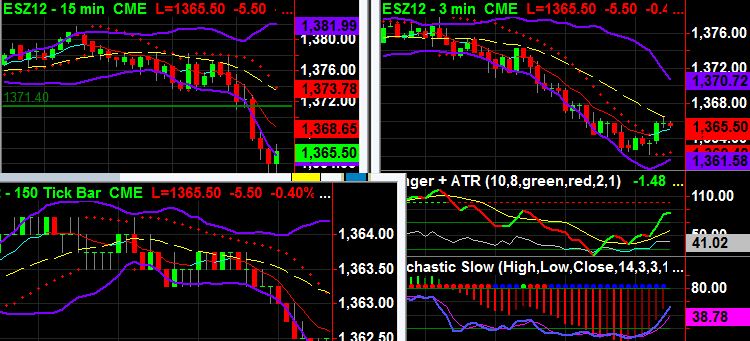
Despite that no "fix" is in sight, stock futures rose on Friday, even following more bad economic data. However, once Congressional leadership reported a "constructive" meeting with President Obama, stocks leaped out of the red and into the black.
Stock futures continued to rise Sunday evening and into the European session, rising modestly during the session. This, even though Spanish debt continues to deepen.


"Uncertainty swirling around the ‘fiscal cliff’ that must be resolved by year-end, the pending jump in capital gains taxes at the start of 2013, and the debt ceiling that will be reached in late February represent clear and present downside risks to the market in the near-term," writes David Kostin in US Weekly Kickstart.
In the Mary Mapes Dodge book titled Hans Brinker,
there is a fictional story within the story of a little Dutch boy who,
on his way to school, notices a hole in the dyke. Having nothing else
to fix the leak, he plugs the hole with his finger and stays there
through the night until workers come to repair it. We are now into the
fourth year of efforts to print trillions of little Dutch boys out of
dollars and euros in order to stop a tide from crashing through a
fundamentally damaged dyke. All of this has bought time, but no workers
have arrived, and no real repairs have been done.
This from Zero Hedge:
"Because not one Wall Street
analyst could have possibly factored in the impact of Sandy into their
expectations of the month's Industrial Production, which in October declined by -0.4% to 96.6 from 97.0
in the Fed's index, well below consensus expectations of a 0.2% rise,
and down from last month's 0.4% increase, it is only logical to blame it all on Sandy. Sure
enough, this is what the Fed just did: "Hurricane Sandy, which held
down production in the Northeast region at the end of October, is
estimated to have reduced the rate of change in total output by nearly 1
percentage point." So let's get this straight: Sandy - which hit on October 29, or with about 94% of the month of October done and impacted New York and New Jersey, not the entire US, is responsible for 250% of the entire October 0.4% drop? Can
we please get back to the "It's all Bush's fault" excuses already. At
least those were idiotic and funny. Blaming everything on Sandy is just
the former. And yes, capacity utilization for the entire USA which
came at 77.8%, the lowest since November 2011, and well below
expectations of 78.3%, was obviously crushed by a tropical storm that
impacted New York and New Jersey for 3 days in the month. Brilliant."
So, I might add, was that! Brilliant!
Based solely on the words of John Boehner that his meeting with President Obama was "constructive", S&P 500 futures have leaped 16 points (about 120 on the Dow) in less than 30 minutes. Oops! It wasn't "words" (plural), it was WORD (singular).

Stocks are losing ground again today on news that things are only getting worse in the economy. The headlines speak for themselves.
Rising lay-offs!


Follow my earlier posting, stocks fell flat and have been straddling the flat line today. But now, the Philly Fed survey has been released, and it's very bad -- far worse than was expected.
from Zero Hedge:
Let's see if Bush
Sandy can be blamed for not only the Empire Fed, whose employment and
expectations components plunged, for the Initial Claims, which soared
and missed expectations by the second most in the past 13 years, but
also for the Philly Fed, which just plunged from 5.7 to -10.7, far below
consensus of 2.0, the 6th miss of the last 8 (except for last month of
course), and returning to solidly negative territory after last month's "miraculous" pre-election surge.
And while virtually all subcomponents plunged, the one that stood out
to the upside was Prices Paid, as the margin collapse is set to ravage
all companies not only in the greater Philadelphia region but everywhere
else soon as reality, deferred for the duration of the Obama reelection
campaign, slams everyone in the stomach.
From the report:
And here is why the combined Empire and Philly Fed diffusion indices spell pain for the upcoming ISM print (courtesy of John Lohman):The survey’s broadest measure of manufacturing conditions, the diffusion index of current activity, decreased 16 points, to a reading of ?10.7. The fallback of the general activity index followed a single positive reading in October that was preceded by five negative monthly readings (see Chart). Nearly 32 percent of firms reported declines in activity this month, while 21 percent reported increases. The demand for manufactured goods, as measured by the current new orders index, declined 4 points from last month and remains in negative territory.
Shipments also fell this month: The current shipments index fell 7 points, to ?6.7. Declines in inventories were also more widespread this month; 31 percent of firms reported declines compared with 21 percent in October. Labor market conditions at the reporting firms remained weak this month. The current employment index, at ?6.8, was slightly improved from its negative reading in October (?10.7) but has remained negative for five consecutive months. The percentage of firms reporting decreases in employment (20 percent) exceeded the percentage reporting increases (13 percent). Firms also indicated fewer hours worked: The average workweek index was virtually unchanged but posted its eighth consecutive negative reading.
Price Indexes Drift Higher
The indexes for prices paid for purchased inputs and for prices received for respondents’ own manufactured goods moved higher this month. The prices paid index increased from 19.0 to 27.9, but the increase was attributable to fewer firms reporting lower prices rather than more firms reporting price increases. With respect to their own manufactured goods, the percentage reporting an increase in product prices (16 percent) was greater than the percent reporting a decrease (10 percent). The prices received index increased marginally, from 5.4 to 6.3.

This morning, we learned that new claims for unemployment are soaring. Initially, when the news was released, stocks went negative for the first time since yesterday's close. However, the second the NYSE opened, stocks began to soar, despite escalating violence between Israel and Hamas, and despite the soaring unemployment. Something is truly wrong with this picture.


Dow closed down about 190 today, partly on the increasingly bellicose talk and actions in the Mid-East, and also because of the announcement that Sandy will cost much more than expected!


More weakness abroad:



Despite a temporary rally on news that Home Depot is forecasting improvement in the housing sector, stocks have now gone negative with just 15 minutes left in the session.

This is a large move for evening futures trading. Something is afoot!


What a strange occurrence when the Dow closes dead flat on Veteran's Day. Bizarre and rare event!
Consumer sentiment rises to multi-year highs, and China shows growth, so the market reverses sharply.


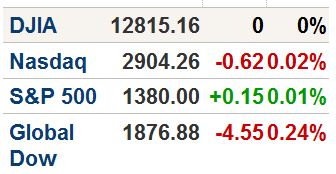
Dow now down 245 points, S&P 500 trading below 1400 for the first time since mid-August.

Following the election last night, stocks rallied after the re-election of Obama seemed assured. Wall St seems to love Obama and his big-spending ways. But then crashed again during the European session. Dow down 180. Ouch!
Prepare for the worst, and even that may be better than we expected.

Today is election day, but there isn't much news to influence the financial markets. Despite the dearth of news, stocks (Dow) are up 140 points.

The S&P 500 is stuck in a holding pattern between Friday's close and the 1400 handle. Dow down marginally at -25. Stocks have been lower since the futures opened last night.

News that manufacturing contracted in the Eurozone doesn't start the week out very well. The S&P 500 futures are down an additional 6 points from Friday's close!

Stocks have now given back most of yesterday's euphoric gains within the past hour. Today's unemployment report showed greater-than-expected job gains, but a higher unemployment rate that rose to 7.9%. Stocks rallied briefly -- about 10 minutes -- then sold off and have grown weaker in the past hour. The Dow is down 110 points.

Two misses, one marginal beat. Now that's data to rally on! The Pollyanna Party continues on Wall St!
ISM Manufacturing: 51.7, Exp. 51.0, Last 51.5
Consumer Confidence: 72.2, Exp. 73.0, Last 68.4
Construction Spending: 0.6%, Exp. 0.7%, Last -0.1%
And since when does ADP have any credibility any more, since in recent months, it has revised its previous months' lower by about HALF the subsequent month, once the headline-seeking HFT algorithms are no longer watching? It changes its methodology, then revises its figures downward the next month, and does so with regularity.
And initial claims "beats" expectations again? Last week's "beat expectations" was revised lower this morning such that it no longer "beat expectations" last week.
Note how another media organization -- one that actually does more than post a headline -- predicted actually what the WSJ did today: "Oh, and this week's just as manipulated print of 363K, which was a beat of expectations of 370K, will be spun as a 9K drop in initial claims of course. Next week this number will be revised to 365K-366K as usual, because the BLS has now upward revised its weekly claims number for something like 80 weeks in a row."
This week's "beat expectations" will be revised next week such that it was about as expected -- or a "missed expectations" as last week's revision showed. How do I know? Because today's initial claims "beat expectations" was the 80th week -- in a row -- that has "beat" expectations, only to be revised worse the following week! How can that kind of record be anything BUT either bad data or manipulated data? And since when are just 158,000 considered to be "strong", as the Wall St insider was quoted to say in the article? With that many jobs created, we won't even create enough jobs for population growth, much less a robust or prosperous economy!
Dow up 140 points.
It's a steady stream of bad news today. However, with stocks having ramped up while markets were closed over the past two days while Hurricane Sandy pounded the Northeast, there is strong support and stocks are down only modestly thus far.


Authored by Charles Hugh-Smith via Peak Prosperity,
With the US elections approaching next week, as well as the
threat of another fiscal cliff showdown looming, we asked contributing
editor Charles Hugh Smith to revisit his earlier work on how
the expansive Central State has come to dominate both private society
(i.e., the community) and the marketplace, to the detriment of the
nation’s social and economic stability. In this updated installment, we
will examine six critical dynamics that will lead to the devolution of
Peak Government.
I can only pass on Societe Generale’s work to you once in a
while, but the piece for today’s Outside the Box is important enough
that its author, Dylan Grice, worked hard to convince his bosses to let
me share it with you. Dylan is one of my favorite investments analysts,
as well as just an all-around nice guy.
In a change from his usual fun-loving demeanor, Dylan issues a serious warning here.