Wednesday, October 13, 2010

Citi Says Foreclosures Gone WIld

Yesterday, Citigroup's homebuilding team hosted a call with investors in which the guest speaker was Adam Levitin, an associate professor of law at Georgetown University. Far from providing the "all green" call participants had desired, Levitin said that what we have recently seen and heard in the news is “just the tip of the iceberg” and that the foreclosure halt may well cause a "systemic problem", as was suggested on Zero Hedge when the news of the Florida's court involvement was first made public (here and here) a month ago. And since by now everyone knows what the key tension points in this potentially massive development are, we will cut straight to Levitin's somewhat unpleasant conclusions: "Our speaker predicted that more and more lenders are likely to stop their foreclosure processes in both judicial and non-judicial states. He also expects more states’ attorney generals to get involved. At the federal level, it is possible than banking regulators might step in as there is legal and reputational risk for the banks involved. Ultimately, if these issues do in fact escalate, the Administration may try to broker some sort of settlement. If such deal brokering does take place, Levitin believes that “some payment” will be exacted from the lenders and servicers. The Administration could bargain for more mortgage principal write downs." In other words, the endgame will likely end up being the extraction of material concession from the banking syndicate, in the form of systemic mortgage writedowns, with Obama's blessing, which will likely put the 25% of homeowners who are underwater on equal footing with the other 75%. It may turn out that this was the plan all along. And people naively wonder why banks have hundreds of billions in cash stashed on the sidelines...
As for Citi's official take on Fraudclosure here are the key issues:

Issues Concerning Affidavits

When the aforementioned paperwork is lost, an agent of the mortgage servicer can sign an affidavit swearing that he or she has personal knowledge that, although now lost, the trustee was once in possession of the necessary documents. The affidavit is considered to have the same weight as sworn testimony in a court of law.

Two problems have emerged with regards to affidavits. First, several news stories have reported that the people signing these affidavits had no knowledge of the matters in question despite the fact that there were legally testifying that they did. Many of these people have since been labeled “robo-signers” given the tremendous volumes of affidavits which they signed in relatively short periods of time. Second, the affidavits may be irrelevant because the issue is not that the mortgage documents were lost but they were never properly transferred at each step of the aforementioned securitization process.

Issues Concerning Tax and Trust Laws

Beyond the affidavit issues, our speaker highlighted potential problems concerning the trusts which hold the securitized mortgages. Most mortgage trusts were set up as REMICs (Real Estate Mortgage Investment Conduits) which are special purpose vehicles used to pool mortgages. Under the IRS code, REMIC confers a special tax status in which the cash flows to the trust are not taxed. Investors in the trust pay taxes. The tax exempt nature is important. If the trusts were in fact to be taxed, the taxes would distort the yields required by investors.

To qualify as a REMIC under the IRS code and enjoy the beneficial tax treatment, the trust (1) must be passive and (2) cannot acquire any new assets 90 days following the trust’s creation.

If, as described above, mortgage documents were never correctly passed through to the trust when it was established, then the trust may not actually own the underlying mortgages it purports to own. Although it is possible that this issue could be remedied by some legal maneuvering, doing so could violate the REMIC status since the trust would be acquiring assets long after the aforementioned 90 day period has expired. Such a violation in turn could trigger a sizeable tax burden for investors. Our speaker indicated that there are a handful of open questions on this front and that this is a legal gray area.

Issues Concerning Title Insurers

Levitin noted that all of the above issues may impact how title insurance companies act. If a scenario emerges in which title companies are unwilling to issue title insurance, in those scenarios lenders may cease lending.

When a home with a mortgage on it is sold, the mortgage must be released at closing by the current mortgage owner before a new mortgage with title insurance is issued. If it is not known with certainty who owns the mortgage in question, it cannot be released. If the title company is not satisfied that there is a good release on the old mortgage, it will refuse to insure the new mortgage.

None of these issues affect mortgages for newly constructed homes. Our speaker expects the mortgage market for new homes to continue to function without any material hindrances.

Issues Concerning MERS

MERS (Mortgage Electronic Registration Systems) functions as a centralized electronic registry of mortgages and tracks ownership of mortgages. MERS allows mortgage ownership to change hands efficiently and relatively quickly since it is electronic and allows all parties to forgo making a filing in local land records. Indeed, MERS was designed to function as a substitute for local land records.

Although MERS was designed to enhance efficiency in the mortgage assignment process, Levitin argued it may not conform with the law. “Slowly but surely” courts are issuing decisions which “cast validity on the MERS process.” Although ~60% of mortgages list MERS as the “nominee” which owns the mortgage, a handful of recent court cases have ruled that MERS has no standing in foreclosure actions either because (1) physical paperwork must be transferred when a mortgage is assigned by one party to another or (2) MERS has no true economic interest in the mortgage in question since it collects no payments from the borrowers.
Of course, all this is irrelevant without an appreciation of the endgame. And that may very well be what the Fed is pursuing all along - the elimination of trillions of private debt, however instead of Uncle Sam eating it all this time (via the GSEs), the banks would end up sharing some if not all of the pain. Of course, if this is indeed the case, it will be a very dangerous tight rope act, as many may just refuse to pay their mortgages outright going forward, and cause major additional pain for the TBTFs, and/or result in other traditionally unpredictable outcomes.
Full citi report, with thanks to Village Whisperer :


CitiBank Report: Foreclosures Gone Wild

Dump the Fed Failure

By Jim Powell at Investor's Business Daily:

Word is that the Federal Reserve is getting new suggestions to again consider targeting interest rates.
Whatever the merits of the suggestions, they highlight an amazing fact: The Fed was established 97 years ago, and Fed officials were given considerable power over the economy as if they knew what they were doing, but they didn't. They're still winging it today.
The Fed failed its first big test in 1920 when the end of World War I was followed by the sharpest depression on record. Wholesale prices plunged more than 50%, the economy contracted by almost 24%, and unemployment doubled to 11%. This was the kind of crisis the Fed was supposed to prevent.
Benjamin Strong, who helped establish the Fed, believed this deflation was an inevitable consequence of wartime inflation. "No one could have stopped it," he remarked.
Fortunately, President Warren Harding pursued tax and spending cuts that promoted an extraordinary recovery. Confidence in the Fed recovered too. According to Adolph C. Miller, an original Fed governor, people came to believe the Fed could tame "the terrors of the business cycle."
But it seemed there were problems with the way the Fed was set up. Economic historian Allan Meltzer reported that "many of the principals responsible for policy were weak men," adding that "lines of authority between the individual reserve banks and the Board were unclear, hence a source of periodic frictions and disputes."
From the beginning, there were conflicting views about what the Fed should do. Benjamin Strong insisted that maintaining a stable price level was a top priority. He also used Fed policy to help restore the gold standard in Europe.
But by the late 1920s, most Fed officials believed their job was to support lending for businesses. Meltzer observed that "the Federal Reserve failed to achieve either its domestic or its international goals."
In 1928, the Fed intended to curb the stock market boom, in part because lending for financial transactions — such as stock speculation — wasn't considered to be the Fed's responsibility. When it became apparent that the Fed had overplayed its hand and ushered in the Great Depression, Fed officials didn't consider that to be their concern.
In 1935, President Roosevelt signed the Banking Act, which transferred more decision-making authority from regional Federal Reserve banks to the Federal Reserve Board. The assumption was that centralizing power would enable officials to enforce good policies faster.
Unfortunately, the law couldn't guarantee that there were good policies. In July 1936 and January 1937, the Board drastically raised the percentage of bank capital that had to be held as reserves and couldn't be loaned out. By suddenly making it harder for employers to obtain capital, the Fed unwittingly played a major role triggering the depression-within-a-depression of 1937-1938.
More than a half-century later, in 2002, Ben Bernanke, then a Fed governor, acknowledged the Fed's role in these calamities: "We did it. We're very sorry. We won't do it again."
As the years went by, Congress asked the Fed to perform more and more functions: maintaining high employment, economic growth, price stability, interest-rate stability, financial market stability and exchange-rate stability. Often policies intended to fulfill one objective conflicted with other objectives. Multiple objectives made the Fed's policies more unpredictable, since private sector employers didn't know which objective might be a top priority — and for how long.
It was especially difficult to anticipate what the Fed might do, because apparently officials couldn't agree on rules to guide their policies. Meltzer reported that one Fed governor "received hundreds of pages of material, but none explained how the Federal Reserve made decisions. There was no written record and no agreement among the participants."
Fed officials generally have focused on short-term events affecting unemployment, consumer prices, stock prices or the dollar — though the Fed can do little about these things, because its policies take a while to play out through our large, complex economy. William McChesney Martin, Fed chairman from 1951 to 1970, was preoccupied with short-term events, and he was unable to control long-term developments such as inflation.
Sometimes Fed officials made bad decisions because they used analytical methods that turned out to be wrong. For instance, President Kennedy's Council of Economic Advisors introduced the "Phillips Curve" to guide policy recommendations, and it was adopted by the Fed. This analytical tool predicted that higher inflation would reduce unemployment. But both inflation and unemployment went up!
The Fed has made serious mistakes because of political pressures. In 1971, President Nixon was worried that unemployment might derail his efforts to win re-election the following year, and he began pressuring Fed Chairman Arthur Burns to help him. Burns was caught on tape pleading with Nixon: "I have done everything in my power to help you as president, your reputation and standing in American life and history ... . No one has tried harder to help you."
Burns gunned the money supply, and what became known as the Great Inflation gathered momentum.
The very success of a Fed policy can have terrible unintended consequences. Fed Chairman Alan Greenspan became known as the "maestro" who mysteriously interpreted statistics in his bathtub. He was credited with maintaining a remarkably stable economy for more than a decade.
Whenever there was a crisis, he promoted easy money. He did this after the 1987 stock crash, the Gulf War, the Mexican peso crisis, the Asian currency crises and the failure of a large hedge fund. Many people came to believe the Fed would always step in to minimize downside risk, and therefore they could be high rollers. So Greenspan's policy was a factor responsible for the dizzy dot-com bubble and crash.
Determined to make sure the economy had recovered from that, Greenspan made money available at bargain rates, providing powerful incentives for people to load up on debt, much of which was spent on housing. The Fed's inability to recognize the developing bubble offers a reminder that officials didn't have a crystal ball and were unable to anticipate consequences of their policies.
As late as May 17, 2007, Chairman Bernanke said: "We believe the effect of the troubles in the subprime sector on the broader housing market will likely be limited, and we do not expect significant spillovers from the subprime market to the rest of the economy or to the financial system."
Intended to save our economy, the Fed has turned out to be perhaps the biggest single source of economic instability. It's the big pig at the trough, and it's unpredictable. It doesn't follow any rules consistently. When it moves, everyone else can be badly knocked around.
The very unpredictability of the Fed causes uncertainty that discourages investors and employers from making commitments for the future — an important reason why we're experiencing a sluggish, jobless recovery now.
Theoretically, the Fed might be able to work if there were perfect people, but there don't seem to be any of those around. After almost a century of the Fed's often violent roller-coaster rides, it's hard to see what might be accomplished with one more bit of tinkering such as with interest-rate targets.
It's time to begin planning for an orderly dissolution of the Fed before it does us any more harm.
• Powell, a senior fellow at the Cato Institute, is the author of "FDR's Folly," "Wilson's War," "Bully Boy" and other books. His next book is "What's Likely to Happen When Government Goes Broke."

Hey Fed! Is THIS No Inflation?

Gold Breaks Another New Record Minutes Ago

This is becoming cliche, but is a sign of what's going on.

Fed Loses Its Sanity, Strives for Higher Inflation!

This is pure lunacy!

from Bloomberg:

Federal Reserve policy makers may want Americans to expect inflation to accelerate in the future so they spend more of their money now.
Central bankers, seeking ways to boost flagging growth after lowering interest rates almost to zero and buying $1.7 trillion of securities, are weighing strategies for raising inflation expectations as well as expanding the balance sheet by purchasing Treasuries, according to minutes of the Fed’s Sept. 21 meeting released yesterday.
Some Fed officials are concerned that expectations of lower inflation will become self-fulfilling, damping demand by increasing borrowing costs in real terms, the minutes said. By encouraging Americans to believe prices will start rising at a faster pace, the Fed would reduce inflation-adjusted interest rates and stimulate the economy. Chairman Ben S. Bernanke said in 2003 that Japan could beat deflation by using a “publicly announced, gradually rising price-level target.”
“The Fed is on the verge of actively targeting a higher inflation rate,” said Dan Greenhaus, chief economic strategist at Miller Tabak & Co. in New York. U.S. stocks advanced, sending benchmark indexes to five-month highs, the dollar fell and gold declined for the first time in three days after the minutes were released.
Trying to raise inflation expectations is untested in the U.S. The policy may backfire if actual inflation drifts higher than the Fed would like, potentially eroding gains won in the early 1980s by former Fed Chairman Paul Volcker, who raised interest rates as high as 20 percent to subdue prices.
‘Elegant’ Theory
“The theory is elegant, but it’s unclear in practice whether short-term moves in inflation expectations really drive real growth,” said Dean Maki, chief U.S. economist at Barclays Capital Inc. in New York and a former Fed researcher.
Jim O’Sullivan, global chief economist at MF Global Ltd. in New York, said in a Bloomberg Television interview that the biggest risk is “boosting long-term inflation expectations more than they lower real interest rates.”
Bernanke on Oct. 15 will deliver a speech on “Monetary Policy Objectives and Tools in a Low-Inflation Environment” at a conference at the Fed Bank of Boston. Some of the panels at the conference will deal with Japan’s experience of deflation.
The Sept. 21 statement saying the Fed “is prepared to provide additional accommodation if needed” was meant to accord “with the members’ sense that such accommodation may be appropriate before long,” the minutes said. The Standard and Poor’s 500 index is up 2.6 percent since Sept. 21 and rose 0.4 percent yesterday to 1,169.77.
Consumer Confidence
The Thomson Reuters/University of Michigan consumer confidence survey showed consumers expect an inflation rate of 2.2 percent over the next 12 months in September, the lowest in a year and down from 2.7 percent in August.
The Fed gave several options for raising short-term price expectations, including providing more information on the inflation rate policy makers consider consistent with their long-term goals and targeting a path for the price level. For the first time, the Fed said it could also target a path for nominal gross domestic product, which isn’t adjusted for inflation.
“The minutes are one of their key communication tools, but it’s not clear what that approach will be,” Maki said.
The report provides more detail on the timing and components of potential easing actions without giving the amount of any additional asset purchases by the Fed. Since the meeting, weaker-than-forecast job growth in September and comments by policy makers, including New York Fed President William Dudley, have fueled speculation that the central bank will soon start a second wave of unconventional easing.
Projection for Purchases
Goldman Sachs Group Inc. economists are projecting that the Fed will announce $500 billion of purchases at the next meeting Nov. 2-3.
“They’re still ironing out the details,” said Chris Low, chief economist at FTN Financial in New York. At the same time, “if we don’t get an announcement in the next meeting I think we’d see quite a bit of disappointment in the bond market and the stock market,” Low said.
Bond traders expect the Fed’s actions to generate higher prices. Their inflation expectations for the next five years, measured by the breakeven rate between nominal and inflation- indexed bonds, rose to 1.47 percent from 1.2 percent on Sept. 20, the day before the Fed’s meeting. Gold prices hit a record $1,366 an ounce on Oct. 7.
Removing Punch Bowl
“The bottom line is, they are trying to reflate, and the market is concerned that historically they have always been late in removing the punch bowl,” said Richard Schlanger, a vice president at Pioneer Investments Inc. in Boston who helps oversee $18 billion. “We are going to be very judicious in our asset allocations here.”
Moderate growth and 9.6 percent unemployment are curbing price gains, prompting U.S. central bankers to warn for the second time in a decade that inflation is too low.
Inflation, measured by the personal consumption expenditures price index, minus food and energy, has been below the Fed’s goal for five consecutive months. The price measure rose 1.4 percent for the 12 months ending August. Prices excluding food and energy have gained at a 1 percent annual pace in the three months through August.
The European Central Bank and Bank of England are among central banks that target an inflation rate through monetary policy. The Fed, by contrast, has no formal inflation objective; instead, Fed officials state a long-run inflation rate they see as consistent with achieving the legislative mandates of stable prices and maximum employment.
Inflation Target
The FOMC could adopt a combination of inflation targeting and price-level targeting to get inflation expectations up, said Mark Gertler, a New York University economist and research co- author with Bernanke.
The Fed could restate its commitment to keep inflation rising annually at around 1.7 percent to 2 percent. At the same time, the FOMC could announce some tolerance for inflation above that goal to make up for recent undershooting of those rates, Gertler said.
That would help convince the public that the Fed wasn’t going to raise rates rapidly if inflation moved above 2 percent, he said. Such a strategy “tells the market that the farther we undershoot, the more aggressive we are going to be,” he said.
A nominal GDP target is “a pretty unlikely outcome,” Gertler said. “I don’t think it is on the table as a serious proposal.”
Attends Meeting
The Fed’s consideration of price-level targeting may draw on research co-written by Gauti Eggertsson, a New York Fed researcher, and Michael Woodford of Columbia University. Eggertsson attended the FOMC meeting last month, his second since joining the Fed in 2004.
Eggertsson and Woodford said in a 2003 paper that a publicly announced price-level target is better than targeting the rate of inflation as a way to increase expectations. Bernanke cited their work in a 2003 speech about monetary policy in Japan.
Woodford said in an interview it would be “desirable” for the Fed to commit to keep rates low to ensure prices rise along a path identified by the central bank.
If people expect higher inflation, “that’s a reason to spend more,” said Woodford, who as a professor worked with Bernanke in the Princeton University economics department.
Japan Policy
Japan, by contrast, tied its low-rate policy last decade to an inflation rate instead of the price level. Woodford declined to discuss his talks with Fed officials.
Dudley, who serves as FOMC vice chairman and is the only regional Fed president to vote at every meeting, said in an Oct. 1 speech that, for example, “if inflation in 2011 were 0.5 percentage point below the Fed’s inflation objective, the Fed might aim to offset this miss by an additional 0.5 percentage- point rise in the price level in future years.”
“There’s some evidence that inflation expectations are playing a role both in limiting demand and keeping prices low,” FTN’s Low said.
“You look at housing now and one of the reasons people aren’t buying is they expect they can get a better price if they wait,” he said. “If that behavior spreads into other markets, it could be a real problem.”

Tuesday, October 12, 2010

Standard & Poors Predicts Foreclosure Fraud Will Lead to Further Real Estate Price Declines

S & P finally chimes in on fraudclosure, and in combination with other recent weak data out of the home segment, now sees an additional 6-8% decline in prices through November 2011.

Stocks Contiue Melt-Up

Atten-tion! Upward MARCH!

The march skyward continues.

Grains Continue Powerful Uptrend

Grains also continue the uptrend. This one is rice, but soybeans and corn both closed higher today. Corn broke out and closed higher than yesterday's limit up price.

Sugar Continues Rise

Lumber Limit Up Two Consecutive Days

Jobless America Risks Global Recovery

by Jeremy Warner at UK Telegraph:

The destructive trade and capital imbalances of the pre-crisis era are back, banking reform appears stuck in paralysing discord, public debt in many advanced economies remains firmly set on the road to ruin, and the spirit of international co-operation that saw nations come together to fight the crisis has largely disappeared.
This was not where we were meant to be in tackling the underlying causes of the crisis and returning the world to sustainable growth. Yet beneath this sense of frustration at lack of progress – and at international organisations such as the IMF and the G20 to bring it about - there is an underlying truth that's often left unspoken; many of the problems in the world economy right now are not international at all, but US specific and can only really be solved by America itself.
I don't want to belittle the difficulties faced by some of the peripheral eurozone nations, but in the scale of things they are a sideshow alongside the malaise which has settled on the world's largest economy.
Ignoring the troubled fringe, Europe as a whole is to almost universal surprise starting to look in reasonable shape again, and for reasons that I will come to, Europeans are in any case not nearly as fixated by high unemployment as their American peers.
What applies to the eurozone is also true of the UK. As in Europe, the dominant issue in UK policy is not joblessness, but unsustainable public debt. There's a real, and growing, trans-Atlantic divide in perceptions and rhetoric. And with good reason.
Europe had a much deeper economic contraction than the US – oddly, perhaps, given that the crisis originated in the US – but joblessness didn't climb nearly as steeply, and in the main eurozone economies is now falling again. In Germany, unemployment is already below pre-crisis levels.
Even in the UK, this has so far been a relatively jobs rich recovery, backed by a reasonably robust pick up in manufacturing and investment. For us, things are not as bad as the doomsayers of America suggest.
Heathrow experienced record levels of cargo and passenger traffic last month, according to new figures from BAA, and in a key marker of returning business confidence, premium traffic is also well up again. This chimes with what UK bankers were saying on the fringes of the IMF meeting in Washington last week.
A year ago at the same event, they were still trying to convince each other that they were still solvent. This year, new mandates are being thrown around like confetti, and many of the inter-bank disputes of the crisis period are now being resolved.
Why America has failed to respond as positively is still not entirely clear, though continued deep recession in house building and other forms of private construction is obviously some part of it. These sectors have historically been a larger proportion of employment than in Britain and Europe, and won't begin to recover until prices stabilise and unsold stock is cleared.
The house price collapse means people can't sell and move to economically stronger parts of the country, as they've tended to in past downturns. High US unemployment – already at 9.7pc and getting on for double that on some wider measures - is becoming entrenched.
If there is one thing the crisis has reminded politicians of it is that they really must be running surpluses during the good times. Going into the downturn, Germany was better prepared than the US, and has therefore proved more resilient.
Whatever the explanation, realisation that there may be a structural problem of unemployment in the US on top of the cyclical one has come as a rude awakening for a country raised on the merits of hard work and enterprise.
US Treasury forecasts, both for growth and the public finances, continue to be based on delusionally optimistic use of "the Zarnowitz rule", which posits that deep recessions are followed by steep recoveries. Regrettably, it's not happening this time around.
These harsh economic realities have combined with the relentlessness of the US political cycle to produce a tsunami of demands for job creative policy. It's not just experience of the Great Depression which instructs American terror of unemployment. Very limited jobless entitlements make the pain of mass and prolonged unemployment very real indeed, another key difference with Europe.
Serious losses for the Democrats in the mid-terms are already pre-cooked. If there aren't solutions over the next year, the Administration may in desperation turn to more populist measures.
Retaliatory action against China and other "currency manipulators" is unlikely to help US employment much, but that's not going to deter a president who sees his chances of a second term going down the pan. It would on the other hand create chaos in China by depriving millions of their jobs.
The Chinese economy is only a fifth of the size of the US, and its consumption less than an eighth. Even assuming other Asian exporters are punished equally, currency devaluation and import tariffs are not going to solve the problem of US joblessness.
So what's left? The Fed can act, by pouring more money into the economy (QE2), but the Hill is paralysed. A second fiscal stimulus of any size is blocked by political division. More monetary stimulus is all very well, but it's a blunt instrument which struggles to get through to the job creative bit of the economy - small and medium sized enterprises - and threatens new bubbles in emerging markets as abundent liquidity chases yield.
There's no political appetite or will in the US for the long term entitlement reform and tax increases necessary to bring the deficit under control. Nobody believes US Treasury forecasts that public debt will be stabilised by 2014. Much more believable are IMF estimates which see gross US debt rising to well in excess of 110pc of GDP by 2015.
The US has no strategy for the jobless and no strategy for rolling back debt. Little wonder that a renewed sense of gloom has settled on international policy makers.

Forbes Highlights Staggering Public Pension Liabilities

by Daniel Fisher at Forbes:

…and if you live in Chicago, the ultimate bill for years of unfunded promises to municipal employees is much, much worse. Like $42,000 per household, according to a new study by Robert Novy-Marx of the University of Rochester and Northwestern University’s Joshua Rauh.
Novy-Marx and Rauh caused a stir last year when they examined state pension plans and found a $3 trillion gap between retirement assets and the promised benefits to government workers. Now they’ve examined the finances of 50 big cities and counties and found a smaller, but potentially more menacing hole in their pension plans. Those cities and counties collectively have promised their municipal unions and other employees $383 billion more than they can reasonably be expected to earn from the assets they have set aside. Extrapolated to all cities across the country, the unfunded liability is $574 billion.
“The $574 billion may seem small relative to the $3 trillion state deficit,” Rauh told me. “But keep in mind this $574 billion is in cities, and people can move out of cities when the goverment tries to raise taxes to pay these benefits.”
Chicago tops the list, with an unfunded pension liability of $44.9 billion or about $42,000 per household, followed by New York City at $122 billion or $39,000 per household and San Francisco at $35,000 per household. Measured another way, Philadelphia is in the worst shape, with only five years of assets to pay benefits at current rates, after which — barring an unprecedented explosion in stock-market returns — it will be forced to raise taxes to cover promises made to its retired employees. After that, assuming city tax revenues have grown 3% a year in the interim, Philadelphia would have to spend 19% of total tax revenue just to pay its retired workers. Boston, Chicago, Cincinnati, Jacksonville and St. Paul all are projected to run out of retirement assets by 2020 unless they increase contributions to their pension plans.
That’s a bigger problem for cities than for states or, say, the federal government, Rauh said.
“If people start seeing increased taxes to pay for pensions, without seeing increased services or actually reduced services, they’re going to leave,” he said.
Novy-Marx and Rauh have been criticized as alarmists for rejecting the accounting method most municipalities use to calculate the present cost of retirement plans. That method discounts the future stream of expected payments back at the expected rate of return on plan assets, typically 8%. Leave aside the fact that very few pensions have earned 8% a year over the past decade. It is nonsensical, they say, to discount future payments, a liability, at the same rate as the fund expects to earn on its assets.
Think about it in personal terms: If you had a $300,000 mortgage on a house that was only worth $200,000, you’d have a $100,000 hole in your balance sheet. Would that liability magically shrink if you shifted $20,000 of bank certificates of deposit into higher-yielding, but riskier stocks? Then why does a city with projected future payments of $66 billion and only $22 billion in assets (I’m thinking of a city whose initials are Chicago) get to reduce the present value of those liabilities simply because a portion of its money is in stocks? The theory is the city is “borrowing” from future taxpayers money that, if it had it to invest, would earn 8%. But it doesn’t have the money.
Novy-Marx and Rauh discount the future benefits at a rate that reflects the risk of the retirees not being paid: The risk-free  Treasury rate. That dramatically increases the tab but paints a more realistic picture of what taxpayers will be asked to cough up in future years when an army of workers retire, and start demanding those rich pensions politicians promised them as a cheap way to get votes.
Here’s some cities and counties to think about leaving before the retirement bill hits.

Pensions Another Looming Crisis

from CNBC:

Big US cities could be squeezed by unfunded public pensions as they and counties face a $574 billion funding gap, a study to be released on Tuesday shows.

iStock

The gap at the municipal level would be in addition to $3,000 billion in unfunded liabilities already estimated for state-run pensions, according to research from the Kellogg School of Management at Northwestern University and the University of Rochester.
“What is yet to be seen is how this burden will be distributed between state and local governments and whether the federal government will be called upon for bail-outs,” said Joshua Rauh of the Kellogg School.
The financial demands of unfunded pension promises come as state and local governments grapple with years of falling tax revenue related to the recession.
The combination has raised concern that defaults, which are historically rare in the $2,800 billion municipal bond market where local governments obtain money, could now rise.
“The bondholders would be competing with the pension beneficiaries for scarce government resources,” Mr Rauh said.
Current pension assets for plans sponsored by Philadelphia can only pay for promised benefits through 2015, while Boston and Chicago would deplete their existing funds by 2019.
Cincinnati, Jacksonville, Florida and St Paul have current pension assets that can only pay for promised benefits through 2020.
Local governments use unique accounting methods that many, such as Mr Rauh, believe understate obligations. Based on his estimates, which use US Treasuries as the benchmark, each household already owes an average of $14,165 to current and former municipal public employees in the 50 cities and counties studied.
“Philadelphia has the most immediate cause for concern, as the city can pay existing promises with existing assets only through 2015,” Mr Rauh said, assuming an 8 percent annualized return, the most common benchmark for municipal plans.
In New York City, San Francisco and Boston the total is more than $30,000 a household and, in Chicago, it tops $40,000.
Taxpayers in these areas risk not only local tax increases and service cuts to pay for benefits, but potentially some of the bill for the $3,000 billion unfunded obligations at the state level, the researchers say.
“The fact that there is such a large burden of public employee pensions concentrated in urban metropolitan areas threatens the long-run economic viability of these cities, as residents can potentially move elsewhere to escape the situation,” Mr Rauh said.
The research examines 77 pension plans sponsored by 50 major cities and counties and covering about 2 million workers, which is estimated to be two-thirds of workers covered by local pensions. Researchers then extrapolated the results – an unfunded liability of about $5,300 per worker – to come up with the total estimate of $574 billion.

Monday, October 11, 2010

QE2 Will Be Either A Small Or Massive Failure

In his latest letter Van Hoisington cuts through the bullshit and asks the number one question (rhetorically): why are bank excess reserves (aka the ugly, liability side of Quantitative Easing) still so high. He answers: "Either the banks: 1) are not in a position to put additional capital at risk because their balance sheets are shaky; 2) are continuing to experience large write-downs on commercial and residential mortgages, as well as on a wide variety of other loans; or 3) customers may not have the balance sheet capacity or the need to take on additional debt. They could also see no expansionary prospects, or fear an uncertain regulatory future. In other words, no viable outlets exist for banks to loan funds." Which leads him to conclude quite simply that while risk assets may hit all time highs courtesy of free liquidity, the economy, also known as the middle class, will be stuck exactly where it was before QE2... and QE1. Van also looks at that other critical variable: velocity of money - "Velocity is primarily determined by the following: 1) financial innovation; 2) leverage, provided that the debt is for worthwhile projects and the borrowing is not of the Ponzi finance variety; and 3) numerous volatile short-term considerations." As an uptick in velocity is critical for any wholesale reflation (as opposed to merely hyperinflation) plan to work, this is one metric Van is unhappy with. Lastly, Hoisington also looks at the fiscal headwinds facing the country (which more so than anything terrify the Goldman economics team), and presents his vision on the bond-bubble argument.
Still Vulnerable
Hoisington Investment Management
By Lacy Hunt and Van Hoisington
October 8, 2010
Despite extreme economic intervention by federal authorities, real GDP has increased by a paltry 3% since the recession ended in June 2009, less than half the 6.6% average growth in the comparable periods of the prior ten recoveries.

Inventory investment, a trendless component of GDP, has accounted for nearly two-thirds of the entire rebound in economic activity from the worst economic contraction since World War II. Over the past four quarters, inventory investment has moved from contracting real GDP at a 5% annual rate to boosting it at a 2% annual rate. Real final sales (GDP less inventory investment) grew at a very meager pace of 1.1%, less than one-fourth the average 4.5% rate of increase in the comparable rebounds. Whether measured by GDP or final sales, economic growth needs to expand at least at the pace of population growth to sustain a steady standard of living. In this rebound, per capita real final sales grew by 0.2%, much lower than the earlier ten postwar expansions when the growth in real per capita sales was a robust 3.2%. Thus, the U.S. standard of living has remained stagnant at a very depressed level. The upward inventory thrust is complete, and probably over-extended (Chart 1).

fig1.GIF
Going forward, the only hope for economic growth is through proper monetary and fiscal policy. Unfortunately, monetary and fiscal policy has yet to contribute to sustainable growth. The greatest probability is that new monetary and fiscal policies will not prove any more successful than prior ones. Instead, unintended consequences will negatively impact output. Thus, our view is that economic conditions will remain depressed, with the probability of a relapse to negative growth of greater than 50%. Moreover, policy makers are proposing actions that have never been tested, complicated by the fact that current economic circumstances have not existed for eight decades.

Another Failed Attempt--QE2

The flaccid nature of this business recovery should serve notice that economic conditions are far more precarious than generally understood. Federal Reserve forecasts were obviously flawed and have now been significantly lowered since they placed great emphasis on the presumed stimulative power of massive deficit spending and numerous aggressive monetary actions. The Fed is contemplating another round of quantitative easing (QE2) because the weakness of the economy has surprised them. They are feeling the political pressure to act, even though the problems facing the economy are not related to monetary policies.

The Fed’s position seems to be that more of the same economic policies are needed, even though they have failed to produce the advertised results. As microeconomist Steven Levitt (author of Freakonomics) documented, conventional wisdom is generally flawed since it fails to ask the right question about economic problems. We view the Fed's econometric model as the personification of conventional wisdom.

For instance, as a result of QE1 the banks are holding close to $1 trillion of excess reserves. The important question is why are banks unwilling to put these essentially zero earning reserves to work. Either the banks: 1) are not in a position to put additional capital at risk because their balance sheets are shaky; 2) are continuing to experience large write-downs on commercial and residential mortgages, as well as on a wide variety of other loans; or 3) customers may not have the balance sheet capacity or the need to take on additional debt. They could also see no expansionary prospects, or fear an uncertain regulatory future. In other words, no viable outlets exist for banks to loan funds.

A parallel situation exists in the corporate sector. Non-bank corporations are sitting on huge cash reserves. In the past two quarters liquid assets amounted to 7% of total assets, the highest level since 1963 (Chart 2). This cash reflects a lack of compelling uses for the funds, as well as the need to hedge against risks, including those of dealing with potential vulnerable counter-parties. The fact that substantial bank and corporate funds remain idle is a strong signal that U.S. economic problems exist outside the monetary sphere.
fig2.GIF
The problem with the U.S. economy is fourfold: 1) The economy is grossly overleveraged, with many asset prices falling; 2) fiscal policy is counter-productive and debilitating to economic growth as government expenditure multipliers are near zero; 3) proposed tax increases are already curtailing economic activity and tax multipliers approach -3%; and 4) increased bureaucracy with many new and yet unwritten regulations from the Dodd-Frank bill, along with health care regulations, make business planning nearly impossible.

With existing excess liquidity in banks and companies, and the above-mentioned key economic problems, it should be clear that QE2 and the purchases of additional assets by the Fed will, like previous purchases in QE1, serve only to bloat excess reserves without advancing income, spending, or jobs. From this point in the cycle, for QE2 to generate expansion, money growth and therefore debt levels would have to rise.

According to economist Hyman Minsky, there are three phases of credit extension: hedge finance, speculative finance, and Ponzi finance. In view of the extremely leveraged conditions, additional credit would be almost exclusively of the Ponzi finance variety – loans with no reasonable prospect of repayment. Indeed, Ponzi finance appears to typify the bulk of the loans being made by the Federal Housing Authority to unqualified home buyers, replicating the practices underwritten by FNMA and Freddie Mac during the heyday of the sub-prime lending extravaganza whose consequences linger. But, for the purpose of argument let’s assume that with additional excess reserves the banks lend to other potential Ponzi-like borrowers. This could lead to an increase in the money supply, but the net result may still not stimulate faster growth in GDP because velocity would fall, as it did from 1997 to 2007 (Chart 3).
fig3.GIF
The Velocity Impediment

For a rise in excess reserves to boost GDP, two conditions must be met. First, the money multiplier must become stable. Second, the velocity of money must not decline. The second condition is not likely in view of the theory and history of velocity. Velocity is primarily determined by the following: 1) financial innovation; 2) leverage, provided that the debt is for worthwhile projects and the borrowing is not of the Ponzi finance variety; and 3) numerous volatile short-term considerations.

Since 1900, M2 velocity has averaged 1.67, and has demonstrated distinct mean reverting tendencies (Chart 3). Velocity has been declining irregularly since Ponzi finance took over in the late 1990s. For leverage to lead to an expansion of velocity the loans must meet the requirement of hedge finance, i.e., where there is a reasonable expectation that the borrower can repay both principal and interest.

Fundamentally, the secular prospects for velocity have not improved even though velocity recovered by 2.1% in the past four quarters. This marginal uptick in velocity reflected an assist in federal spending along with the unparalleled recovery in inventory investment discussed previously. Without the gain in these two GDP components, velocity was unchanged over the past four quarters (Table 1).
fig4.GIF
Unintended Consequences

The Fed's adoption of QE2 may lead to severe unintended consequences. There are two possibilities: 1) QE2 does manage to temporarily improve GDP via continued overleveraging of the economy with non-repayable loans, 2) QE2 goes into the history’s dustbin of failed projects, along with QE1, cash for clunkers, tax credits for first time home buyers, and other numerous failed attempts to boost the economy with rebate checks.

For QE2 to work, a renewed borrowing and lending cycle must take place, resulting in a further leveraging of the already highly overleveraged U.S. economy. Such additional leverage would not be beneficial since increasing indebtedness from these levels ultimately leads to economic deterioration, systemic risk, and in the normative case, deflation, as documented by Rinehart and Rogoff in their book, This Time Is Different. Therefore, at best QE2 can be nothing more than a short-term panacea exacerbating the serious structural problems already facing the United States.

A Branch of Congress

More important, however, is that by implementing QE2 the Fed could eventually lose its historical independence. The Fed is facing some economic headwinds over which they have no control, and thrusting itself into situations with enormous potential for unintended consequences. If the Fed takes additional actions that are as ineffectual as they have been previously, this could lead Congress to assume that the Fed should be given more direct instructions regarding the purchase of financial assets. Congress might assume that QE1 and QE2 were unsuccessful because they were too small, not that they are fundamentally flawed concepts. On such a path, monetary policy could then become a mere branch of fiscal policy--a road to economic perdition.

Fiscal Headwinds

As an example of the headwind the Fed faces, consider present fiscal policy. Between the taxes in the 2010 medical reform law and the sunsetting on the 2001 and 2003 tax cuts, several credible researchers calculate that taxes will rise about $3 trillion over the ten-year period starting in January ($1 trillion of medical law tax increases and $2 trillion of increases resulting from the sunsetting of the 2001 and 2003 tax cuts). The vast range of tax increases include rising marginal rates for all tax brackets: the return of a marriage penalty, a 50% reduction in child tax credit, lower dependent care, adoption tax credits, return of death tax to 55%, rising capital gains and dividend taxes, elimination of health savings accounts, special needs tax caps, return of alternative minimum tax impacting twenty eight million families, shifting of expensing by small businesses, elimination of charitable contributions from IRAs, and inclusion of employer-paid health insurance on individual W2s.

A tax multiplier in the mid range of estimates (-2) is a contractionary force of $6 trillion, or $600 billion per year on average for the next decade. For an economy that grew only $500 billion in the past four quarters (including the aforementioned inventory surge), this tax blow is too large for such a fragile economy to absorb, and beyond the scope of any monetary policy. In addition, a new array of bureaucrats necessitated by new regulations have increased uncertainties and problems, making planning by businesses nearly impossible, and paralyzing commerce. This lagging business regulatory environment is typical. As socio-economist Robert Prechter points out, the Glass-Steagall Act, which separated banking and investment activities, was enacted in 1933 after the worst of the depression, only to be repealed in 1999. Its repeal helped to facilitate the Ponzi financing boom of the 2000s. Thus, changes in regulations only appear after the proverbial "horse is out of the barn", and do little except to inhibit business activity.

Thus, we believe that QE2 is an ill advised program that offers little prospect of boosting economic activity. If the program achieves success, any gains in economic activity will be for a very limited period of time with major risks that any short-term gain will be swamped by incalculably high costs in the future. These unknown, questionable experiments in monetary policy are being made to correct problems that are clearly of a non-monetary nature.

A Treasury Bond Market Bubble?

Over the past several months a number of articles have surfaced emphasizing the theme that the Treasury bond market is in a bubble. The implication of these articles is that yields are so low that they can only go higher, with the result of substantial capital loss to those owning the Treasury paper. It is true that psychology drives markets in the short run making anything possible, so rates may rise or fall, regardless of long-term fundamentals.

A bubble, however, refers to an asset with a price that is substantially beyond the asset’s fundamental or intrinsic value. This immediately raises the question as to what determines these values. A lucid description of this requirement is given by Dr. Seiji S. C. Steimetz in The Concise Encyclopedia of Economics. In his article entitled "Bubbles", Dr. Steimetz defines the fundamental value of an asset as the present value of the stream of cash flows that its holder expects to receive, which includes the series of payments that the asset is expected to generate, and the expected price of the asset when it is sold.

Immediately, the Steimetz definition reveals a distinct delineation between stocks and bonds. The stream of cash flows for stocks, (i.e. dividends) is far less certain than the stream of semi-annual Treasury coupon payments guaranteed by the full faith and credit of the government of the largest economy in the world. In his article on asset bubbles Dr. Steinmetz gives no example of Treasury securities in a bubble, mentioning only common stocks and other types of assets. At maturity, the U.S. government also guarantees the par value of the Treasury bond. No such guarantee or maturity exists for commodities, real estate, common stock, or currencies in the hands of foreign holders.

Charles P. Kindleberger in his breakthrough book, Manias, Panics, and Crashes – A history of Financial Crises, is very explicit. He states, “ A mania involves increases in the prices of real estate or stocks or currency or a commodity in the present and near future that are not consistent with the prices of the same real estate or stocks in the distant future.” There is no mention of Treasury securities. Continuing, he adds “The term ‘bubble’ is a generic term for the increases in asset prices in the mania phase of the cycle.”

Determining Value For Treasuries

Investors are interested in the real or inflation adjusted present value of the stream of earnings from an asset, as well as the real value of the asset when it is sold. This is exactly the approach that Irving Fisher took in The Theory of Interest, published in 1930. According to the Fisher equation, one of the most tested and documented pillars of economics, the long risk-free yield (or the nominal yield) equals the real rate on long Treasury bonds plus the expected rate of inflation. Robert Loring Allen, in his 1993 biography on Fisher wrote: “Fisher’s theory of interest has assumed an honored position in the pantheon of explanations of the formation of interest rates, and indeed, in the functioning of the whole economy. No serious discussion of capital and interest can occur without considering it. If anything, over the years it has grown in importance.”

The real rate is very volatile and not predictable over the short-run. However, it averaged 2.1% over the long run and is mean reverting. Over time the long Treasury bond yield moves in the direction of inflationary expectations. Inflationary expectations lag actual inflation by a considerable period of time, sometimes more than several years. In addition, inflation is a lagging indicator. If the low point in inflation is well down the road, as cyclical analysis would suggest, then the low in bond yields lies ahead. Long Treasuries thus have substantial fundamental or intrinsic value and do not meet the criteria of an asset in a bubble.

Currently, inflation is tracking at a 1% annual rate and the bond yield is around 3.7%. Thus, the real yield is 2.7%, or 60 basis points above the 140-year mean (Chart 4). If the real yield were considerably below the mean and took place in an environment in which inflation was in the process of moving higher, the intrinsic value of Treasury bonds could be questioned. The real yield has remained above the mean for the past three decades. Thus, the mathematical tendency of a mean reverting series, sans economic theory, shows that the risk is that the real yield is headed below the mean and it could remain there for an extended period. For the Treasury bond market to be on the verge of a bond bubble: 1) the real yield would have to immediately lose its mean reverting characteristics that have held since 1871; 2) inflation would need to switch to a leading from a lagging indicator; and 3) inflationary expectations would need to lead actual inflation. All are unlikely.
fig5.GIF
Based on the Fisher equation’s superior analytic approach for determining value in the bond market, investors are still able to purchase long-term Treasury securities at prices which do not yet reflect their positive long-run potential.

Van R. Hoisington

Lacy H. Hunt, Ph.D.

Cotton Touches Limit Up Third Consecutive Day

Price backed off of the limit, but closed close to it.

Gold New Record Closing High

This bull shows no signs of ending!

The Effect of QE on Bond Flows

by Tyler Durden at Zero Hedge:

One of the more obvious side-effects of Ben Bernanke's simplistic QE 2 plan is to force retail investors out of their existing trajectory directed at fixed income products, and back into stocks, so that retail can once again occupy it long-coveted (by the bankers) position of buying Apple and Amazon at triple digit forward multiples. Unfortunately, as JPM's Nikolaos Panigirtzoglou explains, all that QE's lowering of bond yields will do (in addition to sending soybeans limit up every day for the balance of 2010, despite what others claim is merely a hallucination) is "reinforcing retail investors' flows into bonds." The biggest problem with the secular shift away from equities, and into bonds, is that the very mindset that the banking cartel loved for so long: retail buying stocks high, buying even more higher, has now translated completely into bonds. As JPM says: "The more bonds rally, the stronger the buying of bond funds by retail investors." In addition to the daily flash crashes in now countless names, surely this phenomenon explains why retail investors have taken money out of stocks for 23 weeks now (leaving many mutual funds running on fumes and a prayer) and put it into the best performing asset category (after precious metals of course). And QE2 will cement not only retail, but institutional demand for bonds as well: "lower bond yields are widening the deficits of pension funds in both the US and Europe inducing them to move further into fixed income to reduce the mismatch between assets and liabilities... This raises the risk that these institutional investors will move more towards corporate bonds in search for yield. So a potential aggressive move away form government into corporate bonds could exert strong downward pressure on credit spreads." Suddenly the world will realize that the average duration on rate-based exposure is 10+ (especially if Mexico issues a few more 100 Year bonds). And when rates creep up even a tiny little bit, it is game over as the next negative convexity event will be the (credit) market itself. Which is why we have long said that the black swan is not a failed auction, but the merest hint that rates are finally starting to creep up.
More from JPM on this psychological quandary, so very troubling for the Federal Reserve, as well as on other "unexpected" consequences of QE2. Pay close attention to where JP Morgan spits in the face of so many CNBC idiots, and flatly ridicules the whole money on the sidelines bullshit:

  • By lowering bond yields, QE is reinforcing retail investors’ flows into bonds. Retail investors flows into bond funds tend to be a function of past 12 month returns (see Chart 1). The more bonds rally, the stronger the buying of bond funds by retail investors. Bond funds have  generated impressive, close to double digit, returns for second year in a row and the continuing decline in yields is increasing the  attractiveness to retail investors. Even if bond yields stop declining and bonds returns become coupon-like, i.e. 2-3%, retail flows into bond funds are unlikely to turn negative. To a large extent bond funds are benefiting from a structural move away from money market funds as the implosion of SIVs and the Lehman crisis dented investor confidence in money market funds. In addition a cyclical environment of close to zero short rates, makes money funds or bank deposits unattractive relative to bond funds. Bond fund returns will likely have to turn negative for retail investors to start selling them. This requires a significantly rise in bond yields, something that it is unlikely to happen as long as QE is underway.

  • QE is also reinforcing institutional investors’ demand for bonds. As shown in the section below, lower bond yields are widening the deficits of pension funds in both the US and Europe inducing them to move further into fixed income to reduce the mismatch between assets and liabilities. At the same time historically low bond yields are making both pension funds and insurance companies thirsty for yield. This raises the risk that these institutional investors will move more towards corporate bonds in search for yield. And their buying power is big. As Chart 2 shows, pension funds and insurance companies typically buy $100-$150bn of bonds per quarter. So a potential aggressive move away form government into corporate bonds could exert strong downward pressure on credit spreads. The search for yield induced by QE creates a sweet spot for credit.

  • QE is also causing a decline in the US dollar forcing EM policy makers towards more intervention. One form of intervention is for EM policy makers to prevent an appreciation of their currencies by acccumulating foreign currency reserves (e.g. China). Because these reserves are typically invested in US and European government bonds, this exacerbates the bullish momentum in core bond markets. Another form of intervention is to impose taxes on investment flows especially those in bonds (e.g. Brazil). This forces DM bond investors, who were hoping to get an extra yield in EM bond markets, to retrench back to their own bond markets, again exacerbating the bullish momentum in core bond markets. In the 2010 survey on European pension fund allocations intentions by Mercer, the biggest shift was towards EM bonds. This shift is now becoming more difficult following a renewed wave of EM policy intervention. It appears that a “currency war” has already began in EM, and the refusal of China to revalue its currency makes it more likely that EM interventionism will intensify rather than subside from here, amplifying the buying flow in core bond markets.
  • QE is establishing the dollar as a funding currency for carry trades. The dollar carry trade has intensified more recently as shown be recent flows and positions in the section below.
  • QE is creating a regime of low bond yields but also higher uncertainty. At the least, QE makes central bank exit more difficult and raises the risk of a policy error. Higher uncertainty boosts demand for assets such as gold, which has become to the eyes of high-net worth investors, the ultimate hedge against tail risk. ETF holdings of physical gold reached a new record at the end of September.
  • Lower bond yields as a result of QE make equities more attractive from a valuation point of view, but we think a sustained move away from bonds into equities is improbable. First, as explained above, for retail investors to change their buying pattern, absent a significant rise in bond yields, which is unlikely as long as QE is underway. Second, higher uncertainty makes it less likely that corporates will engage into large-scale debt-financed equity buying. Cash holdings are high among corporates but so is net debt (see Chart 3). [YES LADIES AND GENTLEMEN, EVEN JP MORGAN IS REFUTING THE MONEY ON THE SIDELINES LIE]. Elevated cash holdings do not have to be deployed into equity buying. They can be used to repay debt. Or elevated cash holdings might reflect a new desired level of liquidity given that memories of Lehman are still fresh. As explained in Flows & Liquidity Sep 24, corporates tend to become active buyers of their own equity later in the cycle, 2-3 year after the expansion begins.

The Legal Quagmire of the New Mortgage Crisis

from Zero Hedge:

I have one central thought of where this fraudclosure fiasco could lead, and this is why everyone should watch very carefully how the various players move their pieces in this subprime middle game.
Up until now, the banks have been making sweeping statements that this all reflects a "technical" glitch in foreclosure processes.
Well, having a posse of State AGs band together to commence a joint investigation is no longer a minor "technical" glitch. Allegations of masses of forged signatures, falsified or fabricated notarized documents,  back dating etc., if true, collectively amount to an institutional pattern of criminal behavior. Having the Justice Department announce it is opening a preliminary investigation raises the stakes even higher.
Being forced to suspend all foreclosures has obvious "material" economic consequences to the CDO note holders.
Having title companies pull out of the residential real estate market because they no longer trust the veracity of bank provided documents presages claims by mortgagors who lost their properties as well as the subsequent purchasers of same. The only way to conclusively cure that kind of problem is to get waivers, and releases from the various claimants wherever they may be or pass retroactive curative laws or laws doing things like creating a bailout fund to indemnify those who are injured (yikes!). You cannot simply say this is immaterial, sprinkle in the word MERS and hope this will all go away.
The CDO note holders will have potential claims stemming from the interruption of non-performing loan processing. Think breaches of the trust servicing agreements and allegations of "gross negligence or willful misconduct", the latter being magical legal hurdle in these types of agreements. However, the much more troubling aspect, is the growing realization that the various pools of securitized mortgages may never have been properly assigned, transferred and recorded at inception. If this turns out to be the case, game over--the noteholders will have to be made whole (here we will be expanding into the universe of securities "underwriter" liability).
How these problems are all handled in public disclosure documents is another key area to watch. The standard for "materiality" is whether a reasonably prudent investor would consider an item of disclosure important in making an investment decision. What would you say is important?
Remember that RICO is what brought down Drexel. RICO claims can be brought by the state or by private parties. Private RICO actions have apparently already been filed by certain litigants. This is a securities and white collar crime litigators wet dream.
Over and above the criminal and civil liability issues, are the regulatory and reputational risks. The damage to the reputation of a bank caught defrauding its customers is serious indeed. However, think of all the regulatory detonators that can be potentially triggered by all of this. 
The list goes on and on.
What this means is that Jamie Dimon and his 2Big2Fail CEO brethren can no longer pretend that this is just a minor technical hiccup. These developments constitute material risk factors threatening the very 2Big2Fail existence of their banks. That's not hyperbole.
They cannot pretend not to know what happened. They no longer have the luxury of taking the high road. It is now clearly their fiduciary duty to find out what happened and to take whatever corrective measures are necessary to protect the shareholders.
Any fatal mistakes at this point are more than likely to constitute "good cause" for termination. Moreover, as we all know and Messrs Nixon and Clinton will attest, it is often how one behaves in the post facto spin and damage control operation that can lead to ultimate ruin.
They are all spending their Columbus Day weekend lawyering up.
Someone is going to suggest a forensic/legal examination of the documentation. This will take months and months, particularly if they have to look at fraudclosures already processed. 
The good news? Here is a new job class created under Obama, Mortgage Fraud Forensics Specialist. This is not something an accountant is trained to do. This is a legal exercise. Unemployed real estate lawyers take heart. Work is on the way.
The end game may not be here quite yet, but it is approaching very soon, because they will all have to start thinking seriously about how to re-mark these toxic loan portfolios given the stark new market and legal reality.
So where is this great game leading?  Talk of a TARP II rescue would lead to torches, pitchforks and political suicide in Tea Party America.
No, this could very well lead to a 2Big2Fail checkmate. We shall see...
WilliamBanzai7, Esq.

Renewed Weakness In Financial Sector

The financial sectors has been one of strength in recent quarters. Now, it is one of weakness again. Is this an omen of things to come?

by Nathan Vardi at Forbes:

Wall Street is heading into a tumultuous third-quarter earnings season that could seriously bloody the financial sector and leave it shaken.
All indications are the one-two punch of macro-economic events and the Dodd-Frank Wall Street Reform and Consumer Protection Act has negatively impacted Wall Street and left banks reeling. The trading profits that have been so crucial to the big banks in recent years appear to have been hit as the September stock-market rally was built on relatively low trading volume and trading spreads have narrowed.
Investment banks have been unable to mitigate the effect of the trading-profits drop by generating fees in other business lines. Companies continue to line up for initial public offerings, but few companies have been able to actually pull them off and produce revenue for Wall Street firms. Big companies are sitting on tremendous amounts of cash, but they have so far been relatively reluctant to deploy those reserves in Wall Street fee-generating mergers and acquisitions.
At the same time, commercial banking profits are also weakening due to anemic lending and tightening lending margins. There is also a tremendous amount of uncertainty about how financial reform with impact the various products banks peddle. And the recent foreclosure controversy will not help matters.
Deutsche Bank analyst Michael Carrier expects Morgan Stanley to earn a paltry 15 cents per share in the third quarter. Richard Ramsden at Goldman Sachs also sees Morgan Stanley coming in at 15 cents. Morgan Stanley has already reportedly frozen hiring.
Indeed, the weak performance will likely lead to job losses. In recent days D.E. Shaw, the big hedge fund firm, is said to have axed a big chunk of its staff. Trading firm Knight Capital is believed to be shedding 8% of its employees. Analyst Meredith Whitney is predicting 80,000 people in the financial services sector are set to lose their jobs.
Wall Street watchers will be paying close attention to JPMorgan Chase & Co. when it reports on Wednesday. If the nation’s second-biggest bank disappoints things could really get ugly. Goldman Sachs will also be an important barometer and some analysts have already slashed their earnings estimate for Goldman in the days leading up to its earnings release.
Wall Street has been the comeback kid in the last two years, bouncing back quicker from the credit crisis (thanks to the feds) and the regulatory crack-down than most could have imagined. It seemed that Wall Street had regained much of its swagger. The next three weeks may be humbling.

Sunday, October 10, 2010

New CME Currency Weighted Dollar Index Futures

Overview
CME Group and Dow Jones Indexes have created a new currency index and corresponding futures contract.
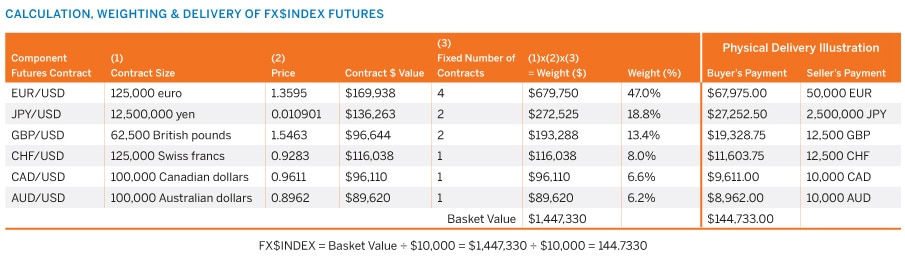
Launched July 26, 2010, Dow Jones CME FX$INDEX futures offer targeted risk management against a basket of major world currencies, all in a single contract. The contract focuses on the most frequently traded CME FX futures: the Euro FX, Japanese yen, British pound, Swiss franc, Canadian dollar and Australian dollar contracts, all traded against the U.S. dollar. The basket is weighted to reflect world trade but also refined to allow more precise hedging.
The index is quoted in U.S. dollars per foreign currency unit, in an inverse relationship. When the U.S. dollar strengthens against the basket of currencies, the Dow Jones CME FX$INDEX goes down, reflecting the relatively lower values of the currencies in the basket. When the dollar weakens against the basket of currencies, the Dow Jones CME FX$INDEX goes up, reflecting the higher values of the currency basket.

Dow Jones CME FX$INDEX Futures Weights
Specifically, 10 Dow Jones CME FX$INDEX futures reflect a basket of the following numbers of contracts:
4 EuroFX
2 Japanese yen
2 British pound
1 Swiss franc
1 Canadian dollar
1 Australian dollar
This Index is calculated as the basket value divided by $10,000. The numbers of contracts comprising the currency weights are fixed – they do not change.

A Well-Designed Index
Market participants have long shown interest in trading baskets of currencies against the U.S. dollar as a means of risk management. The U.S. dollar still remains the dominant currency for financial transactions, despite inroads by other currencies in recent decades, and this type of financial instrument can be a useful tool.
Other dollar index futures have been developed, usually based on factors such as competitiveness of U.S. goods on foreign markets. But these contracts lack the efficiency of the new Dow Jones CME FX$INDEX, as they were either pegged to a historic rather than a current marker, or needed to be hedged with odd numbers of futures contracts to balance or lay off risks.
Our new Dow Jones CME FX$INDEX is weighted by currency to reflect current economic realities as indicated by the Fed’s data on world trade. The futures contracts are designed to ensure that institutional traders, hedgers and market participants trading Dow Jones CME FX$INDEX futures can more precisely and conveniently lay-off risk against a basket of highly liquid CME FX futures contracts. Plus when integrated into a complete portfolio of CME FX futures and options, Dow Jones CME FX$INDEX futures allow for margin synergies with underlying products.

Benefits of Dow Jones CME FX$INDEX Futures

  • More precise, convenient lay off of global FX market risk with a single index contract
  • Access to over $100 billion in daily FX liquidity
  • The safety and security of CME Clearing – more than 100 years without a default
  • Transparent market pricing
  • Electronic access around the world, around the clock on CME Globex
  • Comprehensive portfolio management with CME FX Products

Physically delivered – “Hedgeable” Dow Jones CME FX$INDEX futures are satisfied through the physical delivery of 50,000 Euros; 2,500,000 Japanese yen; 12,500 British pounds; 12,500 Swiss francs; 10,000 Canadian dollars; and, 10,000 Australian dollars. The final settlement price is based on settlements in the six component currency futures. This provides institutional traders, hedgers and market participants with a more precise hedge than with previous U.S. dollar-based indexes, by matching 10 Dow Jones CME FX$INDEX futures vs. 4 EuroFX, 2 Japanese yen, 2 British pound, 1 Swiss franc, 1 Canadian dollar and 1 Australian dollar futures. Traders in “Hedgeable” Dow Jones CME FX$INDEX futures benefit from the liquidity of current CME FX futures, in turn offering a tighter market for our customers.
fx$index table
Enlarge

Stocks Back In Bubble Territory on False Hope for QE2

Surprising to see this frankness from CNBC. By Jeff Cox:

The Dow's rebound to 11,000 on Friday seemed almost inevitable as investors shook off all the bad news and instead focused on slivers of hope in jobs, government intervention and politics.
By nearly any measure, Friday's nonfarm employment report was a disappointment: Payrolls dropped 95,000, the so-called "real" unemployment rate jumped to 17.1 percent and one of the few growth areas came in restaurant and bar jobs.
Yet there was Wall Street, sorting through the rough and finding diamonds in a private payroll increase and continued hopes that a second round of Fed money injections—commonly referred to as quantitative easing, or in this case QE2—would help right a listless ship.
"If there's a tiny positive, you just had a big job loss because you had a heavy loss in government workers. That's the start of a trend painful in the short term but positive in the long term," says Chip Hanlon, president of Delta Global Advisors in Huntington Beach, Calif.
"People might be peering through that a bit and seeing private-sector nonfarm jobs did expand—not enough, but at least there was some expansion," he adds. "It's less about the headline number and the underlying data and more a function of grim expectations."
Yet even the market's meager expectations—flat to slight losses in payrolls and a modest hike in the unemployment rate—weren't met.
The actual job loss was worse than feared though the unemployment rate held steady at 9.6 percent, which was more due to fewer people returning to the labor force than a leveling of job losses.
The U-6 unemployment measure, a broader gauge that includes discouraged workers, swelled to 17.1 percent, a five-month high.
But investors still piled into the market Friday, breaking the 11,000 psychological barrier where it last sat two days before the confidence-shattering Flash Crash, which saw the Dow [.DJIA  11006.48    57.90  (+0.53%)   ] drop as much as 1,000 points in one panicky May 6 session.
"The question that has to be asked—and answered—is why the equity market would be rejoicing over today's somber piece of economic news," David Rosenberg, chief economist and strategist at Gluskin Sheff in Toronto, writes in his daily analysis. "It could boil down to excitement over QE2, even if it is plain to see that QE1 failed in its broad objective to generate sustainable economic growth."
In Rosenberg's view, the jobs report may have been the worst of the year. Adjusting for the decline in labor market participation from frustrated job seekers, the jobless rate actually sits closer to 12 percent, according to his calculations.
And all the rejoicing over government jobs lost may be misplaced as well—"These folks don't spend money and contribute to GDP? Is that the takeaway?" Rosenberg asks.
The answer to Rosenberg's question could be that investors finally are moving away from low-yielding safety plays in the bond market and looking for more returns. With the two-year Treasury yield setting successive record lows and the 10-year below 2.50, investors aren't being given much choice.
"The mentality might be starting to change," says Nadav Baum, executive vice president at BPU Investment Management in Pittsburgh. "It's not about putting money in investments where I know I can't lose money, like money markets and Treasurys. It's where can I go to start making some money. That's why you're getting nice movement in large-cap multinational dividend-paying stocks."
Of course, there's always the Fed.
Market pros have grown increasingly skeptical of the central bank's intervention efforts and whether trying to push down lending rates through Treasury purchases will do any better this time than it did last time.
Wall Street, though, seems convinced easing will help asset prices rise.
"I'm not a fan of quantitative easing round 2," says Liz Ann Sonders, chief investment strategist at Charles Schwab in San Francisco. "It was right the first time, but personally I would have liked a little better (jobs) number to take the pressure of the Fed. There are plenty in the camp that thinks it's going to happen, so maybe that's why we got a little bit of a lift."
Politics also seems to be playing a role. A November takeover by Republicans in Washington is being anticipated as a tipping point towards at least gridlock if not a sea-change in the way Congress does business.
"That could be magic," Bill Spiropoulos, president of CoreStates Capital Advisors, said in a CNBC interview. "That could be something that changes the numbers, when people feel better and they start to think enough of this and there will be definite change. That's something that is not in the equation or in the market."
Indeed, the jump above 11,000 looked tenuous through the day's trading, and it probably will take even more than a better-than-awful jobs report, hopes for political change and another round of government money-printing to effect a lasting change in market sentiment.
"I don't think it's any one thing," Sonders says. "You need a collection of these things. It's hard to say what unleashes animal spirits, but when it happens it happens quickly and feeds on itself."