from Bloomberg:
Housing led the U.S. out of seven of the last eight recessions. This time, it may kill the recovery.
Home sales collapsed after a federal tax credit for buyers expired in April. Since then, the manufacturing-led expansion, which began in the second half of 2009, has been waning, with jobless claims rising and factory orders falling.
“If foreclosures continue to mount and depress home prices, that could send the economy back into a recession,” said Celia Chen, an economist who tracks the industry for Moody’s Analytics Inc. “The housing market and the broader economy are closely intertwined.”
Spending on home construction and items such as furniture and stoves accounted for about 15 percent of gross domestic product in the second quarter, according to West Chester, Pennsylvania-based Moody’s Analytics. Real estate also can influence consumer spending indirectly. When values soared in the mid-2000s, people used the boost in equity to pay for cars and vacations. After prices fell, homeowners lost that cushion and curbed spending.
A report tomorrow by the Chicago-based National Association of Realtors will show July sales of existing homes plummeted 12.9 percent from June, the biggest monthly loss of 2010, according to the median estimate of economists surveyed by Bloomberg.
New-home sales, which account for less than a 10th of housing transactions, stayed at the second-lowest level on record last month, economists predict Commerce Department data will show on Aug. 25.
Tuesday, August 24, 2010
Housing to Drag U.S. Back Into Recession

Historic Fed RIft -- A Sign of Desperation, Fear!
by Jon Hilsenrath at the Wall Street Journal:
WASHINGTON—The Aug. 10 meeting of top Federal Reserve officials was among the most contentious in Ben Bernanke's four-and-a-half year tenure as central bank chairman.
With the economic outlook unexpectedly darkening, the issue was a seemingly technical one: whether to alter the way the Fed manages its huge portfolio of securities.
But it had big implications: Doing so would plunge the Fed back into the markets and might be a prelude to a future easing of monetary policy, moves that divided the men and women atop the central bank.
At least seven of the 17 Fed officials gathered around the massive oval boardroom table, made of Honduran mahogany and granite, spoke against the proposal or expressed reservations. At the end of an extended debate, Mr. Bernanke settled the issue by pushing successfully to proceed with the move.
The debate over the decision to keep the Fed's $2.05 trillion stock of mortgage debt and U.S. Treasury holdings from shrinking, described in interviews with several participants, set the stage for a more consequential discussion inside the Fed that remains very much alive: what to do next, if anything, about America's stubbornly weak recovery and troublingly low inflation.
Mr. Bernanke gets an opportunity to elaborate on this crucial and unresolved question when he and other Fed officials gather Friday and Saturday, along with foreign counterparts and a gaggle of academic experts, at the Fed's annual meeting in Jackson Hole, Wyo.
After steering the economy away from another Great Depression, Mr. Bernanke confronts a painfully slow rebound. Unemployment is still high and inflation is uncomfortably low. Fed officials, who spent much of the early part of this year planning for an exit from easy-money policies, have been forced to think about doing more to jolt the economy to life.
Fed officials emphasize they have common objectives despite being deeply divided over what to do next: They seek to avoid either deflation, a broad decline in prices and wages, or an upsurge of inflation. And they share a strong desire to get the economy growing fast enough to sustain a recovery without unusual government support.
The Fed already has cut the short-term interest rates it targets to near zero, vowed to keep them there for an extended period and purchased trillions of dollars in securities, with money the central bank creates, to push down long-term interest rates.
The most contentious issue now is whether to print more money and buy even more long-term securities, which would expand the Fed's portfolio further. An earlier bond-buying program ended in March.
A decision hinges largely on whether the Fed sees inflation falling much further or if economic growth fails to revive. The Fed and most private forecasters still expect faster growth in 2011, and few economists are predicting outright deflation.
Among the other issues: Should the Fed act quickly, or should it wait for firmer evidence that the economy is truly faltering? And if it does decide to act, should it take small, cautious steps or large, dramatic ones?
Fed officials have divergent views on both issues, and all sides knew that the decision at the Aug. 10 meeting would be widely seen as an indication of which way the Fed was leaning. In the event, it leaned toward action.
Before the meeting, officials at the Federal Reserve Bank of New York, which manages the Fed's portfolio, had grown concerned, according to people familiar with the matter. The Fed's portfolio of mortgage-backed securities was about to begin shrinking much more rapidly than anticipated, as low mortgage rates led more Americans to refinance their mortgages. That in turn meant the mortgage-backed securities held by the Fed were being paid off.
The size of the Fed's portfolio has become one of the central bank's major monetary tools. A shrinking portfolio in the face of slowing economic growth was unwelcome to many officials, including New York Fed President William Dudley. It amounted to prematurely applying the brakes.
The New York Fed's markets chief, Brian Sack, had been revising up his estimates of how much the portfolio would contract. In a memo circulated by Mr. Sack's group a few days before the meeting, the estimate was revised up again. In March, the group projected the portfolio would contract by a bit more than $200 billion by the end of 2011. In a memo circulated by Mr. Sack's group a few days before the meeting, the estimate was revised to up to $340 billion. In addition, about $55 billion in debt issued by the mortgage giants Fannie Mae and Freddie Mac that the Fed held would likely be paid off. Taken together, it represented a potential 20% drop in the Fed's holdings in 18 months' time.
"The shrinking of the balance sheet just didn't feel right to me under the circumstances," says Dennis Lockhart, president of the Atlanta Fed, who tends to be in the middle of the road in most Fed debates.
As is the custom, Fed staff in Washington offered the members of the policy-setting Federal Open Market Committee—the five current Fed governors in Washington and the presidents of the 12 regional Fed banks, five of whom have a vote at each meeting—a range of options before the meeting.
The declining mortgage portfolio was the focal point of debate. The Fed could allow it to continue going down or it could try to keep it stable by putting the money from maturing mortgage bonds into new securities, either Treasurys or other mortgage bonds. Officials spent very little time discussing the idea of expanding the securities portfolio beyond its current size.
The group was under added pressure because this meeting was scheduled to last a single day, a time frame that was standard before the financial crisis, but that had more recently expanded to two days. And unlike many Fed meetings, there was no clear consensus, either inside the Fed or among the cadre of Wall Street pundits who predict and second-guess Fed policy. To allow more time, the meeting was called for 8 a.m., an hour earlier than usual.
Officials were clustered in two camps. In one camp, Mr. Dudley, and the presidents of the Boston and San Francisco Fed banks, Eric Rosengren and Janet Yellen, were distressed that the Fed was far from its objectives of low unemployment and stable inflation. Unemployment was at 9.5%, above the 5% to 6% range that the Fed considers full employment. Inflation was running at around 1%, below the Fed's informal target of 1.5% to 2%. This camp was more inclined to act.
The other camp was skeptical. Fed governor Kevin Warsh, a former Wall Street investment banker who worked closely with Mr. Bernanke during the crisis and who attends many Washington Nationals baseball games with the chairman, worried that a decision to reinvest mortgage proceeds into Treasurys would confuse investors and lead many to believe the Fed was paving the way to resume major purchases before it had decided to do so. An abrupt change in stance, he argued, could lead the public to believe the Fed was more worried about the economy than it really was.
Some officials wanted the Fed to acknowledge the softer economy in its policy statement but hold off on changing the management of the portfolio until there was more clarity on the economy.
Richard Fisher, president of the Dallas Fed, and others expressed a concern that Fed moves might be ineffective, arguing that businesses weren't using already ample, cheap credit to fund investments because they were uncertain about many other problems, including government deficits and new financial regulations.
Narayana Kocherlakota, president of the Minneapolis Fed, argued that a large part of today's unemployment problem is caused by issues the Fed can't solve, such as the mismatch between the skills of jobless workers and the skills that employers wanted. "The Fed does not have a means to transform construction workers into manufacturing workers," Mr. Kocherlakota said in a speech after the meeting.
The president of the Philadelphia Fed, Charles Plosser, who has had misgivings before about Mr. Bernanke's initiatives, deemed the latest move premature because, though the Fed was lowering 2010 growth estimates, it wasn't significantly ramping down its estimates for growth in 2011 and beyond. Two other frequent dissenters, Thomas Hoenig of Kansas City, and Jeffrey Lacker of Richmond, Va., also objected. Fed governor Betsy Duke, a former commercial banker, also expressed reservations, according to participants.
The meeting was a case study in Mr. Bernanke's management style, which reflects his days as chairman of Princeton University's economics department when he had to manage a collection of argumentative academics with strong personalities and often divergent views. Mr. Bernanke encourages debate and disagreement, and then weighs in at the end with his own decision, which has helped him win loyalty at the Fed, even among those who disagree with him, several officials say.
"He sees an unusually uncertain time and he puts his Socratic professor hat back on," says one official familiar with the Fed chairman. "He's comfortable with democracy around the Fed. His view is that is going to help him get to a better judgment."
After listening intently, Mr. Bernanke summed up the debate, acknowledged the disagreements, and then said that the Fed shouldn't allow the passive tightening of financial conditions that was being caused by its shrinking balance sheet. In practice, that would mean taking proceeds from nearly $400 billion in maturing mortgage bonds and buying Treasury debt. The Fed also needed to acknowledge the slower growth outlook, he said. The meeting ended later than usual.
The formal vote—9 to 1—disguised the disagreements. Both Mr. Warsh and Ms. Duke voted with the chairman. So did vice chairman Donald Kohn, governor Daniel Tarullo and four of the five regional Fed bank presidents who have votes this year: Mr. Dudley, Mr. Rosengren, St. Louis' James Bullard and Cleveland's Sandra Pianalto. Mr. Hoenig, as he has at every opportunity this year, formally dissented.
Yields on long-term Treasury bonds fell after the announcement, as proponents of the move anticipated. But stocks later skidded, evidence to internal skeptics that the Fed misfired.
"We sent some garbled message about a weaker economy where we wanted to be more accommodative," says Mr. Plosser. "That was confusing and ran the risk of scaring the markets."
Now the internal debate turns to the future, particularly whether to do more, and if so whether to make small or large steps. In March 2009, when the economy was sinking fast, the Fed chose a big step, the move to buy large quantities of mortgages and Treasury bonds. One Fed official, Mr. Bullard of St. Louis, has drawn the attention of his colleagues by loudly advocating smaller steps as the outlook changes to calibrate Fed policy with changes in the economy, an idea that has gotten the attention of many officials.
"I don't think it's likely that the [Fed] would go with some kind of 'shock and awe' where you do some big policy move all at once," Mr. Bullard said in a recent interview.
Others disagree. "I don't see the benefits of these sorts of small fine-tuning symbolic gestures," says Philadelphia's Mr. Plosser. If the deflation threat becomes real, and he says it hasn't yet, then the Fed might need to attack the problem aggressively.
One thing is clear: Mr. Bernanke, though striving for consensus, is determined to avoid mistakes of past central bankers that created devastating bouts of deflation. As a Princeton professor in the 1990s, Mr. Bernanke lectured Japanese officials for being too timid about combating deflation. And in now-famous remarks he delivered as a Fed governor at a 90th birthday celebration for Milton Friedman in 2002, Mr. Bernanke promised the Fed would never allow a repeat of the deflation of the 1930s.
"The worst outcome for him personally would be to let something like deflation get under way on his watch," says Alfred Broaddus, the former president of the Richmond Fed who served alongside Mr. Bernanke from 2002 until 2005. "He will respond forcefully to evidence that the risk of a deflationary process getting under way is rising materially. He won't be ambivalent."
I Smell Deflation!
Just about everything but treasuries and the Dollar are down tonight. This is a run for safety, pure and simple. Even gold is down after a strong run-up over the past few weeks.
Here is a list of some items that are down tonight, including most commodities across the board:
- Stocks - stock indexes are down worldwide, including China, Japan, and Europe. S&P and Dow are pushing on July support levels
- Grains: corn, soybeans, wheat, oats, (all down together)
- Rice (after a powerful rally yesterday, it has reversed)
- Gold
- Crude Oil
- Natural Gas
- Sugar -- longest-running commodity rally is down overnight
- Coffee -- like sugar, a long-running rally that is down tonight
- Cocoa -- already in a downtrend, cocoa is significantly lower
- Live Cattle -- after strong rally throughout the year, prices are lower
- Lean Hog -- had been rallying recently, but selling off now
Deflation is usually the immediate precursor to hyperinflation. Deflation becomes hyperinflation overnight as people seek to flee from the two things that they had considered to be safe havens up until that time - bonds and the Dollar.
Monday, August 23, 2010
Morose Mood: "We're Entering a Bear Market Now"
SINGAPORE -- Asian stock markets were lower Tuesday, weighed by losses on Wall Street Monday as well as concerns over the pace of global economic growth. In Japan, the Nikkei Stock Average slumped to a 15-month low as exporters' stocks were clobbered by the yen's strength.
"Fear has struck back into the hearts of equity investors. It is the probability of a second (global economic) dip that is in their minds," said head of SIAS Research Roger Tan in Singapore.
Japan's Nikkei Stock Average was down 1.4% at 8,987.89, Australia's S&P/ASX 200 was down 0.6%, South Korea's Kospi Composite shed 1.0% and New Zealand's NZX-50 slipped 0.1%. Dow Jones Industrial Average futures were down 32 points in screen trade.
Traders will be closely watching U.S. existing home sales data due later on Tuesday as well as revisions to second-quarter U.S. gross domestic product due Friday.
Economists expect to see the initial GDP estimate of a 2.4% advance cut down significantly, toward a much more modest 1.3% gain, as national output highlights the toll of a recent string of subpar data.
In Japan, the Nikkei Stock Average broke below the 9,000 level for the first time since May 18, 2009 as exporters' stocks were pounded as the yen hit multi-week highs against the U.S. dollar and the euro.
"There is a sense of resignation and we're all just watching how far stocks will fall," said Kenichi Hirano, operating officer at Tachibana Securities. "We're entering a bear market now."
Losses were broad based with 32 of the Topix's 33 subindexes lower. Tokyo Electron shed 2.6%, Sony lost 2.7% and Canon fell 1.7%. Defensive issues outperformed with Astellas Pharma up 0.7% after a ratings upgrade from Credit Suisse.
In Sydney, banks and resource stocks were weighing on the market, with BHP Billiton down 1.1%, Rio Tinto down 0.6% and Westpac down 0.9%. Some stocks also traded ex-dividend, further dragging the headline index lower.
Sentiment was also hurt by an uncertain outlook for companies. "Headline (earnings) numbers have been okay but the biggest issue continues to be the lack of informative and detailed outlooks and the confidence in the outlook statements is pretty soggy, although the market is trying to bounce off its lows at the moment. It's been a pretty disappointing reporting season," said RBS head of Sydney sales trading, Justin Gallagher.
"I think it's just a recycling of the double-dip (recession scenario). The economic data is certainly not showing any upwards momentum--if anything it's tempering."
Foster's dropped 3.4% after its 7% rise Monday on speculation of a bid for its beer assets. It reported full-year net profit of 698.3 million Australian dollars (US$620 million) excluding writedowns on its wine assets Tuesday. That compared with expectations for a net profit of A$673.6 million, according to a Dow Jones Newswires poll of six analysts.
IG Markets said the underlying result was "strong," but the lack of a final dividend could weigh on the stock.
Australia's political uncertainty also continued to cool the mood in the Sydney market. While the hung parliament will "hit local markets for a time," the long-run impact will be small, said Capital Economics in a note.
"The main political parties have similar fiscal consolidation objectives and the proposed mining tax will either be scrapped or watered down. More broadly, Asia's demand for commodities should stay high while (Reserve Bank of Australia) tightening, we judge, is not over."
In Seoul, the technology and steel sectors weighed on the market as investors worried about an economic slowdown with Samsung Electronics down 1.7% and Posco down 1.7% on profit-taking.
Hyundai Motor rose 1.1% and Kia Motors gained 0.5% on bargain hunting after its losses on Monday. Ssangyong Motor shed 2.8% after surging 6.9% the previous day on news it had signed a memorandum of understanding with India's Mahindra & Mahindra to sell the latter a controlling stake.
In foreign exchange markets, the Japanese yen hit multi-week highs against the U.S. dollar and the euro, lifted by safe-haven demand amid concerns about the pace of global economic growth. Those concerns were underscored by a weak preliminary reading for the euro-zone's purchasing managers index.
The composite PMI slipped to 56.1 in August, the lowest level in two months and down from 56.7 in July.
The euro was at $1.2632 against the dollar, after touching $1.2630 earlier, its lowest level since July 13. That compared with $1.2665 in late New York trade Monday. The single currency bought Y107.46, compared with Y107.95 in New York; it touched Y107.61 earlier, its lowest since July 1. The dollar was at Y85.13, from Y85.25 in New York.
Safe-haven demand lifted Japanese government bonds, with the lead September bond futures up 0.16 at 142.99 points.
Spot gold was at $1,227.80 per troy ounce, down 20 cents from late New York trade. October Nymex crude oil futures were down 32 cents at $72.78 per barrel.
How Hyperinflation Will Ignite Spontaneously
by Gonzalo Lira at his blog:
Right now, we are in the middle of deflation. The Global Depression we are experiencing has squeezed both aggregate demand levels and aggregate asset prices as never before. Since the credit crunch of September 2008, the U.S. and world economies have been slowly circling the deflationary drain.

But the stimulus, apart from being slow and inefficient, has simply not been enough to offset the fall in consumer spending.
The Fed is terrified of the U.S. economy falling into a deflationary death-spiral: Lack of liquidity, leading to lower prices, leading to unemployment, leading to lower consumption, leading to still lower prices, the entire economy grinding down to a halt. So the Fed has bought up assets of all kinds, in order to inject liquidity into the system, and bouy asset price levels so as to prevent this deflationary deep-freeze—and will continue to do so. After all, when your only tool is a hammer, every problem looks like a nail.
But this Fed policy—call it “money-printing”, call it “liquidity injections”, call it “asset price stabilization”—has been overwhelmed by the credit contraction. Just as the Federal government has been unable to fill in the fall in aggregate demand by way of stimulus, the Fed has expanded its balance sheet from some $900 billion in the Fall of ’08, to about $2.3 trillion today—but that additional $1.4 trillion has been no match for the loss of credit. At best, the Fed has been able to alleviate the worst effects of the deflation—it certainly has not turned the deflationary environment into anything resembling inflation.
Yields are low, unemployment up, CPI numbers are down (and under some metrics, negative)—in short, everything screams “deflation”.
This recovery is not going to happen—that’s the news we’ve been getting as of late. Amid all this hopeful talk about “avoiding a double-dip”, it turns out that we didn’t avoid a double-dip—we never really managed to claw our way out of the first dip. No matter all the stimulus, no matter all the alphabet-soup liquidity windows over the past 2 years, the inescapable fact is that the economy has been—and is headed—down.
But both the Federal government and the Federal Reserve are hell-bent on using the same old tired tools to “fix the economy”—stimulus on the one hand, liquidity injections on the other. (See my discussion of The Deficit here.)
It’s those very fixes that are pulling us closer to the edge. Why? Because the economy is in no better shape than it was in September 2008—and both the Federal Reserve and the Federal government have shot their wad. They got nothin’ left, after trillions in stimulus and trillions more in balance sheet expansion—
—but they have accomplished one thing: They have undermined Treasuries. These policies have turned Treasuries into the spit-and-baling wire of the U.S. financial system—they are literally the only things holding the whole economy together.
In other words, Treasuries are now the New and Improved Toxic Asset. Everyone knows that they are overvalued, everyone knows their yields are absurd—yet everyone tiptoes around that truth as delicately as if it were a bomb. Which is actually what it is.
This will jiggle Treasury yields, as asset managers will reduce their Treasury allocations, and go into the pressured commodity, in order to catch a profit. (Actually it won’t even be the asset managers—it will be their programmed trades.) These asset managers will sell Treasuries because, effectively, it’s become the principal asset they have to sell.
Whether it’s true or not is actually beside the point—there is the widespread perception that that is what’s going on. In a panic, widespread perception is your trading strategy.
So when the Fed begins buying Treasuries full-blast to prop up their prices, these asset managers will all decide, “Time to get out of Dodge—now.”
Notice, too, that Treasuries will maintain their yields in the face of this sell-off, at least initially. Why? Because the Fed, so determined to maintain “price stability”, will at first prevent yields from widening—which is precisely why so many will decide to sell into the panic: The Bernanke Backstop won’t soothe the markets—rather, it will make it too tempting not to sell.
The first of the asset managers or TBTF banks who are out of Treasuries will look for a place to park their cash—obviously. Where will all this ready cash go?
When people freak out and begin panic-buying basic commodities, their ordinary financial assets—equities, bonds, etc.—will collapse: Everyone will be rushing to get cash, so as to turn around and buy commodities.
So immediately after the Treasury markets tank, equities will fall catastrophically, probably within the next few days following the Treasury panic. This collapse in equity prices will bring an equivalent burst in commodity prices—the second leg up, if you will.
This is something hyperinflationist-skeptics never quite seem to grasp: In hyperinflation, asset prices don’t skyrocket—they collapse, both nominally and in relation to consumable commodities. A $300,000 house falls to $60,000 or less, or better yet, 50 ounces of silver—because in a hyperinflationist episode, a house is worthless, whereas 50 bits of silver can actually buy you stuff you might need.
Right now, I’m guessing that sensible people who’ve read this far are dismissing me as being full of it—or at least victim of my own imagination. These sensible people, if they deign to engage in the scenario I’ve outlined above, will argue that the government—be it the Fed or the Treasury or a combination thereof—will find a way to stem the panic in Treasuries (if there ever is one), and put a stop to hyperinflation (if such a foolish and outlandish notion ever came to pass in America).
(BTW, I actually think that this last option is something the Federal government might be foolish enough to try. Some moron like Palin or Biden might well advocate this idea of helter-skelter money-printing so as to “help all hard-working Americans”. And if they carried it out, this would bring us American-made images of people using bundles of dollars to feed their chimneys. I actually don’t think that politicians are so stupid as to actually start printing money to “fight rising prices”—but hey, when it comes to stupidity, you never know how far they can go.)
“This is all bloody ridiculous,” I can practically hear the hyperinflation skeptics fume. “We’re just going through what the Japanese experienced: Just like the U.S., they went into massive government stimulus—hell, they invented quantitative easing—and look what’s happened to them: Stagnation, yes—hyperinflation, no.”
That’s right: The parallels with Japan are remarkably similar—except for one key difference. Japanese sovereign debt is infinitely more stable than America’s, because in Japan, the people are savers—they own the Japanese debt. In America, the people are broke, and the Nervous Nelly banks own the debt. That’s why Japanese sovereign debt is solid, whereas American Treasuries are soap-bubble-fragile.
That’s why I think there’ll be hyperinflation in America—that bubble’s soon to pop. I’m guessing if it doesn’t happen this fall, it’ll happen next fall, without question before the end of 2011.
Neanderthal survivalists spend all their time thinking about post-Apocalypse America. The real trick, however, is to prepare for after the end of the Apocalypse.
The first thing to realize, of course, is that hyperinflation might well happen—but it will end. It won’t be a never-ending situation—America won’t end up like in some post-Apocalyptic, Mad Max: Beyond Thuderdome industrial wasteland/playground. Admittedly, that would be cool, but it’s not gonna happen—that’s just survivalist daydreams.
Instead, after a spell of hyperinflation, America will end up pretty much like it is today—only with a bad hangover. Actually, a hyperinflationist spell might be a good thing: It would finally clean out all the bad debts in the economy, the crap that the Fed and the Federal government refused to clean out when they had the chance in 2007–’09. It would break down and reset asset prices to more realistic levels—no more $12 million one-bedroom co-ops on the UES. And all in all, a hyperinflationist catastrophe might in the long run be better for the health of the U.S. economy and the morale of the American people, as opposed to a long drawn-out stagnation. Ask the Japanese if they would have preferred a couple-three really bad years, instead of Two Lost Decades, and the answer won’t be surprising. But I digress.
Like Rothschild said, “Buy when there’s blood on the streets.” The thing to do to prepare for hyperinflation would be to invest in a diversified hard-metal basket before the event—no equities, no ETF’s, no derivatives. If and when hyperinflation happens, and things get bad (and I mean really bad), take that hard-metal basket and—right in the teeth of the crisis—buy residential property, as well as equities in long-lasting industries; mining, pharma and chemicals especially, but no value-added companies, like tech, aerospace or industrials. The reason is, at the peak of hyperinflation, the most valuable assets will be dirt-cheap—especially equities—especially real estate.
What is relevant is, the current situation cannot long continue. The Global Depression we are in is being exacerbated by the very measures being used to fix it—stimulus is putting pressure on Treasuries, which are being shored up by the Fed. This obviously cannot have a happy ending. Therefore, the smart money prepares for what it believes is going to happen next.
I think we’re going to have hyperinflation. I hope I have managed to explain why.
Beef Becoming the Food of Kings Because Only They Can Afford It!

Economic Fears Weigh on Stocks
I thought that after Friday's bounce off support, we might see a rally, but stocks sagged into the close, ending down again. It's difficult to be optimistic in this environment. Very thin volume.

from WSJ:
NEW YORK—U.S. stocks finished in the red for a third straight day as continuing economic fears weighed on the market, overshadowing excitement over a string of acquisitions.
The Dow Jones Industrial Average finished down 39.21 points, or 0.38%, at 10174.41 after a session that saw the measure gain as many as 91 points. The Nasdaq Composite Index slipped 0.92% to 2159.63 while the Standard &Poor's 500-stock index fell 0.40% to 1067.36...
"We've kind of hit a brick wall here and everything's going sideways," said Daniel Morgan, portfolio manager at Synovus Securities. "Everybody's concerned about deflation."
Investors had little U.S. economic data to go on Monday, though the rest of the week includes key reports on the housing market as well as a revision to second-quarter economic growth. Economists are expecting the government's estimate of 2.4% economic growth for the second quarter to be cut to 1.3% when it is released Friday, which would represent a clear slowdown from earlier in the year.
The latest economic data from the euro zone was less than encouraging. Both the region's manufacturing and services purchasing managers indexes slid in August, despite pickups in Germany and France, suggesting that other countries that are implementing strict fiscal plans to narrow large budget deficits have seen a sharper slowdown in their economies...
Meanwhile, a report from Moody's Investors Service warned that growth throughout the euro zone may fall short of preventing credit-rating agencies from downgrading some member countries if their economies begin to suffer in the face of tight austerity budgets.
The euro fell to $1.2662 while the U.S. Dollar Index, which tracks the U.S. currency against a basket of six others, edged up 0.1%. Treasurys rose, pushing the yield on the 10-year note down to 2.61%, while crude-oil futures tumbled to around $73 a barrel and gold futures were off slightly.
Monday's stock-market movements came on one of the thinnest days for trading volume this year, with just over 3.3 billion shares changing hands in NYSE Composite volume. The only two weaker trading days have come on the two previous Mondays.
Corporate Earnings Begin to Show Signs of Exhaustion Along With Economy
from WSJ:
Geysers are spectacular—while they last.
The same might be said of highflying U.S. corporate earnings. They dazzled investors the past year, but now it looks as if their growth may be waning. Although second-quarter profit came in strong, with S&P 500-stock index companies posting 38% year-on-year earnings growth, estimates for 2011 results continue to fall.
Analysts now expect 14.7% earnings growth for S&P 500 companies next year, according to Thomson Reuters.


Sunday, August 22, 2010
In a Dollar Destruction Environment, Buy Liquid Commodities
by John Butler at Financial Sense:
Back in 2006, while working for a major US investment bank, I was asked by the Chief Global Economist to participate in a small survey to estimate the probability of the US economy facing a currency crisis—that is, one that forces interest rates higher—during the coming two years. Concerned that an eventual bursting of the US credit/housing bubble could lead to the dollar losing its pre-eminent reserve currency status, I placed the probability at some 60%, which was the highest response in the survey.
In 2007, he repeated the same survey. This time, I raised the probability to some 75%, as I believed there was clear evidence at that point that the credit/housing bubble was indeed bursting. Once again, this was the highest response in the survey.
Of course, the US has not yet faced a currency crisis and interest rates remain low. My past pessimism would seem, at first glance, to be unwarranted. But there was a period in late 2007 and early 2008 when the dollar came under severe pressure and serious talk began that the US dollar was indeed at risk of losing reserve currency status. Notwithstanding a period of relative dollar strength over the past two years, such talk continues to this day. Given where we are now, were I asked yet again to place a probability on a dollar crisis occurring during the coming two years, I would place it at 80-85%.
Why so high? Because the US economy is now entering a period of even greater economic danger than in 2007-08 and also because all major economic policy decisions taken by the US fiscal and monetary authorities since 2007 have fundamentally undermined the dollar’s reserve currency status. That said, the fiscal and monetary authorities of numerous governments have also made decisions undermining their respective currencies. It is increasingly probable that not only the dollar but various other currencies are going to face crises during the coming years, ending quite possibly in a general devaluation of fiat currencies vis-à-vis real assets. The rising price of gold may indicate that others share this view.
The Real Economic Horror Show
To many observers it is increasingly clear that the US economy is now heading into a dreaded “double-dip”. But it should come as no surprise that, as the various forms of fiscal and monetary stimulus implemented in 2008-09 fade, economic activity is weakening again. After all, the recovery never showed signs of being self-sustaining in the first place, as business investment and job creation remained relatively anaemic when compared to previous post-recession periods.For those espousing stimulus-based neo-Keynesian policies, this situation presents a sort of economic double-horror-show: First, it appears that the stimulus, although unprecedented in scale and scope, has not worked. Second, the US and many other countries now find themselves saddled with significantly larger debt burdens than before, which threatens to constrain government borrowing in future. If that happens, then you can kiss any further hope of additional government stimulus goodbye. Several countries have already been forced by financial markets into accepting that they have exceeded their practical borrowing limits. There is little doubt in our minds that, as the double-dip intensifies and spreads around the globe, additional countries are going to join this undesirable club.
For those like us who do not believe in neo-Keynesian, “free-lunch economics”, the spread of sovereign debt crises is neither unexpected nor unwelcome. Indeed, the financial markets are doing exactly what they are supposed to be doing, which is to place growing constraints on wasteful economic activities, namely government policies that misallocate resources from productive and sustainable to unproductive and unsustainable activities. Sovereign debt crises are part of the solution to unsustainable policies. The other part, of course, is to bring about an end to such policies. We are not there yet, not by a long shot, but in a few places such as Germany, the UK, Greece and Ireland, the trend has shifted in this direction.
Curiously, given its free-market traditions, the US is not only not joining this change of trend, it is accelerating the growth of government. It is not just that the government has taken over significant parts of various industries such as healthcare, consumer finance and automobiles. Government job growth in general is outstripping the private-sector at an historic pace. And given the severe weakness of the private-sector, government wage growth is also growing rapidly relative to the private sector.

It is therefore obvious to us that US government borrowing is going to soar as the economy sinks into the double-dip. Rather than declining in 2011-12, the government is likely to run even higher deficits. But what if the government decides, in response to the weakening economy, to enact another round of stimulus? The deficits will be commensurately higher. What if the federal government begins to bail-out state governments facing funding crises, either explicitly or through less overt subsidies? The deficits will be commensurately higher. Given the current political climate and rhetoric coming out of Washington, what is the probability that, in response to the double-dip, the government enacts additional stimulus and bails out a handful of state governments? We consider it to be quite high.
To us, this is the real economic horror-show. Not only is the most unproductive part of the economy—the federal government—growing dramatically relative to the most productive—the private sector—but the implied future debt burden is also rising dramatically. In other words, the effective tax base is shrinking alongside an exploding public debt burden! The US is therefore already falling into a debt trap from which there is no escape without a dramatic shrinking in the size of government. But what are the odds that Washington is going to decide to shrink itself voluntarily absent a debt crisis? We believe they are remote, which implies that this situation is not going to be resolved without financial markets forcing the issue.
The New Conundrum of Low Treasury Yields
Are we alone in thinking that a US debt crisis is all but inevitable? If not, why aren’t Treasury bond yields heading higher if the deficit is about to explode on the upside and the US is destined to face a debt crisis in the coming years? The answer to this apparent conundrum is surprisingly straightforward: supply and demand. Yes, Treasury supply is going up, but so is demand. But why is demand going up as a debt crisis becomes more and more inevitable?Let’s take a look at who buys Treasury securities, and why. Much of the Treasury market is held by government and financial institutions that, in practice, have little discretion. To the extent that there is a free-market in Treasury securities, it exists amidst much official, somewhat systematic buying from the Fed, foreign central banks, US state and local governments and US financial institutions.
The Fed buys Treasury securities as a matter of policy as this is how it normally goes about expanding the monetary base. As such, Federal Reserve Treasury holdings are not a form of discretionary investment but rather a requirement of policy. At end Q1 2010, Fed Treasury holdings stood at $777bn.
Foreign central bank holdings are also a matter of government policy in that they grow with balance sheets. These have risen dramatically in recent years and at end Q1 stood at about $3.1tn.


Now a Treasury market analyst might argue that it is not the amounts outstanding, but rather the flow of new paper into the market, which is likely to influence the price and hence the level of yields. As such, it is instructive to look at the flows data, to see which entities have been the most important marginal buyers of Treasuries recently.
In Q1 2010, the Treasury issued roughly $1.45tn of securities at a seasonally-adjusted annual rate (saar, as are the following figures). Of this amount, $26bn was bought by the Fed and roughly $150bn was bought by foreign central banks. State and local governments were net sellers in the amount of $34bn, which is not surprising given that their fiscal position is deteriorating. Federal agencies were big purchasers during the quarter, buying $153bn, by far the largest amount on record. Commercial banks bought $236bn. As discussed above, absent commercial credit growth, this most likely reflects a general attempt to generate some income from the huge amount of excess reserves sitting on bank balance sheets. Adding this up, these largely non-discretionary buyers took down some 1/3 of all issuance in the quarter.

This is why the growing debate around the possibility of another round of quantitative easing (QE) is of key importance for investors. QE is nothing more than a policy-wonk term for the monetisation of debt, although policymakers might argue, against historical experience, that it is merely a temporary measure. In a risk-averse environment, some investors might prefer the risk of losses in Treasury securities at some point in future to the risk of near-term losses in equities or other risky securities and hence overweight the former relative to the latter.
However, those investors shorting Treasuries with a longer-term view that yields are headed higher someday as a debt/currency crisis eventually arrives must assume the risk in the meantime that the monetary authority chooses to monetise some portion of the debt, thereby preventing a rise in yields. In this case, those who are short are going to sustain losses in the domestic currency. And unless the domestic currency weakens, those short are going to sustain losses in terms of other currencies as well. It is only in the event that the currency devalues that investors going short will profit. Such perceptions of risk, influenced as they are by credible threats from the monetary authority, most certainly contribute to the conundrum of low yields in the face of rising risks of a debt/currency crisis in future.
Absent a sustainable US economic recovery, in which demand for capital from the private sector would compete with the public sector, thereby driving up Treasury yields, a US debt crisis is highly unlikely to occur absent a currency crisis. But for the issuer of the pre-eminent global reserve currency, the two are really just different sides of the same coin. The dollar comprises a huge portion of the world’s monetary base and hence a huge portion of day-to-day transactions are made in dollars. As the world’s pre-eminent financing currency, a huge portion of day-to-day borrowing and lending also takes place in dollars. Not until the global investor base is ready to replace the dollar with something else is the dollar truly vulnerable to a crisis of sufficient magnitude to push Treasury yields up to levels which would in effect force the US government to downsize, default, or both.
How far are we from this point? We don’t know. We would argue that nobody knows. But we are much closer now than we were in 2008, back when many people actually had confidence that swift action in the form of fiscal and monetary stimulus would work to put the US economy back on a sustainable path. That confidence is already beginning to fade. As the US deficit climbs and climbs and yet the economy remains weak amidst growth in government at private-sector expense, confidence will fade far more. We believe that the US will face a general debt and currency crisis before the end of 2012.
***
Given that the structure of the Treasury market is such that existing yields may not offer investors fair-market compensation for the risk of a US debt/currency crisis in future, and that the same might be said of numerous other countries’ government debt markets, how should investors prepare for another round of QE in the US and/or elsewhere?
One option would be to purchase Treasuries or other government securities in anticipation of a QE-induced rally. Indeed, the recent rally in Treasuries and certain other major government bond markets could be in part a result of QE anticipation. However, because it is impossible to know at what point or in what magnitude a currency might begin to weaken as a result of the money printing associated with QE or the sudden arrival of a general sovereign debt/currency crisis, we would consider purchasing government bonds to be a form of speculation rather than investment. At the same time, however, being short would appear dangerous heading into another round of QE. At this point in time, rather than speculate, we would be on the sidelines of the government bond markets.
If the very reason why QE is becoming more likely is because we are headed into a double dip, then it is probably not a good time to be overweight risky assets in general, such as corporate equities or bonds. Leading indicators may indicate that the cyclical outlook is deteriorating but of perhaps even greater concern is that structural factors, in particular the growth of government relative to the private sector and of increased regulation, are going to constrain after-tax personal incomes and corporate profit growth in the coming years. Defensive equities with high dividend yields would, however, provide some diversification in broader portfolio of assets.
For many investors, this overall picture would imply a retreat into cash. But if we are right that the US and most probably certain other governments are rapidly heading toward a general debt/currency crisis, cash is also not the best place to be. There are likely to be brief periods of cash outperformance as investors flee out of risky assets. But if policymakers stand by, ready to implement another round of QE each and every time it appears that risk aversion is rising to unwelcome levels, such periods of cash outperformance are bound to be fleeting. Basic investment logic dictates that you don’t want to be overweight that which is rising rapidly in supply, at times suddenly and unpredictably.
Those risk-averse investors inclined toward cash should therefore diversify into liquid, primarily defensive commodities. Defensive commodities are those with only a weak correlation to risky assets. Unlike government debt, these do not carry default or devaluation risk. Yes, they can decline in value, but as a group this is highly unlikely unless there is a general flight to cash which, as discussed above, is likely to be met swiftly with yet another round of QE. There is nothing wrong in principle with trying to trade the market, getting long commodities only following a period of cash outperformance and when QE appears imminent. But for most investors, a buy and hold strategy is probably more appropriate. When the smoke clears following each successive round of QE, a broadly-diversified basket of liquid commodities is likely to have outperformed a traditional portfolio of government bonds and corporate securities, as has been the case on average over the past decade. Absent meaningful structural reform, this trend could continue indefinitely.

How the Fed Props Up the Stock Market Through Permanent Open Market Operations
The Financial Times recently reported on the Fed’s latest exit strategy to eventually contain the inflation zombie:
During the crisis, the Fed created roughly $800bn of additional bank reserves to finance asset purchases and loans. This total is likely to rise in the coming months as the central bank completes its asset purchases and the Treasury unwinds financing it provided to the Fed. Fed officials think they could raise interest rates even with this excess supply of reserves by offering to pay banks to deposit their surplus funds with it rather than lend them out. However, they also want to use reverse repos in tandem to soak up some of the excess reserves. Policymakers call this a “belt and braces approach”. [The latter, clearly a nod to the great Gekko.]
 Tyler Durden touched on this last Thursday, and we will expand upon it here as it is particularly relevant to our ongoing theory that it is the proceeds from permanent open market operations (POMOs) and their close cousins that are driving equities. Though this may be received wisdom to Zero Hedge readers, the Fed has done us the favor of providing additional evidence through the FT story. A bit of background, as we are new contributors to this forum:
Money Supply: Based on our previous research on the effects of swings in M2 non-seasonally adjusted money supply (M2) on the stock market, we were a bit surprised in July 09 by the resiliency of the rally, which continued in the face of such a dramatic contraction in M2. The dismal Durable Goods report from last Friday confirms that the capital goods sector is still under significant pressure as a result of a lack of money in the general economy. With banks not lending to normal businesses and consumer credit contracting equally as violently, what is the basis for this rally and from where does the never-ending flow of equities juice flow?
Bank Non-Borrowed Excess Reserves: The Fed statistic that most closely correlates with the 2009 equities run-up appears to be bank non-borrowed excess reserves (bank NBER), which is a component of the monetary base (M0). As explained by the Fed, bank NBER is simply total bank excess reserves minus bank borrowed excess reserves (bank BER). This resulted in bank NBER going negative throughout much of 2008 because banks acquired most of their excess reserves through participation in Fed lending programs. As the Fed has wound down these programs in 2009, bank BER has steadily declined and has been a drag on M0. Concurrently, though, bank NBER has advanced since late March 09 with only one brief material pause in June, and reflects those excess reserves that need not be repaid as part of any Fed lending program. The Fed purchases of MBS, Agency and Treasury securities netted $990 trillion since March 09. The distinction between borrowed and non-borrowed excess reserves is critical because the latter would be ideally suited for leveraging and lending out to hedge funds and the like to “invest” in the high beta stocks that have led the rally.
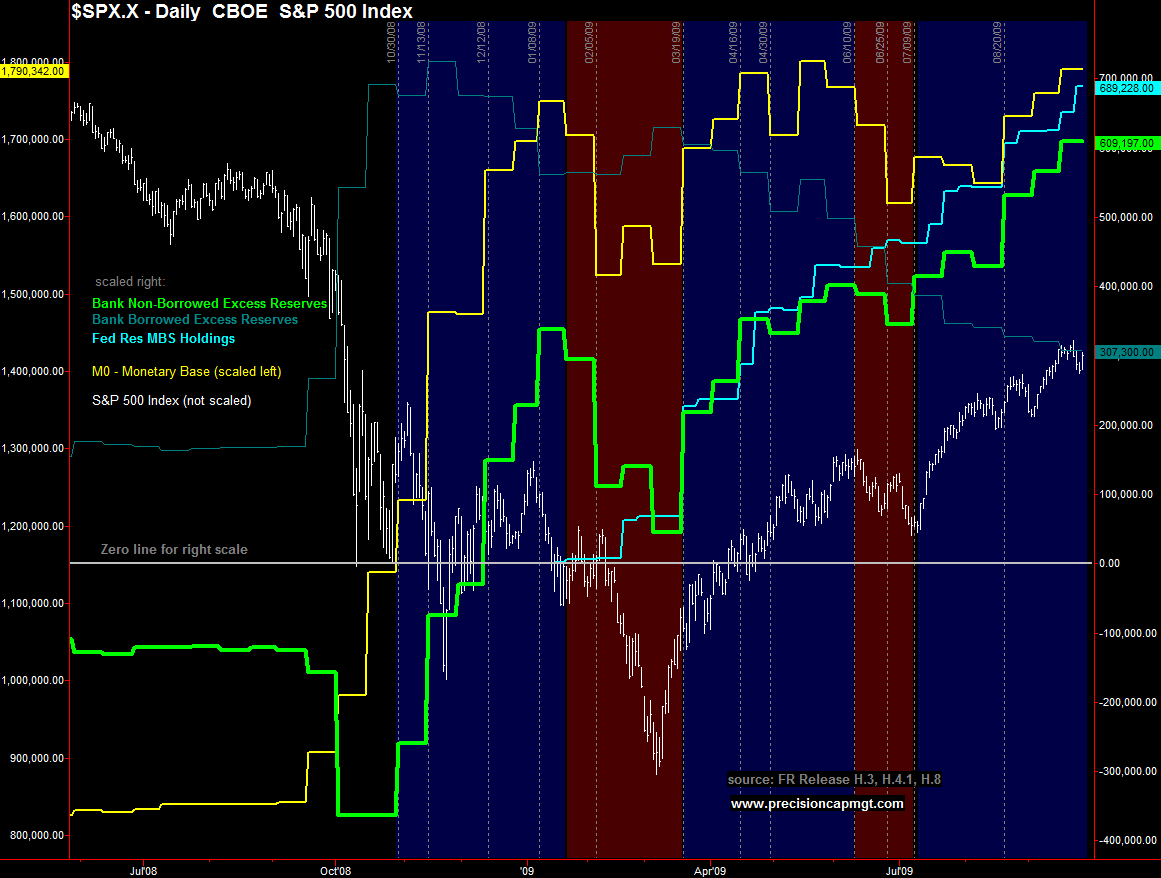
The primary conclusion is simple - the stock juice flows from steadily increasing Bank NBER, which is hidden to even astute observers that focus on only M0 or M2. Though we previously found no historical correlation between M0 (or its constituent components) and the stock market, we have witnessed an historically unprecedented set of circumstances. Now that the Fed has become the world’s largest hedge fund, we are prepared to accept unorthodox conclusions.
So why not inflate both equities and the general economy simultaneously? It was most likely a race against time. The administration and Fed needed to replace the incredible evaporation of wealth that occurred in late 2008/early 2009 to quell the voting and investing masses. They could not reflate the entire economy this quickly without jeopardizing their ability to borrow cheaply and restart the housing bubble. To keep long term yields low, they reflated the stock market only, with the hope that the general economy would eventually catch up in 2010 and be able to sustain the stock market gains. The problem with rising yields has not been solved, but was postponed.
As we noted in previous research, we are toward the end of a seasonal drain on M2. Once over the October hump, it should be easier for the holiday season to carry the market into March 2010, especially with the help of another $834 billion in MBS and Agency POMO into next March (not to mention the possible Treasury SFP wind-down effect to the tune of $114 to 185 billion). The Fed must be perfect, however, as any new panic will quickly feed on itself and likely lead to another mass exodus from equities. This is quite simply because currently, there is absolutely nothing else to back up this rally in the general economy if the Fed funny money cannot do its trick.
Back to Money Market Funds: If bank NBER is materially tied up in equities, then the Fed cannot drain from this source to mitigate inflation, or it risks the resulting cascade of sell orders that accompany the typical panic. According to the FT article:
The obvious counterparties for reverse repo deals are the Wall Street primary dealers. However, the Fed thinks they would only have balance sheet capacity to refinance about $100bn of assets. By contrast, the money-market funds have $2,500bn in assets, which means they could plausibly refinance as much as $500bn in Fed assets. Officials think there would be appetite on the part of the funds, which are under pressure [at gunpoint] from regulators and investors to stick to low-risk liquid investments.The Fed Helps Build Our Case: As of September 17 09, bank NBER had increased by $563 billion since the March 09 rally began. With M2 net flat during this period, the $563 billion has not made its way into the general economy by any stretch. Perhaps it is sitting idle; however, the Fed says only $100 billion would be available from primary dealers in the future? As the vast bulk of bank NBER is concentrated in primary dealers, this begs the obvious question of what will be tying up the remaining $463 billion (and we are not including the expected increases in bank NBER into next March, which could double this amount)? Given a conservative lending leverage ratio of 10 to 1, there is potentially $4.63 trillion already sloshing around. Even if we are much more conservative, given the roughly $2 trillion increase in the US stock market since Mar 09, it is not only easily conceivable, but probable, that a substantial portion was courtesy of the Fed ATM machine.
As Gekko closed his famous speech in Wall Street, “Greed – you mark my words – will save Teldar, and that other malfunctioning corporation, the U.S.A.” While we have focused here only on coercive greed, it will be interesting nonetheless to see how this works out.