Popular Delusions
Memo to Central Banks: You’re debasing more than our currency
By Dylan Grice, Societe Generale
At its most fundamental level, economic activity is no more
than an exchange between strangers. It depends, therefore, on a degree
of trust between strangers. Since money is the agent of exchange, it is
the agent of trust. Debasing money therefore debases trust. History is
replete with Great Disorders in which social cohesion has been
undermined by currency debasements. The multi-decade credit inflation
can now be seen to have had similarly corrosive effects. Yet central
banks continue down the same route. The writing is on the wall. Further
debasement of money will cause further debasement of society. I fear a
Great Disorder.
I am more worried than I have ever been about the clouds
gathering today (which may be the most wonderful contrary indicator you
could hope for...). I hope they pass without breaking, but I fear the
defining feature of coming decades will be a Great Disorder of the sort
which has defined past epochs and scarred whole generations.
“Next to language, money is the most important medium through which modern societies communicate” writes Bernd Widdig in his masterful analysis of Germany’s inflation crisis
“Culture and Inflation in Weimar Germany.”
His may be an abstract observation, but it has the commendable merit of
being true … all economic activity requires the cooperation of
strangers and therefore, a degree of trust between cooperating
strangers. Since money is the agent of such mutual trust, debasing money
implies debasing the trust upon which social cohesion rests.
So I keep wondering to myself, do our money-printing central banks and their cheerleaders understand the
full
consequences of the monetary debasement they continue to engineer?
Inflation of the CPI might be a consequence both seen and measurable. A
broad inflation of asset prices might be a consequence seen, though not
measurable. But what about the consequences that are unseen but
unmeasurable – and are all the more destructive for it? I feel queasy
about the enthusiasm with which our wise economists play games with
something about which we have such a poor understanding.
If you take a look around you, any artefact you see will only
be there thanks to the cooperative behaviour of lots of people you don’t
know. You will probably never know them, nor they you. The screen you
watch on your terminal, the content you read, the orders which make the
prices flicker … the coffee you drink, the cup you hold, the bin you
throw it in afterwards … all your clothes, all your accessories, all
the buildings you’ve been in, all the cars … you get the idea.
Without exception
everything you own, everything you want to own, everything you need,
and everything you think you need embodies the different skills and
talents of a mind-boggling number of complete strangers. In a very real
sense we constantly trust in strangers to a degree, as strangers trust
us. Such cooperative activity is to everyone’s great benefit and I find
it is a marvellous thing to behold.
The value strangers put on each other’s contributions manifests
itself in prices, and prices require money. So it is through money that
we express the extent of our appreciation for the many different
talents embedded in each thing we consume, and through money that our
skills are in turn valued by others. Money, in other words, is the agent
of this anonymous exchange, and therefore money is also the agent of
the hidden trust on which it depends. Thus, as Bernd Widdig reflects in
his book (which I urge you all to read), money …
“… is more than simply a tool for economic exchange; its
different qualities shape the way modern people think, how they make
sense of their reality, how they communicate, and ultimately how they
find their place and identity in a modern environment.”
Debasing money might be expected to have effects beyond the
merely financial domain. Of course, there are many ways to debase money.
Coin can be clipped, paper money can be printed, credit can be created
on the basis of demand deposits which aren’t there ... the effects are
ultimately the same though: the implied trust that money communicates
through society is eroded.
To see how, consider the example of money printing by
authorities. We know that such an exercise raises revenues since the
authorities now have a very real increase in purchasing power. But we
also know that revenue cannot be raised by one party without another
party paying. So who pays?
If the authorities raise taxes explicitly and openly, voters
know exactly why they have less spending power. They also know how much
less spending power they have. But if the authorities instead raise
money by simply printing it, they raise the revenue by stealth. No one
knows upon whom the burden falls. People notice only that they can’t
afford the things they used to be able to afford, or they can’t afford
the things which everyone else can afford. They know that something is
wrong, but they just don’t know what, why, or who is to blame. So
inevitably they look for someone to blame.
The dynamic is similar to that found in the well-worn plot line
in which a group of strangers are initially brought together in happier
circumstances, such as a cruise, a long train journey or a weekend
away. In the beginning, spirits are high. The strangers exchange jokes
and get to know one another as the journey begins. Then some crime is
committed. They know it must be one of them, but they don’t know who. A
great suspicion ensues. All trust between them is broken down and the
infighting begins....
So it is with monetary debasement, as Keynes understood deeply
(so deeply, in fact, that it’s ironic so many of today’s crude
Keynesians support QE so enthusiastically). In 1921 he said:
“By a continuing process of inflation, Governments can confiscate, secretly and unobserved, an important part of the wealth of their citizens. By this method they not only confiscate, but they confiscate arbitrarily;
and, while the process impoverishes many, it actually enriches some ….
Those to whom the system brings windfalls …. become “profiteers” who are
the object of the hatred … the process of wealth-getting degenerates
into a gamble and a lottery .. Lenin was certainly right. There is no
subtler, no surer means of overturning the existing basis of society
than to debauch the currency. The process engages all the hidden forces of economic law on the side of destruction, and does it in a manner which not one man in a million is able to diagnose.”
History is replete with Great Disorders in which currency
debasement has coincided with social infighting and scapegoating. I have
written in the past about the Roman inflation of the Third Century AD.
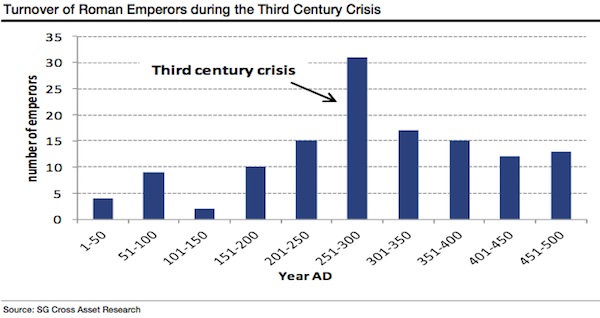
The following chart shows the rapid turnover of emperors during what is
known as the Third Century Crisis. As trade declined, crops failed and
the military suffered what must have seemed like constant defeat, it
wasn’t difficult for a successful or even popular general to convince
the rest of the empire that he’d make a better fist of governing.
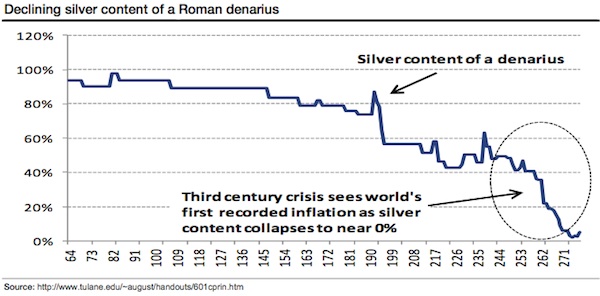
But this political turnover was accompanied by what may be
history’s first recorded instance of systematic currency debasement.
With the empire no longer expanding and barbarians being forced
westwards by the migrations of the Steppe peoples, Rome’s borders were
under threat. But the money required to fund defence wasn’t there.
Successive emperors therefore reached the same conclusions that kings,
princes, tyrants and democratically elected governments would later
reach down the ages when faced with a perceived “shortage of money”:
they created more by debasing the existing stock. In the second half of
the third century, the silver content of a denarius had shrunk to zero.
Copper coins disappeared altogether.
This debasement of currency also coincided with a debasement of
society. Factions grew more suspicious of one another. Communities
fragmented. And one part of the community bore the brunt of the fears:
Christians. While Rome had always welcomed new religions and Gods,
incorporating new foreign deities as their empire grew, Christians were
altogether different. They rejected Rome’s gods. They refused to pray to
them. They said that only their God was deserving of worship. The rest
of the Romans concluded that this obstinacy must be a source of great
anger for their own ancient Roman gods, and supposed that those gods
must now be exacting their own great punishment in return.
So the Romans turned on their Christians with a great violence
which lasted throughout the period of the currency debasement but peaked
with Diocletian’s edict of 303 AD. The edict decreed, among other
things, that Christian meeting places be destroyed, Christians holding
office be stripped of that office, Christian freedmen be made slaves
once more and all scriptures be destroyed. Diocletian’s earlier edict,
of 301 AD, sought to regulate prices and set out punishments for
‘profiteers’ whose prices deviated from those set out in the edict.
A similar dynamic seems evident during Europe’s medieval
inflations, only now, the confused and vain effort to make sense of the
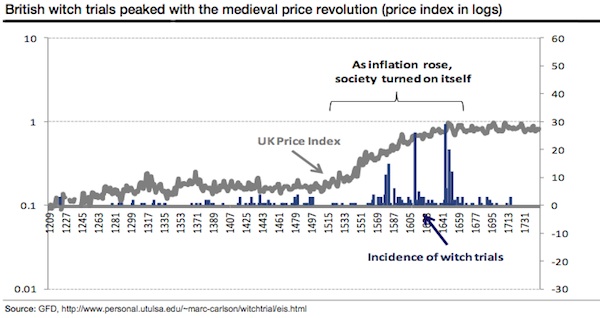
enveloping turmoil saw the blame focus on suspected witches. The
following chart shows the UK price index over the period with the
incidence of witchcraft trials. Note the peak in trials coinciding with
the peak of the price revolution.
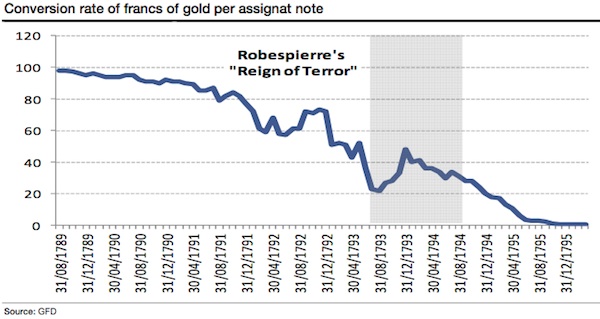
Were the same dynamics at work during the French Revolution of
1789? The narrative of Madame Guillotine and her bloody role is well
known. However, the execution of royalty by the Paris Commune didn’t
begin until 1792, and the Reign of Terror in which Robespierre’s
Orwellian sounding “Committee of Public Safety” slaughtered 17,000
nobles and counter-revolutionaries didn’t start until well into 1793. In
the words of guillotined revolutionary Georges Danton, this is when the
French revolution “ate itself”. But the coincidence of these events to
the monetary debasement is striking.
The political violence was justified in part by blaming nobles
and counter-revolutionaries for galloping inflation in food prices. It
saw ‘speculators’ banned from trading gold, and prices for firewood,
coal and grain became subject to strict controls. According to Andrew
Dickson White, author of “Fiat Money Inflation in France”, (echoing
Keynes’ remark that
“wealth-getting degenerates into a gamble and a lottery”) “economic calculation gave way to feverish speculation across the country.”
However, the most tragic of all the inflations in my opinion,
and certainly the starkest example of a society turning on itself was
the German hyperinflation. Its causes are well known. Morally and
financially bankrupt by the First World War, the reparation demands of
the Allies (which Keynes argued vociferously against) followed by the
French occupation of the Ruhr served to humiliate a once-mighty nation,
already on its knees.
And it really was on its knees. Germany simply had no way to
pay. The revolution following the flight of the Kaiser was incomplete.
Concern was widespread that Germany would follow the path blazed by
Moscow’s Bolsheviks only a year earlier. A
de facto civil war
was being fought on the streets of major cities between extremist mobs
of the left and right. Six million veterans newly demobilized,
demoralized, dazed and without work were unable to support their
families ... the great political need was to pay off the “internal
debts” of pensions, life insurance and welfare support in any way
possible. The risk of printing whatever was required was well
understood. Bernhard Dernberg, vice chancellor in 1919, found himself
overwhelmed with promises to pay for the war disabled, food subsidies,
unemployment insurance, etc., but everyone knew where the money was
coming from:
“A decision of the National Assembly is made. On its basis,
Reich Treasury bills are printed and on the basis of the Reich Treasury
bills, notes are printed. That is our money. The result is that we have
a pure assignat economy.”
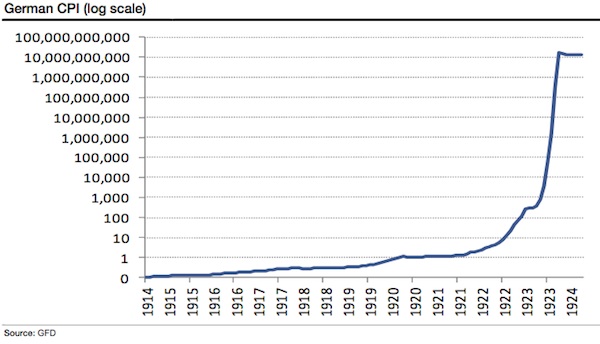
But print they did. Prices would rise by a factor of one
trillion. At the end of the war, Germany owed 154bn Reichmarks to its
creditors. By November 1923, that sum measured in 1914 purchasing power
was worth only 15 pfennigs.
It is difficult to comprehend the psychological trauma
inflicted by this episode. Inflation inverted the efficacy of correct
behaviour. It turned the ethics of thrift, frugality and notions such as
working hard today to bring benefit tomorrow completely on their heads.
Why work today when your rewards would mean nothing tomorrow? What use
thrift and saving? Why not just borrow in depreciating currency? Those
who had worked and saved all their lives, done everything correctly and
invested what they had been told was safe, were mercilessly punished for
their trust in established principles, and their inability to see the
danger coming. Those with no such faith who had seen the danger coming
had benefited handsomely.
Everything, in other words, was dependent on one’s ability to
speculate, recalling what Dickson White observed of the French
Revolution and Keynes reflections more generally. Erich Remarque is best
known for his anti-war novel
“All Quiet on the Western Front” but perhaps his best work was the “
The Black Obelisk”
set in the early Weimar period, and a penetrating meditation on the
upside-down world of inflation. The protagonist Georg poignantly
captures this speculative imperative when he sits down and lets out a
long sigh:
“Thank God that it’s Sunday tomorrow … there are no rates
of exchange for the dollar. Inflation stops for one day of the week.
That was surely not God’s intention when he created Sunday.”
Perhaps the most eloquent chronicler of the Weimar
hyperinflation was Elias Canetti, whose mother moved him from the
security of Zurich to Frankfurt in 1921 to take advantage of cheaper
living. Canetti never forgave her, and his life’s work shows what a
lasting impression the move from heaven to hell made:
“A man who has been accustomed to rely on (the monetary
value of the mark) cannot help feeling its degradation as his own. He
has identified himself with it for too long, and his confidence in it
has been like his confidence in himself … Whatever he is or was, like
the million he always wanted, he becomes nothing”
More tragic still was what German society became during the
inflation. Like other Axis countries on the wrong side of the War and
now in the grip of hyperinflation, Germany turned viciously on its Jews.
It blamed them for the surrounding evil as Romans had blamed
Christians, medieval Europeans had suspected witches, and French
revolutionaries had blamed the nobility during previous inflations. In
his classic “Crowds and Power”, Canetti attributed the horror of
National Socialism directly to a “morbid re-enaction impulse”.
“No one ever forgets a sudden depreciation of himself, for
it is too painful … The natural tendency afterwards is to find something
which is worth even less than oneself, which one can despise as one was
despised oneself. It is not enough to take over an old contempt and to
maintain it at the same level. What is wanted is a dynamic process of
humiliation Something must be treated in such a way that it becomes
worth less and less, as the unit of money did during the inflation. And
this process must be continued until its object is reduced to a state of
utter worthlessness. … In its treatment of the Jews, National Socialism
repeated the process of inflation with great precision. First they were
attacked as wicked and dangerous., as enemies; then, there not being
enough in Germany itself, those in the conquered territories were
gathered in; and finally they were treated literally as vermin, to be
destroyed with impunity by the million.
All this is very disturbing stuff, but testament to a
relationship between currency devaluation and social devaluation. Mine
is not a complete or in any way rigorous analysis, I know.
I emphasize that it’s not in any way meant as some sort of crude mapping on to today’s environment.
My point is to show that money operates in many social domains beyond
the financial, and that tying currency devaluation to social devaluation
might have some merit.
Consider some recent and less extreme currency inflations. The
1970s bear market in equities saw relatively mild inflation which was
also characterized by relatively mild but nevertheless real
factionalization of society. An ideological left vs right battle played
out between labour and capital, unions and non-unions and perhaps most
bizarrely, between
rock and disco.
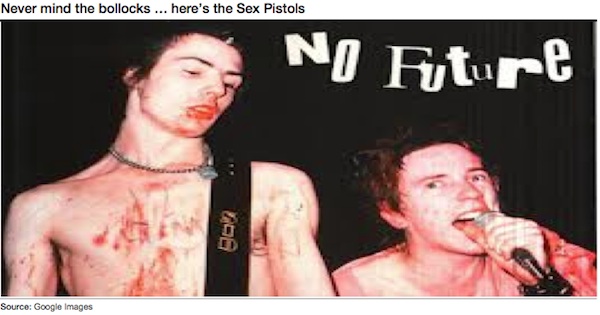
As already stated, money implies a trust in the future. It implies that
today’s money can be used in the future. So in the era of punk, did the
Sex Pistols provide the most concise commentary of the malaise?
Which brings us to today. Despite the CPI inflation of the
1970s receding, our central banks have continued to play games with
money. We’ve since lived through what might be the largest credit
inflation in financial history, a credit hyperinflation. Where has it
left us? Median US household incomes have been
stagnant for the best part of twenty years (chart below)
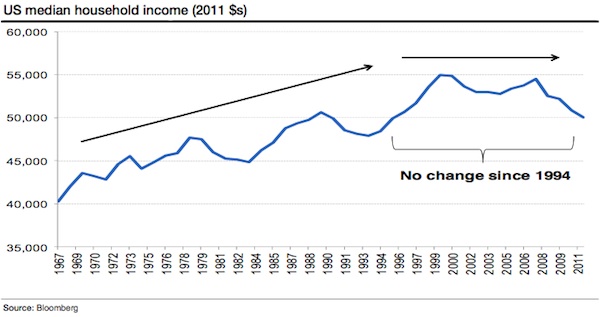
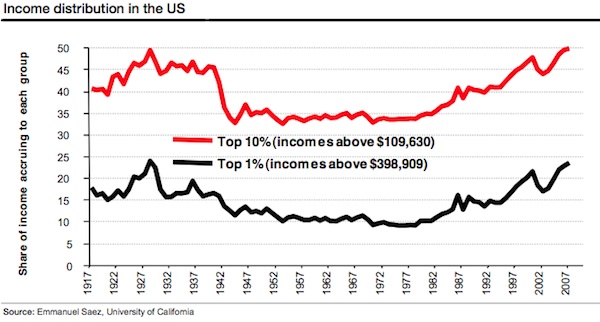
Yet inequality has surged. While a record number of Americans
are on food stamps, the top 1% of income earners are taking a larger
share of total income than since the peak of the 1920s credit inflation.
Moreover, the growth in that share has coincided almost exactly with
the more recent credit inflation.
These phenomena are inflation’s hallmarks. In the Keynes quote
above, he alludes to the “artificial and iniquitous redistribution of
wealth” inflation imposes on society without being specific. What
actually happens is that artificially created money redistributes wealth
towards those closest to it, to the detriment of those furthest away.
Richard Cantillon (writing decades before Adam Smith) was the
first to observe this effect (hence “Cantillon effect”). He showed how
those closest to the money source benefited unfairly at the expense of
others, by thinking through the effects in Spain and Portugal of the
influx of gold from the new world as follows:
“If the increase of actual money comes from mines of gold
or silver … the owner of these mines, the adventurers, the smelters,
refiners, and all the other workers will increase their expenditures in
proportion to their gains. . . . All this increase of expenditures in
meat, wine, wool, etc. diminishes of necessity the share of the other
inhabitants of the state who do not participate at first in the wealth
of the mines in question. The altercations of the market, or the demand
for meat, wine, wool, etc. being more intense than usual, will not fail
to raise their prices … Those then who will suffer from this dearness …
will be first of all the landowners, during the term of their leases,
then their domestic servants and all the workmen or fixed wage-earners
... All these must diminish their expenditure in proportion to the new
consumption …
(Quoted in Mark Thornton, “Cantillon on the Cause of the Business Cycle” Quarterly Journal of Austrian Economics Vol 9, No 3 [Fall 2006])
In other words, the beneficiaries of newly created money spend
that money and bid up the price of goods with their higher demand. Those
who suffer are those who have to pay newly higher prices but did not
benefit from the newly created money.
The credit inflation analog to the Cantillon effect has played
out perfectly in recent decades. Central banks provided cheap money to
banks, the cheap money artificially inflated asset prices, artificially
inflated asset prices made anyone connected to those assets rich as we
became a nation of speculators, those riches were achieved at everyone
else’s expense, and ‘everyone else’ has now realized what has happened
and is understandable enraged … as Keynes explained, “
Those to whom the system brings windfalls …. are the object of the hatred.
And now the social debasement is clear for all to see. The 99%
blame the 1%, the 1% blame the 47%, the private sector blames the public
sector, the public sector returns the sentiment … the young blame the
old, everyone blame the rich … yet few question the ideas behind
government or central banks ...

I’d feel a whole lot better if central banks stopped playing
games with money. But I can’t see that happening anytime soon. The ECB
has thrown the towel in, following the SNB last year in committing
effectively to print unlimited amounts of money for the greater good.
The BoE and the Fed have long since made a virtue of what was once
considered a necessity, with what was once the unconventional
conventional. As James Bullard told everyone a few weeks before the last
Fed meeting, lest there be any doubt:
"Markets have this idea that, there's QE1 and QE2, so QE3
must be the same as those previous ones. It's not that clear to me that
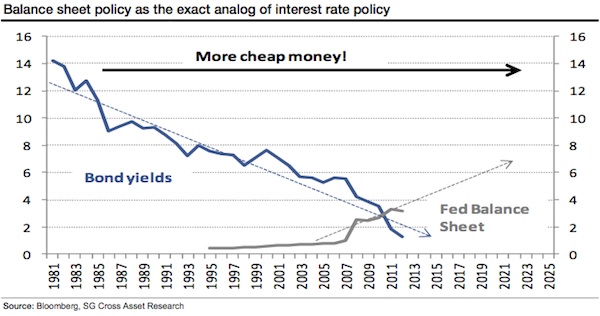
this is the way this is going … it would just be to do balance sheet
policy as the exact analogue of interest rate policy."
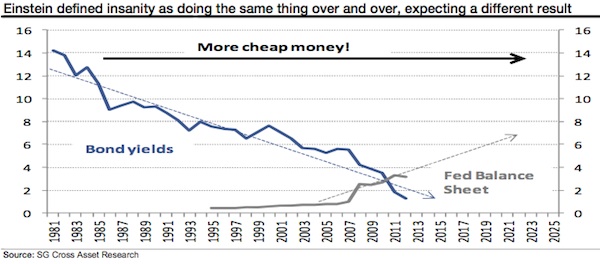
In other words, the central banks’ balance sheets are the new
policy tool. As interest rates embarked on a multi-year decline from the
1980s on, central bank balance sheets are set to embark on a multi-year
climb ...
So as Nobel Prize winning experts in economics
punch the air because inflation expectations have been rising since the policy was announced,
“It’s the whole point of the exercise” (Duh!) the BoE
admits that QE has mainly benefited the rich, but vows to continue anyway.
All I see is more of the same - more money debasement, more
unintended consequences and more social disorder. Since I worry that it
will be Great Disorder, I remain very bullish on safe havens. The next
few issues of Popular Delusions will outline some thoughts on what
exactly that means.


